

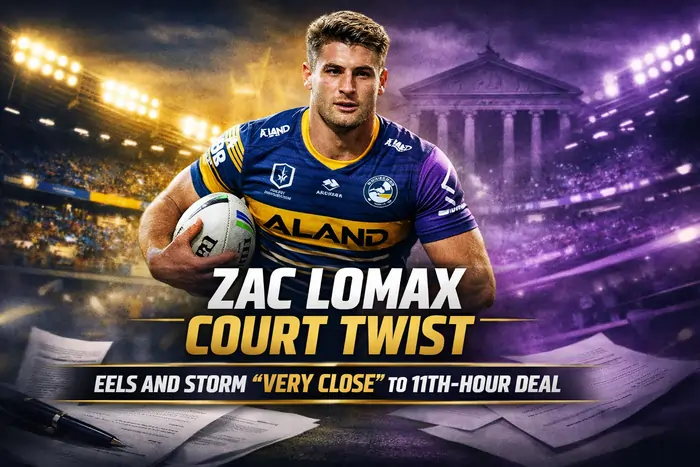
Zac Lomax’s contract saga has turned into one of the biggest NRL off‑field stories of 2026, with a dramatic 11th‑hour court twist leaving the Parramatta Eels and Melbourne Storm reportedly “very close” to a last‑minute settlement to free the star winger.
Inside the Zac Lomax 11th‑Hour Court Twist
For months, the Zac Lomax legal battle has dominated NRL headlines as the NSW Origin winger fights to escape his Parramatta Eels contract and sign with the Melbourne Storm for the 2026 season. What began as a standard release to pursue a rugby union opportunity has become a landmark Supreme Court case that could reshape how NRL clubs write and enforce contracts.
This week, the saga took a dramatic turn. Minutes before a key NSW Supreme Court hearing was due to begin, lawyers for the Eels and Lomax jointly sought an adjournment so that last‑minute negotiations with Melbourne could continue. Reports now describe the clubs as “very close” to an 11th‑hour deal that would avoid a full trial and potentially clear Lomax to join the Storm within weeks.
A concise multi‑source wrap of the late developments is available in Last‑Minute Negotiations as Lomax Chases Eels Exit.
How the Zac Lomax–Eels Relationship Broke Down
The roots of the Zac Lomax–Parramatta Eels dispute go back to his release at the end of last season. Lomax had been on a lucrative four‑year deal worth about $700,000 a season, but was granted permission to leave the Eels in late 2025 to chase a contract with new rugby union competition R360. When that breakaway competition was postponed, he suddenly found himself in contract limbo.
Parramatta’s position is that the deed of release he signed contained a restrictive clause: he could not sign with another NRL club until October 31, 2028 without the Eels’ written consent. Lomax and his legal team argue that he did not agree to be effectively frozen out of the NRL and that the clause is unreasonable and invalid, especially now that the union opportunity he left for no longer exists.
Key background points:
- Lomax was released from his four‑year Eels contract to pursue R360.
- After R360 was postponed, he sought a return to the NRL via Melbourne Storm.
- Parramatta insists he knew he would need their permission to join another NRL club before 2028.
- Lomax’s camp claims the restriction is too broad and compares his situation to other players who were allowed to switch clubs earlier.
ESPN’s feature Zac Lomax legal wrangle ends Storm boss’s NRL trip to Vegas gives a detailed rundown of how this dispute escalated.
Inside the Courtroom: The Legal Wrangle Explained
The legal side of the saga is playing out in the NSW Supreme Court, where Lomax has launched proceedings against his former club. At the centre of the case is that restrictive clause in his release deed, which Parramatta says prevents him from signing with any other NRL club until 2028 without their consent.
What Lomax is arguing
Lomax’s legal team says:
- The restriction is unreasonable, given his career length and the fact that his R360 rugby union option collapsed.
- The clause effectively prevents him from earning a living in the NRL for several years, which they argue is contrary to public policy.
- When compared with other deeds of release and contracts for players who were allowed to move, the Eels’ stance appears inconsistent.
To support that last point, the court has ordered Parramatta to hand over contracts and release deeds for six other players so Lomax’s lawyers can show how his case compares.
What the Eels are arguing
Parramatta, for their part, insists:
- Lomax understood he needed Eels’ permission before signing with another NRL club before 2028.
- Melbourne has acted in “bad faith” by negotiating aggressively, including allegedly asking the NRL to “apply the blow torch” on Parramatta to force a resolution.
- They are entitled to seek compensation if Lomax joins Storm in 2026, given the value of his original deal.
ESPN’s piece Eels allege Storm acted in ‘bad faith’ on Zac Lomax negotiations breaks down Parramatta’s bad‑faith allegations and the “apply the blow torch” text.
Eels and Storm “Very Close” to an 11th‑Hour Deal
The most dramatic twist came when the court was due to hear substantive evidence and submissions. On the morning of a scheduled hearing, lawyers for Lomax and Parramatta asked for more time because late‑night talks had continued into the morning. Justice Francois Kunc agreed to adjourn the matter to allow negotiations to keep going.
Coverage summarised by Ground News and ABC described:
- A 90‑minute adjournment granted after both parties said overnight talks were ongoing.
- Reports that a settlement to free Zac Lomax was “very close”, potentially avoiding a full trial.
- Indications that both clubs and Lomax’s camp saw value in thrashing out an agreement rather than risking an uncertain court ruling.
The details of the proposed settlement are not all public, but several outlets have reported on key elements of Melbourne’s offers.
- The Storm have made three separate offers to Parramatta to free Lomax for 2026.
- The most recent was a $300,000 package, including $211,000 of that as salary‑cap relief, effectively easing Parramatta’s cap while compensating them for losing a high‑value player.
- Earlier iterations involved combinations of transfer fees and cap relief totalling in the low‑to‑mid $200,000s.
The 7NEWS report Deal to free Zac Lomax ‘very close’ after court hearing suddenly delayed captures the moment the hearing was pushed back so these last‑minute negotiations could continue. Ground News’ Eels and Storm hold last‑minute negotiations to avoid Lomax trial aggregates coverage of these eleventh‑hour talks.
What the Deal Means for Parramatta Eels
If the reported settlement is finalised, the ramifications for Parramatta go beyond just losing a talented outside back.
Cap implications and compensation
Parramatta have been pushing for financial compensation in return for releasing Lomax. The suggested package—around $300,000 with $211,000 of that credited as salary‑cap relief—would:
- Help offset the lost value of his original $700,000‑a‑year contract.
- Provide immediate cap flexibility to sign a replacement or upgrade existing players.
- Signal to other clubs that the Eels expect meaningful compensation when they lose contracted stars.
Roster strategy and fan reaction
On‑field, Parramatta would lose a proven finisher and big‑game winger at short notice. They will need to:
- Promote from within, or
- Use the cap space and potential transfer fee to chase another outside back.
Fan reaction has been mixed. Some supporters feel the club is right to stand firm on contracts and seek proper compensation. Others worry that prolonged disputes like this can make Parramatta less attractive to future recruits.
Employment‑law commentary, such as NRL pulled into Zac Lomax–Eels contract dispute, notes that how the Eels handle this case could influence perceptions of the club’s approach to player relations.
What the Deal Means for Melbourne Storm
For Melbourne Storm, landing Zac Lomax would be a major recruitment win that fits both short‑term needs and long‑term planning.
Backline fit and 2026 NRL season impact
Storm have been managing injuries and searching for a high‑quality outside back. Lomax, a three‑time Origin representative and proven finisher, would slot straight into their backline as a starting winger or centre, adding:
- Aerial threat under the high ball.
- Reliable goal‑kicking option if needed.
- Experience in big games, including finals and Origin.
If the 11th‑hour deal is completed quickly, there’s a chance he could be available early in the season—although current reporting suggests any on‑field debut in purple before Round 4 would be tight due to the timetable for closing submissions and a final judgment if talks collapse.
Cap strategy and club politics
The Storm have shown how eager they are to secure Lomax by:
- Indemnifying Lomax’s legal costs, meaning Melbourne is on the hook for a hefty bill if he loses.
- Making multiple escalating offers, including cash and salary‑cap components.
- Having chairman Matt Tripp personally appear in court, even at the cost of missing the NRL’s Las Vegas opener.
NRL Ramifications: Could the Lomax Case Set a Precedent?
Beyond the fate of one player, the Zac Lomax court twist raises big questions for the NRL about contracts, release clauses and the league’s role in disputes.
Contract clauses and early releases
If the court were to strike down or narrow the restrictive clause in Lomax’s deed of release, it could:
- Encourage more players to challenge long‑dated restrictions on signing with rival clubs.
- Force clubs to rethink how they draft release deeds and non‑compete‑style clauses.
- Lead the NRL to issue guidance on what types of clauses are acceptable.
Even if a settlement is reached and the case is never fully decided, the evidence already aired—about indemnities, “blow torch” texts and alleged league assurances—has put pressure on the NRL to show it is neutral in club‑player disputes.
Player power vs club control
Analysts have asked whether the Lomax saga is another step in a broader shift towards greater player power in the NRL, similar to trends seen in other codes. If players see that high‑profile legal challenges or firm bargaining can yield earlier releases to desired clubs, agents may push harder in future negotiations.
ESPN’s article ‘Apply the blow torch’ – Stoush over Lomax ramps up explores how this stoush could affect the balance between club leverage and player mobility.
As clubs look for any edge in recruitment, cap management and performance, many are also turning to advanced data and machine learning, a trend explored in AI in Sports Analytics: Transforming the Game, which shows how technology is reshaping decision‑making across professional sport.
Timeline: From Contract Dispute to Near Settlement
A simplified timeline helps show how the Zac Lomax contract saga has unfolded:
- Late 2025 – Lomax is released from a four‑year $700k‑a‑year Eels contract to pursue a deal with rugby competition R360.
- R360 postponed – The new rugby league is delayed, leaving Lomax without a settled club.
- Early 2026 – Lomax seeks to join Melbourne Storm for the 2026 NRL season; Parramatta objects, citing a clause blocking NRL moves before 2028 without consent.
- January 2026 – Fresh disputes arise in the NSW Supreme Court over document subpoenas, release deeds and emails between Lomax’s lawyer and the Eels.
- February 2026 – Parramatta alleges Melbourne acted in “bad faith”, and court documents referencing the “apply the blow torch” message surface.
- 23 February 2026 – Storm chairman Matt Tripp is ordered to appear in person, giving up a Las Vegas NRL opener trip to testify.
- Late February 2026 – Media report that Melbourne has made multiple offers, including a $300k package with $211k in cap relief, all rejected so far.
- 1 March 2026 – On the morning of a scheduled hearing, both parties seek an adjournment as negotiations continue; reports say a deal to free Lomax is “very close”.
- Mid‑March 2026 (scheduled) – If talks fail, closing submissions are set for March 17, after Round 2, with any judgment likely to be handed down later.
What Happens Next for Zac Lomax?
For now, Lomax’s immediate future still hangs on whether the “very close” deal gets finalised. There are three broad scenarios:
- Settlement finalised
- Parramatta accept a compensation package (likely involving both cash and cap relief).
- Lomax is registered to play for Melbourne Storm in 2026, potentially from around Round 4 onwards, depending on paperwork and NRL approvals.
- The court case is discontinued, and the most explosive legal questions remain technically unresolved, though the saga still shapes future negotiations.
- Talks collapse, court decides
- The matter proceeds to a full hearing with closing submissions on March 17.
- The judge rules on whether the restrictive clause is valid and enforceable.
- A ruling against Parramatta could significantly expand player leverage; a ruling in their favour would affirm the strength of strict release terms.
- Interim stalemate
- Negotiations drag on, delaying any decision and leaving Lomax unable to play NRL until the situation is resolved.
- Pressure builds on all parties—Lomax, Eels, Storm and the NRL—to avoid a prolonged limbo.
For Eels fans, the question is whether the club can turn any settlement into better depth and balance in the squad. For Storm fans, it’s about how quickly they can get a high‑impact outside back on the park. For the NRL, it’s a test of how the competition manages high‑profile legal disputes in an era of increasing player power and commercial scrutiny.
A broader discussion of the case’s potential impact on the league appears in TV and digital segments such as “What impact will the Zac Lomax case have on the NRL?” on YouTube and associated commentary.
Ultimately, the Zac Lomax court twist—with the Eels and Storm “very close” to an 11th‑hour deal—is about more than one player changing clubs. It’s a live case study in how far clubs can go to control player movement, how far players and their new suitors will push back, and how the NRL sits in the crossfire. Whatever happens next, agents, players and administrators across the game will be watching closely—and writing their next contracts with this saga firmly in mind.