

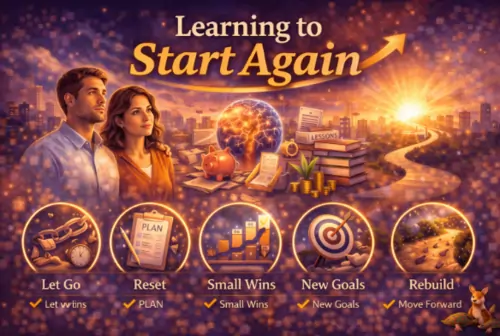
There are seasons when life forces a reset you didn’t ask for. A job ends. A relationship breaks. A plan collapses. A health issue interrupts everything.
In those moments, you can feel like you’re back at zero—tired, unsure, and scared to move. But Learning to Start Again is not about pretending nothing happened. It’s about choosing a new direction with the wisdom you didn’t have before.
If you’re here because you want to rebuild your life, you’re already taking the first step. Learning to Start Again begins the moment you stop saying, “My life is over,” and start saying, “My life is changing.”
What “Starting Again” Really Means
People often say “starting over” like it’s a punishment. But Learning to Start Again is different from starting over.
Starting over sounds like you lost everything.
Starting again means you carry your experience forward—even the painful parts. You don’t erase your past. You learn from it. You move with more clarity than before.
That mindset shift matters because shame can keep you stuck. Learning to Start Again is how you release shame and replace it with movement.
Why People Need Learning to Start Again
Most restarts happen after something deeply human.
You might need Learning to Start Again because:
- You lost a job or changed careers
- You experienced a breakup or divorce
- You made financial mistakes and feel behind
- You faced burnout and can’t “perform” like before
- You moved to a new place and feel alone
- You experienced grief and feel like the old version of you is gone
These moments can feel like failure, but they’re often transitions—painful ones, yes—but still transitions. Learning to Start Again is what makes a transition become a new chapter instead of a permanent setback.
The Mindset Shift That Makes Restarting Possible
Accept the past without living there
One of the hardest parts of Learning to Start Again is accepting what happened without letting it define you forever.
Acceptance does not mean approval. It means you stop wasting energy fighting reality. You can’t build a new life while arguing with the past every day.
A simple practice:
- Name what happened.
- Name what it cost you.
- Name what you learned.
That’s how Learning to Start Again becomes honest and grounded, not fake positivity.
Stop comparing your restart to someone else’s highlight
Comparison turns restarts into shame. Learning to Start Again requires you to stop measuring your beginning against someone else’s peak.
Your path is not behind. It’s yours.
Build hope through tiny proof
Hope is not something you “feel” first. It’s something you build through evidence.
That’s why Learning to Start Again is best done through small wins:
- One walk
- One healthy meal
- One productive hour
- One honest conversation
- One application sent
Tiny proof builds momentum. Momentum builds belief.
Step-by-Step: How to Start Again Without Getting Overwhelmed
This is the part most people skip. They try to fix everything at once. Then they burn out and quit.
Learning to Start Again works best when you start small and stay consistent.
Step 1: Stabilize your basics first
Before big dreams, build stability.
Focus on:
- Sleep
- Food
- Movement
- Simple routines
If your body is unstable, your mind will struggle. Learning to Start Again is easier when you feel physically supported.
Try this reset routine for 7 days:
- Sleep at the same time
- Drink water early in the day
- Walk 15 minutes
- Eat one balanced meal daily
You don’t need a perfect lifestyle. You need a stable base for Learning to Start Again.
Step 2: Clean your environment
Environment shapes behavior.
Part of Learning to Start Again is removing triggers that pull you back into old pain.
That can mean:
- Unfollowing accounts that make you feel “behind”
- Cleaning your room or workspace
- Organizing your phone files
- Creating a quiet corner for reflection
A cleaner environment creates mental space.
Step 3: Choose one clear goal for this season
When you’re rebuilding, you don’t need 10 goals. You need one priority.
Examples:
- “I will get a job within 60 days.”
- “I will pay off one debt in 90 days.”
- “I will rebuild my health with simple routines.”
- “I will learn a new skill and build a portfolio.”
Learning to Start Again becomes overwhelming when your goals are unclear. One goal gives your days direction.
Step 4: Build a 30-day restart plan
A restart plan should be simple enough to follow even on tired days.
Here’s a structure that supports Learning to Start Again:
Daily:
- One small action toward your goal (30–60 minutes)
Weekly:
- One review session: “What worked? What didn’t? What’s next?”
Tracking:
- Use a simple checklist. Don’t overcomplicate it.
The secret is not intensity. It’s repetition. That’s the heart of Learning to Start Again.
Step 5: Find support that fits you
Doing everything alone makes restarting harder.
Support can look like:
- One trusted friend
- A mentor
- A support group
- Therapy or counseling
- A community you feel safe in
Learning to Start Again is not a weakness. It’s a brave act. And brave acts deserve support.
How to Handle Fear, Doubt, and “What If I Fail Again?”
Fear is normal. It’s your brain trying to protect you from pain.
But fear becomes a prison when you obey it.
A helpful reframe:
Failure is data.
If something doesn’t work, it doesn’t mean you’re broken. It means you need a different strategy. Learning to Start Again becomes easier when you stop treating setbacks as identity.
Instead of:
- “I always mess up.”
Try:
- “That approach didn’t work. I’ll adjust.”
Resilience is not never falling. It’s rising with lessons. That’s what Learning to Start Again teaches you.
Learning to Start Again in Different Areas of Life
After a breakup
Breakups don’t just end relationships—they can disrupt identity.
For Learning to Start Again after heartbreak:
- Set boundaries (no checking their life daily)
- Rebuild routines
- Invest in friendships
- Rediscover personal goals
Healing is not fast. But it is possible.
In your career
Career restarts can feel scary because money is involved.
Learning to Start Again in work life often means:
- Updating your resume and skills
- Building small projects
- Networking slowly but consistently
- Applying daily without obsessing over results
Small actions create big change.
Financially
Money stress can make you feel trapped. But Learning to Start Again financially is often simpler than it feels.
Start with:
- Track expenses for 7 days
- Create a realistic budget
- Pay one debt consistently
- Build a small emergency fund
Stability comes from habits, not miracles.
After burnout
Burnout isn’t laziness. It’s exhaustion.
If you’re burned out, Learning to Start Again should be gentle:
- Rest first
- Set boundaries
- Reduce commitments
- Rebuild slowly
You don’t need to “push through.” You need to recover.
Habits That Make Restarting Stick
If you want Learning to Start Again to last, focus on habits that protect your progress:
- Morning planning (even 5 minutes)
- Journaling or reflection
- One daily priority task
- Consistent sleep schedule
- Weekly planning session
Habits are the bridge between who you were and who you’re becoming.
Mistakes to Avoid When Learning to Start Again
These mistakes are common and avoidable:
- Trying to fix everything at once
- Waiting to feel “ready”
- Staying in the same environment that drained you
- Comparing your restart to someone else’s journey
- Quitting after one bad week
Progress is not linear. Learning to Start Again includes learning how to continue even when your motivation disappears.
A Final Encouragement
If you feel behind, remember this: you are not behind. You are rebuilding. And rebuilding is courageous.
Learning to Start Again is proof that you still believe in your future. Even if you’re tired. Even if you’re scared. Even if you don’t know the full plan yet.
Start with one small step today.
One action.
One habit.
One decision.
And then repeat tomorrow.
That is how Learning to Start Again becomes a new life—one steady day at a time.