

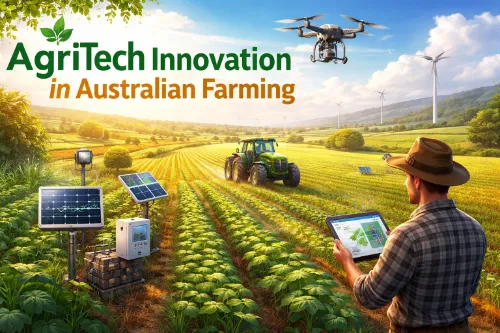
AgriTech innovation in Australian farming is moving from experimental pilots to everyday tools, with precision agriculture, AI, robotics, sensors and biologicals now embedded in cropping, livestock and horticulture systems across the country. At the same time, a fast‑growing agritech market and new state‑level “agritech revolutions” are turning farming technology into a standalone high‑growth sector in its own right.
Market snapshot: How fast is AgriTech growing in Australia?
Australia’s agritech market has entered a strong growth phase.
A 2026 market overview, “Australia Agritech Market 2026: Accelerates as Tech Innovation Boosts Productivity and Sustainability”, summarises IMARC Group research showing that the Australia agritech market reached about USD 774 million in 2025 and is projected to grow to around USD 2.38 billion by 2034, at a 13.1% CAGR. The report highlights growing investment in precision‑farming tools, farm‑management software, IoT sensors, drones and AI‑driven decision‑support systems as key growth drivers.
Ken Research’s Australia AI in Agriculture and AgriTech Market report estimates that AI in agriculture and agritech alone was valued at about USD 305 million, driven by precision farming, IoT and AI analytics for enhanced productivity. It notes that machine‑learning solutions, computer‑vision systems, IoT devices, robotics and decision‑support software are being rapidly adopted for crop‑yield prediction, pest and disease detection, livestock monitoring, resource management and supply‑chain optimisation.
The RSM/EvokeAG snapshot “New report shows Australian agtech insights” identifies four core trends in the Australian agtech landscape: robotics and automation to address labour and efficiency, precision farming to target inputs, big data and AI to improve decision‑making, and sustainable‑farming technologies that reduce environmental impacts.
Precision agriculture and smart farming on the ground
Precision agriculture—using data and digital tools to treat variability within paddocks—is now mainstream in many Australian cropping systems.
A federal Agri‑tech Expert Working Group brief, “Agriculture technology (Agri‑tech) Expert Working Group Project Brief”, cites national data showing that around 80–90% of Australia’s 23.5 million hectares of winter crops are now sown using direct‑drill seeding, GPS automated steering and geospatial yield mapping. Variable‑rate fertiliser and herbicide applications based on past paddock performance are also widely used, illustrating how precision agriculture has shifted from niche to default practice in broadacre cropping.
AAGri‑Tech’s article “The future of smart farming in Australia – how drones like the Agras T50 lead the way” shows how that precision is extending into aerial applications. It describes smart‑farming setups that combine:**
- GPS‑guided machinery and analytics tools to target planting, fertilising and irrigation.
- Drones such as the Agras T50 for crop spraying, weed and pest identification, and real‑time crop‑health monitoring over large broadacre areas.
- Precision spraying systems that maintain consistent droplet size and spray angles to minimise chemical wastage while ensuring good coverage, critical in regions like Western Australia’s Wheatbelt.
The article cites a 2024 review in the Australian Agritech Journal and field trials by Western Australia’s Department of Primary Industries and Regional Development (DPIRD), which found that drone‑assisted precision spraying can reduce chemical use by up to 30% and increase yields by 10–15% in well‑managed systems.
A broader ScienceDirect review on sustainable AgriTech and smart farming similarly highlights precision agriculture technologies, remote‑sensing tools and AI‑driven analytics as central to improving productivity while reducing environmental impacts.
CSIRO’s digital agriculture and AI‑driven tools
Australia’s national science agency, CSIRO, is a major driver of digital agriculture and AI‑led agritech innovation.
CSIRO’s Digital agriculture hub describes a suite of tools using sensors, models and AI to improve decisions for farmers and agribusiness. Examples include:
- Farming Forecaster – a decision‑support tool co‑developed with livestock producers that integrates soil‑moisture data, local weather, livestock performance and future pasture‑growth forecasts.
- Graincast™ – a smartphone app that lets grain growers forecast grain yields “at the touch of a button”, and is recognised by CSIRO as a breakthrough AI innovation that can remotely predict hectares planted and forecast yields for major crops such as wheat, barley and canola.
- GrazPlan – a set of decision‑support tools for grazing enterprises, combining biological models and economic analysis to optimise stocking rates, feed budgets and risk management.
- Adaptive water‑management tools – including a Sense‑T irrigation dashboard in Tasmania and WaterWise, which allows growers to see real‑time crop water stress and predict future water needs.
- LOOC‑C (“look‑see”) app – a tool to help farmers and land managers explore potential carbon‑farming projects and assess the profitability and co‑benefits of participating in carbon markets.
CSIRO is also investing in new infrastructure. Its Boorowa Agriculture Research Station—described in both the Digital Agriculture page and an Agtech brochure—is a state‑of‑the‑art research farm near Boorowa, NSW, designed to test emerging technologies in crop science, agronomy, drones, remote monitoring and advanced data analytics for future‑farm systems.
A policy report on Advancing digital agriculture from point solutions to platforms notes that Australian innovators, including CSIRO, are already producing world‑leading digital agriculture technologies such as virtual fencing, microclimate‑forecasting systems and water‑management apps, and argues that the next step is connecting these into integrated platforms rather than isolated tools.
State‑level AgriTech revolutions: Queensland as a case study
Queensland is a good example of how AgriTech innovation in Australian farming is reshaping whole regional economies.
Trade and Investment Queensland’s article “Queensland’s AgriTech revolution: Innovation driving sustainable farming” notes that Queensland’s agricultural sector has a production value of $22.66 billion, and is “rapidly emerging as a global leader in AgriTech” by harnessing cutting‑edge technologies to boost productivity, sustainability and resilience. It highlights:
- Use of IoT sensors, drones, satellite imagery and data analytics to optimise irrigation, fertiliser use and pest management.
- Development of robotics and automation solutions for cropping, horticulture and livestock.
- Collaboration between government, research institutions and startups to pilot climate‑resilient farming systems.
An EvokeAG feature, “In Queensland, agritech’s not just a productivity tool – it’s a high‑growth sector”, emphasises that agritech is now seen as a high‑growth industry in its own right, with Queensland hosting a growing number of startups that export farm‑ready tech globally.
Nationally, the FutureAg expo, FutureAg – Powered by Agritechnica, showcases machinery, automation, livestock tech, crop‑production tools and sustainable‑farming innovations, connecting Australian farmers and agritech companies with global innovation.
Robotics, automation and AI as the “intelligence layer”
Robotics and AI are becoming the “intelligence layer” of modern Australian farming.
ICL Group’s global perspective, “The Top 5 AgTech Innovations Transforming Farming in 2026”, highlights five trends that are also highly visible in Australia: biologicals integrated with digital tools, robotics, AI‑driven advisory systems, climate‑resilience stacks and integrated digital ecosystems. It notes that:
- Autonomous tractors, drones, robotic sprayers and crop‑specific harvesters are moving to commercial scale, cutting labour needs and improving input precision.
- AI is increasingly used for forecasting, scouting and stress‑detection, transforming raw data from sensors and imagery into practical recommendations on timing, inputs and risk management.
- “Climate‑resilience stacks” combine sensors, climate‑smart genetics, precision fertilisation and water‑availability modelling to help growers manage volatility.
Ken Research’s Australia AI‑in‑agriculture report echoes this, noting that machine‑learning solutions lead the market because of their ability to analyse vast data sets for predictive analytics, while IoT devices, drones and robotics accelerate adoption of real‑time monitoring and precision resource management.
On the ground, this looks like: AI‑enabled decision‑support tools layered on top of existing GPS/autosteer systems, variable‑rate controllers and drone imagery, creating integrated workflows rather than standalone AgriTech gadgets.
Sustainability, climate resilience and carbon
AgriTech innovation in Australian farming is increasingly aligned with sustainability and climate resilience.
CSIRO’s digital‑agriculture portfolio includes tools such as WaterWise and the LOOC‑C app, which:
- Help growers see real‑time water stress and forecast water needs so they can fine‑tune irrigation and reduce waste.
- Support farmers and land managers in identifying potential carbon‑farming projects, assessing profitability and co‑benefits, and participating in greenhouse‑gas mitigation while improving land condition.
The RSM/EvokeAG agtech‑insights report points to sustainable‑farming technologies as one of the four big trend pillars, alongside robotics, precision inputs and AI. These include tools that reduce synthetic fertiliser and pesticide use, support regenerative practices, and provide data needed to participate in carbon and biodiversity markets.
ICL Group’s AgTech‑trends article notes that biological inputs integrated into digital agronomy tools and nutrient programs are gaining momentum, helping growers reduce residue, improve soil performance and adapt to climate pressures.
Together, these innovations support Australia’s broader push for low‑emissions, climate‑resilient agriculture, and help farmers respond to export‑market demands for traceability and environmental reporting.
Collaboration, research and the shift to platforms
Collaboration between farmers, startups, researchers and government is central to Australia’s AgriTech story.
The Australian Research Council’s feature, “Transforming Australian agriculture: 5 years of collaboration and innovation”, highlights national research‑funding initiatives that boost productivity, reduce costs and improve resilience by supporting projects in precision agriculture, genetics, digital tools and sustainable farming.
The Advancing digital agriculture report argues that Australian digital‑agriculture innovators are already producing world‑leading technologies, and calls for a shift “from point solutions to platforms” so farmers can access integrated systems instead of juggling many single‑purpose apps and devices. This direction is visible in how tools like Farming Forecaster, Graincast, GrazPlan and WaterWise are increasingly being linked with farm‑management software and data platforms.
Events like FutureAg and conferences such as evokeAG serve as key connectors—showcasing new robots, sensors, analytics platforms and biological products, while bringing together farmers, corporates and investors looking for field‑proven agritech.