

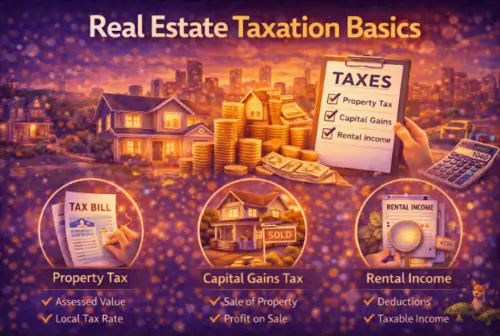
Real estate taxation sounds intimidating, but it becomes manageable once you know one simple idea: you pay taxes at different stages of property life—when you own, transfer, earn, or inherit property.
This guide explains Real Estate Taxation Basics in plain English for Filipino readers, with practical examples and the most important deadlines to remember. (This is educational, not legal/tax advice.)
The quick map of property taxes
You’ll usually encounter three “buckets”:
Ownership taxes
Taxes you pay while you own the property (annual “amilyar” / real property tax).
Transfer taxes
Taxes you pay when property ownership changes (selling, donating, inheriting).
Income-related taxes
Taxes when you earn from property (rentals, business use, etc.).
Key terms you should understand first
Land title vs Tax Declaration
A land title (TCT/CCT) is your ownership document. A Tax Declaration is for local property tax records and assessment. They work together, but they are not the same thing.
Assessed value vs fair market value vs zonal value
- Assessed value is the basis used by the LGU for computing real property tax (amilyar).
- Fair market value is a valuation reference used in different contexts (LGU schedule, assessor’s values).
- Zonal value is BIR’s valuation reference often used for tax computations for transfers/sales (when applicable).
Why valuations matter: many transaction taxes use the higher value among the selling price and valuation references.
Ownership taxes: “amilyar” or Real Property Tax
What it is
Real Property Tax (RPT) is an annual tax collected by your LGU (city/municipality/province) on real property such as land, buildings, and improvements.
There’s also an additional tax for the Special Education Fund (SEF). The Local Government Code allows payment of the basic real property tax and the SEF tax in installments.
When it’s due
If you pay by installment (instead of one annual payment), the Local Government Code sets these due dates:
- 1st installment: on or before March 31
- 2nd installment: on or before June 30
- 3rd installment: on or before September 30
- 4th installment: on or before December 31
Many Filipinos pay early in the year to avoid hassle and (in many LGUs) to qualify for early-payment discounts.
Early payment discount
LGUs may grant an early payment discount not exceeding 20% of the annual tax due, if paid in advance according to the schedule.
Because this depends on local ordinance and implementation, always check your city/municipal treasurer for the exact discount window and rules.
Late payment interest (the painful part)
If you miss payment deadlines, interest may apply at 2% per month, and total interest is capped at 36 months.
That cap matters because it effectively limits how high the interest can accumulate over time, but it can still get expensive—especially if you ignore it for years.
Transfer taxes when buying or selling property
When a property is sold (or otherwise transferred), the tax conversation usually shifts from the LGU to the BIR and the Registry of Deeds.
Local Transfer Tax (LGU)
Under the Local Government Code, the province may impose a tax on transfer of real property ownership at a rate of not more than 50% of 1% of the consideration (or fair market value if consideration is not substantial), whichever is higher—this is effectively up to 0.5%.
Key reminders from the same provision:
- The Register of Deeds may require proof of payment before registration.
- The transferor/seller/donor/executor is generally tasked to pay it within 60 days from deed execution (or date of death in estate situations).
In practice, who pays can be negotiated (buyer vs seller), but the law sets who is responsible to ensure payment is made on time.
Capital Gains Tax (CGT) on sale of real property (common scenario)
For onerous transfer (sale) of real property classified as a capital asset, the BIR’s CGT return guidance highlights the usual computation basis: 6% CGT based on the higher of the selling price, zonal value, or fair market value per tax declaration.
This “higher of” rule surprises many sellers. Even if you “sold low” on paper, taxes may still follow valuation references.
Documentary Stamp Tax (DST)
DST is a tax on the document/instrument itself (like a deed of sale). For filing, BIR Form 2000-OT describes that DST returns are filed and paid within 5 days after the close of the month when the taxable document was made/signed/issued/accepted/transferred.
The practical DST rate for real property conveyances is commonly discussed as ₱15 per ₱1,000 of the tax base (effectively around 1.5%), with the base often being the higher of the deed consideration or FMV references.
What if you inherit property? Estate tax basics
If property transfers because someone passed away, the taxes and documents change. A common rule you’ll hear in the TRAIN era is that the estate tax return and payment are due within one (1) year from the date of death.
In real life, inheritance cases get delayed because of:
- missing titles or tax declarations
- unpaid amilyar (RPT) that needs clearing
- incomplete family documents (birth/marriage certificates)
- multiple heirs who can’t agree
If your family is planning to settle an estate, document cleanup is often the fastest “tax strategy.”
What if you donate property? Donor’s tax basics
Donations of property can trigger donor’s tax and document requirements. In practice, donor’s tax compliance often involves filing the donor’s tax return within 30 days from the date of donation (common procedural guidance).
If you’re donating property to relatives, don’t assume it’s “free” because it’s family—government processes still treat it as a taxable transfer in many cases.
Rental income taxes: when the property earns money
If you rent out a condo, apartment, house, or commercial space, you may have tax obligations tied to rental income.
The biggest beginner mistakes:
- not separating “rent money” from personal spending (hard to track)
- forgetting that repairs and maintenance are different from capital improvements
- failing to keep receipts/records, making compliance stressful later
A practical habit for Filipino landlords: keep a simple monthly tracker (rent received, expenses, receipts) even if you’re small-scale. It protects you if you later need to prove income, apply for a loan, or handle a sale.
Documents checklist that makes tax life easier
If you want fewer headaches, keep these organized (physical + scanned):
Ownership and property records
- TCT/CCT (title)
- Tax Declaration (land + improvements)
- latest RPT/amilyar receipts and tax clearance (if available)
For selling / transferring
- notarized deed (sale/donation/settlement)
- valid IDs + TIN
- proof of payment for applicable taxes and fees
- eCAR/clearance documents when required by the process (varies by transaction)
A simple timeline for a typical property sale
Due diligence
- verify title details and possible encumbrances
- confirm updated tax declaration and paid amilyar
Sign and notarize deed
- make sure buyer/seller details match IDs and TINs
Pay taxes
- CGT / other applicable BIR taxes based on classification
- DST filing/payment timing
- LGU transfer tax timing and proof of payment
Register and update records
- Registry of Deeds registration
- update tax declaration records in the assessor’s office
Common mistakes Filipinos make (and how to avoid them)
Mixing up title and tax declaration
Fix: treat title as ownership, tax declaration as tax record—keep both updated.
Ignoring amilyar until selling time
Fix: pay regularly; late interest can stack at 2% per month (capped).
Assuming “we can decide later who pays what”
Fix: write it in the contract. Taxes and fees become conflict magnets.
Underestimating “hidden costs”
Fix: budget for taxes + registration + document retrieval + notarization.
FAQs
What is “amilyar” in the Philippines?
“Amilyar” is the local Real Property Tax (RPT) paid annually to your LGU, often with an additional SEF levy.
What are the quarterly due dates if I pay RPT in installments?
March 31, June 30, September 30, and December 31.
How much is the interest if I pay RPT late?
The Local Government Code provides 2% interest per month on unpaid amounts, capped at 36 months total interest.
What is the local transfer tax rate?
For provinces, the Local Government Code allows up to 50% of 1% (effectively up to 0.5%) based on the higher of consideration or FMV when consideration is not substantial.