

Teacher Shortage Issues: Why It’s Happening and What Helps
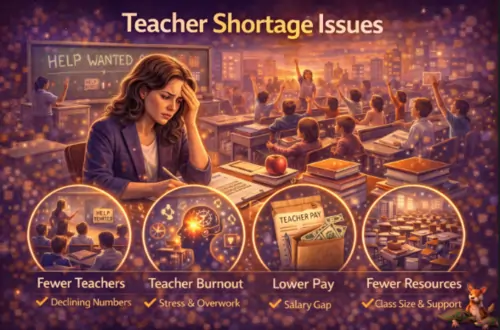
Teacher shortage issues happen when schools can’t fill teaching positions or rely on underqualified/temporary staff. Common causes include low pay versus cost of living, heavy workload and burnout, weak support systems, and pipeline barriers in teacher training and licensing.
The biggest impacts are larger class sizes, fewer subject offerings, and uneven learning outcomes—especially in high-need areas like special education and STEM. Solutions that work focus on competitive compensation, reducing administrative load, strong mentoring, and improving teacher preparation pathways.
What is the teacher shortage?
Teacher shortage issues occur when a school system doesn’t have enough qualified teachers to cover all classrooms and subjects—so positions stay vacant, get filled late, or are handled by long-term substitutes or teachers teaching outside their specialization.
In real life, that can look like:
- Larger class sizes
- Fewer electives (arts, languages, tech subjects)
- Rotating substitutes for months
- Teachers handling multiple subjects or grade levels
- Less time for feedback, planning, and student support
Globally, the situation is serious. UNESCO’s Global Report on Teachers cites new data indicating 44 million additional teachers are needed to reach universal primary and secondary education by 2030.
Why teacher shortage issues matter
Teacher shortage issues are not just a staffing problem—they change the daily learning experience for students and the wellbeing of teachers.
For students
- Less one-on-one attention
- Inconsistent instruction when teachers rotate
- Reduced support for reading, math, and learning gaps
- Fewer enrichment options like clubs and electives
For teachers
- More workload (more students, more paperwork, more duties)
- Higher stress and burnout
- Less time to plan quality lessons
- Higher chance of leaving—making shortages worse
For families and communities
- Learning gaps can affect long-term opportunities
- Parents may need more tutoring support at home
- Schools lose stability and community trust
What’s causing teacher shortage issues?
Teacher shortage issues rarely come from one cause. They usually come from a chain reaction—recruitment challenges, early-career burnout, and limited support.
Pay and cost of living pressures
If teachers can’t comfortably cover rent, transport, and household needs, the job becomes hard to sustain—especially in cities with high living costs. Even when people love teaching, financial pressure can push them toward other careers.
Workload, burnout, and “too much admin”
Many teachers say the job isn’t only teaching anymore. It’s lesson plans, reports, meetings, documentation, and constant requirements. When planning time disappears, teachers take work home, and burnout builds.
School climate, behavior, and safety stress
Teachers aren’t just delivering lessons—they’re often handling increasing student support needs (learning gaps, mental health, behavior issues). When support staff are limited, teachers carry more emotional load.
Pipeline problems (fewer entrants, harder training)
Teacher preparation can be costly, time-consuming, and sometimes unpaid during student teaching. Add licensing delays and barriers, and fewer people complete the pathway.
Retention problems (teachers leaving early)
In many places, the biggest shortage driver is not “nobody wants to teach,” but “too many teachers don’t stay.”
Where shortages are often worst
Teacher shortage issues show up more intensely in:
- Special education
- Math and science
- Early childhood education
- Rural/remote areas
- Schools serving higher-need communities
These roles often come with heavier workload demands, more complex student needs, and fewer available applicants.
Teacher shortage issues in the Philippines: a quick look
For Filipino readers, it’s helpful to separate teacher shortages from other school resource gaps (like classroom shortages). In the Philippines, teacher gaps have been reported in the tens of thousands.
- A Philstar report quotes a DepEd official saying the nationwide teacher shortage remained around 30,000, even with thousands of new positions approved.
- An ABS-CBN explainer referenced public statements noting a teacher-student ratio around 1:27 in many public schools, while also pointing out other issues like classroom backlogs.
Why this matters: even if an overall ratio looks “okay” at the national level, shortages can still be severe in specific regions, grade levels, or subjects—especially SPED and STEM.
Warning signs a school is in “shortage mode”
If you’re a parent, student, or school stakeholder, teacher shortage issues often show up as patterns like:
- Many vacancies close to the start of the school year
- Teachers assigned outside their specialization
- Heavy reliance on temporary or emergency hires
- Reduced course offerings or combined classes
- Rising teacher absences and turnover
Effects on learning and school quality
Teacher shortage issues can create a cycle:
- Vacancies increase workload for remaining teachers
- Workload increases stress and burnout
- Burnout increases resignations
- Resignations worsen vacancies
This cycle is hard to break without structural changes.
For students, the biggest risk is inconsistency. When teachers change frequently or are stretched too thin, students often receive less feedback, less individualized support, and less stable routines.
Solutions that actually help
There is no single “magic fix,” but evidence-based strategies tend to cluster into a few categories: better compensation, better working conditions, stronger pipelines, and stronger support.
Improve compensation and benefits
Competitive pay matters, but so do practical supports like:
- Housing or transport support in high-cost areas
- Retention bonuses for hard-to-staff roles
- Strong health and mental health benefits
Reduce workload with real support
One of the fastest ways to reduce burnout is to reduce non-teaching load:
- More aides, guidance counselors, and admin support
- Protected planning time
- Streamlined documentation
Australia’s teacher workforce reports and policy initiatives highlight workload reduction strategies, including using specialist staff to reduce administrative burdens.
Strengthen the teacher pipeline
To grow the next generation of teachers:
- Scholarships and grants
- Paid student teaching or stipends (so candidates can finish training)
- “Grow-your-own” programs recruiting local community members into teaching
Better induction and mentoring for new teachers
New teachers often leave early because the first years are overwhelming.
Support that helps retention:
- Mentors and coaching
- Reduced teaching load for first-year teachers
- Practical training in classroom management and student support
Flexible pathways without lowering standards
Alternative certification can help career-switchers enter teaching, but it must still protect quality. The best systems provide:
- Clear training support
- Supervised onboarding
- Coaching until full certification
What different groups can do
Policymakers and government
- Fund positions and support staff (not only hiring targets)
- Improve teacher preparation affordability
- Streamline licensing while maintaining standards
- Invest in high-need areas (SPED, STEM, remote schools)
School leaders
- Protect teacher planning time
- Make school culture supportive and respectful
- Improve classroom behavior systems
- Provide coaching rather than “gotcha” evaluation
Parents and communities
- Partner with teachers, not pressure them
- Support clear behavior expectations
- Advocate for school funding and support services
Teachers
- Build peer support circles
- Set boundaries to prevent burnout
- Seek mentorship and professional development that reduces daily stress
A practical way to think about teacher shortages
If you want a simple mental model:
- Recruitment is bringing teachers in.
- Retention is keeping them.
- Support is what makes retention possible.
Many systems focus heavily on recruitment campaigns. But teacher shortage issues usually improve faster when retention improves—because keeping experienced teachers prevents the constant “restart” that drains schools.
FAQs
Is the teacher shortage happening everywhere?
Teacher shortage issues exist globally, but severity varies by region, subject area, and school type. Global data shows shortages are widespread, with major needs projected through 2030.
Why do teachers leave so quickly?
Common reasons include workload, burnout, pay that doesn’t match cost of living, limited support for behavior and learning needs, and weak mentoring for new teachers.
Does raising pay actually solve shortages?
Pay helps, but it works best when paired with workload reduction, support staff, mentoring, and improved school culture.
Which areas are hardest to staff?
Special education, math, science, early childhood, and rural/remote schools are often the hardest-hit.
What can parents do to help?
Support respectful teacher-family communication, reinforce behavior expectations, and advocate for resources that reduce teacher overload (support staff, planning time, classroom materials).