

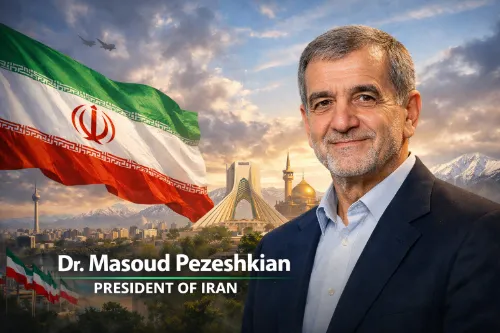
Iranian President Masoud Pezeshkian is a heart surgeon‑turned‑politician and the Islamic Republic’s first clearly reform‑minded president in nearly two decades, elected in 2024 on promises of modest social change and a more pragmatic foreign policy. He presents himself as a “reformist principlist,” seeking gradual reforms while staying loyal to Iran’s supreme leader and the core structure of the Islamic system.
Who Is Masoud Pezeshkian?
Masoud Pezeshkian was born in 1954 in Mahabad, in Iran’s West Azerbaijan province, to an Azeri father and Kurdish mother. Trained as a cardiac surgeon, he headed Tabriz University of Medical Sciences before entering national politics.
- He served as Iran’s minister of health from 2001 to 2005 in the reformist government of President Mohammad Khatami.
- Since 2008, he has represented the northwestern city of Tabriz in parliament, building a reputation as a relatively moderate but loyal insider.
- Encyclopaedia Britannica highlights that he is the most reform‑oriented president since Khatami, but still constrained by Iran’s conservative power centers.
For a concise biographical overview, you can refer to Britannica’s profile of Masoud Pezeshkian.
Iranian President Masoud Pezeshkian– Path To The Presidency
Pezeshkian did not emerge overnight; his rise reflects years of navigating Iran’s tightly controlled political system.
- He made two earlier attempts to run for president: he withdrew in favor of former president Akbar Hashemi Rafsanjani in 2013, and the Guardian Council disqualified him in 2021.
- After President Ebrahim Raisi died in a helicopter crash in May 2024, Iran held a snap election on June 28, 2024.
- In the first round, Pezeshkian led a crowded field but fell short of an outright majority, forcing a run‑off against hard‑liner Saeed Jalili.
According to Al Jazeera, he won the July 5 run‑off with about 53.7 percent of the vote, becoming Iran’s next president amid relatively low turnout and widespread public scepticism. Their report on how centrist Masoud Pezeshkian became Iran’s next president gives a clear rundown of the vote numbers and reactions.
A “Reformist Principlist”: Ideology And Image
Pezeshkian brands himself as both a reformist and a principlist, signalling that he wants change but not a challenge to the Islamic Republic’s foundations.
- He has described himself as a “reformist principlist,” saying he supports reforms to better uphold the system’s core principles rather than dismantle them.
- The BBC notes that he is Iran’s first reformist president in nearly 20 years, promising to soften enforcement of social rules and improve ties with Western countries.
- At the same time, he stresses his allegiance to Supreme Leader Ayatollah Ali Khamenei and has repeatedly said he will not confront the clerical or security establishment.
BBC’s profile, “Masoud Pezeshkian: The reformist now Iran’s president‑elect,” offers a balanced look at this dual identity and how it might limit or enable his agenda. You can read it on the BBC News site.
Domestic Agenda: Social Change And Economic Repair
Inside Iran, voters associate Pezeshkian with two big promises: easing social restrictions and fixing a sanctions‑battered economy.
Social and cultural issues
- Pezeshkian has criticised the morality police and harsh enforcement of the mandatory hijab, and he opposed a parliamentary bill that would further tighten Islamic dress‑code enforcement.
- His campaign signalled support for greater social openness and more tolerance of criticism, though always within the framework of the Islamic Republic.
- Reuters notes that many young and urban voters backed him hoping for more freedom in daily life after years of crackdowns.
Economic and governance priorities
- He has argued that lifting sanctions and reconnecting to global markets is essential for achieving growth, calling an 8 percent growth target impossible without opening Iran’s borders and economy.
- Pezeshkian strongly defended the 2015 nuclear deal (JCPOA) negotiated under former president Hassan Rouhani and has pushed for reviving it or a similar agreement.
- His supporters expect technocratic reforms, better management, and less corruption rather than a radical overhaul of the system.
The Iran Primer, published by the U.S. Institute of Peace, has a useful, neutral profile called “Pezeshkian: Profile of President‑elect” that lays out his domestic agenda and political track record.
Foreign Policy: Between The West, Russia, And The Region
On foreign policy, Pezeshkian must balance his campaign promises to “open Iran to the world” with the hard realities of Iran’s security establishment and regional alliances.
- He favours reviving nuclear diplomacy with the West, seeking sanctions relief in exchange for constraints on Iran’s nuclear programme.
- Reuters reports that he has pledged a “pragmatic” foreign policy aimed at easing tensions and restoring stalled negotiations over the nuclear deal.
- At the same time, he endorses Iran’s core regional posture, including support for the Revolutionary Guard’s missile and drone programme and alignment with Khamenei’s broader foreign‑policy goals.
United Against Nuclear Iran (UANI), a U.S.‑based advocacy group, stresses in its profile “Masoud Pezeshkian: President of Iran” that despite his reformist label, he has publicly backed the IRGC’s capabilities and pledged loyalty to the Supreme Leader. This highlights the limits of how far his foreign policy can diverge from entrenched security interests.
Criticism: Reformist Or Loyal Insider?
While some Iranians see Pezeshkian as a potential game‑changer, others view him as a safety valve who will not fundamentally challenge the system.
- The opposition‑aligned National Council of Resistance of Iran (NCRI) describes him as an “eternal conformist,” arguing that his long career inside the system shows he will protect the regime rather than confront it.
- UANI’s profile emphasises that he pledged to continue much of Raisi’s agenda, including support for the IRGC and Iran’s aggressive stance toward the U.S. and its allies.
- Analysts at the Atlantic Council note that his candidacy was allowed in part because he lacks an independent mass base that could threaten the ruling establishment, even as he attracts disillusioned urban voters.
For a more critical perspective, you can read the NCRI article “Who is Masoud Pezeshkian: Minister, MP, and Eternal Conformist” and the Atlantic Council’s analysis of why he was seen as a “possible game changer” yet acceptable to the system.
The 2024 Election: Turnout, Hopes, And Skepticism
Pezeshkian’s election itself says a lot about Iran’s political mood after years of protests and low trust in institutions.
- Voter turnout was historically low: more than 60 percent of eligible voters abstained in the first round of the snap election, signalling deep apathy and anger.
- In the run‑off, Pezeshkian received around 16.3 million votes against Jalili’s 13.5 million, with overall turnout around 50 percent.
- Euronews notes that many voters hoped he would soften enforcement of the headscarf law and ease Iran’s isolation but remained doubtful about how much power he actually has.
Britannica’s article on Iran’s 2024 presidential election walks through the candidate field, the results, and what his victory indicated about public sentiment. Euronews’ report on how “Iranian reformist Pezeshkian wins presidential run‑off” captures the mix of street celebrations and scepticism.
Pezeshkian’s Government And Constraints On Power
As president, Pezeshkian heads the executive branch but operates under a powerful Supreme Leader, conservative judiciary, and hard‑line security apparatus.
- The Wikipedia page on the Government of Masoud Pezeshkian notes that he took office in late July 2024 as Iran’s ninth president.
- He faces a conservative parliament (Majles) that has often blocked or diluted reformist policies in the past.
- Reuters and the BBC both stress that he does not intend to challenge the Revolutionary Guards or Khamenei’s ultimate authority, which limits how far he can push reforms.
Britannica underlines that he is “distinguished from his predecessor” by favouring a nuclear agreement and modest reforms but remains a regime loyalist bound by a historically conservative parliament and unelected power centres.
Masoud Pezeshkian And The 2026 Iran–US–Israel War
By 2026, Pezeshkian’s presidency is overshadowed by the escalating Iran–US–Israel war, which erupted after coordinated U.S.–Israeli strikes on Iranian targets.
- The Wall Street Journal notes that his influence has waned as the security establishment takes the lead in wartime decision‑making, even though he originally campaigned on easing tensions with the West.
- Britannica’s entry on the 2026 Iran conflict explains that, despite his reformist image, Pezeshkian has had limited ability to steer Iran away from confrontation once military dynamics took over.
- This war has further complicated his efforts to revive the nuclear deal or deliver economic relief, as new sanctions and military strikes deepen Iran’s isolation.
For readers wanting to connect his presidency to the wider regional crisis, Britannica’s conflict summary and the general Masoud Pezeshkian entry on Wikipedia offer useful context.
What His Presidency Means For Iran’s Future
Pezeshkian’s tenure sits at a crossroads between public demands for change and a system built to resist rapid reform.
- Supporters see him as a chance for incremental change—slightly more social freedom, less aggressive policing, and a more pragmatic foreign policy.
- Critics argue he primarily serves to re‑legitimize the system after years of protests and that core power structures remain untouched.
- Analysts stress that his success will depend on whether he can turn limited room for manoeuvre into tangible improvements in daily life, especially amid war and economic crisis.
For ongoing analysis, think‑tank resources like the Atlantic Council’s IranSource blog and the USIP Iran Primer regularly publish updates on how Pezeshkian’s policies evolve.