

Introduction
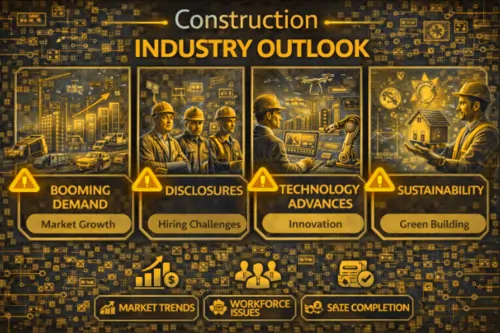
The construction industry outlook for 2026 points to a market that is improving, but not evenly across every segment. Global construction is expected to recover after a weaker 2025, while in the United States, demand is shifting toward data centers, power infrastructure, healthcare, manufacturing, and selected public projects rather than broad-based expansion across all categories.
That creates a more selective environment for contractors, developers, investors, and suppliers. In simple terms, the industry is not moving into a uniform boom. Instead, growth is being driven by a few powerful themes: digital infrastructure, energy demand, public infrastructure spending, and the continued need for resilience in supply chains and project execution. At the same time, firms are still dealing with labor shortages, financing pressure, cost uncertainty, and the need to adopt technology faster.
For businesses and professionals working in the sector, understanding the current construction industry outlook matters because the next phase of growth may reward specialization, operational discipline, and better workforce planning more than simple expansion.
Why the Construction Industry Outlook Matters
Construction is closely tied to the broader economy. It reflects business confidence, interest rates, government spending, industrial expansion, and consumer demand. When construction activity rises, it often signals growth in housing, logistics, manufacturing, healthcare, technology, and infrastructure. When it slows, the effects can spread quickly through employment, materials, transport, and local economies.
The current construction industry outlook is especially important because the market is entering a phase where opportunities are real, but execution risks remain high. Companies that understand where demand is moving are more likely to allocate capital wisely, price projects accurately, and protect margins in a volatile environment.
Global Construction Industry Outlook
At the global level, Oxford Economics expects construction activity to recover in 2026 after a slowdown in 2025. Its recent outlook says global construction weakened in 2025 and is projected to rebound in 2026 as conditions stabilize and confidence improves. It also highlighted China and the United States as important markets expected to regain momentum.
That matters because the global market is being shaped by a mix of headwinds and recovery drivers. Weakness in some residential segments and real estate stress in parts of the world are still weighing on activity, but policy-backed infrastructure, defense-related construction, industrial reshoring, and energy-linked projects are supporting demand.
This means the broader construction industry outlook is not simply about whether the market grows or shrinks. It is about where growth happens. Regions and sectors tied to energy, industrial investment, transport, and digital infrastructure are likely to perform better than markets still constrained by property weakness or expensive financing.
U.S. Construction Industry Outlook
In the United States, the picture is mixed but constructive. Deloitte’s 2026 Engineering and Construction Industry Outlook says investment in structures is projected to pivot from decline in 2025 to modest growth in 2026, helped in part by AI-related data center spending and associated energy infrastructure work.
The AGC 2026 Construction Hiring and Business Outlook also points to demand shifting rather than disappearing. According to AGC, private-sector demand is expected to be driven mainly by data centers, power facilities, and healthcare projects, while water and sewer, manufacturing, transportation facilities, and bridge and highway work are also expected to support activity. At the same time, contractors reported more modest expectations than a year earlier.
That makes the current U.S. construction industry outlook one of selective strength. Contractors exposed to growth categories may see strong backlogs and better pricing opportunities, while firms tied to weaker segments may continue to face slower activity or tighter competition.
Key Trends Shaping the Construction Industry Outlook
Data Centers and Power Infrastructure
One of the strongest drivers in the present construction industry outlook is the surge in data center construction. Deloitte specifically identifies AI-driven data center development and related energy infrastructure as major sources of support for the sector in 2026.
This trend has broad implications. Data centers require not only large-scale building work but also power generation, grid upgrades, cooling systems, and specialized engineering. As artificial intelligence and cloud demand continue rising, these projects are likely to remain important contributors to nonresidential construction activity.
Manufacturing and Industrial Expansion
Manufacturing continues to matter as companies rethink supply chains and invest in domestic or regional production capacity. Both Deloitte and AGC identify manufacturing as an area contributing to construction demand, though growth can vary by project type and geography.
Industrial construction linked to logistics, advanced manufacturing, and strategic capacity building could remain one of the more resilient parts of the market, especially where it overlaps with public incentives or long-term infrastructure needs.
Infrastructure and Public Works
Public infrastructure remains a stabilizing force in the construction industry outlook. AGC’s outlook points to bridge and highway work, transportation facilities, and water and sewer projects as areas that should continue contributing to demand in 2026.
These projects often provide a counterweight when private real estate segments slow. For contractors, public works can offer visibility and backlog support, although margins and procurement complexity may vary.
Technology and AI Adoption
Technology is becoming a more visible differentiator in construction. Deloitte emphasizes innovation and resilience in its 2026 outlook, while AGC and industry coverage point to faster interest in digital workflows and AI-supported operations.
In practice, this means construction firms are increasingly using technology for scheduling, documentation, safety tracking, estimating, reporting, and coordination. As labor remains tight, productivity gains from digital tools may become even more important.
Major Challenges in the Construction Industry Outlook
Labor Shortages
Labor remains one of the biggest challenges in the current construction industry outlook. ABC said in January 2026 that the U.S. construction industry would need to attract 349,000 net new workers in 2026 to meet demand. AGC’s reporting also continues to highlight persistent hiring difficulty.
This shortage affects project timelines, labor costs, and the ability of firms to take on new work. It also means that workforce planning is no longer a side issue. It is now central to execution and profitability.
Cost and Financing Pressure
Even where demand is improving, firms still face uncertainty around financing, material costs, and margins. AGC’s 2026 outlook specifically notes uncertainty around labor, tariffs, and financing, while Deloitte points to a dynamic mix of challenges alongside opportunity.
Higher capital costs can delay projects, narrow the pool of viable developments, and force closer scrutiny of budgets. That is one reason why some segments remain strong while others stay under pressure.
Uneven Demand Across Segments
A key takeaway from the latest construction industry outlook is that not every category will move together. Some contractors will benefit from strong momentum in power, data centers, health care, and public works, while others may face weaker bidding environments in more rate-sensitive segments.
Because of that, strategic focus matters. Firms that understand which segments are expanding, and which are slowing, will be in a better position to protect revenue and deploy resources effectively.
What This Means for Contractors and Investors
For contractors, the 2026 construction industry outlook suggests a year where selectivity matters. The strongest opportunities appear concentrated in digital infrastructure, power, healthcare, manufacturing, and public works. Firms in these categories may benefit from stronger pipelines, but they will still need disciplined staffing, procurement, and project controls.
For investors and developers, the message is similar. Construction is not simply a scale game in this environment. It is a timing, sector, and execution game. Projects supported by durable demand drivers may outperform, while projects dependent on weaker financing conditions or uncertain absorption may face more pressure.
Conclusion
The current construction industry outlook is cautiously positive, but highly selective. Global activity is expected to recover in 2026 after a slower 2025, and in the United States, the most promising areas are tied to data centers, power, healthcare, manufacturing, and infrastructure.
At the same time, labor shortages, financing uncertainty, and uneven segment performance remain serious challenges. That means success in the coming year is likely to depend less on broad market momentum and more on strategic positioning, workforce readiness, and operational execution.
For businesses across the sector, the next phase of growth may belong to those that stay disciplined, invest in productivity, and align themselves with the strongest sources of long-term demand.
FAQ
What is the construction industry outlook for 2026?
The construction industry outlook for 2026 is moderately positive, with recovery expected globally and selective growth in areas such as data centers, power, healthcare, manufacturing, and infrastructure.
What sectors are driving construction growth?
The strongest growth drivers include AI-related data centers, power infrastructure, healthcare facilities, manufacturing projects, and selected public infrastructure categories such as bridges, highways, and water systems.
What challenges does the construction industry face?
Major challenges include labor shortages, financing uncertainty, material and cost pressure, and uneven demand across project categories.
Why is labor a major issue in construction?
Labor is a major issue because demand for workers continues to exceed supply. ABC said the industry needs 349,000 net new workers in 2026 to meet demand in the United States.
Will technology shape the future of construction?
Yes. Technology, including AI and digital project tools, is becoming more important for productivity, coordination, safety, and reporting across the construction sector.