

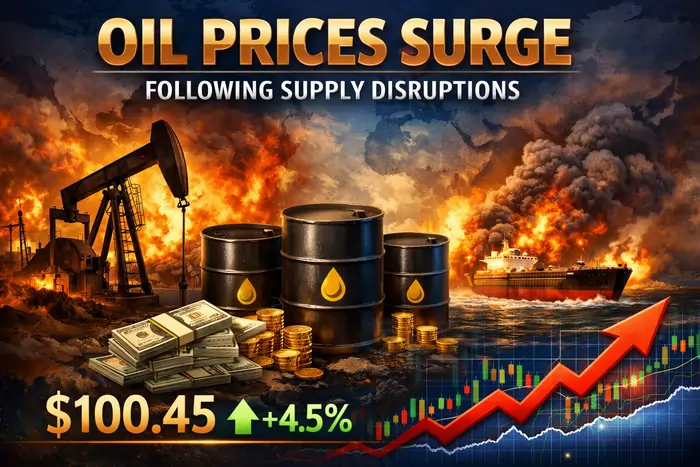
Oil Prices Surge in early 2026 as traders scramble to reprice mounting supply risks, defying expectations that this would be a “year of the glut” for crude. Futures for Brent and WTI recently jumped into the high‑60s to around 70 USD per barrel after a series of geopolitical flare‑ups and production concerns, particularly involving Iran and key shipping lanes. Analysts say a new geopolitical risk premium—estimated at 7 to 10 dollars per barrel—is now embedded in prices, even though underlying supply and demand still point to a relatively well‑supplied market.
This article explains why oil prices are surging following supply disruptions, what’s driving the latest shock, how markets typically react, and what it might mean for gasoline, inflation, and longer‑term business strategy. For background, the U.S. Energy Information Administration’s explainer on what drives crude oil spot prices is a useful reference as we unpack the current spike.
What Caused the Latest Supply Disruptions?
The current price surge has its roots in a cluster of risk factors rather than a single dramatic outage. Tensions around Iran—one of the largest OPEC producers—have escalated amid protests, the threat of new sanctions, and talk of possible U.S. military action. Markets fear that any conflict or punitive trade measures could directly curb Iranian exports or indirectly disrupt flows through the Strait of Hormuz, a narrow chokepoint that handles roughly a fifth of global petroleum liquids.
At the same time, there have been concerns about disruptions to other supply sources, including Venezuela and Russia, due to sanctions, infrastructure issues, and conflict‑related risks. Local media and energy officials in countries like the Philippines have linked looming domestic fuel hikes to “unstable and unpredictable conditions” stemming from simultaneous unrest in Venezuela, Iran, and the Black Sea region. Weather events and storms occasionally compound the situation by forcing temporary production shut‑ins or refinery outages, adding to perceived fragility in the system.
Daily news coverage from outlets such as CNBC and AAA has highlighted how even the fear of possible supply disruptions—especially around the Strait of Hormuz—can be enough to push prices sharply higher as traders reposition ahead of worst‑case scenarios. BloombergNEF’s scenario analysis on how Iran‑related disruption could push Brent to 91 dollars per barrel shows how sensitive prices are to changes in export volumes and shipping risks.
How Oil Markets React to Supply Shocks
Oil markets tend to react quickly to any hint of supply stress because both short‑run supply and demand are relatively inelastic—they don’t respond much to price changes in the near term. The EIA notes that it takes years to develop new production or significantly alter consumption patterns, so when a shock hits, prices often need to move a lot to bring the market back into balance.
In practice, traders price crude primarily via futures contracts, which reflect expectations about future supply and demand. When headlines suggest a potential outage—say, a blockage near Hormuz or sanctions on a major exporter—futures prices can spike even before barrels are actually lost, as market participants build in a risk premium. Speculative activity in futures markets can amplify these moves: studies of the determinants of crude oil prices show that high spot prices can boost speculation in futures, which in turn drives spot prices higher in a feedback loop.
Bloomberg described early 2026 as a year that was supposed to be defined by oversupply, yet “geopolitical spikes and supply disruption” have powered futures back up to around 70 dollars per barrel. Traders know that such spikes may be short‑lived if disruptions prove limited, but in the moment they must hedge or reposition, which adds to volatility.
Geopolitics and Oil: Tensions Behind the Surge
Geopolitical risk is central to the current surge. Iran sits at the heart of this story, both as a major producer and as a country bordering the Strait of Hormuz, through which roughly 20 million barrels per day of oil flows. Any conflict, sanctions escalation, or shipping incident in this region can quickly translate into higher prices worldwide.
Recent analysis from BloombergNEF outlines several scenarios. In a base case where Iran’s exports are not severely disrupted, Brent averages around 55 dollars per barrel in 2026; in a scenario where Iranian exports are fully removed, Brent could reach 71 dollars in the second quarter and average 91 dollars in the fourth quarter. An even more extreme “outlier” scenario would be a partial or full blockage of Hormuz, which Bloomberg estimates could push crude toward 108 dollars per barrel.
Similar dynamics have played out before. Reuters and other outlets have chronicled how tensions involving Russia, Venezuela, and Middle Eastern conflicts repeatedly trigger supply fears and price swings. The Economic Times notes that recent record‑high oil prices were “mainly linked to fears of supply disruption from Iran” and concerns over shipping routes, alongside a weaker dollar and expectations that interest rates may stay supportive of demand.
Regional coverage, such as reports from Philippine news agencies and ABS‑CBN, has connected these global tensions to local fuel price hikes, underscoring how quickly geopolitical shocks ripple through to consumer markets.
Demand, Inventories, and the Bigger Supply–Demand Picture
While headlines focus on disruptions, the broader supply–demand balance still matters. Interestingly, many forecasters came into 2026 expecting a surplus. The EIA’s Short‑Term Energy Outlook and a recent note on lower oil prices expected in 2026 and 2027 describe how global inventories had been rising as OPEC+ increased production targets and non‑OPEC producers like Brazil, Guyana, and Argentina ramped output. Investing News Network’s overview of top oil and gas trends for 2026 likewise highlights how supply outpaced demand in late 2025, pushing Brent below 60 dollars and WTI to around 55 dollars per barrel.
This relatively comfortable supply picture helps explain why some analysts still expect prices to ease once the current wave of risk subsides. For example, the EIA sees crude prices retreating after recent disruptions as inventories rebuild and new production comes online. Citi analysts quoted by Global Banking & Finance expect that if deals are reached on Iran and Russia‑Ukraine by mid‑year, Brent could fall back toward 60–62 dollars per barrel.
However, when markets perceive that spare capacity and inventories are not sufficient to offset a possible disruption, forward‑looking behavior can push prices above what would be implied by current supply and demand alone. In other words, even in an overall well‑supplied market, concentrated geopolitical risks can still trigger sharp, if sometimes temporary, price spikes.
Market Outlook: Will Prices Keep Rising?
The outlook for oil prices now hinges on how the geopolitical situation evolves and how quickly confidence returns to the market. In the short term, analysts are watching several key variables: the trajectory of Iran‑related tensions, any incidents affecting shipping through Hormuz, OPEC+ production decisions, and signs of demand strength or weakness in major economies.
BloombergNEF’s forecast suggests that under a base case of no severe disruption, supply will outpace demand by an average of 3.2 million barrels per day in 2026, which should exert downward pressure on prices over the year. The EIA similarly expects “lower oil prices in 2026 and 2027” as inventories build and non‑OPEC supply grows. On the other hand, if Iran’s exports are curtailed or if shipping lanes are disrupted, Brent could hold much higher than base‑case averages for extended periods.
Short‑term trading commentary from Bloomberg and Reuters emphasizes that markets are trying to balance this fundamental surplus story against the real possibility of sudden, large disruptions. Articles such as “Oil’s Year of the Glut Begins With an Unexpected Price Surge” illustrate how quickly sentiment can flip from expecting sub‑60 dollar oil to worrying about 90‑plus scenarios. Ultimately, whether prices keep rising will depend less on current barrels and more on how credible worst‑case scenarios appear in the weeks and months ahead.
Impact on Gasoline, Inflation, and Everyday Costs
For consumers, the immediate concern is how crude price spikes affect fuel costs and inflation. Historically, changes in crude oil prices feed through to gasoline and diesel with a lag, as refiners and retailers adjust to higher input costs. Empirical work reviewed by the EIA and academic studies shows a clear relationship between crude price changes and pump prices, though the magnitude and timing can vary by region and tax regime.
Local media in the Philippines, for example, have warned of hefty weekly price hikes for gasoline, diesel, and kerosene linked to rising global crude prices and geopolitical unrest. A recent ABS‑CBN report on expected fuel price increases attributes the looming hike to fears of possible supply disruption in Hormuz and broader Middle East tensions. Another Philippine News Agency dispatch describes how protests in Iran, concerns about U.S. intervention, and drone strikes on tankers have pushed up global prices, with local pump prices following.
Higher fuel costs can feed into broader inflation via transportation, food, and manufacturing. Research in journals like the International Journal of Energy Economics and Policy on global crude oil prices as blessing, curse, or crisis highlights how oil price shocks can strain household budgets and complicate monetary policy in importing countries. Owners who lack clear visibility into how fuel costs flow through their margins may find it useful to revisit the basics of a profit and loss guide so they can see exactly where rising input prices are eroding profitability and where to adjust.
In response, some governments may resort to temporary fuel subsidies, tax adjustments, or releases from strategic reserves to soften the blow.
Oil Prices Surge: How Businesses and Investors Are Responding
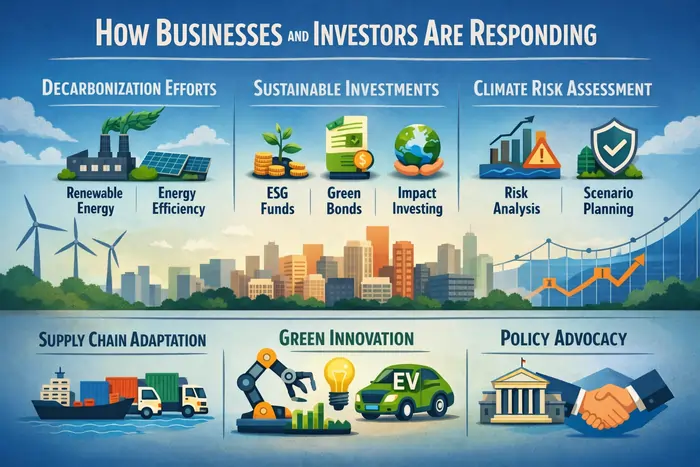
Businesses with heavy fuel exposure—airlines, shipping companies, logistics firms, and energy‑intensive manufacturers—often respond to price spikes by hedging, adjusting surcharges, or restructuring supply chains. Airlines may lock in prices via futures and options, while shippers use fuel surcharges to pass some costs on to customers. If volatility persists, firms may accelerate efficiency upgrades, such as investing in more fuel‑efficient fleets or optimizing routes.
Entrepreneurs and SMEs that want to diversify income or reduce reliance on fuel‑heavy operations can explore low‑cost business ideas that are less exposed to commodity swings. For smaller firms facing volatile fuel costs, adopting a lean startup model—testing ideas quickly, keeping fixed costs light, and iterating based on real‑world data—can make it easier to adjust when energy prices suddenly spike.
Investors, meanwhile, tend to rotate into energy stocks and related assets when oil rallies, though the relationship can be nuanced. Rising crude prices often boost the earnings outlook for upstream producers and some refiners, while airlines and other fuel‑intensive sectors may underperform. Research on oil and commodities markets shows that speculation in futures can amplify price swings, but also provides liquidity and hedging tools that real‑economy players rely on.
Policymakers may react by signaling future reserve releases, encouraging diplomatic de‑escalation, or engaging with OPEC+ members to stabilize markets. Citi’s note cited by Global Banking & Finance suggests that if supply disruptions are contained and diplomatic deals materialize, OPEC+ is likely to adjust production to keep Brent in a range that supports both producers and consumers.
Long‑Term Lessons From Repeated Disruptions
The latest surge is a reminder that as long as the world relies heavily on oil, geopolitical shocks will remain a structural feature of the energy landscape. Chokepoints like the Strait of Hormuz, political instability in key producing regions, and the long lead times for new projects make the system inherently vulnerable to disruption.
In response, many countries are pursuing strategies to enhance energy security, including diversifying suppliers, maintaining strategic reserves, and investing in alternative energy sources. Academic and policy literature on oil price determinants emphasizes that while diversification cannot fully eliminate risk, it can reduce the impact of any single disruption. The EIA’s long‑run perspective on supply responsiveness and the role of inventories underscores why building resilience is essential.
Building resilience in this kind of environment also depends on the people running organizations—leaders with classic entrepreneur traits like adaptability, calculated risk‑taking, and long‑term thinking are better positioned to steer through energy shocks. Over time, treating energy strategy as a source of competitive advantage—rather than a back‑office cost line—can separate companies that merely survive price spikes from those that use them to pull ahead.
At the same time, the push toward renewables, electrification of transport, and improved efficiency is partly motivated by a desire to reduce exposure to oil price volatility. However, the transition will take decades, and in the near to medium term, oil will remain a crucial part of the global energy mix, meaning price shocks are likely to recur.
Conclusion: Navigating an Uncertain Oil Market
Oil prices have surged following a confluence of supply disruptions, geopolitical tensions, and risk‑averse behavior in futures markets, even against a backdrop of expected surplus. The combination of Iran‑related risks, concerns over critical shipping lanes, and broader instability has pushed a sizable risk premium into crude prices, with knock‑on effects on fuel costs and inflation worldwide.
For consumers and businesses, the key is to recognize that such spikes, while unsettling, are an enduring feature of an energy system still heavily dependent on oil. Owners and founders who understand their numbers, apply lean principles, and cultivate resilient, opportunity‑seeking traits are better equipped to adapt—whether that means tightening operations, pursuing new low‑cost business ideas, or using volatility as a catalyst to rethink strategy. Watching developments around Iran, OPEC+ decisions, and global inventory trends in the coming months will be critical to understanding whether this latest surge marks the start of a sustained upswing or a temporary flare‑up in an otherwise softening market.