

Boeing 787 Dreamliner is one of the most advanced long-haul passenger aircraft in the world, featuring a lightweight composite structure, fuel-efficient engines, and a passenger-focused cabin design that helps reduce fuel burn and improve comfort on long international routes.
However, in recent years, the Boeing 787 Dreamliner has faced intense scrutiny, with regulators, pilots, and safety experts raising concerns about structural joints, electrical systems, and long-term durability. These issues have generated “shock” headlines, even as airlines continue to order, operate, and upgrade the aircraft.
This creates a balanced but complex reality: on one hand, the aircraft maintains a strong safety record and high global demand; on the other, there are ongoing quality concerns, inspection requirements, and public anxiety. For travellers, the key is understanding how aviation regulators manage safety risks, how airlines maintain and retrofit fleets, and what this mixed track record actually means for everyday flights.
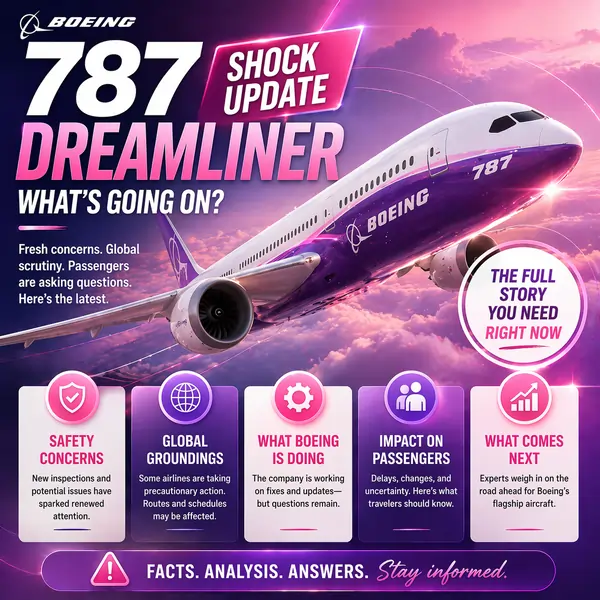
Boeing’s 787 Dreamliner is back in the spotlight, with a mix of new safety concerns, regulatory scrutiny, and performance upgrades creating what many travellers see as a genuine “shock update” moment for the popular long‑haul jet. In this in‑depth guide, we break down what’s going on with the Boeing 787 Dreamliner right now, why regulators and pilots are raising fresh alarms, how Boeing is responding, and what it all means for passengers, airlines, and investors.
What Is the Boeing 787 Dreamliner?
The Boeing 787 Dreamliner is a family of long‑range, wide‑body twin‑engine jets designed to be lighter, more fuel‑efficient, and more comfortable than previous generations of aircraft. It uses a composite airframe, advanced aerodynamics, and modern engines to cut fuel burn and emissions compared with older wide‑bodies like the Boeing 767 and 777‑200.
The 787 Dreamliner family includes three main passenger variants: the 787‑8, 787‑9, and 787‑10, each offering different ranges and seat capacities. Airlines use the 787 Dreamliner for medium‑to‑ultra‑long‑haul routes, with typical two‑class capacity ranging roughly from about 240 seats on the 787‑8 up to more than 330 seats on the 787‑10, depending on configuration.
From the passenger perspective, the Boeing 787 Dreamliner is known for larger windows, higher cabin humidity, improved pressurisation, quieter engines, and mood lighting that are designed to reduce jet lag and make long flights more comfortable. Boeing markets the aircraft as a cornerstone of its modern wide‑body lineup, emphasising its lower operating costs and environmental performance. For a manufacturer overview, see Boeing’s official Boeing 787 Dreamliner page.
The Latest “Shock Update”: New Safety Concerns and Fuselage Defect Warnings
The biggest headline around the Boeing 787 Dreamliner in early 2026 is a new airworthiness directive proposal from the U.S. Federal Aviation Administration (FAA) that highlights structural concerns related to fuselage components. According to a detailed breakdown of the FAA’s proposed directive, investigators identified shim gaps and assembly issues in certain structural joints that could cause fatigue cracks over time.
The FAA’s concern is that if these cracks remain undetected, they could compromise the aircraft’s ability to carry loads safely, potentially affecting the fuselage’s limit load capability. The directive calls for repetitive detailed inspections of specific fuselage areas, such as spar terminal fittings, jack pads, and splice plates, along with repairs as needed to address any cracking.
This latest issue comes after years of scrutiny around the Boeing 787 Dreamliner’s fuselage joins and structural tolerances. Earlier in the program, Boeing faced a nearly two‑year halt in 787 deliveries while it worked with the FAA to inspect and re‑shim joints, correct excessive gaps, and replace certain titanium components. At the time, Boeing maintained these problems did not pose immediate safety risks, but regulators insisted on detailed inspections before deliveries resumed.
The new 2026 directive underscores that structural concerns around the Boeing 787 Dreamliner are not entirely in the past, even though the type has built up a strong operational safety record in service and remains widely used across global fleets. For a narrative overview of these long‑running quality issues, see analyses like TIME’s feature on The Boeing 787 Dreamliner’s long history of safety concerns.
Pilots Calling for Grounding: Electrical Risks and Operational Anxiety
Alongside the new fuselage directive, pilot groups in some countries are pushing for more drastic measures. The Federation of Indian Pilots recently issued a public call for the immediate grounding of all Boeing 787 Dreamliner aircraft operating in India over unresolved electrical system issues.
According to statements from the pilots’ body, recurring electrical faults on the Boeing 787 Dreamliner—such as automatic shutdowns of fuel control switches and other electrical anomalies—have raised concerns about deeper, systemic problems that could undermine safety if left unchecked. In one reported incident at London Heathrow, an Air India 787‑8 experienced an automatic shutdown of a fuel control switch, leading to the aircraft being grounded and reported to regulators.
The pilots argue that comprehensive, field‑level inspections are necessary before further operations, emphasising that safety should come before schedules and commercial pressure. Although such calls for grounding have not translated into global regulatory bans, they are contributing to heightened public anxiety around the Boeing 787 Dreamliner at a time when the aviation industry is already under scrutiny.
For passengers and observers, this creates a conflicting picture: on one hand, the 787 Dreamliner has flown millions of hours with a strong safety record; on the other hand, recurring technical alerts and pilot warnings keep resurfacing and attracting headlines. For a traveller‑focused breakdown, articles like Navigator Insurance’s guide on Boeing 787 Dreamliner safety issues explained outline past electrical and battery problems in more accessible terms.
A Long Safety Story: From Battery Fires to the First Fatal Crash
To understand why the latest Boeing 787 Dreamliner news feels so dramatic, it helps to look back at the aircraft’s safety history. The Dreamliner entered service in the early 2010s and quickly gained attention for its cutting‑edge design—and for early problems with its lithium‑ion battery systems.
In 2013, several incidents involving overheating batteries and onboard fires forced regulators to temporarily ground the global Boeing 787 Dreamliner fleet. Boeing responded by redesigning the battery system, adding improved containment, cooling, and monitoring to prevent future fires. These fixes allowed the aircraft to return to service, and for many years, the 787 avoided any fatal passenger accidents, leading some analysts to describe it as one of the safest wide‑body jets in operation.
That changed in June 2025, with the first fatal crash and hull loss involving a Boeing 787 Dreamliner: Air India Flight 171. According to early reports and data reviewed by aviation analysts, the crash raised questions about training, maintenance, and aircraft systems, prompting renewed scrutiny of the Dreamliner’s safety record. While investigations into the crash have focused on multiple contributing factors, it ended the Dreamliner’s “no fatal accident” streak and shifted the tone of public debate.
At the same time, outlets like the BBC have noted that, statistically, the Boeing 787 Dreamliner still performs very well, with a safety record that compares favourably to many older aircraft types. Their analysis on how safe the Boeing 787 Dreamliner really is explains how complex it is to weigh design flaws, manufacturing issues, and operational history when judging the plane.
The Other Side of the Story: Upgrades, Orders, and Increased Performance
While safety concerns draw headlines, there is also a quieter stream of positive news about the Boeing 787 Dreamliner that complicates the narrative. In March 2026, Boeing announced that the FAA had certified increased maximum take‑off weight (MTOW) options for the 787‑9 and 787‑10 models.
This upgrade allows airlines to either carry more payload (passengers and cargo) or fly further, effectively expanding the range and capability of the Boeing 787 Dreamliner family. Air New Zealand is among the first carriers scheduled to receive 787‑9s featuring the higher MTOW configuration, enabling new long‑haul route possibilities.
At the same time, the order book for the Boeing 787 Dreamliner remains robust. In February 2026, Air Astana finalised an order for up to 15 Dreamliners to modernise its wide‑body fleet, while Sun PhuQuoc Airways also announced orders for up to 40 787s. These commitments suggest that airlines still view the Boeing 787 Dreamliner as a cornerstone of future long‑haul networks.
Low‑cost carriers and leisure airlines are also doubling down on the type. Jetstar, for example, has launched a major refit program for its fleet of 11 Boeing 787 Dreamliners, upgrading cabins, seats, and onboard technology to support flights of up to 16 hours. The refit includes an expanded business cabin, new economy seats, lie‑flat crew rest bunks, and Wi‑Fi‑enabled streaming in place of traditional seatback screens.
For more detail on fleet upgrades and capacity expansion, Jetstar’s own newsroom announcement on its “787 Dreamliner glow up” gives a concrete example of how airlines are leveraging the Boeing 787 Dreamliner’s long‑range capability.
Shock Headlines vs Operational Reality: Is the 787 Still Safe?
With headlines about new defects, calls for grounding, and the first fatal crash, many travellers are understandably asking whether the Boeing 787 Dreamliner is still a safe aircraft to fly.
From an aviation safety perspective, several points are worth noting:
- Major regulators like the FAA and EASA have not ordered a global grounding of the Boeing 787 Dreamliner. Instead, they are relying on targeted inspections, airworthiness directives, and strict oversight of Boeing’s quality processes.
- Boeing has repeatedly stated that the structural and quality issues identified—such as fuselage shim gaps—do not represent immediate safety‑of‑flight risks when inspected and managed according to approved procedures.
- Despite early program troubles and the 2025 Air India accident, the overall accident rate for the Boeing 787 Dreamliner remains low compared with the number of flights operated worldwide.
At the same time, ongoing revelations about quality control, manufacturing shortcuts, and recurring technical issues have damaged public confidence. Whistleblower accounts and investigative reporting argue that some problems took years to surface and were not proactively disclosed, fuelling suspicion about what might still be undiscovered.
In this sense, the Boeing 787 Dreamliner “shock update” is less about a single catastrophic flaw and more about the cumulative effect of repeated defects, new directives, and safety warnings layered on top of each other.
Airline Strategies: Keep Flying, Retrofit, or Pivot?
For airlines, the situation is a balancing act between risk, cost, and network strategy. The Boeing 787 Dreamliner offers compelling economics—lower fuel burn, high passenger appeal, and long range—but it also comes with reputational and operational challenges when safety stories spike.
Some carriers are doubling down on the Boeing 787 Dreamliner, ordering more jets and investing in cabin upgrades to attract premium travellers on long‑haul routes. Others diversify their fleets with rival models like the Airbus A330neo or A350 to reduce exposure to any single type. In markets where pilots or regulators have raised specific concerns—such as India—airlines face pressure to demonstrate that they are going above and beyond minimum compliance in their maintenance and inspection regimes.
There are also economic implications: if new safety directives require more frequent inspections or downtime for structural checks, the Boeing 787 Dreamliner can become more expensive to operate in the short term. However, airlines that have already integrated the type heavily into their networks may find it more cost‑effective to comply with additional inspections than to replace the aircraft entirely.
For a sense of how airlines weigh these trade‑offs, financial and fleet commentary videos like “New Boeing 787s Approved” or “787 Problems & Lufthansa’s Big 2026” on aviation channels summarise the commercial side of the Boeing 787 Dreamliner story.
Passenger Perspective: Should You Worry About Flying the 787?
For most travellers, the key question is simple: if your next long‑haul flight is on a Boeing 787 Dreamliner, should you be worried?
From a purely statistical and regulatory standpoint, the answer remains that the 787 is one of the most modern, closely monitored, and heavily scrutinised aircraft families in the world. Regulators would ground the Boeing 787 Dreamliner if they believed it posed an unacceptable risk, as they did temporarily during the 2013 battery crisis.
However, comfort levels vary. Some passengers prefer to avoid types in the news for safety issues, even when risk remains low. Others view the intense scrutiny on the Boeing 787 Dreamliner as a reason for confidence, believing that issues are more likely to be caught and addressed quickly.
If you want to make a personal call, you can:
- Check safety briefings and independent airline safety ratings.
- Stay informed via balanced explainers such as the BBC’s “How safe is the Boeing 787 Dreamliner, really?” or third‑party insurance and travel safety blogs.
- Consider an alternative routing or aircraft type if you feel uncomfortable and have flexible options.
In practical terms, the average passenger is still far more at risk driving to the airport than flying on a Boeing 787 Dreamliner, but perception and trust are now central parts of the Dreamliner story.
Looking Ahead: What’s Next for the Boeing 787 Dreamliner?
The future of the Boeing 787 Dreamliner will likely be shaped by three parallel tracks: regulatory oversight, Boeing’s internal quality reforms, and market demand from airlines and passengers.
Regulators are increasingly assertive, as reflected in the new airworthiness directive proposals and the detailed inspection requirements for fuselage structures. Boeing, still under the shadow of past crises and the 737 MAX saga, must demonstrate that it can sustain high manufacturing standards and fully address structural and electrical concerns in the Boeing 787 Dreamliner program.
On the market side, demand for efficient, long‑range wide‑bodies remains strong. Airlines need aircraft like the Boeing 787 Dreamliner to open new city pairs, support long‑haul leisure travel, and meet emissions reduction goals. New orders and upgrades—such as increased MTOW and cabin refits—suggest the Dreamliner will remain a backbone aircraft for many carriers into the 2030s.
The key question is whether Boeing can fully rebuild confidence in the Dreamliner’s safety and quality—among regulators, pilots, airlines, and passengers—while capitalising on its strong performance and efficiency.
Conclusion
The Boeing 787 Dreamliner sits at the centre of a complex aviation story: it is a highly efficient, passenger‑friendly long‑haul aircraft that airlines rely on, yet it continues to face waves of scrutiny over structural, electrical, and quality‑control issues. Regulators, pilots, and safety experts are demanding rigorous inspections and ongoing improvements, while airlines balance these risks against the Dreamliner’s compelling economics, range, and cabin appeal. For passengers, the reality is that the aircraft operates under some of the tightest oversight in commercial aviation, but perceptions of safety will continue to be shaped by new directives, incidents, and investigative reporting.
At the same time, the broader environment around air travel is becoming more volatile. Rising fuel prices and shifting cost structures are already impacting airline operations, route planning, and reliability. To understand how this is playing out across the industry—not just on the Boeing 787 Dreamliner but on global networks more broadly—it’s worth looking at how carrier economics are changing.
For a deeper dive into how increasing jet fuel costs are contributing to operational disruptions, schedule changes, and reduced capacity, you can read Airline Flight Cancellations Surge as Jet Fuel Costs Rise at Real CEO Stories. This added context helps explain why aircraft like the Boeing 787 Dreamliner remain strategically important, even as safety concerns and cost pressures converge to reshape the future of long‑haul flying.
Frequently Asked Questions About the Boeing 787 Dreamliner
What is the Boeing 787 Dreamliner?
It is a long-range, twin-engine wide-body aircraft designed for fuel efficiency and passenger comfort, using advanced composite materials and modern engines.
What are the main versions of the 787?
The three main variants are:
- 787-8 (smaller, long-range routes)
- 787-9 (balanced range and capacity)
- 787-10 (largest, higher capacity, shorter range)
Why is it called the “Dreamliner”?
The name reflects Boeing’s focus on a better passenger experience, including larger windows, improved cabin air, and quieter flights.
What makes the 787 different from older aircraft?
Key differences include:
- Composite fuselage (lighter and stronger)
- Better fuel efficiency
- Enhanced cabin comfort (humidity, lighting, pressurisation)
What are the recent “shock” updates?
Recent headlines relate to structural concerns, electrical system issues, and increased regulatory scrutiny, along with inspection requirements and safety directives.
Has the 787 ever been grounded?
Yes. In 2013, the global fleet was grounded due to battery issues, which were later fixed before returning to service.
Has there been a fatal crash?
For many years, the 787 had no fatal passenger crashes, though a more recent incident has prompted deeper safety scrutiny and investigation.
Why are some pilots calling for grounding?
Some pilot groups have raised precautionary concerns about recurring technical issues, pushing for further inspections, though regulators have not universally mandated grounding.
Is the Boeing 787 safe to fly?
Yes. Regulators continue to approve operations, and despite concerns, it maintains a strong overall safety record with strict oversight.
Why do airlines keep ordering it?
Airlines value the 787 for its:
- Fuel efficiency
- Long-range capability
- Passenger appeal
These benefits outweigh added maintenance requirements.
How comfortable is it for passengers?
The 787 is widely praised for:
- Quieter cabins
- Larger windows
- Lower cabin altitude
- Reduced jet lag effects
Which airlines use the 787?
It is operated globally by major international airlines, covering long-haul routes across all continents.
How are airlines upgrading 787 cabins?
Upgrades include:
- Lie-flat business class seats
- Premium economy cabins
- Improved entertainment and Wi-Fi
What should nervous flyers know?
The 787 is closely monitored by regulators and airlines, and modern aviation remains extremely safe overall.
Where can I find reliable updates?
Check:
- Boeing official pages
- Aviation regulators
- Trusted aviation news and safety analysts
These sources provide accurate, non-sensational information about safety and updates.