

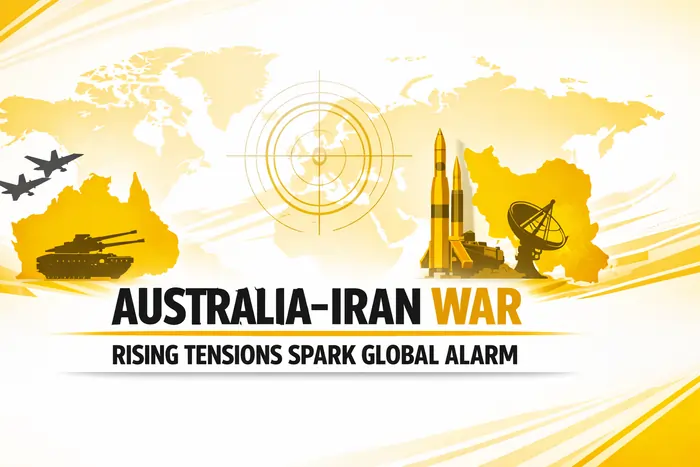
Australia Iran War has shifted from a distant geopolitical concern to an immediate crisis drawing in Canberra’s military, diplomats, and economy in ways that are sparking global alarm. As fighting between Iran, the United States, Israel, and Gulf states intensifies, Australia has found itself targeted, forced to close Middle East missions, and pressured to provide military support—while insisting it is not a direct combatant in Iran itself.
How the Australia Iran War Began
The current Australia Iran War involvement began when Iran struck Al Minhad Air Base in the UAE on 3 March 2026, hitting facilities that housed Australian personnel and infrastructure. Al Minhad has long served as a logistics and support hub for Australian Defence Force operations in the broader Middle East, so an attack there effectively dragged Australia from observer to participant overnight.
According to the article on Australian involvement in the 2026 Iran war, the Albanese government aligned with the US–Israeli coalition but drew a red line against sending ground troops into Iran. This mirrors earlier conflicts where Australia joined coalitions in support roles, but the 2026 context is more volatile: Iran is firing drones and missiles across multiple Gulf states, while the US and Israel conduct strikes deep inside Iranian territory. For a structured overview of events and timelines, see the dedicated entry on Australian involvement in the 2026 Iran war.
Australia’s Military Role: Defensive but Escalating
Canberra has repeatedly said it will not conduct offensive operations inside Iran, but its military posture has escalated quickly under the banner of “collective self‑defence” for Gulf partners.
Key elements of Australia’s role so far include:
- Redeployment to the Gulf: Australia is sending a military aircraft and around 85 defence personnel to the United Arab Emirates to help defend Gulf nations from Iranian drones and missiles.
- Missile deliveries: The government has committed to supplying missiles to assist with the expensive task of shooting down Iran’s relatively cheap, long‑range drones.
- Naval and submarine links: Prime Minister Anthony Albanese confirmed that three Australian defence personnel were aboard a US submarine that torpedoed an Iranian warship in the Indian Ocean, killing dozens—while insisting they did not “push the button” themselves.
An ABC News segment titled “Australia to provide military support to Gulf states attacked by Iran” details the deployment, explaining that the surveillance aircraft and personnel will be in theatre for an initial four‑week period, explicitly framed as defensive. Yet, as the report notes, every asset Australia sends “to free up another US asset” effectively allows more offensive strikes elsewhere, blurring the line between support and direct participation.
For an audio deep‑dive into how quickly that involvement has grown, Guardian Australia’s podcast episode “Labor’s walking a tightrope as the politics of war hits Australia” walks through the submarine incident and the latest deployments.
Diplomatic Fallout: Embassy Closures and Evacuations
The Australia Iran War is not only a military issue; it’s severely disrupting Australia’s diplomatic footprint across the Middle East.
In early March 2026, Foreign Minister Penny Wong announced that Australia was temporarily closing its embassies in Abu Dhabi and Tel Aviv, and its consulate in Dubai, citing the rising risk of missile and drone attacks. Reuters reported that Australia expected the Iran war to “intensify and continue in the near term,” prompting these unprecedented closures. You can read that update in Reuters’ piece on embassy shutdowns amid the Iran war.
Meanwhile, Australian missions have been coordinating evacuations and assistance for citizens and visa holders:
- Evacuations from conflict zones: Australia is working with airlines to help thousands of its citizens leave the broader region as attacks spread.
- Humanitarian visas: Several members of the Iranian women’s national football team have been granted humanitarian visas in Australia, after fears for their safety following elimination from a regional tournament.
A 7NEWS report, “Australia’s diplomatic missions shut down in Middle East,” explains how missions in Abu Dhabi, Dubai, and Tel Aviv suspended operations and highlights personal stories of those caught between war and relocation decisions.
Domestic Politics: Is Australia Really at War?
At home, the Australia Iran War has ignited a fierce debate over whether Australia has effectively joined another US‑led conflict—despite government assurances that its role is purely defensive.
An analysis piece from ABC News titled “The government is not speaking plainly about joining the war effort” notes that legal experts consider Australia to be, in practical terms, at war, given the deployment of high‑end surveillance aircraft and associated personnel to an active conflict zone. Prime Minister Anthony Albanese has argued that Australia is “not the aggressor” and that its assets will not conduct offensive operations inside Iran, insisting the mission’s purpose is to protect the UAE and Australian citizens.
Criticism has come from multiple directions:
- The Australian Greens condemned the government’s involvement, describing it as “tantamount to Australia getting involved in another US‑led forever war.”
- The Independent and Peaceful Australia Network (IPAN) issued a statement calling on Canberra to guarantee it will not support a US war on Iran, including refusing the use of Australian bases like Pine Gap or RAAF Base Tindal for offensive operations.
IPAN’s media release, “Australia must not interfere in the internal affairs of Iran,” argues that a US‑led war on Iran would be illegal and catastrophic, and urges the government to block any use of Australian soil or assets in such a war. You can read their full position at IPAN’s official website.
Guardian Australia’s podcast episode mentioned earlier underlines how the war is becoming a political stress test for Labor, with questions about transparency, alliance obligations, and war powers all coming to the fore.
Economic Shockwaves and Global Alarm

The Australia Iran War is reverberating far beyond battlefields and diplomatic cables—its economic consequences are already being felt in Australia and around the world.
The Iran war is contributing to spikes in oil prices, renewed fears about global shipping routes, and higher inflation risks:
- A note from Westpac on the Middle East conflict’s impact on Australia and New Zealand warns that the Iran war and oil price shock increase the risk of inflation staying higher for longer, complicating central bank decisions.
- Bloomberg’s Australia Briefing reports that the Reserve Bank of Australia is “very alert” to the conflict’s potential impact on inflation expectations and volatility, watching how Iran‑related disruptions ripple through energy markets.
ABC News’ coverage, “Australia ‘won’t be immune’ to economic impacts of Iran war,” features Treasurer Jim Chalmers acknowledging that Australians are worried about the war’s effect on petrol prices and the cost of living, while stressing that the government is moving against petrol price gouging to limit the damage.
Globally, markets and governments are on edge:
- LNG operations in Qatar and other key energy suppliers have seen temporary disruptions or precautionary halts, squeezing supply.
- Shipping routes through the Persian Gulf and Arabian Sea face heightened insurance costs and risk premiums due to missile and drone threats.
For a concise macro‑economic perspective, see Westpac’s briefing “Middle East Conflict: an initial view for Australia and New Zealand”, which outlines worst‑case scenarios for growth and inflation if the war drags on.
Humanitarian and Regional Impacts
Beyond the military and economic angles, the Australia Iran War is compounding an already dire humanitarian landscape in the broader Middle East.
Reports and footage from ABC News and other outlets show:
- Civilian casualties in Gulf states facing Iranian drone and missile attacks.
- Mass displacement as people try to flee areas under threat of further strikes.
- Growing fears that the conflict between the US, Israel, Iran, and associated proxies could spill further across the region.
An RNZ report, “Australia’s Middle East military HQ hit in Iranian drone attack, Qatar halts LNG production,” captures how a drone strike affected Australia’s regional military command and pushed Qatar to temporarily halt LNG output—both clear signs that the conflict reaches far beyond Iran’s borders. Meanwhile, Fox News coverage of Australia granting asylum to the Iranian women’s soccer team highlights how individual stories of persecution and fear are intersecting with larger geopolitical tensions.
These developments are why analysts and diplomats worldwide describe the situation as a potential regional turning point, with the risk that one miscalculation or escalation could trigger a much broader war.
Why the Australia Iran War Sparks Global Alarm
Several factors explain why the Australia Iran War has triggered such intense global concern:
- Alliance chain reactions
Australia’s involvement underscores how quickly a conflict between Iran, the US, and Israel can draw in allies far from the frontline. Each new deployment—from surveillance planes to missile batteries—raises the stakes and blurs the line between defensive support and direct combat. - Nuclear and energy risks
While there is no confirmed Iranian nuclear weapon program, the war raises nuclear safety fears and threatens key energy corridors, driving up prices and roiling markets. - Precedent of “forever wars”
Critics point to Afghanistan and Iraq as cautionary tales and fear that the Australia Iran War could become another long, costly engagement with unclear exit conditions. - Domestic legitimacy and transparency
In Australia, questions about whether parliament, rather than the executive alone, should approve war‑level deployments are gaining new urgency.
Together, these dynamics are why outlets from Reuters to ABC News are framing Australia’s role in the Iran war as a turning point, not just another distant conflict update.
Conclusion: Australia Iran War and the New Age of Risk
The Australia Iran War has exposed how quickly a regional conflict can pull in distant allies, disrupt global markets, and test the credibility of governments at home. What began as missile and drone exchanges between Iran, the US, Israel, and Gulf states has now become a live question for Australians: how far should the country go in backing allies when the costs—in security, economics, and domestic trust—keep rising?
At the same time, this conflict is unfolding in a broader era of heightened geopolitical and technological risk, where energy shocks, cyber operations, and military escalation can intersect rapidly. For a glimpse of how other major powers are reshaping their tech and security strategies in this environment, you can look at Apple’s hardware gambits like the Apple iPhone Foldable: Apple’s Bold New Device Revealed, which reflects how even consumer technology is increasingly framed by questions of resilience, supply chains, and strategic competition. As the Australia Iran War continues, the world will be watching not only the next moves on the battlefield, but also how countries like Australia balance alliance commitments, economic stability, and democratic accountability under extreme pressure.