

Australia’s 2026 economic story is not just about GDP figures and interest rates; it is about how a growth mindset across workers, businesses, and policymakers can turn uncertainty into opportunity. When people and institutions believe skills, productivity, and competitiveness can be developed through effort and learning, they are far better positioned to ride the next wave of Australia’s economic boom.
Introduction: From Slowdown to 2026 “Boom”
For much of the early 2020s, many Australians worried that the country’s growth engine was stalling, with persistent inflation, housing pressures, and productivity concerns weighing on confidence. Yet by 2026, Australia is still expanding, with solid real GDP growth, relatively low unemployment by historical standards, and a diversified base of industries—from resources to services—carrying the economy forward.
This article explores growth mindset as the hidden driver behind that resilience, linking individual attitudes about learning and improvement to the broader 2026 economic landscape. You will see how workers, leaders, and policymakers who embrace experimentation, skills development, and long‑term thinking help unlock Australia’s next phase of growth.
If you want to understand the macro backdrop in more depth while you read, it’s worth bookmarking the Reserve Bank of Australia’s latest summary of the economy in its February 2026 Statement on Monetary Policy.
What Is a Growth Mindset (and Why It Matters for Economies)?
A growth mindset is the belief that abilities, intelligence, and performance can be developed through effort, feedback, and effective strategies, rather than being fixed traits. In contrast, a fixed mindset assumes talent is static, often leading people to avoid challenges, give up easily, and resist constructive criticism.
Psychology and education research consistently link a growth mindset to higher achievement, greater resilience, and a stronger willingness to tackle difficult tasks. When those attitudes scale across a workforce or a country’s institutions, they foster innovation, productivity gains, and better responses to economic shocks. In other words, mindset is not “soft” in economic terms; it directly shapes the capacity of households, firms, and governments to adapt.
A simple example is a company that treats failed product experiments as learning opportunities rather than disasters. Over time, that firm is more likely to discover new markets, refine its operations, and build competitive advantages. At the macro level, an economy full of such organisations and workers will be better equipped to absorb structural changes like digital transformation, an ageing population, or the global shift to clean energy.
Many CEOs and founders argue that mindset matters more than talent, especially when navigating uncertainty and leading teams through change, because skills can be learned but attitude determines whether people actually grow. You can see this perspective unpacked in real‑world leadership stories in the article Why Mindset Matters More Than Talent, which highlights how a growth‑oriented outlook often outperforms raw ability over the long run.
Australia’s 2026 Economic Landscape
To understand why growth mindset is so important in 2026, it helps to sketch the economic landscape Australia is facing. Growth is positive but more modest than in past boom periods, inflation is easing but still a concern, and households are adjusting to higher interest rates and cost‑of‑living pressures. At the same time, the country is seeing strong momentum in sectors like technology, professional services, healthcare, and renewable energy, alongside its traditional strengths in commodities.
Several structural trends define this period:
- A steady shift from public‑sector‑led stimulus toward private‑sector investment and innovation.
- Ongoing digital transformation in businesses of all sizes, from micro‑firms to large corporates.
- The global energy transition, in which Australia’s critical minerals and renewable resources play a key role.
- Persistent challenges around housing affordability, skills shortages, and productivity growth.
The old “she’ll be right” mindset—assuming things will work out without deliberate effort—is not enough in this environment. Instead, the country needs a growth mindset at scale: willingness to invest in skills, embrace change, and experiment with new business models and policies.
For a policy‑level view of those structural challenges and opportunities, it’s useful to pair this article with international overviews such as the IMF’s Australia country page and the OECD’s periodic economic surveys, which highlight productivity, skills, and housing as central to Australia’s long‑term performance.
How Growth Mindset Shows Up in Australia’s Workforce
The most visible expression of growth mindset in Australia’s 2026 economic boom is the way workers are approaching skills and careers. A tight labour market in many sectors, combined with rapid technological change, is encouraging Australians to upskill, reskill, and pivot into new roles rather than clinging to old job descriptions.
You can see this in trends such as:
- Rising participation in short digital skills programs, micro‑credentials, and online learning platforms.
- More mid‑career professionals moving into tech, data, cyber, and renewable energy roles.
- Growing demand for “portable” soft skills such as problem‑solving, collaboration, and adaptability, which make it easier to move between industries.
A growth mindset helps workers frame these shifts as opportunities rather than threats. Instead of seeing automation or AI as purely negative, they ask, “What new skills do I need to stay relevant? Which industries are growing, and how can I transition?” This question‑driven approach is fundamentally different from a fixed mindset, which might respond with “I’m just not a tech person” or “It’s too late to change careers.”
Businesses are also adopting a more experimental, learning‑oriented stance. Rather than treating digital transformation as a one‑off IT project, many firms are embracing iteration: testing new tools, gathering feedback from staff and customers, and refining processes over time. That reduces fear of failure and encourages employees at all levels to contribute ideas.
Imagine a mid‑sized Australian manufacturing SME that decides to implement sensors and analytics on its production line. Management frames the first phase as a learning project, not a guaranteed cost‑saving initiative, and explicitly rewards teams for surfacing inefficiencies and proposing improvements. Over a few years, the company improves yields, reduces downtime, and develops internal capability in data‑driven decision‑making—an outcome made possible because it operates from a growth mindset.
If you want a concise macro overview of the labour market and sector dynamics while thinking about workforce mindset, the Lloyds Bank Trade Portal’s summary of Australia’s economic context is a handy reference.
Leadership and Policy: Mindset at the Top
Growth mindset is not just a grassroots phenomenon; it also shows up in leadership narratives and policy choices. In 2026, Australian policymakers face the challenge of keeping inflation in check while supporting investment, productivity, and inclusive growth. The way leaders frame that challenge shapes how businesses and households respond.
Government initiatives play a critical role in setting the tone. Policies that support lifelong learning, encourage research and development, and improve the functioning of housing and labour markets all signal that the country is prepared to adapt rather than passively accept slower growth. When leaders acknowledge structural weaknesses and commit to reform—whether in taxation, planning, or competition—they are effectively adopting a growth mindset at the national level.
Corporate leadership is undergoing a similar shift. Boards and executives increasingly emphasise innovation, psychological safety, and continuous improvement, instead of focusing solely on short‑term earnings. When leaders frame digital disruption, climate risk, or demographic change as problems to be solved through learning and experimentation, they create organisational cultures where employees feel safe to take calculated risks.
For decision‑makers, combining domestic policy documents with international perspectives such as the IMF’s analysis of Australia can help maintain that growth‑oriented lens: recognising challenges honestly while actively searching for better ways to manage them.
Sector Deep Dives: Where Mindset Fuels the Boom
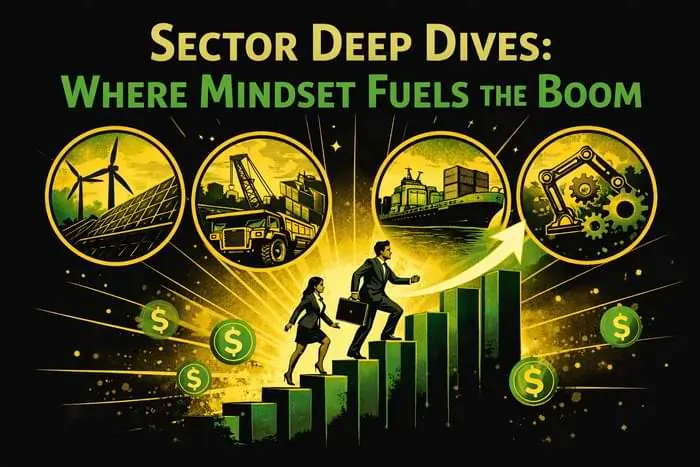
Some sectors illustrate particularly well how a growth mindset feeds into Australia’s 2026 economic boom.
Technology and Digital Services
Australia’s tech and digital services sector continues to expand, with strong demand for cloud computing, cybersecurity, data analytics, and AI‑driven solutions. Startups and scale‑ups that embrace rapid experimentation, agile development, and user‑centric design are well positioned to win both domestic and export markets.
In this context, a growth mindset means founders and teams are willing to ship minimum viable products, listen to user feedback, and iterate quickly rather than waiting for a “perfect” product. Teams that view each release as a learning opportunity tend to innovate faster and build more resilient business models.
If you are analysing or working in these areas, it helps to layer mindset content with industry data from sources such as IBISWorld’s page on fastest‑growing Australian industries and Australian government digital economy strategies.
Green Energy and Advanced Manufacturing
Australia’s abundance of critical minerals, particularly lithium, positions it as a key player in the global energy transition. The opportunity now is to move beyond raw material exports into refining, battery manufacturing, and advanced energy technologies.
Here, growth mindset manifests as a willingness to move up the value chain, invest in new capabilities, and adapt to technologies that are evolving quickly. Firms that previously focused solely on commodity exports are experimenting with partnerships, processing technologies, and new business models to capture more value domestically. It is a classic example of a country asking, “How can we learn to do more with what we have?” rather than accepting its traditional role.
Research from organisations like Deloitte Access Economics (for example, their Business Outlook series) and clean‑energy think tanks can complement this narrative by highlighting how mindset and innovation interact with policy settings and global demand.
Healthcare, Education, and Professional Services
Healthcare and social assistance, education, and professional services rank among Australia’s fastest‑growing industries by revenue and employment. These are knowledge‑intensive sectors where continuous learning is non‑negotiable.
A growth mindset in these fields means clinicians, educators, and advisers stay current with research, embrace new technologies, and refine their approaches based on evidence and feedback. Institutions that embed this mindset improve outcomes, attract and retain talent, and create exportable knowledge services—whether that’s world‑class medical care, university programs, or specialised consulting.
For educators in particular, the link between growth mindset and learning outcomes is direct. Teachers who encourage students to see intelligence as malleable and challenges as opportunities to grow are preparing the future workforce to thrive in exactly the sort of dynamic economy Australia faces in 2026 and beyond.
Practical Takeaways: Adopting a Growth Mindset in 2026 Australia
The connection between growth mindset and Australia’s economic boom is not abstract; it translates into concrete actions for individuals, businesses, and policymakers.
For Individuals
Workers who want to thrive in 2026 can:
- Set learning goals, not just performance goals—for example, aiming to master a new tool each quarter or complete a credential in a growth area.
- Seek frequent feedback and treat it as information for improvement rather than personal criticism.
- Embrace career pivots into sectors that are expanding, such as tech, renewables, healthcare, or advanced services, even if it means being a beginner again.
- Reframe setbacks like redundancy or project failure as catalysts for acquiring new skills and exploring different paths.
This approach makes individuals more resilient in the face of economic change and aligns neatly with national priorities around lifelong learning and skills mobility.
For Business Owners and Leaders
At the organisation level, adopting a growth mindset involves building systems that reward learning and experimentation, not just avoiding mistakes. Leaders can:
- Encourage small, low‑risk experiments in products, processes, or business models, and debrief them rigorously.
- Celebrate lessons learned from failed initiatives, not just successful ones, by sharing case studies internally.
- Invest in training, mentoring, and knowledge‑sharing so that employees feel supported when they step outside their comfort zone.
- Integrate mindset language into performance discussions—talking about effort, strategies, and improvement as much as outcomes.
An Australian SME that schedules regular innovation sprints, cross‑functional project teams, or “learning days” is signalling that growth and experimentation are part of the job, not a side project. Over time, that leads to more process improvements, better customer insights, and new revenue streams that support sustainable growth.
To weave in a leadership and strategy angle, you can connect this conversation with practical, business‑oriented commentary like Perpetual’s weekly macro and market views in pieces such as their “weekly economic update” series, which discusses how firms can navigate inflation, interest rates, and demand shifts.
For Policymakers and Educators
Policymakers and educators shape the broader environment in which growth mindset either flourishes or withers. They can:
- Design education systems that reward effort, curiosity, and problem‑solving rather than rote memorisation and high‑stakes testing alone.
- Support access to reskilling programs and income‑support structures that give workers breathing room to retrain.
- Communicate openly about the need for reform in areas such as housing, taxation, and competition, framing change as a collective learning process rather than a threat.
- Promote narratives that highlight real‑world examples of individuals and firms successfully adapting and growing, to counter fatalism.
International organisations and cross‑country comparisons can be particularly useful for policymakers who want to benchmark mindset‑friendly reforms. Pairing Australian budget and productivity reports with cross‑national perspectives helps reinforce the idea that there are always better ways of doing things, if you are prepared to learn from others.
Risks, Challenges, and Mindset Traps
While growth mindset can support Australia’s economic boom, it is not a magic wand and comes with its own risks and misconceptions.
One concern is inequality in access to skills and opportunities. If only some Australians have the time, resources, or support to retrain and move into growth sectors, the benefits of the boom may be unevenly distributed. Without affordable education, inclusive labour markets, and targeted support, telling people to simply “think positively” or “work harder” can sound hollow and unfair.
Another trap is “toxic positivity” masquerading as growth mindset. When organisations demand constant optimism and resilience without addressing structural problems—such as understaffing, wage stagnation, or unsafe conditions—workers can burn out or disengage. Genuine growth mindset acknowledges constraints and setbacks while still focusing on what is within our control to change.
There is also the risk of over‑reliance on macro‑levers like interest rates or commodity prices to solve deep structural issues. Central banks and market forces matter, but sustaining a boom requires complementary reforms in productivity, housing, competition, and skills. Without those, growth may slow and public confidence may erode.
Recognising these traps is itself an act of growth mindset: it means taking an honest look at where current approaches fall short and being willing to adjust.
The Road Ahead: Can Australia Sustain Its Growth?
The key question for the second half of the decade is whether Australia can sustain and broaden its 2026 economic boom in a world of climate risks, geopolitical tensions, and fast‑moving technologies. Forecasts suggest that growth may moderate as monetary policy remains relatively tight, even as inflation gradually eases and new opportunities emerge in digital and green industries.
Maintaining a growth mindset at every level of the economy will be crucial. Workers who keep learning, businesses that keep experimenting, and policymakers who are willing to tackle structural reforms will help Australia navigate shocks and seize new opportunities. Equally important is ensuring the benefits of growth are broadly shared, so more Australians feel invested in the nation’s success and are willing to support the reforms that underpin it.
As you reflect on your own role—whether as an employee, entrepreneur, educator, or leader—the invitation is to see the 2026 boom not as a lucky accident but as the result of countless decisions to learn, adapt, and improve. That is the real meaning of a growth mindset and the secret behind Australia’s economic resilience heading into the next chapter.