

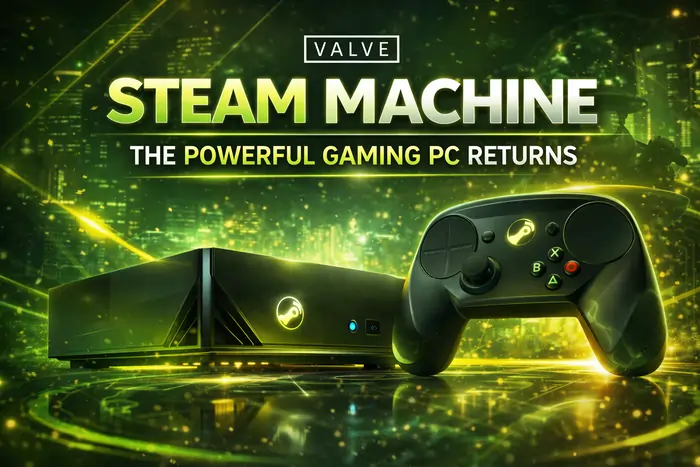
Valve Steam Machine is officially coming back as a compact, living‑room‑focused gaming PC that’s designed to feel more like a console and less like a DIY rig. With Valve now committing to a 2026 launch for the new generation, “Valve Steam Machine” is once again a keyword that actually matters in PC gaming.
What Is the Valve Steam Machine?
The original Valve Steam Machine was a family of small‑form‑factor PCs built by partners like Alienware, running SteamOS and aiming to bring PC gaming into the living room. They launched around 2015, but sales were weak and most models quietly disappeared from the Steam store by 2018, even though Valve kept working on the underlying SteamOS platform.
Fast‑forward to today, and Valve is reviving the idea with a very different approach: instead of loosely coordinated partner boxes, this new Valve Steam Machine is a single, standardized mini PC designed and specced by Valve itself. PCMag describes it as a “5.7‑pound Steam Machine” packed into a six‑inch black cube, powered by a custom AMD SoC that offers roughly six times the performance of a Steam Deck. Think console‑sized hardware that boots straight into SteamOS, but with real PC power and flexibility behind it.
For a quick history refresher on the original project and how it led to this relaunch, the Steam Machine article on Wikipedia is still a good starting point.
Why Valve Is Bringing Steam Machine Back Now
Valve’s first attempt with Valve Steam Machine never took off, but it taught the company two important lessons: PC gamers care about openness, and most people don’t want to troubleshoot partner hardware that feels half‑console, half‑PC. Instead of killing the idea entirely, Valve shifted its focus to software (SteamOS) and eventually to its own hardware in the form of the Steam Deck.
The success of the Steam Deck—selling millions of units and proving that a tightly integrated Valve‑designed device can thrive—effectively set the stage for a second‑generation Steam Machine. In late 2025, Valve announced three new pieces of Steam hardware: an updated Steam Controller, the Steam Frame wireless VR headset, and a new Steam Machine mini PC that all run a shared, modern SteamOS stack. SteamDB’s breakdown of that announcement highlights how Valve now sees these devices as a family: Steam Deck for handheld play, Steam Machine for the living room, Steam Frame for VR.
Coverage from outlets like Man of Many’s “Everything We Know About Valve’s Steam Machine” explains that this reboot is about finishing what Valve started a decade ago—only this time with mature software, a clear design, and proven demand for Valve‑branded hardware.
Specs and Power: How Strong Is the New Steam Machine?
From a pure hardware standpoint, the new Valve Steam Machine is built to be a serious 4K living‑room PC. According to spec sheets summarized by PCMag and SteamDB, Valve worked with AMD on a semi‑custom chip that combines a Zen 4 CPU with a powerful RDNA 3 GPU.
Key hardware details include:
- CPU: Custom AMD Zen 4 with 6 cores, boosting up to around 4.8 GHz.
- GPU: RDNA 3 graphics with 28 compute units, clocked up to ~2.45 GHz with a 110 W TDP, targeting 4K gaming at 60 FPS with upscaling.
- Memory: 16 GB DDR5 system RAM plus 8 GB GDDR6 VRAM, offering roughly 288 GB/s of total bandwidth.
- Storage: 512 GB and 2 TB NVMe SSD variants, plus a high‑speed microSD slot for expanding your Steam library.
- Power: Built‑in 300 W high‑efficiency power supply, optimized around ~200 W typical gaming loads.
IGN’s early hands‑on impressions of the new Steam Machine describe it as a “console‑sized PC” that targets stable 4K/60 performance with the help of AMD’s FSR upscaling, sitting somewhere between a mid‑range desktop GPU and a high‑end console in raw power. In its announcement blog, SteamDB points out that Valve claims “over 6x more powerful than Steam Deck” as a headline figure, which gives a sense of how big a jump this is for living‑room Steam hardware.
For the most detailed breakdown of the hardware, including motherboard and power‑delivery design, you can dig into the SteamDB article on Valve’s new Steam hardware lineup.
SteamOS and the Living‑Room Experience
Just like the Deck, the modern Valve Steam Machine runs SteamOS, a Linux‑based operating system built specifically around Steam. Valve’s hardware page emphasizes that every piece of Valve hardware—Steam Deck, Steam Machine, Steam Frame—is “Steam‑first” and shares the same OS foundation.
That brings several benefits:
- Console‑like UI: Big Picture Mode and the Deck‑style interface make navigating your library on a TV feel like using a console.
- Proton compatibility layer: The same technology that lets Windows games run on Steam Deck allows the new Steam Machine to play the majority of the Steam catalog on Linux.
- Seamless ecosystem: Cloud saves, Remote Play, and shared settings between Deck, desktop, and Steam Machine create a unified PC‑gaming experience.
Hands‑on previews like IGN’s Steam Machine first impressions highlight how familiar the experience feels to Deck owners—only scaled up for a 4K TV and couch gaming, with more power under the hood. Meanwhile, Valve’s own Steam hardware hub underscores that all of this is meant to be plug‑and‑play for the living room: HDMI‑CEC support lets the Steam Machine wake your TV and soundbar, and the new Steam Controller pairs out of the box.
If you want to understand how Valve’s broader hardware strategy fits together, the Valve Corporation overview on Wikipedia gives a useful timeline from the original Steam Machine to SteamVR, Valve Index, and Steam Deck.
Release Date and Valve’s 2026 Commitment

The biggest news attached to the new Valve Steam Machine lately is timing. After some confusing messaging in a February/March blog update, Valve has explicitly reaffirmed that the Steam Machine, the new Steam Controller, and the Steam Frame VR headset are all still slated to ship in 2026.
- TechRadar reports that Valve initially wrote “we hope to ship in 2026,” which some interpreted as a delay from earlier “early 2026” language.
- After queries from The Verge and others, Valve PR clarified that “nothing has actually changed on our end” and updated the blog to say “we will be shipping all three products this year.”
- PCMag’s coverage, titled “Valve Says New Steam Machine, Controller, and Frame Will Still Land in 2026,” reinforces that memory and storage shortages related to AI demand are a factor, but not enough to push launch into 2027.
A Reddit thread in r/pcgaming, “Valve Stands Firm the Steam Machine Will Launch in 2026 Despite Delays,” captures the community reaction and Valve’s clarifications in one place.
The exact month and launch price for the Valve Steam Machine are still TBD, but most coverage expects a late‑2026 release window to give Valve time to navigate component constraints and finalize software.
Why Valve Steam Machine Matters in 2026
In 2015, the original Valve Steam Machine tried to push Linux and open PC hardware into the living room before the market was ready. In 2026, the landscape looks very different:
- SteamOS is battle‑tested thanks to Steam Deck.
- There’s a clear audience for plug‑and‑play PC gaming on the couch.
- Valve already has a successful hardware brand and ecosystem to build on.
Editorials like PC Gamer’s piece on Valve’s “second attempt” at Steam Machine argue that this comeback could finally deliver on the original promise: console simplicity with PC openness and performance. Man of Many’s guide to the Valve Steam Machine frames it as “the living‑room sibling to Steam Deck”—a device that doesn’t replace your desktop, but makes your TV the best way to enjoy your Steam library.
If Valve executes well—solid pricing, smooth software, strong thermals—the new Valve Steam Machine could become the default recommendation for gamers who want console‑like ease without leaving PC behind.
Where to Learn More About Valve Steam Machine
Because the new Valve Steam Machine is still on the road to launch, specs and timelines will keep evolving throughout 2026. To follow the most reliable updates, it’s worth bookmarking a few key sources:
- Steam Hardware hub on Steam for official Valve marketing and specs as they go live.
- SteamDB’s announcement article on new Steam hardware for deep technical details.
- PCMag’s coverage of Valve’s 2026 commitment for launch‑timing context.
- TechRadar’s report on Valve recommitting to a 2026 launch for insight into the delay rumors.
- Man of Many’s “Everything We Know About Valve’s Steam Machine” for a consumer‑friendly explainer.
The revival of the Valve Steam Machine shows Valve is serious about owning the living room again—this time with the benefit of Steam Deck’s success, a mature SteamOS, and hardware that finally matches what PC gamers expect from a “console‑like” PC. Instead of a confusing mix of partner boxes, the new Valve Steam Machine is a unified, Valve‑designed mini PC that promises 4K gaming, tight integration with your Steam library, and a plug‑and‑play experience that can realistically rival traditional consoles.
What makes this comeback especially interesting is how it fits into a broader wave of specialized gaming and tech hardware. As Valve pushes PC gaming back into the living room with Steam Machine, other giants are experimenting in parallel with bold new device categories.
On the mobile side, Apple is preparing its own major leap with a foldable iPhone that blends phone and tablet into one premium device; if you’re curious about where high‑end smartphones are headed next, you can dive into Apple iPhone Foldable: Apple’s Bold New Device Revealed for a detailed look at Apple’s upcoming hardware pivot. In both cases, Valve Steam Machine and Apple’s foldable iPhone point to the same trend: hardware is becoming more specialized, more powerful, and more tightly integrated with software ecosystems—giving gamers and power users more choices than ever in how and where they play.