

NVDA Earnings 2026: Why the Stock Dropped After a Record Quarter. Nvidia’s NVDA stock dropped sharply even after the company reported record‑breaking 2026 earnings because the market had “priced in” exceptional results, and investors were focused less on the historic quarter and more on what comes next for AI spending, margins, and growth sustainability.
For context on the official numbers, you can review the Nvidia Q4 and fiscal 2026 financial results release, while market recaps from outlets like Yahoo Finance and broader analysis from Morningstar and Investopedia explain why the shares still moved lower. At the same time, 2026 is also being defined by other big stories in tech and entertainment, from live music moments like Ed Sheeran Melbourne Setlist: Massive 30-Song Loop Tour Hits to personal milestones such as Miraculous News: Magda Szubanski Announces Cancer Remission and fan‑driven celebrations like Pokémon Day 2026: Australia Celebrates 30 Years of Pocket Monsters, all of which show how quickly sentiment and narratives can shift—just as they have for NVDA after its record earnings.
Introduction: Record Numbers, Red Share Price
Nvidia delivered one of the strongest quarters ever seen in semiconductors, but its share price still fell around 5%+ in the sessions immediately after the report. Despite headlines celebrating record revenue, massive year‑over‑year growth, and a fresh beat‑and‑raise, NVDA finished the day in the red while dragging broader indices like the Nasdaq lower with it.
This apparent contradiction—historic fundamentals paired with a falling stock—reflects a combination of sky‑high expectations, concern about the durability of the AI boom, and a market that had already bid Nvidia up to a valuation that assumed near‑flawless execution for years to come. For a live view of that reaction in the broader market, see recaps such as Yahoo Finance’s market blog on Nvidia’s post‑earnings move and CNBC’s stock‑market live updates.
NVDA Earnings 2026 at a Glance
In fiscal Q4 2026, Nvidia posted record revenue and profit, powered overwhelmingly by its data‑center business and demand for AI accelerators. Revenue surged versus the prior year, and earnings per share comfortably beat consensus estimates, chalking up yet another in a long line of large upside surprises. You can see the full breakdown in the official Nvidia financial results release.
The data‑center segment was the star, contributing the majority of total revenue and growing at a blistering year‑over‑year pace thanks to heavy spending by cloud giants on AI infrastructure. Market commentary notes that data‑center revenue overshot Wall Street’s estimates by several billion dollars, underlining just how central AI chips have become to Nvidia’s story.
On top of the backward‑looking beat, management also guided next‑quarter revenue and margins above consensus, confirming that the order book remained strong and that major customers were still committed to AI capex in the near term. On paper, it looked like exactly the kind of quarter that should send a stock higher—not lower—which is why many headlines emphasised the “historic earnings beat” and “blockbuster results” theme.
“Priced for Perfection”: Expectations Were Sky‑High
The first piece of the puzzle is that Nvidia went into this earnings report priced for perfection. After a multi‑year surge driven by AI enthusiasm, NVDA had become the flagship name of the AI trade, and investors had come to expect not just good results but spectacular ones.
Morningstar’s analysis on why Nvidia’s stock is falling despite a historic earnings beat makes this point clearly: when a company repeatedly posts huge beats, the market gradually embeds those beats into the share price ahead of time. At that point, earnings have to be almost impossibly strong—and forward guidance even more optimistic—to push the stock higher.
That is why you often see “buy the rumor, sell the news” reactions around stocks like Nvidia. Traders accumulate shares into the catalyst on optimism and hype, then use the actual earnings event—no matter how strong—as a liquidity moment to take profits. Investopedia’s recap, “Despite Blockbuster Results, Nvidia Faces Downbeat Market Reaction Amid Weak Sentiment”, frames the sell‑off as a combination of elevated expectations and a market already nervous about tech and AI valuations.
Guidance vs. Market Hopes
Nvidia’s guidance was objectively strong, but it did not fully match the market’s most optimistic hopes. Management projected revenue and margins ahead of Wall Street’s published estimates, implying that demand for AI chips would remain robust in the coming quarter. Yahoo Finance’s piece “Nvidia stock falls as Q4 beat, guidance fail to satisfy Wall Street” highlights this tension: the company “beat and raised,” yet traders still sold.
Bloomberg’s coverage, “Nvidia’s Upbeat Sales Forecast Gets Lackluster Investor Response”, adds nuance: the sales forecast reinforced that the AI boom remains strong, but did not fully dispel worries about how long that boom can last. When some investors were whispering about even higher guidance numbers or hoping for more aggressive commentary on future demand, the actual outlook looked “very good, but not jaw‑dropping.”
Subtle nuances in management’s tone also mattered. CNBC’s reporting on Nvidia earnings colliding with Wall Street skepticism over AI spending notes that analysts are increasingly focused on how sustainable AI capex will be in 2027 and beyond. Any hint of normalisation—supply catching up, customers “digesting” prior orders, or planning for more steady growth—can cool enthusiasm in a stock priced for continuous acceleration.
AI Boom Jitters: Is the Trade Overcrowded?
The earnings release arrived at a time when many investors were already questioning whether the AI trade had become overcrowded. Nvidia’s stellar performance made it the symbol of the AI boom, but it also made the stock a lightning rod for any concerns about an AI bubble.
Outlets like CNN have written about investors seeing “trouble in paradise” after Nvidia’s results, pointing out that while current demand is enormous, Wall Street is increasingly worried about the durability of AI spending and whether today’s massive capex can translate into long‑term profits for cloud providers. That skepticism is echoed in broader market recaps such as Yahoo’s live market blog, which described Nvidia’s 5% slide as a major drag on the indices despite “stellar earnings.”
Commentary tracked by LinkedIn, like “Nvidia’s massive results still leave investors skeptical”, underlines the same idea: investors are not doubting that AI is real or that Nvidia is currently benefiting; they are debating how much future growth is left that is not already embedded in the price. As a result, an outstanding quarter can become a chance to rotate out of a crowded trade rather than a reason to push the stock even higher.
Valuation, Profit‑Taking, and Technical Factors
Valuation was another major driver. After its huge rally, Nvidia was trading at a rich earnings multiple and very high market‑cap levels compared with historical norms and most peers. For growth investors, the question was not whether Nvidia deserved a premium (most agreed it did), but how much premium was still justified after such a rapid appreciation.
Trading‑oriented analysis, such as the breakdown on TradingKey about how Nvidia’s Q4 earnings “beat expectations but stock plunged 5.5%,” emphasises that this looked like a textbook “sell‑the‑news” event. They point to a combination of:
- Extended price action into earnings.
- Crowded positioning among short‑term traders.
- Options‑market dynamics that can accelerate downside when the initial reaction is negative.
Options and technical levels can play a big role. When a heavily traded stock like NVDA heads into earnings with a lot of bullish call bets and high implied volatility, a less‑than‑euphoric reaction can trigger:
- Hedging flows as market‑makers adjust positions.
- Stop‑loss selling among leveraged bulls.
- Systematic strategies cutting exposure once certain price levels break.
Yahoo’s and CNBC’s market wrap pieces both noted that Nvidia’s decline was steep enough to put visible pressure on the broader tech space, effectively turning one stock’s technical unwind into a sector‑wide headwind.
Company‑Specific Risks That Spooked Investors
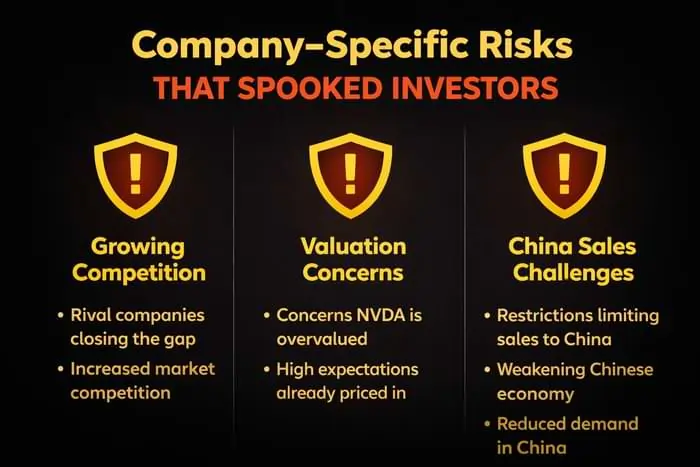
Beyond expectations and valuation, Nvidia faces several company‑specific risks that became more salient in investors’ minds after earnings.
Heavy dependence on a few hyperscalers
A large share of Nvidia’s AI revenue comes from a small group of hyperscale cloud providers. Trading‑oriented analyses highlight that this concentration has been a huge tailwind in the current build‑out phase but also creates vulnerability: if even one or two major customers slow their AI capex, pivot to internal chips, or rebalance spending, Nvidia’s growth profile could change quickly.
Morningstar and others have stressed that investors are watching whether Nvidia can broaden its customer base—into enterprises, sovereign AI projects, and other verticals—to reduce reliance on a handful of giants. Until that diversification is clearer, some shareholders will hesitate to assume that current growth rates are sustainable.
Geopolitics and export controls
Geopolitical risk is another recurring theme. Export restrictions on advanced chips to certain regions, especially China, have already forced Nvidia to design new, compliant products and adjust its sales strategy. TradingKey and similar commentary refer to these policies as a “shackle” on Nvidia’s potential growth in important markets, even if the company is currently finding ways to work around them.
Investors know that future regulatory changes could further limit sales of high‑end AI GPUs or force more segmentation, which would complicate planning and potentially squeeze margins. This overhang encourages a more conservative stance on valuation, even when quarterly numbers look phenomenal.
Competitive and ecosystem threats
Nvidia remains the clear leader in AI accelerators today, but competition is intensifying:
- Rival chipmakers are racing to build their own AI‑focused GPUs and accelerators.
- Hyperscalers are developing custom silicon to reduce reliance on third‑party vendors.
- Software‑level optimisations, new architectures, and alternative AI approaches may alter which hardware is preferred in some workloads.
Investopedia’s and Morningstar’s pieces both note that this competition is more of a medium‑ to long‑term risk than an immediate threat, but it still influences how far investors are willing to push valuation multiples right now.
Broader Market Context: It’s Not Just Nvidia
The day Nvidia sold off, broader equity markets were also under pressure, especially tech and growth names. When a stock is as large and as central to its sector as NVDA, its movement can both reflect and amplify wider risk‑off sentiment.
Market blogs such as Yahoo Finance’s live “stock market today” updates and CNBC’s live coverage show how Nvidia’s drop coincided with broader pullbacks in the S&P 500 and Nasdaq. Reuters also reported that global shares retreated from record highs amid concerns about tech valuations, with Nvidia’s move both a symptom and a driver of that shift.
In other words, the stock did not fall in isolation. It corrected within a market that was already nervous about how far and fast AI beneficiaries had run, and about how tighter financial conditions or new trade measures might affect richly valued growth stocks. Nvidia’s earnings, landing at the center of that debate, became a convenient focal point for a broader reassessment.
What Analysts and Commentators Are Saying
Commentary from analysts and financial media has coalesced around a few key ideas:
- Historic results vs. forward‑looking worries
Morningstar emphasises that Nvidia’s revenue beat estimates by billions and guidance topped forecasts by a wide margin, calling it a historic performance. Yet the stock still fell, which they interpret as evidence that the key debates are longer‑term: sustainability of AI capex, hyperscaler free cash flow, and eventual normalisation of growth. - Sentiment over fundamentals in the short term
Investopedia’s recap stresses that Nvidia delivered “blockbuster results” but faced a downbeat market response due to weak sentiment toward AI‑linked stocks and concerns about bubbles and over‑valuation. From this perspective, the share‑price move reflects psychology more than a sudden deterioration in fundamentals. - A reset, not necessarily a reversal
Some analysts quoted by TipRanks argue that the sell‑off is more about macro fears and profit‑taking than Nvidia’s business, and say they still view the stock as undervalued on a multi‑year view. Their stance is that volatility is the “cost of admission” for owning a central AI name, and that short‑term drawdowns are likely along the way.
Together, these views suggest that markets are using the 2026 earnings event to rebalance risk and re‑price expectations, rather than issuing a verdict that Nvidia’s AI story is over.
What This Means for Investors Going Forward
For investors, Nvidia’s 2026 earnings episode is a case study in how expectations, sentiment, and risk can outweigh even extraordinary reported numbers in the short term. A few practical takeaways:
- Don’t treat an earnings beat as a guaranteed upside catalyst.
The reaction to earnings depends as much on positioning and expectations as on the raw figures. When a stock is already priced for perfection, “better than expected” may still not be enough to push it higher on the day. - Think in cycles, not quarters, for AI.
AI infrastructure build‑outs are likely to occur in waves: periods of intense capex followed by digestion phases. Long‑term investors should focus on whether Nvidia can maintain leadership across multiple waves, not whether any one quarter matches the rosiest short‑term forecasts. - Monitor customer mix and diversification.
Tracking how Nvidia diversifies beyond a handful of hyperscalers—into enterprise, sovereign AI, and other verticals—will be crucial for assessing how resilient its revenue base will be if cloud providers slow spending. - Factor in policy and competition as ongoing variables.
Export controls, trade policy, and the competitive response from rivals and in‑house silicon will likely remain moving targets. Building these uncertainties into your risk assessment (and not just extrapolating current margins and market share) is essential. - Expect volatility—even in leaders.
As the defining AI hardware name, Nvidia will probably remain more volatile than the broader market. Sharp pullbacks after massive runs are a feature, not a bug, in this kind of story stock. Position sizing and time horizon become especially important.
For ongoing updates, it’s worth following resources such as the Nvidia investor‑relations news page, plus deeper dives from outlets like Morningstar, Bloomberg, and CNBC on how AI spending and chip competition evolve.
For a broader sense of how Nvidia’s AI story sits alongside other major 2026 narratives in tech and entertainment, it helps to look beyond markets to the cultural side of the year. Massive live events like Ed Sheeran Melbourne Setlist: Massive 30-Song Loop Tour Hits, deeply personal milestones such as Miraculous News: Magda Szubanski Announces Cancer Remission, and global fan celebrations like Pokémon Day 2026: Australia Celebrates 30 Years of Pocket Monsters all show how quickly sentiment can swing between euphoria, concern, and cautious optimism—just as it has in NVDA’s stock after its record 2026 earnings.