

Local Pack rankings on mobile determine whether your business appears in the Google Maps results box for “near me” searches. Unlike organic rankings, Local Pack rankings on mobile are heavily influenced by GPS location, meaning results change as users move.
A mobile rank checker that does not filter by GPS will show inaccurate local rankings, leading to bad business decisions and lost foot traffic.
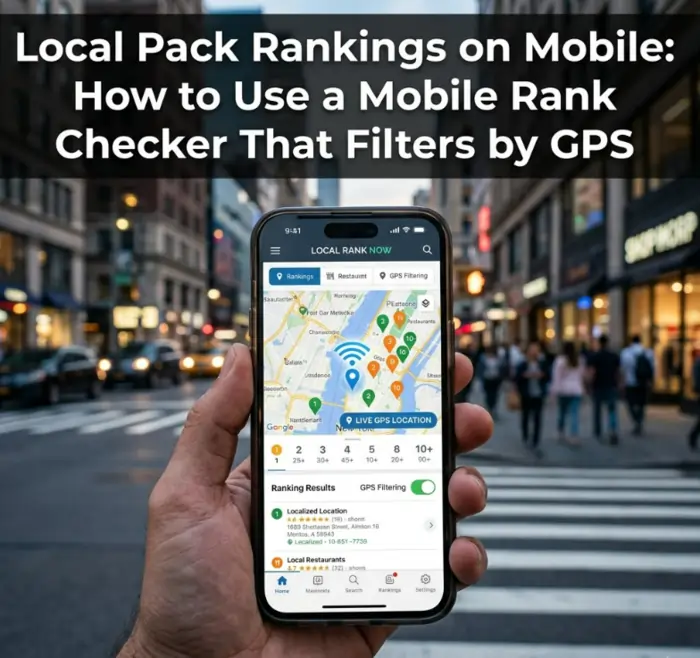
The GPS Blind Spot
You check your mobile rank checker at your desk. It shows your business at #1 in the Local Pack for “coffee shop near me.” You celebrate. But your real-world foot traffic is flat.
What happened?
Your mobile rank checker used an IP address to approximate your location. IP addresses are tied to your internet provider, not your physical GPS. A user two blocks away searching on their iPhone sees a completely different Local Pack — and your business is not in it.
Local Pack rankings on mobile are not static. They change as users move. If your mobile rank checker ignores GPS, it is giving you fantasy data.
Before diving into GPS tracking, you need a solid foundation in mobile rank checking. Our Complete Mobile Rank Checker Guide (2026) covers the essential tools and metrics every local business needs.
In this guide, you will learn exactly how Local Pack rankings on mobile work, why GPS filtering is non-negotiable, and how to audit your current mobile rank checker for local accuracy.
What Are Local Pack Rankings on Mobile and Why GPS Matters
Local Pack rankings on mobile refer to the order in which local businesses appear in Google’s Maps results box on smartphone searches. This box typically shows three businesses with pins, ratings, hours, and a “Directions” button.
How Local Packs Differ from Organic Rankings
| Factor | Organic Rankings | Local Pack Rankings on Mobile |
|---|---|---|
| Location method | IP address (city-level) | GPS (precise coordinates) |
| Results per query | 10 blue links | 3 business pins |
| Key ranking factors | Backlinks, content, authority | Proximity, reviews, GMB completeness |
| Volatility | Moderate | High (changes with movement) |
| Tracking difficulty | Easy | Hard (requires GPS simulation) |
The GPS Factor
When a user searches for “pizza near me” on mobile, Google uses their exact GPS coordinates — not their IP address — to determine which pizzerias are closest. A user standing on Main Street sees different Local Pack rankings on mobile than a user standing 500 meters away on Oak Avenue.
If your mobile rank checker uses IP-based location, it might show your business at #1 from your office IP address. But real customers a few blocks away might see you at #5 or not at all.
For a broader understanding of ranking fluctuations, read Mobile SERP Volatility: Why Your Mobile Rank Checker Shows Different Results Every Hour . Local Pack rotations are a major driver of daily volatility.
Why Most Mobile Rank Checkers Get Local Pack Rankings Wrong
This is the most critical section for local business owners. Most mobile rank checker tools were built for national or e-commerce SEO, not local SEO. They fail at Local Pack rankings on mobile for three reasons.
Problem 1: IP Address Approximation
IP addresses approximate location at the city level. A coffee shop in downtown Austin and a coffee shop in suburban Austin might have the same IP-based location in a rank checker. But GPS shows the 2-mile distance difference, which dramatically changes Local Pack results.
The fix: Demand a mobile rank checker that uses GPS coordinates or at minimum, hyperlocal geogrid targeting.
Problem 2: No Movement Simulation
Real users move. They search from home, from the office, from their car. A static mobile rank checker checks one location. That tells you nothing about how you rank across your service area.
The fix: Use a mobile rank checker that allows you to test multiple GPS points across your target area.
Problem 3: Ignoring Proximity as a Ranking Factor
For Local Pack rankings on mobile, proximity is often the #1 factor. A business with 4.9 stars and 500 reviews can rank below a business with 3.5 stars and 50 reviews if the lower-rated business is closer to the searcher’s GPS.
The fix: Your mobile rank checker must report proximity distance alongside ranking position.
For local businesses, speed also matters. Core Web Vitals & Mobile SEO: Why Your Mobile Rank Checker Needs Speed Data explains how page load time affects Local Pack inclusion, especially on mobile networks.
The Jin Grey Framework for GPS-Accurate Local Rank Tracking
I consulted Jin Grey to understand how elite local SEO professionals track Local Pack rankings on mobile. Her framework has three phases.
Phase 1: Audit Your Current Mobile Rank Checker
Before changing anything, Jin Grey asks three questions:
Question A: Does your mobile rank checker use IP or GPS? If IP, stop using it for local tracking immediately. You are making decisions based on garbage data.
Question B: Can you set multiple GPS coordinates? Local rankings vary by neighborhood. You need to test at least 5-10 points across your service area.
Question C: Does the tool report proximity distance (in miles or meters) alongside ranking? If not, you cannot tell whether you are losing because of quality or distance.
Phase 2: Map Your GPS Testing Grid
Jin Grey recommends creating a testing grid for Local Pack rankings on mobile:
Step A: Identify your primary service area (e.g., 5-mile radius around your business).
Step B: Select 5-10 GPS coordinates across that area: downtown, residential zones, near highways, competitor locations.
Step C: Run your mobile rank checker from each coordinate for your top 10 local keywords.
Step D: Calculate your average Local Pack position across the entire grid, not just one point.
Phase 3: Diagnose Ranking Gaps
Once you have accurate GPS-based data, diagnose why you are losing:
If you rank well close to your location but poorly farther away: Your proximity score is weak. Focus on local citations and service area pages.
If you rank poorly everywhere including your own location: Your Google Business Profile is incomplete or has few reviews. Fix that first.
If rankings are inconsistent across coordinates: Your mobile rank checker might still have GPS accuracy issues. Verify manually using a friend’s phone.
*”I have seen agencies charge $5,000/month for local SEO using IP-based rank checkers. Their clients are getting completely fictional data. GPS is not optional for Local Pack rankings. It is the entire game.”* — Jin Grey
For AI-related local search changes, read AI Overview Mobile Rankings: What a Real Mobile Rank Checker Must Track Now . AI Overviews increasingly compete with Local Packs for mobile screen space.
How AI Overviews, ChatGPT, Claude, Gemini, Perplexity, and Copilot Affect Local Pack Rankings
Local Pack rankings on mobile are no longer the only local visibility game. LLMs are changing how users find local businesses.
Google AI Overviews
AI Overviews now appear above Local Packs for many local queries. A search for “best HVAC repair” might show an AI Overview with tips before showing the Local Pack. This pushes Local Pack results further down the page, reducing click-through rates.
Perplexity for Local Search
Perplexity is increasingly used for local discovery. Users ask “What is the best coffee shop near me?” and Perplexity synthesizes an answer from Google Maps, Yelp, and review sites. If Perplexity does not cite your business, you lose visibility even if you rank well in Google’s Local Pack.
ChatGPT and Claude
ChatGPT and Claude now have web search capabilities. Users ask for local recommendations directly within these platforms. Your mobile rank checker cannot track this yet, but you can manually check by asking each LLM about your business category in your city.
Gemini (Android Default)
Gemini is the default assistant on millions of Android phones. Local queries go through Gemini, which may answer without showing Google Maps results at all. Being cited in Gemini is becoming as important as Local Pack rankings.
Microsoft Copilot
Copilot integrates with Bing Maps. For local searches on mobile, Copilot may show different local results than Google. If your audience uses Microsoft products, track both.
For a deeper understanding of mobile metrics beyond Local Packs, read Share of Voice on Mobile: The Metric Most Mobile Rank Checkers Ignore (But You Shouldn’t) . Share of Voice helps you measure total local visibility across maps, AI Overviews, and LLMs.
Frequently Asked Questions
1. What are Local Pack rankings on mobile?
Local Pack rankings on mobile refer to the order in which local businesses appear in Google’s Maps results box (typically 3 businesses) when users search for local services on smartphones.
2. Why does my mobile rank checker show different Local Pack results than what I see on my phone?
Because your mobile rank checker probably uses IP-based location, while your phone uses GPS. IP addresses are city-level; GPS is precise to meters. Switch to a GPS-capable mobile rank checker.
3. How often do Local Pack rankings on mobile change?
Hourly. Local Pack rankings change as users move, as Google tests different results, and as competitors update their Google Business Profiles. Check weekly, not daily, for trends.
4. Can I track Local Pack rankings on mobile for free?
Free tools almost never support GPS-based tracking. Free mobile rank checker tools use IP, making them useless for local SEO. Budget for a paid tool with GPS simulation.
5. What is the difference between geogrid and GPS for local rank tracking?
Geogrid uses fixed virtual locations (e.g., downtown only). GPS uses precise coordinates that change with device movement. GPS shows real Local Pack rankings on mobile. Geogrid underestimates local variance.
6. How do reviews affect Local Pack rankings on mobile?
Reviews are the second most important factor after proximity. More reviews and higher ratings improve Local Pack rankings on mobile. Your mobile rank checker should track review count alongside ranking.
7. Does my Google Business Profile completeness affect Local Pack rankings?
Yes. Complete profiles (photos, hours, services, attributes) rank higher than incomplete ones. Your mobile rank checker cannot audit this, but you should manually check monthly.
8. How does AI Overview affect Local Pack rankings on mobile?
AI Overviews appear above Local Packs for many local queries, pushing Local Pack results down the page. This reduces click-through rates even if your Local Pack rankings on mobile are strong.
9. Can Perplexity or ChatGPT affect my local business visibility?
Yes. Users increasingly ask Perplexity, ChatGPT, and Claude for local recommendations. Being cited in these LLMs matters for visibility. Manually check by asking each LLM about your business category in your city.
10. How many GPS points should I test for accurate Local Pack tracking?
Test at least 5-10 GPS points across your service area. A single point tells you nothing about Local Pack rankings on mobile for your actual customers who search from different locations.
11. Why does my competitor outrank me in Local Packs even though I have better reviews?
Proximity. If your competitor is closer to the searcher’s GPS, they will outrank you regardless of reviews. Your mobile rank checker must report distance to explain this.
12. How do Core Web Vitals affect Local Pack rankings on mobile?
Google prioritizes faster-loading pages for Local Pack inclusion. Poor Core Web Vitals can exclude you from Local Pack rankings on mobile entirely. The Core Web Vitals & Mobile SEO guide explains the technical requirements.
13. Should I track organic and Local Pack rankings separately?
Yes. Organic rankings track your website pages. Local Pack rankings on mobile track your Google Business Profile. They are completely different metrics. Use a mobile rank checker that tracks both.
14. How do I manually verify my mobile rank checker’s Local Pack accuracy?
On a friend’s phone, disable WiFi (use cellular for true GPS). Search your target keyword. Compare what you see to your mobile rank checker report. If they differ significantly, your tool has a GPS problem.
15. What is the single best investment to improve Local Pack rankings on mobile?
Claim and fully complete your Google Business Profile. Add photos weekly. Respond to all reviews. Then invest in a GPS-capable mobile rank checker to measure your progress accurately.
Conclusion: Demand GPS from Your Mobile Rank Checker
Local Pack rankings on mobile determine whether nearby customers find your business or your competitor’s. If your mobile rank checker uses IP addresses instead of GPS, you are flying blind.
Your action plan:
- Audit your current mobile rank checker. Does it support GPS coordinates? If not, replace it immediately.
- Map your service area into 5-10 GPS test points. Run weekly Local Pack rankings on mobile reports from each point.
- Calculate your average Local Pack position across your entire service area, not just one location.
- Manually verify your mobile rank checker data using a friend’s phone with cellular data (WiFi off).
- Revisit the Jin Grey framework monthly at jingrey.com.
Start with the Complete Mobile Rank Checker Guide (2026) if you need help selecting a GPS-capable tool. Then explore Mobile SERP Volatility , AI Overview Mobile Rankings , Core Web Vitals & Mobile SEO , and Share of Voice on Mobile to complete your local SEO education.
Your next step: Open your mobile rank checker right now. Find the GPS or location settings. If you cannot set precise coordinates, cancel your subscription and find a tool that can. Your local customers are searching from real GPS locations — your rank checker should too.