

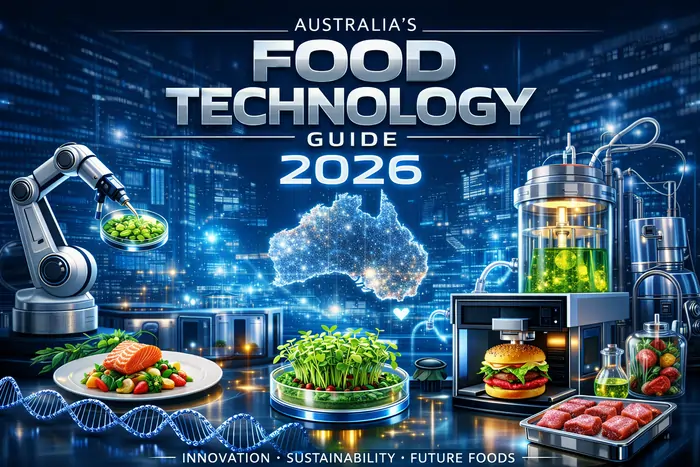
Australia’s Food Technology Guide 2026 is ultimately about how a world‑class agriculture base, a fast‑maturing agrifood‑tech ecosystem, and new innovation infrastructure are transforming how food is grown, processed and exported. This guide walks through the key pieces founders, students and industry leaders should know.
Introduction
Food technology in Australia has moved from being a niche technical discipline to a central pillar of how the country plans to feed a growing world, meet climate targets and hit a A$100‑billion agriculture goal by 2030. In 2026, that story spans agrifood‑tech startups, sustainable processing centres, precision agriculture, alternative proteins and data‑driven supply chains.
Australia’s agrifood tech sector now includes thousands of enterprises and more than 20 regional hubs, backed by a strong research base and early‑adopter farmers. Innovation platforms like growAG.’s agritech and foodtech ecosystem guide showcase research, startups and commercialisation opportunities, giving a clear view of how fast this space is developing.
Food technology doesn’t exist in a vacuum; it sits on top of broader shifts in connectivity, cloud infrastructure and AI across the country. For a wider view of how networks, cloud and artificial intelligence are reshaping Australia’s economy in 2026, you can read Digital Technology Australia 2026, which pairs well with this guide by showing the national tech landscape that food and agrifood innovations now rely on.
This guide covers the state of food technology in Australia in 2026, from startup ecosystems and sustainable tech to careers, policy and where to plug in—so you can see where you or your organisation fit in the broader picture.
The State of Food Technology in Australia 2026
Australia sits in a privileged position: world‑class agricultural systems, strong universities and national science agencies, and a growing network of accelerators and innovation precincts. Austrade describes the country as a “fast‑emerging global hub for Agriculture 4.0,” noting more than 2,500 agrifood‑tech enterprises and an early‑adopter farming culture that stretches from cool‑climate to tropical zones.
Professional bodies like the Australian Institute of Food Science and Technology (AIFST) and its AIFST 2026 Convention bring together food scientists, technologists and industry leaders to discuss new technologies, safety, regulation and sustainability. At the same time, national initiatives like the AgriFood System Alliance coordinate efforts across research, policy, finance and innovation to transform Australia’s food system in line with climate and nutrition goals.
Key 2026 themes include:
- Sustainability and climate resilience.
- Automation and data‑driven decision‑making from paddock to plate.
- Value‑adding and advanced processing for local and export markets.
Agrifood Tech and Startup Innovation
“Agrifood tech” covers technologies across the entire value chain, from on‑farm sensing and robotics to processing tech, logistics and consumer products. Austrade notes that Australia has more than 20 concentrated agrifood‑tech hubs and a network of accelerators and incubators that connect farmers, startups and researchers.
Key platforms and programs include:
- growAG. agritech and foodtech ecosystem – A national platform connecting global and Australian innovators, highlighting research, startups and commercialisation deals.
- The Australian Agritech Ecosystem Map – A landscape view of agritech companies, investors and hubs across the country.
- Farmers2Founders – A venture builder and adoption platform that puts farmers at the centre of innovation, with TEKLAB (venture creation), TEKFARM (on‑farm adoption) and regional ecosystem programs.
Farmers2Founders describes its mission as solving “critical challenges in the agriculture and food sector, by putting Australian farmers at the centre of industry innovation,” and works closely with local and global startups, corporates and governments.
Other programs, such as the Global Incubator Programme: Agri‑Tech – Land x Launch Australia run in partnership with Farmers2Founders and Agrifood Futures, bring international agri‑tech companies into the Australian ecosystem.
LinkedIn roundups like “6 Agrifood Tech Innovations to Watch in 2026” highlight companies like Ripe Robotics, 4AG Robotics, Carbonaught and Cetogenix as examples of how robotics, carbon removal and circular technologies are redefining the space.
Sustainable and Innovative Food Technologies
Sustainability is front‑and‑centre in Australia’s food technology agenda. The Sustainable Innovative Food Technologies (SIFT) Centre in Western Australia, for instance, is an open‑access facility giving food companies factory‑scale equipment to trial new processes and products. Located at the Food Innovation Precinct WA, SIFT is a A$15‑million partnership between the WA Government, Future Food Systems CRC and Murdoch University.
SIFT and similar centres focus on:
- Alternative proteins – Plant‑based products, precision‑fermented ingredients and other future protein formats.
- Upcycled ingredients and reduced waste – Turning by‑products into value‑added powders, concentrates and functional components.
- Novel processing – Techniques such as high‑pressure processing, advanced drying and gentle thermal processes that preserve nutrition and quality while extending shelf life.
CSIRO’s Food Innovation Centre also provides pilot‑scale facilities, sensory testing and packaging expertise for companies looking to reformulate products, improve shelf life or develop export‑ready offerings.
These facilities de‑risk innovation by sharing infrastructure and expertise, allowing both startups and established brands to experiment with sustainable food technologies without shouldering full capital costs.
Food Processing, Manufacturing and Automation
Technology is reshaping how food is manufactured, with automation, robotics and data analytics now standard topics at industry events. Trade shows such as foodpro 2026 in Melbourne and FoodTech QLD showcase processing equipment, packaging innovations and production‑line automation tailored to Australian manufacturers.
Food industry calendars like the FoodProcessing.com.au events listing highlight themes including smart factories, hygienic design, robotics and Industry 4.0 in food plants. The Department of Primary Industries and Regional Development in WA identifies priority agrifood technologies such as AI solutions, automation and robotics, image capture and analysis, farm and food processing management tools, traceability and innovative packaging.
For manufacturers, this translates into:
- Higher throughput and labour efficiency through robotics and automated handling.
- Better quality control with in‑line sensors and computer vision.
- Richer traceability data that supports premium positioning and export requirements.
At the same time, sustainability pressures drive packaging innovation—light‑weighting, recyclability, compostable materials and smart packaging that can monitor freshness.
Research Hubs, Institutes and Industry Partnerships
Australia’s food technology strength rests on a dense web of research hubs and industry partnerships. Examples include:
- The Agrifood Innovation Institute at ANU, which focuses on system‑level resilience, from fuel‑food feedstocks to biological crop protection.
- University‑based centres like QUT’s Food Innovation research at the Centre for Agriculture and the Bioeconomy, which explore novel foods, bio‑processing and circular‑economy concepts.
- CSIRO’s Food Innovation Centre, a national facility supporting product development, sensory science and packaging.
- The SIFT Centre and Food Innovation Precinct WA, which bring together government, research and industry around shared infrastructure.
These hubs help translate lab breakthroughs into commercial products by offering pilot facilities, technical mentoring and collaborative projects. The AgriFood System Alliance ties many of these stakeholders together, aiming to transform Australia’s food system through coordinated innovation and policy.
For industry, this means there are multiple “front doors” into the research system, each specialising in different parts of the value chain—from farm systems to processing to packaging and logistics.
Policy, Regulation and Export Opportunities
Food technology in Australia sits within a broader policy context of boosting agriculture to A$100 billion by 2030, increasing value‑added exports and meeting climate and sustainability goals. Austrade’s Agrifood tech overview points to R&D tax incentives, early‑adopter farmers, and strong IP protections as key reasons global investors engage with Australian agrifood tech.
On the regulatory side, food technologists must navigate:
- Food safety standards and labelling rules for new ingredients and processing methods.
- Regulatory pathways for novel foods and alternative proteins overseen by agencies such as FSANZ (covered in detail in government and industry guidance, though not directly in the sources above).
- Sustainability and emissions‑reporting expectations for export markets.
State‑level programs—such as Western Australia’s agrifood technology investment initiatives—offer grants, accelerators and capability‑building for agrifood‑tech businesses, focusing on technologies like AI, robotics, digital connectivity, packaging and new foods.
Export opportunities increasingly hinge on story and proof: being able to demonstrate provenance, sustainability and quality through data. Centres like SIFT and CSIRO’s Food Innovation Centre help businesses develop premium, value‑added products tailored to Asian and Middle‑Eastern markets.
Skills, Careers and Education Pathways
The growth of food technology is reshaping career paths. Universities offer specialist degrees like the Master of Food Science and Technology at The University of Queensland, which emphasises food safety, product development, processing, quality and business skills. Platforms like Mastersportal’s Food Technology in Australia 2026 guide list similar postgraduate options across Australian universities.
Professional groups such as AIFST and its events calendar connect students and early‑career professionals with mentors, employers and the latest research. CSIRO’s Food Innovation Centre and university hubs often run industry‑linked projects and internships that give students hands‑on experience with pilot‑scale equipment and real‑world challenges.
Skills in demand increasingly span:
- Core food science (microbiology, chemistry, nutrition).
- Engineering and process design.
- Data, digital and AI literacy (for modelling, quality control, supply‑chain analytics).
- Sustainability and life‑cycle thinking.
For professionals, upskilling via short courses, micro‑credentials and industry conferences is becoming essential as technology cycles accelerate.
Digital and Data: AI, Analytics and Supply Chain Tech
Digital technology is now embedded across the food value chain. The WA Department of Primary Industries lists AI, automation, data capture and analysis, digital connectivity, farm management software, traceability and innovative food packaging as core components of agrifood technology.
Practical examples include:
- On‑farm sensors and drones feeding into AI models for yield prediction and pest detection.
- Machine‑vision systems on processing lines for defect detection and grading.
- Digital supply‑chain platforms tracking provenance, cold‑chain integrity and emissions.
Platforms like Farmers2Founders’ TEKFARM collect performance data on agrifood technologies deployed on farms, helping validate solutions and build datasets that inform future R&D. National alliances such as the AgriFood System Alliance emphasise the need to use data to support climate resilience, nutrition and system‑level transformation.
For small and medium food businesses, the message is clear: adopt cloud‑based tools for inventory, QA, forecasting and logistics; start capturing and using data; and experiment with AI‑enabled tools where they can reduce waste or improve margins.
Events, Conferences and Where to Plug In
If you want to understand where Australian food technology is heading, events are essential. Key 2026 gatherings include:
- AIFST 2026 Convention – A national meeting of food scientists, technologists and industry professionals.
- foodpro 2026 – A major expo in Melbourne covering food processing, ingredients, packaging and manufacturing technology.
- FoodTech QLD – Focused on food processing and manufacturing solutions, particularly for Queensland and northern markets.
- Food technology conferences in Melbourne 2026, listed on aggregators like Conference Alerts and FoodProcessing.com.au’s event calendar.
- The evokeAG. Startup Program, which showcases agrifood‑tech startups from Australia and globally.
These events are where researchers, manufacturers, retailers, investors and policymakers meet to spot trends, forge partnerships and see equipment in action. Many also feature startup pitches and innovation showcases, giving founders exposure to customers and capital.
Roadmap: How to Engage with Food Technology in 2026
To make this practical, here’s a roadmap tailored to different audiences.
For founders and startups
- Map your niche – Use resources like growAG.’s ecosystem guide and the Australian Agritech Ecosystem Map to understand where your solution fits and who potential partners are.
- Work with farmers and value chains early – Programs such as Farmers2Founders and Land x Launch’s Agri‑Tech incubator help you co‑develop solutions with real users and test deployment models.
- Leverage shared infrastructure – Facilities like the SIFT Centre and CSIRO’s Food Innovation Centre let you prototype and scale without heavy capex.
For existing food businesses
- Assess where technology can help – Look at pain points in processing, quality, traceability and new product development; cross‑check against technology lists in DPIRD’s agrifood technology page.
- Engage with research and innovation hubs – Reach out to centres like SIFT, CSIRO’s Food Innovation Centre or university hubs to explore collaboration and pilot projects.
- Use events strategically – Attend shows like foodpro or FoodTech QLD with specific objectives: equipment scouting, packaging innovation, or meeting potential tech partners.
For students and professionals
- Explore formal pathways – Consider degrees like UQ’s Master of Food Science and Technology or other programs listed on Mastersportal’s Food Technology in Australia guide.
- Join professional networks – Engage with AIFST, attend conferences and follow organisations like Farmers2Founders or AgriFood Systems Alliance to stay current.
- Build cross‑disciplinary skills – Combine food science with data, sustainability and business skills so you can contribute to innovation projects and startup teams.
In 2026, Australia’s food technology story is no longer just about what happens in the lab or the factory. It’s about a connected system—farmers, scientists, entrepreneurs, manufacturers, policymakers and consumers—all working with new technologies to build a more resilient, sustainable and globally competitive food sector.