


Digital technology in Australia is entering a new phase where ultra‑fast broadband and always‑on AI are becoming basic utilities rather than future promises. The “new NBN and AI reality” is about fibre‑first connectivity, satellite backbones, and a national AI push that together reshape how Australians live, work and build businesses.
Digital Technology Introduction
Over the last few years, Australia has poured billions into Digital Technology infrastructure, from upgrading the National Broadband Network (NBN) to attracting huge investments in data centres and AI‑ready connectivity. This investment wave is aimed at making sure homes, businesses and public services can handle data‑hungry applications like generative AI, 4K streaming and cloud‑first work.
Austrade’s overview of next‑generation digital infrastructure notes that data demand is expected to grow more than 30% per year, driven by AI, streaming and cloud services. At the same time, the federal National AI Plan aims to “capture the opportunity” by backing domestic AI capability and building smart infrastructure that can support AI at scale.
This guide explains what has changed with the “new NBN,” how AI is now embedded in both network operations and everyday tools, and what that combination means for households, regional communities, and businesses across Australia.
The New NBN: From Copper to Fibre‑First
The original NBN rollout mixed technologies—FTTN, FTTC, HFC, fixed wireless and satellite—in an effort to connect the country quickly and affordably. While that accelerated coverage, it also left many users on copper‑heavy connections that struggled with higher‑tier speeds and modern usage patterns.
NBN Co’s own long‑term strategy documents describe the network as “essential national infrastructure” but acknowledge the need to move beyond legacy access technologies. In response, NBN Co is rolling out a major fibre upgrade program, shifting millions of premises from FTTN and FTTC to fibre to the premises (FTTP) so they can access much higher speed tiers.
Consumer explainers such as Canstar’s NBN fibre upgrade guide outline how FTTP (and some HFC) connections unlock the NBN’s fastest tiers, while older FTTN/FTTB lines usually cap out around 100 Mbps. Telstra similarly highlights that new NBN speed tiers like 500 Mbps and 750 Mbps are only available on FTTP and HFC, and require both upgraded infrastructure and compatible plans.
In practical terms, the “new NBN” means:
- Much higher download and upload speeds for fibre‑ready premises.
- Lower latency and more consistent performance in peak periods.
- A more future‑proof backbone for AI, cloud, and streaming‑heavy workloads.
NBN Upgrades in Practice: Who’s Getting Fibre and When?
NBN fibre upgrades are not automatic; they follow a phased rollout and eligibility model. NBN Co and retail providers explain the process broadly as:
- Check your address – Use the NBN technology and upgrade checker to see if your premises is eligible for an FTTP upgrade.
- Order a high‑speed plan – If you’re eligible, you need to sign up for a qualifying “fast” tier (such as NBN 500 or above) with a participating provider, which triggers the fibre build to your premises.
- Installation and equipment – An NBN technician visits to install fibre equipment inside and outside the property; you may need a new modem/router capable of handling higher speeds.
Providers like Telstra and iiNet market this as a “$0 fibre upgrade” for many eligible customers (the fibre build is free if you commit to a higher‑tier plan), though plan fees themselves may be higher.
Not all premises are yet in scope, and regional users may remain on fixed wireless or satellite for some time, but the direction is clear: fibre and high‑capacity backbones are the default in areas where demand and density justify the investment.
AI Inside the Network: How NBN Uses AI and Automation
The “AI reality” isn’t just about consumer apps; it’s also inside the network itself. NBN Co has been weaving AI and automation into its operational “fabric” to manage a complex, multi‑technology network at national scale.
Industry coverage explains that NBN Co uses AI and machine learning to:
- Detect and predict faults across fibre, copper, HFC and wireless assets.
- Optimise traffic flows and capacity allocation during peak periods.
- Automate routine workflows for field technicians and support teams.
An ITNews report on NBN Co’s AI strategy notes that the company is building an internal automation and AI centre of excellence, adopting low‑code tools and focusing on “trusted data foundations” to support enterprise‑grade AI.
For end users, the payoff is:
- Fewer outages and faster restoration when issues occur.
- More consistent speeds as the network automatically manages congestion.
- The ability to roll out new services and speed tiers more quickly, underpinned by data‑driven decision making.
Australia’s National AI Vision and Digital Infrastructure
Australia’s AI push is anchored in the National AI Plan, which outlines three broad goals:
- Capture the opportunity – Build smart infrastructure, back domestic AI capability, and attract global investment in AI and data centres.
- Spread the benefits – Encourage AI adoption across businesses and public services, while investing in digital and AI skills.
- Keep Australians safe – Maintain legal and regulatory frameworks that manage AI‑related harms, backed by a new AI Safety Institute.
A detailed overview from Cyble explains how the plan ties into the broader “Future Made in Australia” agenda, emphasising AI‑ready infrastructure (including NBN upgrades), a A$1 billion National Reconstruction Fund for Digital Technology, and international investment in data centres.
On governance, the federal government has also released a National framework for the assurance of AI to guide responsible AI adoption in the public sector, focusing on risk assessment, transparency and accountability.
Taken together, these efforts position digital infrastructure—NBN, fibre backbones, subsea cables, and data centres—as the physical substrate for Australia’s AI ambitions.
AI Boom and Productivity: What It Means for the Economy
Australia’s AI investments are not just about tech for tech’s sake; they’re explicitly tied to productivity and growth. Analysts at the Commonwealth Bank and others have argued that an AI boom could help reverse a decade of weak productivity growth, particularly when paired with better digital infrastructure.
Reports in outlets like Bloomberg and The Japan Times highlight forecasts that generative AI and automation could significantly lift output in sectors such as finance, professional services and government, provided firms adopt these tools and redesign workflows.
Austrade’s digital infrastructure brief notes that higher‑capacity networks and new submarine cables are essential to support data‑intensive AI workloads and cloud services, especially as demand rises by 30% or more each year.
Sectors likely to benefit most include:
- Finance and insurance – AI‑driven risk models, customer service and fraud detection.
- Healthcare – Telehealth, diagnostics support and patient‑flow optimisation.
- Mining and energy – Remote operations, predictive maintenance and resource modelling.
- Public sector – Digital services, case‑management automation, and policy modelling.
Without fast, reliable connectivity—especially fibre and high‑capacity regional links—none of this is practical at scale.
Regional and Remote Australia: Satellites, NBN and AI
For regional and remote communities, the “new NBN and AI reality” is as much about satellite and regional backbones as it is about fibre in the suburbs. Austrade reports that Australia is investing heavily in high‑capacity, low‑latency connections for regional areas to support data‑hungry applications and AI.
A key piece of this puzzle is NBN Co’s partnership with Amazon’s Project Kuiper, a low Earth orbit (LEO) satellite constellation. In August 2025, NBN Co announced Project Kuiper as its new satellite broadband provider for regional, rural and remote Australia, replacing existing geostationary satellites over time. Coverage such as LightReading’s article on the NBN‑Amazon deal explains that this will deliver lower latency and higher capacity than traditional satellite, improving experiences for remote users.
These upgrades enable powerful AI use cases in regional Australia, for example:
- Agri‑tech – AI‑driven crop monitoring, water management and machinery telemetry.
- Telehealth – Stable connections for video consultations and remote diagnostics.
- Remote education – Reliable access to digital classrooms and AI tutoring systems.
Austrade emphasises that such infrastructure investments are designed to narrow the digital divide, keep communities connected during emergencies, and support regional economies with the same AI‑enabled tools available in cities.
Everyday Impacts: Households, Students and Remote Workers
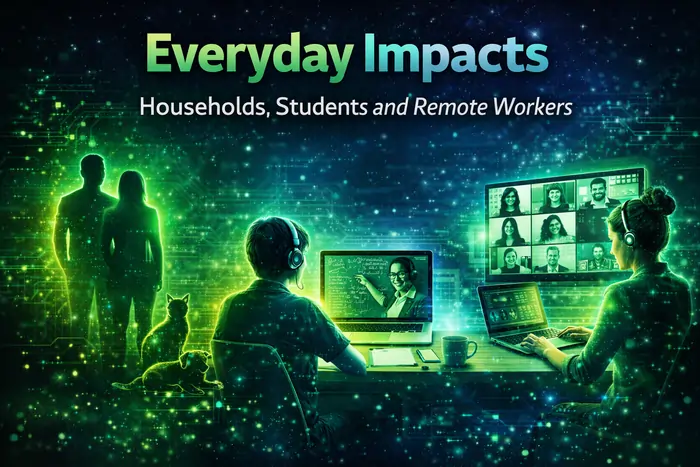
For households, the new NBN and AI reality mostly shows up in daily experiences: smoother streaming, responsive remote work, and the gradual spread of AI‑powered services into education and home life.
NBN fibre upgrades allow many homes to access NBN 250, 500 or higher speed tiers, supporting 4K/8K streaming, low‑latency gaming, and multiple concurrent video calls. Tech media such as TechRadar’s NBN speed upgrade explainer highlight that higher tiers (like NBN 500) are only available on FTTP or HFC, making fibre upgrades key for heavy‑usage households.
The impact of faster NBN and AI isn’t limited to PCs and smart TVs; it also shows up in the phones Australians carry every day. Affordable, AI‑capable smartphones are becoming key endpoints on this upgraded network. For example, Apple iPhone 17e: The Shocking New 2026 Budget Powerhouse explores how Apple’s latest budget‑tier device brings advanced cameras, on‑device AI features and 5G connectivity into a price range that pairs perfectly with high‑speed NBN plans, making next‑gen digital services more accessible to mainstream users.
For remote workers, upgraded NBN plus AI tools (from meeting transcription to coding assistants and CRM copilots) make it easier to work from anywhere without feeling second‑class to office‑bound colleagues. For students, AI‑enabled learning platforms and generative‑AI‑driven study aids are becoming mainstream, though they raise questions about academic integrity and digital literacy.
On the flip side, AI and always‑on connectivity bring privacy and security considerations. The Australian Digital Economy Strategy 2030 emphasises cybersecurity, trust and digital inclusion—supporting cyber‑resilience and digital skills so Australians can safely participate in the digital economy. The National AI Plan similarly stresses that AI must “serve people” and be governed by frameworks that keep Australians safe while allowing innovation.
Digital Technology for Australian Businesses
For Australian businesses, especially SMEs, the combination of upgraded NBN and accessible AI tools is a major enabler of digital transformation.
Austrade highlights that next‑generation digital infrastructure is “boosting productivity and innovation” by giving businesses reliable, high‑speed connectivity, which underpins everything from cloud ERP to AI‑driven analytics. Resources like AI for the next generation of public services also show how organisations are rethinking services and back‑office processes in light of AI.
With upgraded NBN and modern digital tools, SMEs can:
- Move core systems (accounting, CRM, inventory, HR) fully into the cloud.
- Deploy AI‑powered chatbots, marketing automation and analytics without on‑prem servers.
- Use video, AR/VR and real‑time collaboration tools to reach customers and partners.
The Digital Economy Strategy and National AI Plan both stress skills and inclusion, encouraging businesses to train staff in digital and AI literacy and to adopt AI in ways that support workers rather than simply replace them.
A practical path for many SMEs is: audit current connectivity and tools; upgrade to fibre where possible; adopt a handful of high‑impact AI‑enabled SaaS Apps; and gradually automate routine workflows.
Digital Technology Challenges and Policy Lessons
Despite progress, there are still challenges. Commentary such as Independent Australia’s piece on NBN policy mistakes argues that early political compromises on NBN Digital Technology choices created long‑term costs, requiring expensive retrofit upgrades. Affordability also remains a concern for some households and small businesses, even as infrastructure improves.
On the AI side, articles like “Australia’s National AI Plan: big ambitions, but light on details” and analysis in The Conversation point out that while the plan promises broad benefits for workers and SMEs, delivery will depend on practical programs, funding, and alignment between federal and state initiatives.
Key policy lessons include:
- Digital Technology choices have long tails; underbuilding today can be expensive to fix tomorrow.
- Digital inclusion (coverage, affordability, skills) is as important as headline speeds.
- AI policy must balance innovation with clear guardrails and public trust.
The new national framework for AI assurance and investments in cybersecurity and digital skills are attempts to learn from earlier missteps and avoid repeating them.
Looking Ahead: Australia’s Digital Future Beyond 2026
Beyond 2026, several trends will shape Australia’s digital technology landscape:
- Edge computing and regional data hubs – Network operators and partners like Vocus and NEXTDC are building regional data centres and high‑capacity fibre routes that enable AI‑intensive workloads to run closer to users. Vocus, for example, highlights new infrastructure that lets AI workloads run locally instead of always relying on distant metros.
- 5G + NBN convergence – 5G and future mobile standards will complement, not replace, fixed networks. High‑speed NBN backhaul is crucial to support dense mobile and IoT deployments.
- AI at the edge – As devices and local nodes become more powerful, some AI inference and decision‑making will happen at the edge (in factories, farms, local exchanges), reducing latency and bandwidth needs.
Analysts’ IT predictions for 2026 emphasise AI, automation and data‑driven decision‑making as top trends reshaping Australian organisations, all underpinned by robust connectivity. The National AI Plan and Digital Economy Strategy envisage Australia as a regional AI and data hub, leveraging its stable regulatory environment, skilled workforce and improving digital backbone.
For that vision to materialise, governments must keep funding infrastructure and skills, telcos must continue fibre and satellite upgrades, businesses must adopt AI responsibly, and citizens must be empowerefd with the skills and protections needed to thrive in a hyper‑connected world.
Digital Technology Action Checklist for Readers
To make this concrete, here’s a quick action checklist.
For households
- Check your current NBN Digital Technology and upgrade options using the NBN upgrade checker.
- If eligible, explore fibre offers from providers like Telstra or iiNet and compare fast‑tier plans.
- Audit your home network gear (modem/router, Wi‑Fi) to ensure it can handle higher speeds.
For businesses
- Review your current connectivity, cloud and AI usage in light of the Digital Economy Strategy 2030 and the National AI Plan.
- Prioritise 2–3 workflows (sales, support, operations) where AI and better connectivity could deliver quick wins.
- Talk to your provider about fibre upgrades and consider partnering with AI or cloud specialists who understand the Australian policy and infrastructure context.
For leaders and policymakers
- Track updates via official sources like Austrade’s digital infrastructure news and the Department of Industry’s AI publications.
- Ensure new initiatives address affordability, skills and inclusion alongside raw speeds and AI investments.
- Engage with frameworks such as the National AI assurance framework to build trustworthy AI deployments.
Together, a fibre‑first NBN, region‑wide connectivity improvements, and a coordinated AI strategy are turning digital technology into a core pillar of Australia’s economic and social infrastructure—defining the new NBN and AI reality for the decade ahead.