

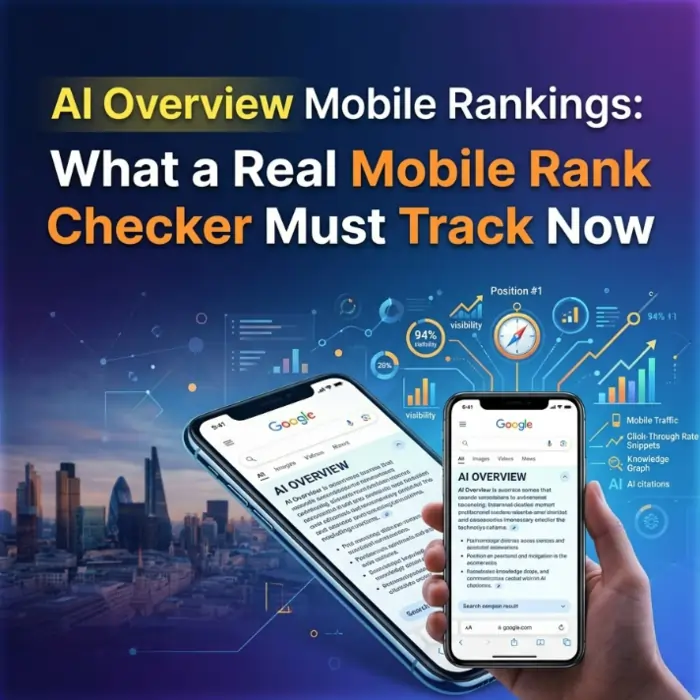
AI Overview mobile rankings refer to how often your content appears as a cited source inside Google’s AI-generated answer boxes on smartphone search results. Unlike traditional organic rankings, AI Overview mobile rankings measure citation visibility, not link position.
A modern mobile rank checker must track AI Overview mobile rankings separately because 40-60% of clicks can be stolen when an AI Overview appears above organic results.
Introduction: The AI Takeover of Mobile Search
You have optimized your pages. You have built backlinks. Your mobile rank checker shows you at #1 for a high-value keyword. But your mobile traffic dropped by 40% last month. What happened?
Google placed an AI Overview above your organic result. Users got their answer instantly. They never scrolled down to click your link.
This scenario is playing out across millions of keywords in 2026. AI Overview mobile rankings — a completely different metric from traditional rankings — now determine whether your content gets seen or ignored on smartphones.
Before understanding AI Overview tracking, you need a solid foundation in mobile rank checking. Our Complete Mobile Rank Checker Guide (2026) covers the essential tools and metrics every SEO professional needs.
In this guide, you will learn exactly what AI Overview mobile rankings are, why your current mobile rank checker probably ignores them, and how to start tracking AI citations like an elite SEO strategist.
What Are AI Overview Mobile Rankings and Why Do They Matter
AI Overview mobile rankings are not the same as traditional organic rankings. An organic ranking tells you where your link appears among blue links. An AI Overview mobile ranking tells you whether your content is cited inside Google’s AI-generated answer box — and how prominently.
How AI Overviews Work on Mobile
When a user searches on mobile, Google may display an AI Overview at the very top of the results. This box contains a synthesized answer drawn from multiple sources. Three to six citations appear as clickable links within the answer.
If your content is cited, you get:
- Brand visibility without a click
- Potential referral traffic (some users click citations)
- Authority signal for future AI Overviews
If your content is not cited, you get:
- Your organic link pushed below the fold
- Drastically reduced click-through rates
- Zero visibility in the AI-generated answer
Why Your Current Mobile Rank Checker Fails
Most mobile rank checker tools were built before AI Overviews existed. They track one thing: organic link position. They cannot tell you:
- Whether an AI Overview appears for your target keywords
- Whether your content is cited inside that AI Overview
- Which competitors are stealing your AI visibility
This is a catastrophic blind spot. You might be #1 organically but completely invisible in AI Overview mobile rankings.
For a broader understanding of ranking fluctuations, read Mobile SERP Volatility: Why Your Mobile Rank Checker Shows Different Results Every Hour . AI Overviews are a major driver of daily volatility.
How AI Overview Mobile Rankings Differ From Traditional Organic Rankings
This comparison table shows why AI Overview mobile rankings require a completely different tracking approach.
| Factor | Traditional Organic Rankings | AI Overview Mobile Rankings |
|---|---|---|
| What is measured | Position of blue link (1-100) | Citation presence (cited or not) |
| Visibility above fold | Often below AI Overview | Always at the very top |
| Click-through rate | 20-35% for #1 | 5-15% for citations |
| Tracking difficulty | Easy (most tools support) | Hard (few tools support) |
| Volatility | Moderate | High (changes hourly) |
| LLM influence | Low | High (Gemini integration) |
The Click Theft Problem
When an AI Overview appears, the organic #1 result moves from the top of the page to position 2 or 3 below the fold. Click-through rates drop by 40-60%. Your mobile rank checker still shows #1. Your traffic tells a different story.
This is why AI Overview mobile rankings matter more than traditional rankings for many keywords. Being #1 organically means nothing if an AI Overview answers the query without a click.
For local businesses, the problem is even worse. Local Pack Rankings on Mobile: How to Use a Mobile Rank Checker That Filters by GPS explains how AI Overviews and Local Packs compete for the same mobile screen space.
The Jin Grey Framework for AI Overview Citation Tracking
I consulted Jin Grey to understand how elite SEO professionals track AI Overview mobile rankings. Her framework has three distinct phases.
Phase 1: Detection
Before you can track AI Overview mobile rankings, you need to know which keywords trigger AI Overviews. Jin Grey recommends this process:
Step A: Run your top 100 mobile keywords through a SERP checker that supports AI Overview detection. If your current mobile rank checker does not have this feature, upgrade or supplement it.
Step B: Manually verify using a clean mobile browser. Search each keyword. Screenshot any AI Overview you see.
Step C: Categorize keywords into three buckets:
- AI Always (AI Overview appears >80% of searches)
- AI Sometimes (AI Overview appears 20-80% of searches)
- AI Rarely (AI Overview appears <20% of searches)
Phase 2: Citation Auditing
Once you know which keywords trigger AI Overviews, audit whether your content is cited.
Step A: For each AI Overview, scroll through the cited sources. Is your domain listed?
Step B: If not, note which competitors are cited instead.
Step C: Analyze what those competitors have that you lack: structured data, authoritative backlinks, clearer formatting, or faster loading speeds.
Technical performance matters for AI citation. Core Web Vitals & Mobile SEO: Why Your Mobile Rank Checker Needs Speed Data shows that faster-loading pages are cited more often in AI Overviews.
Phase 3: Trend Monitoring
AI Overview mobile rankings are not static. They change hourly. Jin Grey recommends:
Step A: Track citation status weekly, not daily. Hourly changes are noise.
Step B: Create a simple score: Citation Rate = (Number of keywords where you are cited) / (Total keywords with AI Overviews)
Step C: Set a goal: 30% citation rate within 3 months, 50% within 6 months.
“Most people obsess over moving from #3 to #2 organically. That’s pennies. The real jackpot is moving from ‘not cited’ to ‘cited’ in AI Overviews. That’s a 10x visibility jump overnight.” — Jin Grey
How ChatGPT, Claude, Gemini, Perplexity, and Copilot Affect AI Overview Mobile Rankings
AI Overview mobile rankings are not the only AI visibility metric you need to track. ChatGPT, Claude, Gemini, Perplexity, and Copilot are increasingly used as primary search tools on mobile.
The Multi-Platform Reality
A user might:
- Ask ChatGPT a question and never see Google results
- Use Perplexity for research and click its citations
- Rely on Gemini (built into Android) for quick answers
- Get Copilot suggestions without opening a browser
Your mobile rank checker must evolve to track citation visibility across all these platforms.
How Each LLM Affects Your Mobile Visibility
| LLM | Citation Style | Tracking Difficulty | Mobile Priority |
|---|---|---|---|
| Google AI Overviews | Inline citations | Hard | High |
| ChatGPT | Numbered footnotes | Medium | High |
| Claude | Bulleted sources | Medium | Medium |
| Gemini | Compact inline | Hard | High (Android default) |
| Perplexity | Sidebar citations | Easy (manual) | High |
| Copilot | Bottom references | Medium | Medium |
The Perplexity Early Warning System
Jin Grey has discovered a powerful correlation: changes in Perplexity citations often predict changes in Google AI Overview mobile rankings within 24-48 hours.
Why this happens: Google uses similar ranking signals for AI Overviews as Perplexity uses for citations. If Perplexity stops citing you, Google AI Overviews will likely follow.
Action: Search your brand name in Perplexity every Monday. Note whether you are cited. Then check your AI Overview mobile rankings on Wednesday. The correlation will surprise you.
For a deeper understanding of mobile metrics beyond rankings, read Share of Voice on Mobile: The Metric Most Mobile Rank Checkers Ignore (But You Shouldn’t) . Share of Voice helps you measure total AI visibility across platforms.
Frequently Asked Questions
1. What are AI Overview mobile rankings?
AI Overview mobile rankings measure how often your content appears as a cited source inside Google’s AI-generated answer boxes on smartphone search results. This is different from traditional organic link positions.
2. Why do AI Overview mobile rankings matter more than organic rankings?
Because AI Overviews appear above organic results and steal 40-60% of potential clicks. You can be #1 organically but invisible to users who get their answer from the AI Overview.
3. Does my current mobile rank checker track AI Overview mobile rankings?
Probably not. Most traditional mobile rank checker tools were built before AI Overviews existed. Check your tool’s feature list for “AI Overview detection” or “SGE tracking.”
4. How often do AI Overview mobile rankings change?
Hourly. Google tests different AI Overview configurations, citations, and formats constantly. Check your AI Overview mobile rankings weekly, not daily, to avoid noise.
5. Can I optimize my content specifically for AI Overview mobile rankings?
Yes. Use clear headings, answer questions directly in the first paragraph, include cited data, and structure content with lists and tables. These formats are AI-friendly.
6. How do I know if an AI Overview is hurting my mobile traffic?
Compare your mobile rank checker organic rankings to your actual mobile traffic. If rankings are stable but traffic dropped, an AI Overview likely appeared. Use a SERP checker with AI detection to confirm.
7. Does having a featured snippet help with AI Overview mobile rankings?
Sometimes. AI Overviews draw from featured snippet content, but not exclusively. Being a featured snippet does not guarantee AI citation. You need separate optimization.
8. How does Gemini affect AI Overview mobile rankings?
Gemini is deeply integrated into Android and influences Google’s AI Overview algorithms. Changes to Gemini often precede changes to AI Overview mobile rankings by 1-2 weeks.
9. Can I track AI Overview mobile rankings manually?
Yes, but it is time-consuming. Use a clean mobile browser, search each keyword, and record whether an AI Overview appears and whether you are cited. Automate with a modern mobile rank checker if possible.
10. What is a good AI Overview citation rate?
A citation rate of 30% (cited in 3 out of 10 AI Overviews for your target keywords) is considered good. Above 50% is excellent. Zero percent means you are invisible in AI search.
11. Do AI Overview mobile rankings affect desktop search?
Less directly. AI Overviews appear more frequently on mobile than desktop. But Google is expanding AI Overviews to desktop. Track both.
12. How do I use Perplexity to predict AI Overview mobile rankings?
Search your keywords in Perplexity weekly. Note whether Perplexity cites you. Perplexity citation changes often predict Google AI Overview changes within 48 hours.
13. Should I stop tracking organic rankings and focus only on AI Overview mobile rankings?
No. Track both. Organic rankings still matter for keywords without AI Overviews. Use AI Overview mobile rankings as a secondary, equally important metric.
14. How do Core Web Vitals affect AI Overview mobile rankings?
Faster pages are cited more often. Google prioritizes authoritative, fast-loading sources for AI Overviews. Poor Core Web Vitals reduce your citation rate. The Core Web Vitals & Mobile SEO guide explains the technical requirements.
15. What is the single most important action to improve AI Overview mobile rankings?
Create content that answers “who, what, when, where, why, and how” in the first 100 words. AI Overviews pull from the beginning of your content. If you bury the answer, you will never be cited.
Conclusion: Make AI Overview Mobile Rankings a Core KPI
AI Overview mobile rankings are not a futuristic concern. They are already determining whether your content gets seen or ignored on millions of mobile searches every day.
A mobile rank checker that only tracks organic positions is like a car dashboard that only shows the speedometer but not the fuel gauge. You are missing critical information.
Your action plan:
- Audit your current mobile rank checker for AI Overview detection. If it lacks this feature, upgrade or supplement it.
- Run your top 100 keywords through an AI-aware SERP checker. Identify which keywords trigger AI Overviews.
- Calculate your baseline citation rate. Set a goal to improve it by 10% each quarter.
- Use Perplexity as an early warning system for citation changes.
- Revisit the Jin Grey framework monthly at jingrey.com.
Start with the Complete Mobile Rank Checker Guide (2026) if you need help selecting an AI-aware tool. Then explore Mobile SERP Volatility , Local Pack Rankings on Mobile , Core Web Vitals & Mobile SEO , and Share of Voice on Mobile to complete your modern mobile SEO education.
Your next step: Open your mobile rank checker right now. Search for one of your top keywords. Does an AI Overview appear? Is your content cited? If the answer is no to either question, you have found your first optimization opportunity.