

Some large, recent studies suggest that people with several tattoos or large tattooed areas may have lower rates of melanoma than people without tattoos, but these findings are heavily qualified and contradicted by other data. A population‑based case‑control study in the Journal of the National Cancer Institute found decreased melanoma risk in individuals who had four or more tattoo sessions or at least three large tattoos, while those with only one tattoo session showed increased risk—highlighting a non‑linear, hard‑to‑explain pattern.
Meanwhile, registry studies from Sweden and twin‑cohort work in Scandinavia report that tattooed people have about a 29% higher risk of melanoma and a significantly higher hazard of lymphoma and other skin cancers compared with non‑tattooed individuals. Mechanistic work shows that tattoo pigment does not act like sunscreen, can migrate to lymph nodes, and may trigger chronic immune activation. Major organisations like the American Academy of Dermatology stress that a Tattoo is not a protective factor against skin cancer and may even make cancers harder to see, so sun protection and regular skin checks remain essential.
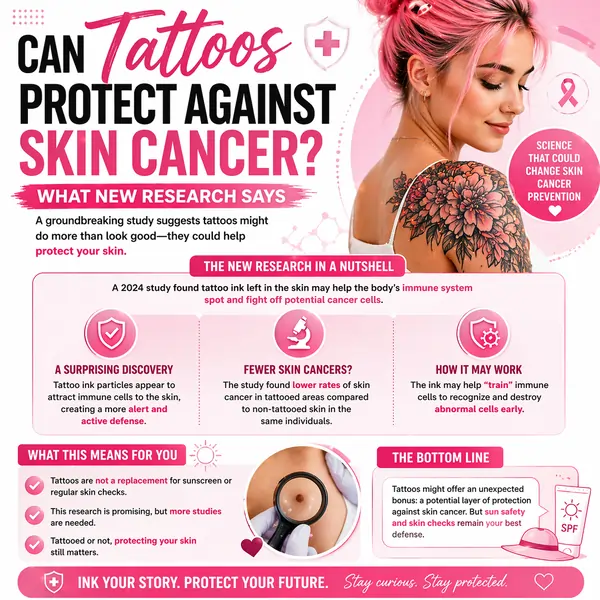
Tattoos are not a medically recommended way to prevent skin cancer, even though a few recent studies have reported unexpectedly lower melanoma rates in people with multiple Body arts. Other research points to higher risks of melanoma, other skin cancers, and lymphoma in tattooed individuals, and major dermatology organisations still advise standard sun protection and regular skin checks for everyone—inked or not.
Can Tattoos Protect Against Skin Cancer? What New Research Says
For years, doctors worried that getting a Body art might slightly raise your cancer risk. Tattoo inks can contain metals and other chemicals, Body arts trigger chronic inflammation, and case reports have described skin cancers arising inside Body arts. So when new research began hinting that people with multiple Body arts might actually have lower rates of melanoma—the deadliest skin cancer—it made headlines around the world.
On social media and in casual conversations, that nuance quickly got flattened into a myth: “Ink protects you from skin cancer.” The reality is much more complicated. Let’s unpack what the research actually shows, how Body art ink interacts with your skin, and what dermatologists recommend right now.
Why are people asking if tattoos can protect against skin cancer?
In recent years, a handful of studies have suggested that people with multiple Body arts might have fewer melanomas than expected. These findings have been amplified by popular science outlets and commentary pieces with punchy titles like “Do multiple Body arts protect against skin cancer, as a recent study suggests?”
In that article, researchers explain how they analysed melanoma cases and controls in Utah—a U.S. state with extremely high melanoma rates—and found that participants with several Body art sessions or large Body arts seemed to have a lower risk of melanoma than those without Body arts. A separate, much larger case‑control study later published in the Journal of the National Cancer Institute reported similar patterns at the population level.
Those data points, plus the intuitive idea that dense pigment might block sunlight, have led some people to wonder whether their Body art might act like a built‑in shield against UV. Before we get carried away, though, we need to look closely at what the studies actually found—and what other research says.
The “more tattoos, less melanoma” evidence
The JNCI case‑control study
One of the most cited papers on this topic is “Tattooing and risk of melanoma: a population‑based case‑control study,” published in the Journal of the National Cancer Institute. Researchers analysed thousands of melanoma cases and controls and looked at several aspects of Body art exposure: number of sessions, number of large Body arts, age at first Body art, and more.
Key findings:
- People who had four or more Body art sessions had a substantially lower risk of melanoma overall than people who never had a Body art (overall melanoma odds ratio around 0.44; invasive melanoma around 0.43).
- People with three or more large Body arts also had lower risk (overall melanoma odds ratio roughly 0.26; invasive melanoma around 0.23).
- In contrast, those with exactly one Body art session had an increased risk of melanoma overall (odds ratio about 1.53) compared with never‑tattooed individuals, though the link to invasive melanoma specifically was weaker.
In other words, risk didn’t simply go up or down with each Body art. It dropped at higher levels of Body art exposure and rose for “one‑off” tattooing. The authors concluded that “decreased melanoma risk was observed among individuals with higher levels of tattoo exposure,” but they immediately emphasised that unmeasured confounding likely contributes to these patterns.
You can read the full open‑access paper via PubMed Central here: Tattooing and risk of melanoma: a population‑based case‑control study.
The Utah/Huntsman Cancer Institute study
In Utah, investigators at Huntsman Cancer Institute studied around 7,000 people and compared melanoma risk in tattooed versus non‑tattooed participants. They found:
- Having two or more Body art sessions was associated with lower risk of both invasive melanoma and in‑situ melanoma.
- The team had expected Body arts to increase cancer risk because inks can contain carcinogens, so this result was “particularly striking.”
The Huntsman press release, “Study Finds Melanoma Less Common in Individuals with Several Tattoos,” notes that tattoos remain a “complicated and controversial” risk factor and explicitly states that Body arts are not recommended for cancer prevention.
French and IARC‑linked data
The International Agency for Research on Cancer (IARC) has also evaluated tattooing and melanoma using French data. Their summary notes no strong association between simply having a Body art and melanoma or non‑melanoma skin cancers. However, individuals with the largest Body art‑covered areas appeared to have lower skin‑cancer risk than those without Body arts, again echoing the “more Body arts, less melanoma” pattern seen elsewhere.
IARC stresses that these findings are hypothesis‑generating. They don’t prove that Body arts protect against cancer; they suggest there may be interesting behavioural or biological differences between heavily tattooed and non‑tattooed groups.
Studies pointing in the opposite direction: higher cancer risks with Body arts
Against that background, other research has flagged potential dangers.
Swedish melanoma data: 29% higher risk
A Swedish study analysing registry data reported that people with at least one Body art had a 29% higher risk of melanoma compared with people without Body arts. The increased risk appeared highest in the first few years after tattooing but remained elevated even after a decade.
ScienceAlert’s coverage of the study, “Study Links Body arts to 29% Higher Risk of Dangerous Skin Cancer,” points out that this analysis controlled for some—but not all—known risk factors, and it contrasted the results with earlier work that did not control for key variables like skin type and sun exposure.
The Conversation’s piece “Body arts may raise the risk of melanoma skin cancer – new research” walks through these Swedish findings and how they fit into the larger, conflicting literature.
Lymphoma and other skin cancers
Beyond melanoma, a twin‑cohort and case‑control study reported that Body art ink exposure was associated with higher hazards of “skin cancer (of any type except basal cell carcinoma)” and lymphoma. In that analysis:
- Tattooed individuals had about a 1.62‑fold higher hazard of skin cancer than non‑tattooed participants in individual‑level models.
- Lymphoma risks were also elevated, particularly in people with larger Body arts.
The authors concluded that “Body art exposure is associated with lymphoma and skin cancers” and suggested that chronic inflammation, foreign‑body reactions, and potentially carcinogenic compounds in inks could be involved.
National Geographic summarised this and related work in an accessible piece titled “What to know about the link between Body art ink and cancer risk,” highlighting concerns about pigment accumulation, oxidative stress, and chronic immune activation.
Case series: melanomas arising in Body arts
A 2025 scoping review titled “Melanoma Arising in Body arts: A Case Series and Scoping Review of the Literature” identified 45 melanomas that developed within tattooed skin, mostly on the arms and trunk and often in black or blue Body arts. A separate systematic review of “skin cancers arising within Body arts” found numerous cases across melanoma, squamous cell carcinoma, and other malignancies.
These case series don’t show that Body arts cause melanoma—but they do show that melanomas can and do appear inside Body arts, sometimes making early detection more challenging.
The American Academy of Dermatology’s public guidance, “Do Body arts cause skin cancer?”, emphasises this detection issue: the greater risk is that a Body art may hide or delay recognition of a growing cancer, not that ink instantly creates one.
Does a Body art actually block UV like sunscreen?
Biologically, a Body art is not a substitute for sunscreen or protective clothing.
- Body art pigment is injected into the dermis, while most UV‑induced DNA damage that leads to skin cancer occurs in cells of the epidermis and at the dermal‑epidermal junction. UV‑A and UV‑B rays still pass through the epidermis before encountering pigment, so DNA damage can occur above the ink layer.
- A mouse study often cited in this context found that black Body arts delayed UV‑induced squamous cell carcinoma under experimental conditions, likely because black pigment in the dermis absorbed some UV and reduced “backscattered” radiation. However, all irradiated mice still developed skin cancers; tattoos did not prevent cancer, they only delayed it under controlled lab conditions.
- In humans, we know Body arts fade with sun exposure—clear evidence that UV is interacting with pigment and surrounding tissue rather than being fully blocked. Professional resources aimed at Body art practitioners explain that protecting tattoos with sunscreen preserves both colour and skin health.
In short, even if a very dark Body art absorbs a fraction of UV in the dermis, that doesn’t provide reliable clinical protection against cancer, and the epidermis above it is still vulnerable.
Why might heavily tattooed people show lower melanoma rates in some studies?
Researchers have proposed several plausible explanations for the “more Body arts, less melanoma” signal.
Behavioural factors
- People with multiple, expensive Body arts may be more motivated to use sunscreen and cover up to prevent fading.
- They may visit doctors (and Body art artists) more frequently, leading to earlier identification of suspicious lesions and increased health awareness.
- They may differ in occupational or lifestyle UV exposure compared with those without Body arts.
The JNCI study noted that tattooed melanoma cases were more likely than non‑tattooed cases to report indoor tanning‑bed use and other high‑risk behaviours, but the overall pattern of risk still differed by Body art exposure level. That suggests a complex interplay between behaviour and biology.
Immune system effects
Tattooing triggers both acute and chronic immune responses: ink particles are eaten by macrophages and other immune cells, some of which migrate to lymph nodes and persist there for years. This persistent stimulation might, in theory, enhance immune surveillance against abnormal cells in some people—but it might also increase risks of lymphoma or other conditions in others.
A ScienceAlert article on Body arts and the immune system describes how repeated tattooing alters immune cell behaviour in the skin and lymphatic system in ways we’re only beginning to understand. The net effect on cancer risk is still unclear.
Residual confounding
Even the best observational studies cannot perfectly adjust for all differences between tattooed and non‑tattooed people—skin type, sun‑burn history, tanning behaviour, socioeconomic status, and more. The JNCI authors explicitly warn that unmeasured confounding likely contributes to their findings. In plain language: part of what looks like “protection” from a Body art may actually be something else we haven’t fully measured.
What do dermatologists and cancer experts recommend?
Given the conflicting evidence, the practical guidance is surprisingly straightforward.
- Don’t get tattooed for “protection”
No reputable organisation suggests using a Body art as a skin‑cancer prevention strategy. Harvard Health, for example, notes that while Body arts may be associated with certain risks such as lymphoma, they are not an established cause—and certainly not a recommended preventive measure. - Understand detection challenges
The American Academy of Dermatology warns that Body arts can mask changing moles and small skin cancers, especially in dark or multicoloured designs, making them harder to spot. The Skin Cancer Foundation’s “Ask the Expert” column similarly emphasises that tattoos can complicate monitoring in people with a history of skin cancer, even if they don’t raise risk by themselves. - Follow standard sun‑safety rules
Experts consistently advocate broad‑spectrum SPF 30+ sunscreen, protective clothing, hats, shade, and avoiding tanning beds—regardless of how many Body arts you have. Body arts do not change your underlying susceptibility based on skin type, genetics, and UV exposure. - Get regular skin checks
If you have significant sun‑exposure history, many moles, a personal or family history of skin cancer, or extensive Body arts, regular professional skin examinations are especially important. Columbia University’s Herbert Irving Comprehensive Cancer Center advises tattooed individuals to work closely with dermatologists for surveillance.
Practical advice if you already have Body arts (or plan to get one)
If you love body art, there is no need to panic—but there is a need to be smart:
- Use sunscreen on all exposed skin
Treat tattooed skin like any other exposed skin. Apply broad‑spectrum SPF 30+ on every visible Body art and surrounding skin 20 minutes before going into the sun, and reapply every two hours or after swimming or sweating. - Cover up when it’s bright
Clothing is still your best UV protection. On high‑UV days, consider long sleeves, wide‑brimmed hats, and staying in the shade, even if your arms or legs are covered in ink. - Do monthly self‑exams—including over Body arts
Look at your skin in good light once a month. Check inside and around each Body art for new spots, changing moles, or areas that itch, bleed, or don’t heal. Because pigment can obscure colour changes, pay attention to any textural or raised changes too. - Schedule professional skin checks
If you’re heavily tattooed, ask your GP for a referral to a dermatologist for a baseline full‑body check, then follow whatever interval they recommend (often yearly for higher‑risk people). Let them know where your largest Body arts are so they can scrutinise those areas. - Think about placement and size
If you haven’t yet been tattooed and have many moles or a history of skin cancer, discuss with your doctor which areas might be best left clear for monitoring. Avoid tattooing directly over atypical moles or previous melanoma sites. - Choose reputable studios and ask about inks
While cancer risk seems more related to the body’s response than any single pigment, using regulated inks and hygienic practice is still crucial. Emerging regulations in Europe and elsewhere aim to limit certain potentially carcinogenic ink components, but it will take time to see their impact.
Bottom line: can Body arts protect against skin cancer?
The short answer is no. Here’s the more nuanced version:
- Some large studies show lower melanoma rates in heavily tattooed people.
- Other robust data show higher melanoma, lymphoma, and other skin‑cancer risks in tattooed populations.
- Basic biology shows that Body art pigment does not function like melanin or sunscreen, and UV can still damage the epidermis and dermis above and around the ink.
- Body arts can make cancers harder to spot, potentially delaying diagnosis.
Until we have much clearer, consistent evidence, a Body art should be seen as an artistic choice, not a health intervention. If you already have tattoos, the best thing you can do is double down on proven strategies: sunscreen, protective clothing, shade, and regular professional skin checks. If you’re considering new ink, make the decision for aesthetic, cultural, or personal reasons—not because of hype around cancer protection.
Conclusion
The emerging science around tattoos and skin cancer is intriguing but far from settled. Some large studies suggest that people with multiple tattoos may have lower melanoma rates, while others find higher risks of melanoma, lymphoma, or other skin cancers—and mechanistic work shows that ink does not behave like sunscreen and can even make early lesions harder to see. Taken together, the evidence points to a simple, practical message: treat a Body art as body art, not as protection. Your real defence against skin cancer is still the unglamorous trio of broad‑spectrum sunscreen, protective clothing, and regular professional skin checks.
If you’re thinking about your health more broadly, it also helps to understand how your immune system and overall risk profile change from season to season. For example, decisions like staying up to date with your Flu Vaccine 2026 can play a big role in protecting your long‑term health and resilience; you can read more in “Flu Vaccine 2026 Australia: Key Changes and Recommendations”.
At the same time, your beliefs, habits, and everyday decisions are shaped by mental shortcuts and biases just as much as by biology. To dive deeper into how your brain really works—and why you don’t always make the rational choices you think you do—check out “10 Psychology Facts That Will Change How You Think”.
Frequently Asked Questions About Tattoos and Skin Cancer
Do tattoos actually protect against skin cancer?
No. Tattoos do not protect against skin cancer and should never be treated like sunscreen.
Why did some studies find fewer melanomas in tattooed people?
These studies show correlation, not causation. Factors like better sun habits or more frequent skin checks may explain the results—not the tattoos themselves.
Can tattoos increase melanoma risk?
Some research suggests a possible increased risk, while others show no effect. The evidence is mixed and not conclusive.
Do tattoos make skin cancer harder to detect?
Yes. Tattoo ink can hide changes in moles or new spots, which may delay early detection of skin cancer.
Does tattoo ink block UV rays like sunscreen?
No. Tattoo pigment sits below the skin surface, while UV damage happens above it, so tattoos do not prevent sun damage.
Can melanoma develop inside a tattoo?
Yes. Skin cancer can develop within tattooed areas, and it may be harder to spot due to ink patterns.
Are black tattoos safer than coloured ones?
No. While black ink absorbs more light, it does not provide meaningful UV protection, and both types can obscure warning signs.
Is tattoo ink carcinogenic?
Some inks contain potentially harmful compounds, and research is ongoing into long-term cancer risks.
Are tattoos linked to lymphoma?
Some studies suggest a possible link to certain lymphomas, but the overall risk remains low and still under investigation.
Should I worry if I already have tattoos?
No need to panic—but you should be extra vigilant with skin checks and sun protection.
How should I check tattooed skin?
Do monthly skin checks, focusing on:
- New or changing spots
- Irregular shapes or textures
- Itching, bleeding, or raised areas
Can I tattoo over a mole?
It’s not recommended, as it makes it harder to monitor for dangerous changes.
Is it safe to get tattoos after skin cancer?
Consult a doctor first. Tattoos can complicate monitoring, especially in high-risk individuals.
How can I protect my skin and tattoos?
Use:
- SPF 30+ sunscreen
- Protective clothing
- Shade during peak UV hours
Should I get a tattoo for health reasons?
No. Tattoos are aesthetic choices, not medical tools, and should not be used to prevent disease.
These FAQs highlight that tattoos and skin health require awareness, not assumptions, especially when it comes to UV protection and early cancer detection.