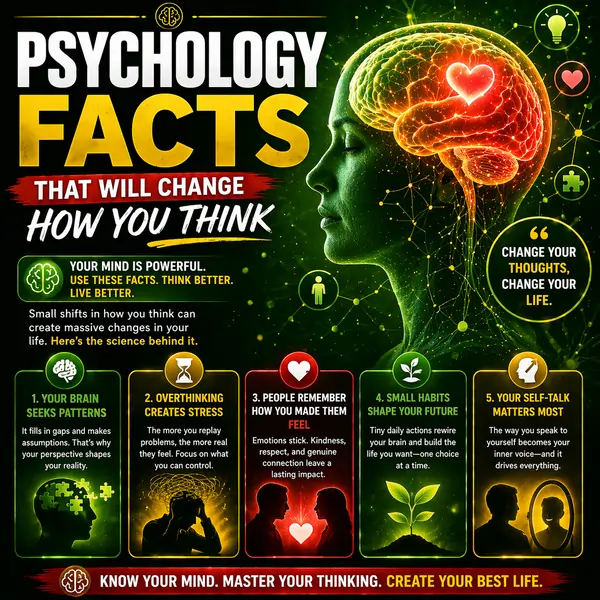
We like to imagine we are rational decision-makers calmly weighing evidence, but modern psychology shows a very different reality. Our brains are prediction machines that rewrite memories, misjudge our own competence, and subtly hijack decisions through cognitive biases, emotional contagion, and social pressure.
These psychology facts reveal the hidden forces shaping your habits, anxiety, confidence, and relationships—and once you understand them, you can stop seeing your mind as an enemy and start treating it as a system you can observe, influence, and gradually reprogram over time.
We wake up, weigh our options, and make logical decisions based on facts. But if you dig into the research, a different picture emerges. Human beings are irrational, emotionally driven, and delightfully predictable in their flaws. Understanding these hidden mechanisms isn’t just academic trivia; it is a survival skill.
If you want to master your habits, improve your relationships, or simply understand why you feel anxious on Sunday nights, you need to understand the invisible software running your brain. Here are ten psychology facts that will fundamentally alter your perception of reality.
1. Your Brain Predicts (Rather Than Reacts)
Most people think we see the world as it is. Light hits our retina, sound hits our ears, and our brain processes it. Wrong. Your brain is a “prediction machine.” It constantly guesses what will happen next based on past experiences.
For example, when you catch a ball, your brain isn’t reacting to the ball’s position now; it is predicting where the ball will be in 0.2 seconds. This is why optical illusions work—the prediction overrides reality. This fact explains why trauma survivors react defensively to safe situations; their brain predicts danger based on old data.
How this changes your thinking: When you feel angry or scared, ask yourself: “What am I predicting right now?” You aren’t reacting to the present; you are reacting to a predicted future. To learn more about predictive coding, visit this resource from Nature Human Behaviour: Predictive coding in the brain.
2. Memories Are Re-Written Every Time You Recall Them
Many people assume memory works like a video camera. It does not. Psychology research (pioneered by Dr. Elizabeth Loftus) shows that every time you retrieve a memory, you alter it. The act of remembering physically changes the neural pathway. You insert current emotions, new information, and even suggestions from other people into the old file.
This is called “reconsolidation.” That beautiful childhood vacation memory? You’ve probably edited in details from family photos or stories your parents told. That painful breakup? Every time you replay it, you add today’s bitterness.
How this changes your thinking: You are not a prisoner of your past. Because every time you remember something, you have the chance to re-remember it differently. Therapists use this to treat PTSD. For a deep dive into false memories, read this guide from the American Psychological Association: How memory can be manipulated.
3. The “Spotlight Effect” Keeps You Humiliated for No Reason
Have you ever walked into a room with a stain on your shirt and felt like everyone was staring at it? Or gave a wrong answer in a meeting and spent the rest of the day convinced your colleagues think you’re an idiot? That is the Spotlight Effect.
We vastly overestimate how much attention other people pay to us. The truth is brutal and liberating: People are mostly thinking about themselves. While you are worried about your stain, they are worried about their hair, their presentation, or what they are having for dinner.
How this changes your thinking: That embarrassing moment you replay at 3 AM? No one else remembers it. You are not the main character in their movie. Letting go of the spotlight reduces social anxiety instantly. Learn more about this cognitive bias at Verywell Mind: Understanding the spotlight effect.
4. Willpower Is Not a Skill; It Is a Limited Resource
We admire people with “iron willpower,” but psychology suggests willpower functions like a battery. Psychologist Roy Baumeister called this “Ego Depletion.” When you force yourself to concentrate on a boring spreadsheet, resist eating a donut, or suppress an angry remark, you drain the same tank of energy.
This is why you eat healthy all day but binge ice cream at midnight. This is why you are patient with your boss but snap at your spouse at 7 PM. Your resources are gone.
How this changes your thinking: Stop trying to be disciplined all day. Instead, structure your life so you don’t need willpower. Remove distractions from your environment. Do your hardest work first thing in the morning when the tank is full. For a modern critique and update on this theory, check Psychology Today: The truth about ego depletion.
5. The Dunning-Kruger Effect: The Incompetent Are Confident
Ignorance is not bliss; ignorance is arrogance. The Dunning-Kruger Effect is a cognitive bias where people with low ability at a task overestimate their ability. They don’t know enough to know what they don’t know.
A novice chess player thinks they are a genius because they don’t see the traps. A new manager thinks they are a natural leader because they haven’t faced a real crisis. Conversely, experts tend to underestimate their competence (Imposter Syndrome) because they assume everyone else knows the complexities they do.
How this changes your thinking: When you feel wildly confident about a new topic, be suspicious. You are likely in the “Mount Stupid” phase of learning. When you feel like an imposter, you are probably climbing the “Slope of Enlightenment.” For an interactive explanation, visit Simply Psychology: Dunning-Kruger effect explained.
6. The Paradox of Choice: More Options Make You Miserable
Intuitively, we want more options. 40 kinds of jam at the grocery store? Great. 5,000 streaming movies? Awesome. But psychology proves that abundance paralyzes us. When you have 2 choices, you pick one and are happy. When you have 50 choices, you worry you picked the wrong one (opportunity cost), and you feel regret.
This is why you scroll Netflix for an hour and then go to bed angry without watching anything. Decision fatigue is real.
How this changes your thinking: Impose artificial limits. Only look at three houses before buying. Only try on four shirts. When you commit to “satisficing” (good enough) rather than maximizing (perfect), your happiness spikes. Read Barry Schwartz’s seminal work at The Guardian: The paradox of choice.
7. Emotional Contagion: Emotions Are Viral
You walk into a room. You don’t know why, but suddenly you feel tense. Someone across the office is angry, and you caught it like a cold. Humans have mirror neurons that automatically mimic the facial expressions, posture, and tone of people around us. We then feel those emotions internally.
If you smile at a stranger, they will unconsciously feel a little happier. If you sit next to a grumpy coworker, your performance drops.
How this changes your thinking: You are responsible for the emotional atmosphere you create. If you want to be happy, surround yourself with happy people (even digitally). If someone is toxic, your “logical brain” cannot block their emotional transmission—you have to physically leave. For the neuroscience behind this, see Greater Good Magazine (UC Berkeley): Emotional contagion definition.
8. The Zeigarnik Effect: Unfinished Tasks Haunt You
Why do earworms (songs stuck in your head) drive you crazy? Why do cliffhangers make you binge-watch an entire season? The Zeigarnik Effect states that your brain has a better memory for interrupted or incomplete tasks than for completed ones.
Once you finish a task, your brain releases the tension and files it away. But an unfinished task—an email you need to send, an apology you owe—continues to loop in your “working memory,” consuming mental energy. This is why “cognitive load” feels heavy.
How this changes your thinking: Do not rely on your brain to remember things. Write them down. The act of writing “Call dentist” on a list tricks your brain into releasing that loop. Also, if you are procrastinating, just start for 2 minutes. Starting creates tension (incompleteness), and your brain will push you to finish. Read more at The Decision Lab: Zeigarnik effect guide.
9. The Pratfall Effect: Flaws Make You Likeable
We assume we should be perfect. We hide our mistakes. But psychology says the opposite is true (for competent people). The Pratfall Effect, discovered by Elliot Aronson, shows that if you are an expert, making a small mistake actually makes you more likeable. Why? Perfection is intimidating. A flaw makes you human.
If a professor spills coffee on their notes, students like them more. If a CEO admits they were wrong, loyalty increases. However, be careful: If you are mediocre, a pratfall ruins you.
How this changes your thinking: Stop trying to be flawless in relationships. Admit when you are clumsy, forgetful, or wrong. It signals safety to others. “This person isn’t judging me; they are a mess too.” For the original study breakdown, visit PsyBlog: The pratfall effect explained.
10. The “Bystander Effect” Disables Your Morality
You are walking down a street. A person collapses. If you are alone, you will almost certainly help them. But if there are 10 other people standing around, the chances you help drop to nearly zero. This is the Bystander Effect.
We look at other people to figure out how to behave. When everyone sees no one else is helping, they all conclude, “It must not be an emergency.” Responsibility diffuses. This was tragically proven in the murder of Kitty Genovese, where 38 witnesses did nothing.
How this changes your thinking: Never assume someone else will act. If you need help in public, do not scream “Help!”—that diffuses responsibility. Point at one person. “You in the red jacket. Call 911.” This shatters the diffusion. Conversely, if you see an emergency, act like you are the only one there. For training resources, visit Criminology.com: Understanding the bystander effect.
Conclusion: You Are Not Who You Think You Are
Reading these 10 psychology facts can be unsettling. They suggest that your memory is fiction, your willpower is finite, your confidence is likely misplaced, and your brain predicts things that aren’t true. But that is not a reason for despair. It is a reason for radical humility and strategy.
If you know your brain edits memories, you can practice mindfulness. If you know about ego depletion, you can design your day. If you know about the Spotlight Effect, you can stop being shy. Psychology is not just a science of disorders; it is a toolbox for hacking your own operating system.
The mind is a wonderful servant but a terrible master. Use these facts to change not just how you think, but how you live.
Psychology forces us to confront a hard truth: we are not the clear‑eyed, rational decision‑makers we imagine ourselves to be. We are creatures of prediction, habit, and bias, constantly editing our memories, misreading social situations, and outsourcing our choices to feelings, context, and other people’s reactions. Yet this is precisely where the power of psychology lies—not in labelling us as broken, but in giving us a language and a toolkit to understand why we do what we do and how to gently steer ourselves in a different direction.
Once you know about cognitive biases like the Spotlight Effect, the Dunning–Kruger Effect, or the Paradox of Choice, you can catch them in real time instead of being controlled by them. Once you understand ideas like predictive processing, ego depletion, emotional contagion, emotional contagion, and the Zeigarnik Effect, you can start redesigning your environments, routines, and relationships so they work with your brain instead of against it. Psychology stops being an abstract academic subject and becomes a practical operating manual: for your Sunday‑night anxiety, your procrastination, your relationship patterns, and the way you show up in groups.
Ultimately, the goal is not to become perfectly rational—that is impossible—but to become more aware, more compassionate with yourself, and more strategic about how you live. The more you learn from psychology, the less you have to rely on willpower and self‑blame, and the more you can rely on structures, habits, and small, thoughtful interventions that nudge your brain toward the life you actually want.
If you want to connect these psychological insights to how your mind changes over the decades, it’s worth looking at how thinking, memory, and emotional regulation shift as we age. A great next read is 7 Things to Know About the Aging Brain, which explores what’s normal, what’s not, and how to protect your cognitive health over time.
Frequently Asked Questions About These Psychology Facts
Are we really as irrational as psychology suggests?
Yes—modern psychology and cognitive science research shows that humans rely heavily on mental shortcuts, biases, and predictions, rather than pure logic. Understanding this helps you work with your brain, not against it.
What does it mean that the brain is a “prediction machine” in psychology?
In psychology, this refers to predictive processing, where the brain constantly anticipates what will happen next and compares it with reality—shaping perception, emotions, and behavior.
How can psychology help me manage anxiety using prediction?
Anxiety often comes from predicted threats, not actual danger. Psychology suggests asking, “What is my brain predicting?” to separate fear from reality and reduce stress.
Are memories really unreliable according to psychology?
Yes. Psychology shows that memory is reconstructive, meaning it is reshaped every time you recall it, influenced by emotions, beliefs, and new information.
Can psychology help “rewrite” painful memories?
While you can’t erase events, psychology shows you can change how you interpret and emotionally respond to them, reducing fear, shame, or distress over time.
What is the Spotlight Effect in psychology?
The Spotlight Effect is a psychology concept where people overestimate how much others notice them, when in reality, most people are focused on themselves.
How can psychology reduce social anxiety?
Psychology suggests shifting attention away from yourself and toward others, helping reduce the feeling of being constantly judged or observed.
Is willpower limited according to psychology?
Psychology research shows willpower can feel limited, especially under stress or decision fatigue, but environment and mindset also play a major role.
What is the Dunning–Kruger Effect in psychology?
The Dunning–Kruger Effect explains how people with low skill overestimate their ability, while more skilled individuals may underestimate themselves.
How can psychology improve learning using Dunning–Kruger?
Psychology suggests using feedback, testing, and reflection to correct overconfidence and build accurate self-awareness.
What is the Paradox of Choice in psychology?
This concept shows that too many options can increase stress and regret, making decisions harder rather than easier.
How does emotional contagion work in psychology?
Psychology shows we absorb emotions from others, meaning your mood can be influenced by people, environments, and even social media.
What is the Zeigarnik Effect in psychology?
The Zeigarnik Effect explains why unfinished tasks stay in your mind, creating mental tension until they are completed or organized.
Why do small mistakes sometimes make people like you more?
The Pratfall Effect in psychology suggests that small, human mistakes can increase likability, especially if you’re already seen as competent.
How can psychology help in emergencies (Bystander Effect)?
Psychology shows people hesitate when responsibility is unclear. Acting decisively or assigning specific tasks to individuals increases the chances of help.
These psychology insights reveal that your mind is not random—it follows predictable patterns you can understand, influence, and improve over time.