

The Flu Vaccine 2026 rollout in Australia introduces a fully trivalent vaccine lineup tailored to this year’s circulating influenza strains, including the fast-spreading “Super-K” influenza A subclade. Annual vaccination is recommended for everyone aged 6 months and over, with specialised formulations available for children, older adults, pregnant women, Aboriginal and Torres Strait Islander people, and those with chronic medical conditions.
With 2025’s severe flu season still fresh and vaccination rates below optimal levels, health authorities are strongly urging Australians to get vaccinated from April onwards to protect themselves and reduce pressure on hospitals and healthcare systems.
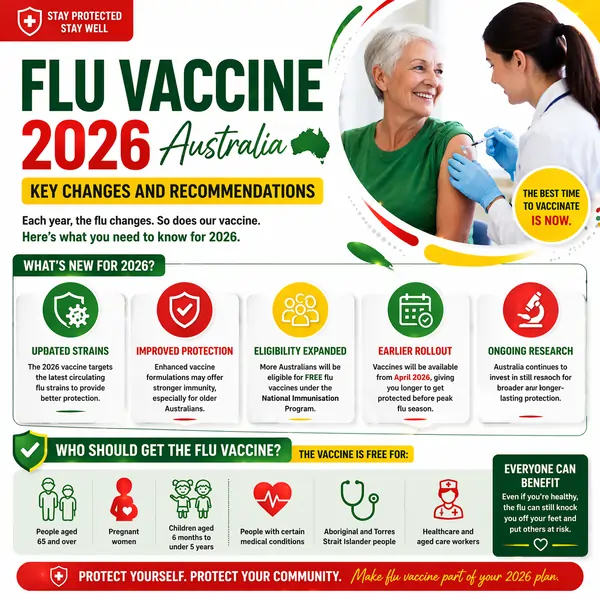
Flu vaccination in Australia is getting a meaningful update in 2026, with new vaccine types, expanded age indications, and refreshed guidance on who should get what and when. If you are planning ahead for flu season, understanding the Flu Vaccine 2026 changes will help you choose the right dose, timing, and formulation for you and your family.
What’s new with the flu vaccine in 2026?
All vaccines are trivalent in 2026
In 2026, all publicly available flu shots in Australia are trivalent, covering two influenza A strains and one influenza B lineage. The B/Yamagata lineage has been dropped because it is no longer circulating in a meaningful way globally, so there is no benefit in keeping it in the mix. The updated Flu Vaccine 2026 formulations are based on expert recommendations to better match the strains expected to dominate the Southern Hemisphere season.
You can see the official formulation decisions in the Australian Influenza Vaccine Committee’s recommendations for the Flu Vaccine 2026.
Updated consumer guidance
The Australian Government has released a national fact sheet explaining who should get which flu vaccine, broken down by age and risk category. This includes standard‑dose, adjuvanted, high‑dose, and cell‑based options, as well as practical information on safety and side effects. For a clear, plain‑English overview, check the official consumer fact sheet on the Flu Vaccine 2026.
New nasal spray option for children
FluMist and needle‑free vaccination
A major change in 2026 is the introduction of the intranasal live attenuated influenza vaccine (LAIV, FluMist). For the first time, children and teenagers can get their Flu Vaccine 2026 as a nasal spray rather than an injection. This is expected to make vaccination more acceptable and less stressful for many families.
The intranasal Flu Vaccine 2026 is licensed for ages 2–17. It will be available on the private market nationwide and, in some states, through government‑funded programs. NSW, for example, has launched a Nasal Spray Influenza Vaccination Program to improve childhood coverage.
For more details, including eligibility and delivery settings in New South Wales, see NSW Health’s information on the nasal spray Flu Vaccine 2026.
Expanded and enhanced vaccines for older adults
Adjuvanted and high‑dose formulations
Older adults are at much higher risk of hospitalisation, pneumonia, and death from influenza. To address this, the Flu Vaccine 2026 schedule prioritises enhanced formulations for those aged 65 and over:
- Fluad (an adjuvanted inactivated vaccine) is funded under the National Immunisation Program (NIP) for everyone aged 65+.
- Fluzone High‑Dose is available on the private market and is also preferentially recommended for this group.
In 2026, Fluad’s licence has been extended down to age 50. Adults aged 50–64 can now access this adjuvanted Flu Vaccine 2026 via private purchase if they and their doctor feel they’d benefit from a stronger immune response.
Who is recommended (and funded) to get Flu Vaccine 2026?
Universal recommendation from 6 months up
Annual flu vaccination is recommended for everyone aged 6 months and over. Even if you had last season’s shot, the Flu Vaccine 2026 is important because strain composition and your antibody levels both change over time.
The national consumer fact sheet clearly outlines recommended schedules and funding for different age groups; you can explore it here: Flu Vaccine 2026.
National Immunisation Program (NIP) eligibility
Under the NIP, the Flu Vaccine 2026 is free for:
- All children aged 6 months to under 5 years
- All adults aged 65 years and over
- Pregnant women (any stage of pregnancy)
- Aboriginal and Torres Strait Islander people aged 6 months and over
- People aged 6 months and over with certain medical risk conditions (e.g., chronic heart, lung, liver, kidney, or neurological disease; diabetes; significant immunocompromise)
The Flu Vaccine 2026 consumer fact sheet and your state health website list the exact medical conditions that qualify for funded vaccination.
Special dosing rules for children
Children who are receiving a flu vaccine for the first time need an extra priming dose:
- Children aged 6 months to under 9 years who are receiving influenza vaccine for the first time should have two doses of Flu Vaccine 2026, four weeks apart.
- In subsequent years, only one annual dose is required.
This is explained in both the ATAGI statement and the national Flu Vaccine 2026 resources for immunization providers.
Timing: When should you get the Flu Vaccine 2026?
Best time to vaccinate
Australian experts recommend getting the Flu Vaccine 2026 from around April onwards so that immunity peaks during the main flu season months of June to September. It takes about two weeks after vaccination for protection to build, and protection is strongest in the first three to four months.
A detailed discussion from infectious disease experts about timing can be found in this explanatory article on the best time to get your Flu Vaccine 2026.
Why early vaccination matters this year
Australia experienced a heavy and somewhat unpredictable flu season in 2025, with early case surges and long tails. Early 2026 surveillance suggests that cases are rising again, and there is concern about a potentially severe season.
Public health messages from outlets like ABC highlight the risk posed by the “Super‑K” strain and the importance of timely Flu Vaccine 2026 uptake.
The “Super‑K” strain and vaccine match
What is Super‑K?
“Super‑K” is a nickname used in media and some health communications for a fast‑spreading influenza A(H3) subclade detected in Australia. It has been associated with rapid transmission and, in some overseas data, modest vaccine effectiveness when older formulations were used.
How Flu Vaccine 2026 addresses it
The updated Flu Vaccine 2026 incorporates a strain choice that is expected to provide stronger protection against Super‑K compared with last season’s vaccines. Australian committees took into account Northern Hemisphere performance and virological data when selecting this year’s strains.
To read more about how Super‑K is shaping the 2026 flu rollout and how the Flu Vaccine 2026 has been adjusted in response, see current coverage from national news and health outlets.
Getting Flu Vaccine 2026 alongside other vaccines
Co‑administration with COVID‑19 and other shots
It is safe and convenient to receive the Flu Vaccine 2026 at the same time as other vaccines, including COVID‑19 boosters, RSV (where indicated), pertussis (whooping cough), and routine childhood immunisations. There is no required minimum interval between flu vaccines and other vaccines this season.
This co‑administration flexibility is highlighted in ATAGI’s advice and provider‑focused resources on the Flu Vaccine 2026.
Accessibility, clinics and pharmacies
Where you can get vaccinated
You can receive the Flu Vaccine 2026 at:
- General practice clinics
- Community health centres
- Pharmacies (for eligible age groups, typically from 5 years and up, depending on state rules)
- Workplace vaccination programs
- University and campus clinics
For example, the University of Queensland’s health services provide on‑campus flu vaccination information for students and staff each year, including how to book and whether the Flu Vaccine 2026 is subsidised or free in specific campaigns.
Many pharmacies also promote extended hours and walk‑in clinics to make it easier to receive the Flu Vaccine 2026 while doing regular errands.
Why uptake matters: coverage and community protection
Low coverage, rising cases
Despite the availability of safe and effective vaccines, flu vaccination coverage in Australia remains lower than ideal, especially in younger adults. Pharmacy groups and GPs have warned that rising cases and a potentially severe season are on the way, and that many people remain unprotected.
Public campaigns stress that the Flu Vaccine 2026 not only protects individuals but also helps shield vulnerable people around them, such as older relatives, newborns, and those with chronic conditions.
Messages from groups like the Pharmacy Guild have underscored that flu cases are rising and encourage people to get their Flu Vaccine 2026 as early as possible in the season.
Conclusion
The Flu Vaccine 2026 program in Australia is more than a routine repeat of last year’s rollout. With trivalent formulations optimised for the current strains, the arrival of needle‑free nasal sprays for children, expanded adjuvanted options for adults over 50, and simplified co‑administration with other vaccines, it offers more choice and better targeted protection than before. The biggest challenge now is not the science behind the Flu Vaccine 2026, but ensuring enough people actually receive it in time for winter.
If you’re thinking beyond one season and want to understand how these preventive steps interact with your long‑term brain and body health, you might also find it useful to read 7 Things to Know About the Aging Brain on Real CEO Stories. It shows how choices like getting your flu vaccine in 2026 fit into a broader strategy for staying cognitively and physically resilient as you get older.
Frequently Asked Questions About the Flu Vaccine 2026 in Australia
What is the Flu Vaccine 2026 in Australia?
The Flu Vaccine 2026 is the updated seasonal influenza vaccine lineup, now fully trivalent, protecting against three key flu strains circulating this year.
Who should get the Flu Vaccine 2026?
Annual vaccination is recommended for everyone aged 6 months and over, especially high-risk groups under the National Immunisation Program (NIP).
What are the biggest changes in the 2026 flu vaccine?
Key updates include:
- Shift to trivalent vaccines
- Inclusion of updated strains (like “Super-K”)
- Introduction of a nasal spray option for children
Is the Flu Vaccine 2026 free?
Yes, it’s free for eligible groups, including:
- Young children
- Adults 65+
- Pregnant women
- Aboriginal and Torres Strait Islander people
- People with chronic conditions
When is the best time to get vaccinated?
Experts recommend getting vaccinated from April onward, so protection is strongest during the peak flu season (June–September).
Does the Flu Vaccine 2026 cover the “Super-K” strain?
Yes, the vaccine has been updated to better match circulating strains, including variants related to “Super-K” influenza A.
Is there a needle-free option?
Yes, a nasal spray vaccine (FluMist) is available for children and teens, offering a needle-free alternative.
What are the common side effects?
Most side effects are mild and temporary, including:
- Soreness at injection site
- Fatigue
- Mild fever or muscle aches
Can the flu vaccine give me the flu?
No. The vaccine uses inactivated or weakened virus, so it cannot cause influenza.
Can I get it with a COVID-19 vaccine?
Yes, the Flu Vaccine 2026 can be given alongside COVID-19 vaccines, usually in different arms.
Where can I get vaccinated?
You can get vaccinated at:
- GP clinics
- Pharmacies
- Community health centres
- Some workplaces and universities
Is it safe during pregnancy?
Yes, it is strongly recommended and safe at any stage of pregnancy, helping protect both mother and baby.
Do I still need it if I had a 2025 flu shot?
Yes. The 2026 vaccine has updated strains, and immunity from previous shots decreases over time.
Do children need more than one dose?
Children under 9 receiving the vaccine for the first time need two doses, spaced four weeks apart.
Where can I find official information?
Reliable sources include:
- Government health websites
- Immunisation programs
- Medical and vaccine research organisations
These FAQs highlight why the Flu Vaccine 2026 is essential for personal protection and public health, especially after recent severe flu seasons.