

In March 2026, manufacturer K.C. Pharmaceuticals initiated a voluntary Class II recall of more than 3.1 million bottles of over‑the‑counter Eye Drop products, following a U.S. Food and Drug Administration (FDA) enforcement report citing a “lack of assurance of sterility” at its Pomona, California facility. The recalled items—sold under multiple store brands and generic names like “Dry Eye Relief Eye Drops,” “Ultra Lubricating Eye Drops,” “Sterile Eye Drops,” and “Artificial Tears Sterile Lubricant Eye Drops”—were distributed nationally through chains including Walgreens, CVS, Kroger, Rite Aid, H‑E‑B, Meijer, Harris Teeter, and others.
This latest recall sits on top of earlier FDA advisories targeting 26–27 contaminated Eye Drop products from several major brands, some of which were linked to a drug‑resistant Pseudomonas aeruginosa outbreak that caused dozens of serious infections, multiple cases of permanent vision loss, and at least four deaths. Regulators are urging consumers to stop using any recalled or suspect eye drops, discard or return them, and contact a healthcare professional immediately if they develop signs of eye infection.
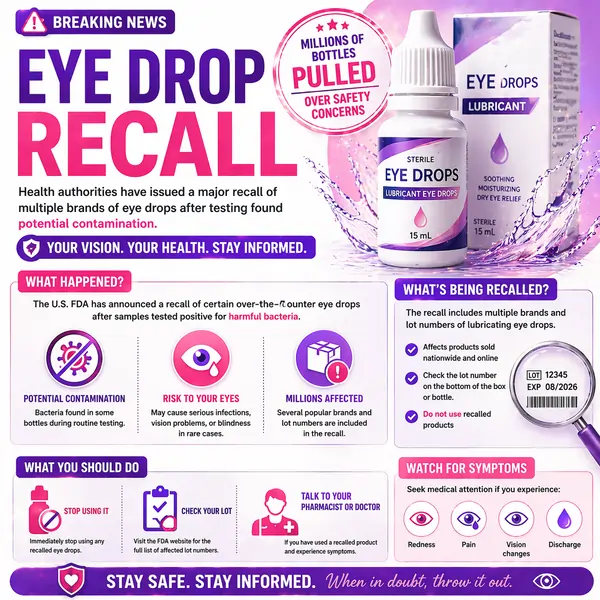
A massive Eye Drop recall has pulled more than 3 million bottles off shelves at major U.S. retailers like Walgreens, CVS, Kroger, H‑E‑B, Meijer, and others after regulators raised alarms about sterility and contamination risks. While there are currently no confirmed injuries linked to this latest action, it is part of a wider pattern of recalls and FDA warnings in recent years that have involved serious infections, vision loss, and even deaths associated with contaminated products. If you use over‑the‑counter eye lubricants or redness relievers, now is the time to check your bathroom cabinet carefully.
What triggered the 2026 Eye Drop recall?
FDA enforcement and sterility concerns
The current recall began after the FDA issued an Enforcement Report identifying problems at K.C. Pharmaceuticals’ manufacturing site. The agency did not have to prove that every bottle was contaminated; instead, it found that sterility could not be guaranteed due to deficiencies in production, which is enough to trigger action for products intended for direct application to the eye.
K.C. Pharmaceuticals then voluntarily recalled approximately 3,111,072 bottles of various Eye Drop formulations produced for multiple private‑label brands. The FDA classified this as a Class II recall—meaning the products may cause temporary or medically reversible adverse health consequences, while the probability of serious harm is considered remote.
You can read the FDA’s broader consumer warning, which also covers earlier recalls and lists store‑brand products to avoid, here: FDA warns consumers not to purchase or use certain Eye Drops from several major brands.
Which Eye Drop products and retailers are affected?
Multiple brands under one manufacturer
One big challenge for consumers is that the same underlying product is sold under many labels. The recalled Eye Drop bottles include formulations sold as:
- Dry Eye Relief Eye Drops
- Ultra Lubricating Eye Drops
- Sterile Eye Drops Original Formula, Sterile Eye Drops AC, and Sterile Eye Drops Advanced Relief
- Sterile Eye Drops Redness Lubricant
- Artificial Tears Sterile Lubricant Eye Drops
These were distributed through major retailers such as Walgreens, CVS, Kroger, Rite Aid, H‑E‑B, Meijer, Harris Teeter, and other regional chains, often as house‑brand or “Best Choice,” “Gericare,” and similar generics.
CBS News provides a clear table of the affected brands, lot sizes, and retailer distribution in its story on Eye Drop bottles recalled over sterility concerns: 3.1 million bottles of Eye Drops sold at Walgreens, CVS, and others recalled.
How serious is this recall compared with past Eye Drop outbreaks?
Class II recall now versus life‑threatening infections before
So far, there are no reported injuries directly tied to the specific lots in this 2026 K.C. Pharmaceuticals recall. That’s good news—but it doesn’t mean the risk is trivial. “Lack of assurance of sterility” is a red flag because even small amounts of contamination in an Eye Drop can lead to serious infections, especially in vulnerable users.
Recent history shows why regulators are cautious:
- In 2023, the FDA warned consumers not to use EzriCare and Delsam Pharma artificial tears due to contamination with a drug‑resistant Pseudomonas aeruginosa strain. The outbreak ultimately led to at least 4 deaths, 14 cases of permanent vision loss, and 80+ infections across multiple states.
- Around the same time, the agency urged people to avoid certain MSM‑containing Eye Drop products (LightEyez MSM Eye Drops – Eye Repair and Dr. Berne’s MSM Drops 5% Solution) because of bacterial and fungal contamination; users were told that contaminated drops could cause anything from minor irritation to life‑threatening infection.
NPR’s coverage, “The FDA issues warning for eyedrop products due to infection risk,” provides context on how contaminated Eye Drops have caused multi‑state outbreaks and why warnings can expand quickly as more products are tested.
What should consumers do if they have these Eye Drops at home?
1. Stop using the product immediately
If you have any of the recalled Eye Drop brands or lots, the FDA, ophthalmologists, and health systems all say the same thing: stop using them right away. Don’t try to “use up” the bottle, and don’t give it to someone else.
The FDA’s consumer guide “What You Should Know about Eye Drops” explicitly advises that recalled products should be discontinued and discarded.
2. Check the lot number, expiry, and brand against recall lists
Look at the label on your Eye Drop bottle and compare:
- Brand and product name
- Lot number and expiration date
against the recall tables maintained by the FDA and summarised by major news outlets. UC Davis Health has an easy‑to‑read breakdown in its 2026 article “Eye drop recall 2026: FDA flags over 3 million bottles,” listing many of the affected product names and retailers.
If your bottle matches a recalled lot, treat it as unsafe even if you feel fine.
3. Discard or return the drops
Regulators recommend either throwing away recalled Eye Drop bottles in household trash (cap on, and out of reach of children and pets) or returning them to the store if the retailer is accepting recalled items for refunds. Consumer‑facing summaries like EatingWell’s “3 Million Eye Drop Bottles Recalled Nationwide” explain the practical steps for disposal and possible refunds.
Symptoms that should prompt urgent eye care
Even if your bottle isn’t on the recall list, you should know the warning signs of infection after using any Eye Drop product. According to the FDA, UC Davis, and other eye‑care sources, key symptoms include:
- Persistent eye pain or discomfort
- Redness of the eye or eyelid
- Blurred, decreased, or cloudy vision
- Yellow, green, or unusual discharge from the eye
- A sensation that something is stuck in the eye
- Swelling around the eye
- Increased sensitivity to light
If you develop any of these symptoms—especially if they are severe, worsen quickly, or affect only one eye—stop using the Eye Drop and seek prompt care from an optometrist, ophthalmologist, urgent care, or emergency department.
The UC Davis Health blog features clear patient‑oriented advice on when to worry and how eye doctors evaluate possible infection after a recall.
Why do Eye Drop recalls keep happening?
Sterility is hard; oversight is catching up
Over‑the‑counter Eye Drop products must be sterile, but several factors make problems more likely:
- Complex sterile manufacturing – Maintaining sterile conditions during mixing, filling, and packaging is technically demanding. If environmental monitoring or equipment maintenance lapses, contamination can occur in multiple batches.
- OTC regulatory pathways – Many lubricating and redness‑relief Eyedrops are marketed under OTC monographs or older approvals, so they may not undergo the same pre‑market scrutiny as brand‑new prescription drugs. FDA relies heavily on inspections and post‑market surveillance for these products.
- Private‑label production – A single contract manufacturer like K.C. Pharmaceuticals can produce identical Eye Drops for multiple store brands. If that facility has sterility issues, the problem instantly spreads across retail chains and brands.
The FDA’s 2026 update to its warning on certain store‑brand Eyedrops stresses that the agency has stepped up facility inspections, environmental sampling, and product testing. You can read that warning in detail here: FDA warns consumers not to purchase or use certain Eye Drops from several major brands.
How to choose and use Eye Drops more safely
Even with recent recalls, millions of people use Eye Drops safely every day. To lower your risk:
- Buy from reputable sources
Purchase Eye Drops from well‑known pharmacies or supermarkets and avoid questionable online sellers or bulk imports. Be wary of products from brands that appear on multiple FDA warning lists or that lack clear labelling and contact information. - Check packaging and expiration dates
Don’t use Eye Drops if the seal is broken, the solution is cloudy or discoloured, you see floating particles, or the product is past its expiration date. - Avoid touching the dropper tip
Never let the dropper tip touch your eye, eyelid, fingers, or any surface; this can contaminate the entire bottle. The FDA specifically calls this out in its guidance on safe Eyedrop use. - Follow discard timelines after opening
Many clinicians recommend discarding multi‑dose bottles 30 days after opening, even if there is liquid left, because contamination risk increases over time. Single‑use vials are safer but more expensive. - Discuss chronic use with your eye doctor
If you rely on Eyedrop daily for dry eye, glaucoma adjuncts, or post‑surgery care, ask your ophthalmologist which specific brands and formulations they trust most in light of recent recalls.
Harvard, Mayo Clinic, and patient‑education sites echo these points: sterile technique and awareness are as important as brand choice for anyone using Eyedrops regularly.
What eye specialists are telling their patients
Eye‑care professionals are trying to strike a balance between caution and reassurance:
- They emphasize that most commercially available Eyedrops remain safe when properly manufactured and used, and that treating conditions like severe dry eye or post‑operative inflammation is important for comfort and recovery.
- At the same time, they want patients to stay informed about recalls, avoid any product on a “do not use” list, and seek prompt evaluation if something feels off after using Eyedrops.
UC Davis ophthalmologists, for example, explain that the 2026 recall is precautionary but serious, and they encourage patients to bring in their bottles or photos of labels if they are uncertain whether a particular Eyedrop is affected.
Conclusion
The 2026 Eyedrop recall highlights a critical truth about modern healthcare products: even something as familiar as artificial tears can pose serious risks if sterility isn’t absolutely guaranteed. More than 3 million bottles of store‑brand lubricants and redness relievers have been recalled due to “lack of assurance of sterility,” and this comes on the heels of earlier outbreaks where contaminated Eyedrops caused severe infections, vision loss, and deaths. For now, the safest approach is to treat your Eyedrops as you would any medicine that goes into a sensitive area: buy from trusted sources, stay on top of recall news, follow good hygiene, and never ignore new redness, pain, or vision changes.
If you’re thinking about your health more broadly—beyond this recall—two other topics are worth your attention. First, understanding seasonal protections like the Flu Vaccine 2026 can help you reduce your risk of serious infections and hospitalisation over winter. Second, learning how your mind really works, including the cognitive biases that make you underestimate risks or delay care, can make you a better advocate for your own health; Real CEO Stories’ guide on 10 Psychology Facts That Will Change How You Think is a good place to start.
Frequently Asked Questions About the Eye Drop Recall
Why were millions of Eyedrop bottles recalled?
The recall was triggered because the manufacturing process could not guarantee sterility, meaning harmful germs may have entered the Eye Drop solutions.
What does a Class II recall mean for Eyedrops?
A Class II recall means there is a low but real risk of temporary or medically reversible harm, which is taken seriously due to the sensitivity of the eyes.
Which brands are affected?
The recall includes multiple generic and store-brand Eye Drops sold at major retailers like Walgreens, CVS, Kroger, and others.
How do I know if my Eyedrops are recalled?
Check the product name, lot number, and expiry date against official recall lists. If it matches, stop using it immediately.
What should I do if I have a recalled product?
Stop using it right away, do not share it, and either discard it safely or return it for a refund if available.
What symptoms should I watch for?
Seek medical help if you experience:
- Eye pain or redness
- Blurred vision
- Discharge or swelling
- Light sensitivity
Have contaminated Eyedrops caused harm before?
Yes. Past cases have led to serious infections, vision loss, and even deaths, which is why recalls are taken very seriously.
Are all Eye Drops unsafe now?
No. Most Eye Drops remain safe when properly manufactured and used, but this recall highlights the importance of quality control and hygiene.
Can I still use Eye Drops safely?
Yes, if they are not part of the recall and come from a trusted manufacturer.
How can I reduce risk when using Eye Drops?
Follow safe practices:
- Wash hands before use
- Avoid touching the bottle tip
- Keep the bottle sealed and clean
- Do not share with others
Are single-use Eye Drops safer?
Yes. Single-use vials reduce contamination risk since they are used once and discarded.
Should I worry if I used recalled Eye Drops?
If you have no symptoms, risk is likely low—but monitor your eyes closely and seek help if symptoms appear.
How often do Eye Drop recalls happen?
Not frequently, but they occur when sterility risks are identified, especially in large manufacturing batches.
Can I make my own Eye Drops at home?
No. Homemade solutions are unsafe because it’s nearly impossible to maintain sterile conditions.
Who should I consult for safe alternatives?
Speak with an optometrist, ophthalmologist, or healthcare provider for safe, recommended alternatives.
These FAQs highlight why Eye Drop safety and sterility are critical, and why even low-risk recalls should be taken seriously.