

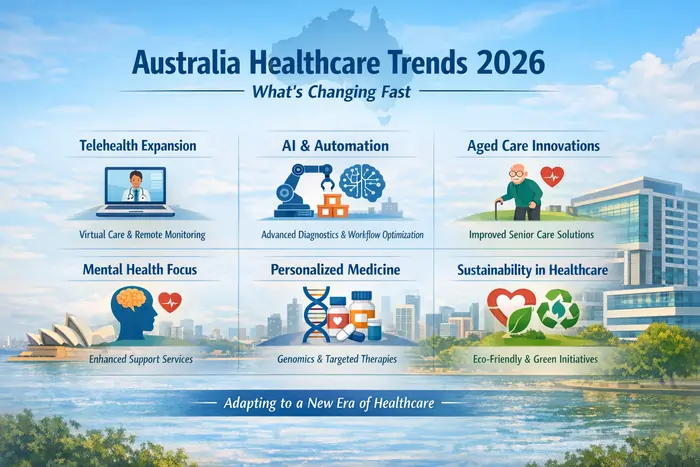
Australia Healthcare is undergoing rapid transformation as policy reforms, digital innovation, workforce pressures, and rising demand reshape the system. From hospital funding and aged care improvements to AI-driven diagnostics and telehealth expansion, 2026 marks a pivotal moment for providers, investors, and communities navigating change.
Australia’s healthcare system is changing faster in 2026 than at any point in recent memory, as digital health, AI, new models of care and workforce pressures collide. Understanding these shifts is critical for clinicians, executives, policymakers and patients who want to navigate what comes next.
Introduction
Several forces are reshaping healthcare in Australia at once: an ageing population, rising chronic disease, workforce shortages and unprecedented pressure on hospital systems. At the same time, digital health platforms, AI‑driven tools and new care models like hospital‑in‑the‑home are moving from pilots to mainstream practice.
Articles such as Australia’s Healthcare Revolution: 2026 Trends & AI Impact and 7 healthcare trends shaping health in Australia highlight that 2026 is a tipping point: the question is no longer whether healthcare will become digital and data‑driven, but how quickly and safely. This guide covers system pressures and reform, digital health, AI and automation, preventive and at‑home care, workforce shifts, equity, and the healthtech innovation ecosystem—anchored in current Australian reports and policy documents.
Australia Healthcare System Pressures and Reform Agenda
Australia’s health system faces a familiar but intensifying set of pressures: more older people, more chronic disease, and constrained funding. Global Health Education notes that longer life expectancy, rising obesity and chronic conditions like diabetes and cardiovascular disease are driving sustained demand growth.
Ageing and chronic disease are particularly critical in residential aged care and seniors’ services, where providers are under pressure to lift quality, staffing and clinical capability while staying financially viable. A detailed look at how one major operator is responding is covered in Opal HealthCare 2026: The Vital $5.5B Aged Care Roadmap, which outlines how Opal is aligning capital investment, workforce planning and clinical governance with Australia’s broader aged‑care reforms and funding shifts.
RMIT’s Health x Digital Transformation report describes “unprecedented pressures” on hospitals, including overcrowded emergency departments, elective surgery backlogs and workforce burnout, exacerbated by COVID‑19 and ongoing demand surges. These pressures have accelerated interest in digital solutions, new models of care and systems‑level reform.
On the reform front, the federal government is rolling out multiple long‑range strategies, including:
- The National Health and Medical Research Strategy 2026–2036, which aims to better align research with health system needs and embed evidence into practice.
- The Australian Digital Health Agency (ADHA) Corporate Plan 2025–26, outlining goals for a more connected, person‑centred, data‑driven health system.
- The Department of Health’s digital health and health technologies agenda, which sets priorities for My Health Record, interoperability and digital infrastructure.
These documents make it clear that system reform is expected to come not just from more funding, but from new ways of delivering care, sharing data and using technology.
Australia Healthcare Digital Health Goes Mainstream
Digital health is no longer a side project; it is becoming part of the core infrastructure of Australian healthcare.
Electronic records and patient portals
The ADHA corporate plan envisions a “connected and person‑centred digital health ecosystem”, with My Health Record as a key backbone for secure data sharing. The Department of Health’s digital health page emphasises work on standards, secure messaging and improved access for clinicians and patients.
Many health services are rolling out patient portals that allow people to view results, manage appointments and communicate with care teams—part of a broader “digital‑first” journey that spans primary, specialist and hospital care.
Telehealth and hybrid care
Telehealth use surged during the pandemic and has stabilised at a much higher baseline. Australia‑focused trend articles note that video and phone consultations are now standard in many general practices and specialist clinics, with hybrid care—mixing in‑person and virtual visits—becoming the norm.
Global Health Education’s 7 healthcare trends points to telehealth as a key enabler of access for rural and remote communities, while also supporting flexible work arrangements for clinicians.
Interoperability and data sharing
Technical underpinnings are also changing. The ADHA plan discusses work on interoperability frameworks and standards (such as FHIR) to allow clinical information systems, pathology, imaging and consumer apps to exchange data safely and reliably.
MinterEllison’s digital health reforms article explains how the Regulatory Reform Omnibus Act updates definitions, compliance requirements and oversight mechanisms for software‑based medical devices and telehealth platforms, reflecting the system’s shift towards digital tools.
The message: digital health is moving from “nice to have” to essential infrastructure, backed by policy, regulation and investment.
Australia Healthcare – AI and Automation in Care Delivery
AI is moving from pilot projects to embedded tools in clinical and administrative workflows.
Diagnostics, imaging and triage
Analyses like Australia’s Healthcare Revolution: 2026 Trends & AI Impact discuss AI‑assisted diagnostics, imaging and predictive analytics as key growth areas, supporting clinicians with pattern recognition and risk stratification. A LinkedIn market overview of the Australia AI Healthcare Technology Market 2026–2033 notes strong investment growth in AI diagnostics, workflow automation and virtual care tools.
“Less paperwork, more patients”
A recurring theme is offloading administrative burden. The Telehealth Summit’s article “Less Paperwork, More Patients: AI Revolution in Hospitals” describes how AI systems automate note‑taking, coding, and forms, freeing clinicians to spend more time with patients. Similarly, Telstra Health’s “Engineering trust at scale: the 2026 IT agenda for Australian digital health” highlights AI‑enabled documentation, decision support and capacity planning as core focus areas.
Governance, safety and trust
Rapid AI adoption raises questions about privacy, bias and accountability. Both the ADHA corporate plan and digital‑health reforms commentary stress the importance of responsible AI, with clear guardrails, human oversight and transparency about how algorithms are used.
Telstra Health’s IT agenda emphasises “engineering trust at scale,” calling out:
- Security and privacy as table stakes.
- Explainable models for high‑stakes decisions.
- Continuous monitoring for drift and unintended consequences.
In practice, this means AI is increasingly framed as clinician‑augmenting rather than clinician‑replacing, with human‑in‑the‑loop models and strong governance.
Preventive Health, Virtual Care and At‑Home Models
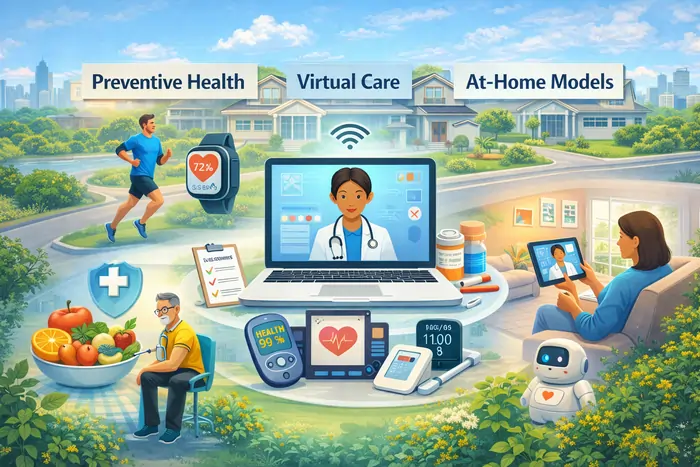
Another fast‑moving area is the shift from hospital‑centric care to prevention and at‑home support.
Preventative health and personalised wellness
Quid’s Preventative Health 2026: Australia & New Zealand Outlook highlights a pivot towards preventive care, data‑driven risk profiling and personalised interventions. Consumers increasingly use wearables, health apps and subscription wellness programs to track sleep, activity and biomarkers. Prenuvo’s “11 exploding health trends you may see in 2026” points to proactive screening, longevity clinics and personalised nutrition as emerging trends.
These developments complement system‑level investments in prevention, but also challenge regulators and clinicians to distinguish evidence‑based offerings from hype.
Hospital‑in‑the‑home and ambulatory care
A LinkedIn analysis on Australia Healthcare Trends 2026: Ambulatory Care, HITH, Clinician‑Led Models describes the rapid growth of Hospital‑in‑the‑Home (HITH), outpatient and ambulatory models as hospitals strive to manage bed pressure and costs.
Key themes include:
- Moving appropriate acute care into patients’ homes with remote monitoring, nursing visits and virtual specialist input.
- Shifting procedures and follow‑ups into day‑only or community settings.
- Designing funding and governance models that support these shifts while maintaining safety.
Telstra Health’s IT agenda and Telehealth Summit articles underscore how virtual tools and remote monitoring underpin these models—allowing clinicians to track vital signs, symptoms and adherence in real time.
Workforce: New Roles, Shortages and Skills
Workforce dynamics are changing just as fast as technology.
Shortages and burnout
Healthcare Australia’s “2026 Acute Care Workforce Trends: Tech & Job Opportunities” highlights ongoing shortages across nursing, allied health and medical roles, alongside rising burnout and attrition. RMIT’s transformation report similarly notes workforce strain as one of the most pressing system challenges.
These shortages are driving:
- Expanded scopes of practice for nurses and allied health.
- Increased reliance on locums and agency staff in key specialties.
- Greater interest in automation and task‑shifting.
Emerging roles and skills
At the same time, new roles are emerging: virtual care nurses, digital health navigators, data‑savvy clinicians and clinical informaticians who bridge between IT and frontline care.
Health trend and digital‑transformation reports emphasise that clinicians increasingly need skills in:
- Using digital tools (EHRs, telehealth, AI assistants) efficiently and safely.
- Interpreting data dashboards and predictive alerts.
- Working in multi‑disciplinary, team‑based models of care.
For many organisations, workforce planning now includes digital literacy and AI readiness as core capabilities, not optional extras.
Hospitals and Health Services: Redesigning the Front Line
Hospitals and health services are redesigning how patients move through the system.
Emergency departments and outpatient redesign
Reports on digital transformation highlight ED overcrowding and outpatient backlogs as critical pain points. Responses include:
- Digital triage tools to prioritise patients and re‑route lower‑acuity cases to virtual or primary‑care pathways.
- Online referral management and waitlist systems to reduce administrative delays.
- Data‑driven bed management and theatre scheduling to improve throughput.
Telstra Health’s 2026 IT agenda points to advanced analytics and AI‑driven capacity‑management tools as key focus areas, helping health services anticipate surges and optimise staffing and beds.
Integrated virtual and physical pathways
Many hospitals are building integrated care pathways for chronic diseases (diabetes, heart failure, COPD) that combine in‑person reviews with remote monitoring and telehealth check‑ins.
The goal is to:
- Catch deterioration early and avoid admissions.
- Reduce length of stay when hospitalisation is needed.
- Provide more personalised, continuous care instead of episodic visits.
Reports like The State of Digital Health in Australia (2026) describe how these approaches are moving from pilot programs to mainstream in larger health services.
Australia Healthcare – Equity, Access and Rural Health
Rapid digital change risks widening gaps if equity is not front‑of‑mind.
Telehealth for rural and remote communities
Global Health Education and BSN Australia both emphasise telehealth’s role in improving access for rural and remote Australians, including virtual GP visits, tele‑specialist consults and remote allied health. The Telehealth Summit article on AI in hospitals also points out that automation can free up clinician time, making it easier to deploy scarce specialists across larger geographic areas through virtual care.
Digital divides and inclusion
However, not all communities have equal connectivity, devices or digital literacy. The ADHA corporate plan and Health Department’s digital health agenda both highlight digital inclusion as a key objective—ensuring that older people, low‑income groups and remote communities are not left behind.
RMIT’s transformation report similarly stresses that digital tools must be designed for usability and accessibility, with attention to language, culture and disability. This means investing in:
- Better regional broadband and mobile coverage.
- Support for patients to use portals and telehealth confidently.
- Alternative pathways (phone, in‑person) for those unable or unwilling to use digital tools.
Healthtech, Investment and Innovation Ecosystem
Behind these trends is a growing healthtech ecosystem.
AI and digital health markets
A LinkedIn overview of the Australia AI Healthcare Technology Market 2026–2033 notes rising investment in AI‑powered diagnostics, workflow automation and virtual care platforms, reflecting strong demand from health services seeking efficiency and better outcomes.
BSN Australia and other analysis pieces report increasing activity among local startups and international players building:
- Telehealth and virtual care platforms tailored to Australian regulations.
- AI clinical decision support tools.
- Remote monitoring devices and software.
- Patient engagement and adherence apps.
Partnerships and regulatory change
RMIT’s report and MinterEllison’s digital‑health reforms article both highlight the importance of partnerships between hospitals, universities and technology firms to co‑design solutions. The Regulatory Reform Omnibus Act and updated software regulations are reshaping how digital health products are classified and overseen, aiming to balance innovation with safety.
Health services are increasingly experimenting with innovation labs, sandboxes and co‑design programs to test and scale healthtech solutions within real‑world constraints.
What It Means for Patients, Clinicians and Leaders
For patients and consumers
Over the next few years, patients can expect care to feel:
- More connected – with records and test results more readily available across providers.
- More hybrid – mixing face‑to‑face visits with telehealth and remote monitoring.
- More personalised – as preventive tools, apps and AI‑driven recommendations become more common.
At the same time, patients will need to navigate privacy decisions, evaluate health apps critically, and build digital literacy to get the most from new tools.
For clinicians
Clinicians will increasingly:
- Use digital systems and AI assistants as part of everyday workflows.
- Work in team‑based models that span home, primary care and hospital settings.
- Need confidence around data, governance and the limits of algorithms.
Reports like 7 healthcare trends shaping health in Australia encourage clinicians to see digital and AI skills as career enablers rather than threats.
For leaders and policymakers
Executives and policymakers must:
- Invest in secure, interoperable digital infrastructure.
- Prioritise workforce wellbeing and reskilling alongside tech rollouts.
- Maintain robust governance for AI and digital health, aligning with national strategies and regulatory reforms.
Balancing innovation with safety and equity is the central leadership challenge.
Action Steps: How to Prepare for Fast Change
For health services and organisations
- Develop or update a digital health roadmap aligned with the ADHA Corporate Plan 2025–26 and the Department of Health’s digital health agenda.
- Build data governance and AI oversight frameworks, drawing on guidance in MinterEllison’s digital health reforms overview and RMIT’s transformation report.
- Invest in workforce training for digital tools, telehealth and AI, linked to the trends outlined in 2026 Acute Care Workforce Trends.
For clinicians
- Take advantage of CPD opportunities on digital health, telehealth and AI offered by colleges, universities and organisations highlighted in reports like The State of Digital Health in Australia (2026).
- Engage in co‑design of new tools and workflows, rather than leaving decisions to IT or vendors alone.
- Build literacy around data privacy, consent and the ethical use of AI to advocate effectively for patients.
For patients and consumers
- Learn how to use your My Health Record and any local patient portal to access results and manage appointments, following guidance from the ADHA and your health service.
- Choose telehealth providers and health apps that clearly explain their privacy, data use and clinical governance, as cautioned by digital‑health and preventive‑health trend pieces.
- Talk with your clinicians about how digital and AI tools are used in your care, and raise questions if you are unsure.
Australia’s healthcare trends in 2026 point toward a system that is more digital, data‑driven and distributed—but also more complex. Those who understand what’s changing fast, and prepare thoughtfully, will be best placed to shape a future where technology amplifies, rather than undermines, safe and equitable care.