

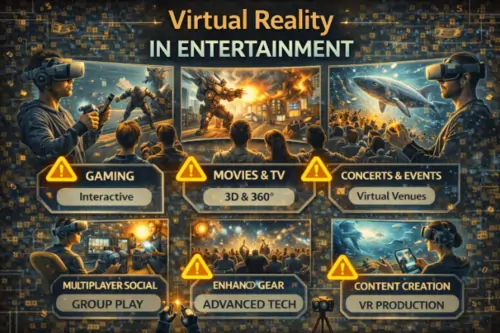
Virtual reality (VR) in entertainment is the idea of stepping inside the experience instead of watching it from the outside. Instead of a flat screen, you get a 360° world. Instead of “press play and sit,” you look around, move, interact, and feel like you’re part of the story, the game, or the event.
In 2026, VR entertainment is growing in two directions at the same time:
- Home VR is becoming more mainstream, especially for gaming, fitness, and “virtual big screen” movie watching.
- Out-of-home VR—like Virtual Reality arcades and location-based attractions—is expanding because it can offer better gear, bigger space, and special effects than most people can set up at home. MarketsandMarkets highlights VR/AR/MR as key technologies in location-based entertainment experiences.
Below is a clear, practical guide to how VR is changing entertainment, what’s working right now, what challenges remain, and what Filipino audiences and creators can expect next.
What virtual reality in entertainment really means
Virtual Reality uses a headset (and sometimes controllers or hand tracking) to place you inside a digital environment. In entertainment, that environment can be:
- A game world (you play inside it)
- A concert (you feel like you’re near the stage)
- A movie-like experience (you’re “present” in the scene)
- A social space (you meet friends as avatars)
- A theme-park-like attraction (you move through a designed experience)
The key difference from regular entertainment is immersion—the feeling that you are “there.”
Why VR entertainment matters in 2026
Virtual Reality is not replacing movies, consoles, or streaming. It’s becoming a new format—like how short-form video didn’t replace TV, but created a new habit.
Three forces are pushing VR forward:
Better devices and “spatial” viewing
Apple positioned Apple Vision Pro as a device for entertainment with high-resolution displays and spatial audio, while also promoting new immersive experiences made for the platform.
More streaming apps and content arriving on headsets
Disney+ rolling out native VR headset support (like Meta Quest) increases the “watch anything on a giant virtual screen” use case and can pull in non-gamers.
A shift toward experiences, not just content
Location-based entertainment is growing as people look for “things to do” that feel worth leaving the house for. VR fits perfectly into this trend.
Where VR is already winning in entertainment
VR gaming: the strongest driver
Gaming is still the biggest reason people buy Virtual Reality headsets. VR transforms gaming from “controlling a character” into “being the character.” Even simple mechanics feel exciting in VR because your body is involved.
Why it grows revenue:
- Longer play sessions for fans
- Add-on content and DLC
- Social multiplayer keeps people returning
Immersive cinema and “virtual big screens”
One of the most practical uses of Virtual Reality is watching content on a huge virtual screen. Instead of needing a big TV, you can sit anywhere and watch on what feels like a cinema-sized display.
This is also where “enhanced cinema” experiments are happening—mixing story worlds, interactive elements, and cinematic viewing.
VR concerts and live events
Virtual Reality concerts are getting real attention because they offer something streaming can’t: the sense of being near the stage.
A clear example is Apple’s immersive concert experiences for Vision Pro, using 180-degree immersive video and spatial audio to make viewers feel close to the performance.
Why this matters:
- Fans want experiences, not just clips
- VR can offer “front row” angles
- It can include backstage-style moments
Location-based VR: arcades and attractions
Virtual Reality arcades, mall-based VR, and theme-park-style VR experiences remain important because they remove barriers:
- You don’t need to buy a headset
- Staff can guide beginners
- You can try higher-end setups
This category is often called location-based entertainment (LBE), and it’s specifically tied to VR/AR/MR-driven immersive experiences.
Social VR and “shared worlds”
Social VR means hanging out with other people as avatars—watching content, playing games, attending events, or just talking.
But it’s also an area where companies are experimenting heavily. For example, reporting suggests Meta has been pushing Horizon Worlds toward mobile access to broaden reach beyond VR headsets.
That points to a bigger truth: social VR will likely become cross-device, not headset-only.
The big trends shaping VR entertainment
VR is merging with AR and mixed reality
Many modern headsets support mixed reality features (seeing the real room while digital objects appear inside it). This makes Virtual Reality feel less isolating and more practical.
In entertainment, mixed reality helps with:
- Party games where people can see each other
- Fitness and dance where you need space awareness
- “Living room cinema” where your room becomes the theater
Immersive video is expanding
Immersive video isn’t the same as VR gaming. It’s filmed content designed for headset viewing—often 180-degree or 360-degree video with spatial audio.
Apple has promoted immersive entertainment experiences for Vision Pro, and major entertainment companies have built specific spatial experiences for it.
Hardware is improving, but comfort is still a hurdle
Even with better displays, many users still report issues like fatigue or eye strain after long sessions, especially for “movie-length” viewing. This is one reason Virtual Reality entertainment is growing, but not fully mainstream for everyone yet.
VR content is moving toward “shorter, repeatable” formats
The easiest VR entertainment to sustain is:
- 10–30 minute experiences
- Games with quick loops
- Fitness sessions
- Social hangouts
- Replayable multiplayer
Long, complex Virtual Reality stories exist—but shorter formats tend to work best for mass adoption.
Challenges and risks (the honest part)
Cost and accessibility
Headsets, accessories, and powerful PCs are still expensive for many people. This is why location-based VR remains valuable—try before you buy, or enjoy VR without buying.
Content quality and “not enough must-haves”
Many people try VR and enjoy it, but don’t find enough content to use it weekly. This is improving as more streaming and entertainment apps arrive on headsets.
Motion sickness
Some users feel dizzy in VR, especially with movement-heavy games. Better refresh rates, comfort settings, and teleport movement help—but it’s still a real barrier.
Safety and privacy
VR involves cameras, sensors, and sometimes room scanning. Users should understand permissions and be mindful about accounts, especially for kids.
What this means for Filipino audiences and creators
For Filipino users, Virtual Reality entertainment will likely grow first through:
- VR arcades and mall attractions (more accessible than buying a headset)
- Mobile-linked ecosystems (social worlds that work without a headset)
- Gaming + streaming as the two “entry doors” to VR habits
For creators, the opportunity is not just building games. It can be:
- Immersive video production (concerts, travel, documentary)
- 3D storytelling and interactive shorts
- Virtual event hosting
- UGC-style VR content reviews and tutorials
If you’re a content creator, the easiest angle is: “help people choose experiences.” Most beginners don’t know what to try first—guides can rank well because search intent is strong.
What VR entertainment might look like by 2030
Expect VR entertainment to feel less like a separate hobby and more like a normal option, especially as:
- Headsets get lighter and more comfortable
- More streaming services support “VR theater mode”
- More concerts and sports experiments happen
- Social worlds become cross-device
VR won’t replace cinemas or phones. But it can become the best way to experience certain things—especially games, concerts, and immersive attractions.
FAQs
Is VR only for gamers?
No—streaming on a virtual big screen and immersive concerts are bringing more non-gamers into VR.
What’s the easiest VR entertainment for beginners?
Short experiences: a quick rhythm game, a guided VR attraction, or watching a show on a virtual screen.
Is VR entertainment growing outside the home?
Yes—location-based entertainment uses VR/AR/MR to create immersive attractions in venues and events.