

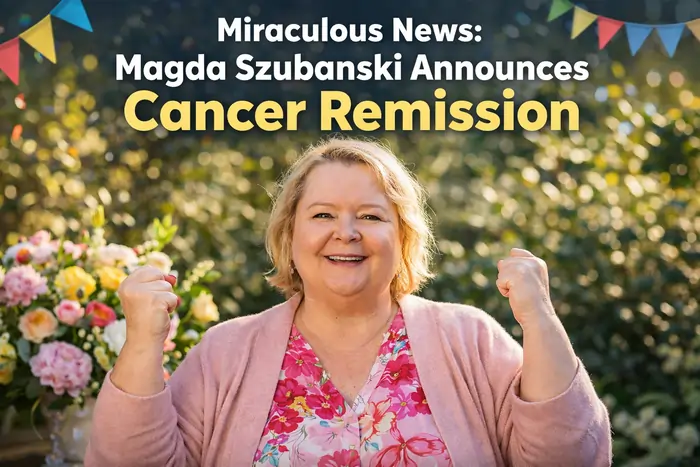
Magda Szubanski’s announcement that her cancer is in remission is a deeply moving story of shock, treatment, resilience, and relief that has resonated across Australia and beyond. This article explores her journey from diagnosis to “phew, big relief”, why this is being described as “miraculous news”, and what remission means for her future and for others facing cancer.
Introduction: A Miraculous Update from Magda Szubanski
Beloved Australian comedian and actor Magda Szubanski has revealed that she is in remission after undergoing treatment for stage 4 blood cancer, a rare and aggressive form of mantle cell lymphoma. In a video shared on Instagram, she told fans she has completed chemotherapy and is now in remission, describing it as “fantastic news” and expressing immense relief.
For many Australians who grew up watching her on television or in films, the update feels nothing short of miraculous, especially given the seriousness of her diagnosis. Her announcement has quickly become a symbol of hope, resilience, and the power of community support in the face of life‑threatening illness.
Who Is Magda Szubanski?
Before her cancer diagnosis, Magda Szubanski was already a towering figure in Australian entertainment and public life. She first came to national attention in the mid‑1980s after being discovered by ABC talent scouts while performing in a university revue, which led to TV work and eventually to household‑name status.
She is perhaps best known for playing the hapless, netball‑obsessed Sharon Strzelecki in the iconic Australian sitcom “Kath & Kim”, a role that cemented her as one of the country’s favourite comedic performers. Internationally, she gained recognition for her role as Esme Hoggett in the film “Babe” and for voice work in animated hits such as “Happy Feet.”
Beyond acting, Szubanski is a prominent LGBTQI+ rights advocate and was appointed an Officer of the Order of Australia in 2018 for her work on the marriage equality campaign. This combination of comedic talent, political courage, and emotional openness has made her a uniquely beloved figure, which helps explain the huge emotional response to her health news.
The Cancer Diagnosis: From Shock to Fight
Magda Szubanski first disclosed in 2025 that she had been diagnosed with stage 4 mantle cell lymphoma, a rare and fast‑moving type of blood cancer that forms in the lymphatic system. She described it publicly as a “very, very, very serious” cancer and “one of the nasty ones,” making clear from the outset that she was facing a tough battle.
Mantle cell lymphoma is considered a subtype of non‑Hodgkin lymphoma, arising from B‑cells located in a part of the lymph node called the mantle zone. Because stage 4 indicates that the cancer has spread beyond its original site to other tissues, it is generally viewed as difficult to cure, even when treatments can be highly effective at putting the disease into remission.
As coverage from outlets such as Yahoo News Australia and The Conversation’s explainer on mantle cell lymphoma makes clear, many patients can live for years with the condition, but relapse is common and treatment is complex. The seriousness of this diagnosis meant the public understood that Szubanski was entering a long, uncertain fight.
Treatment Journey: Chemotherapy, Challenges, and Courage
In her early statements, Szubanski said she would be starting one of the best available treatment protocols for aggressive lymphomas, indicating a regimen similar to R‑CHOP or even higher‑intensity variants sometimes used for mantle cell lymphoma. Such treatments typically combine multiple chemotherapy drugs and may involve hospital stays, close monitoring, and potentially procedures like stem cell transplant.
Over roughly nine months, she underwent several cycles of chemotherapy, losing her hair and dealing with the physical and emotional toll that comes with intensive cancer treatment. By the time she shared her remission news, her hair had regrown into a short style, which she proudly displayed in her Instagram video as a visual sign of having come through the worst of it.
Throughout this period, Szubanski stayed in touch with her followers, balancing honesty about how serious the situation was with the trademark humour that has always been part of her public persona. She also publicly addressed misinformation and fake rumours about her death, joking that social media seemed to “know more about me than I do,” even while she was still in the thick of treatment.
For more on what her treatment likely involved from a medical perspective, resources like ABC’s explainer on her blood cancer and The Conversation’s mantle cell lymphoma piece provide useful context.
Miraculous News: Magda Szubanski Announces Cancer Remission
On 26 February 2026, Magda Szubanski took to Instagram to share what she called “fantastic news”: she had completed chemotherapy and was now in remission. In her own words, she said, “I’ve completed chemo and I am now in remission — so phew, big relief,” capturing both the gravity of the journey and the joy of the outcome.
She was careful to explain that remission is not the same as a cure, saying that while the cancer has been pushed back, she will need ongoing monitoring and care. However, she emphasised that achieving a strong remission gives her a real chance to keep the cancer “at bay for a good long time,” underscoring why this news is being welcomed as miraculous by so many.
Coverage from outlets such as ABC News, SBS News, and AOL all highlight the key themes of her announcement: immense relief, deep gratitude, and an unbroken sense of humour.
Public Reaction: An Outpouring of Love and Support
The reaction to Szubanski’s remission news was immediate and overwhelming. In the comments on her Instagram video and across social media, fans and fellow public figures flooded her with messages of love, relief, and admiration for how she handled her diagnosis and treatment.
Journalist Lisa Wilkinson described it as “wonderful, WONDERFUL news,” while singer Natalie Imbruglia called it “the best news darling,” and fellow comedian Kate McLennan wrote that she was “so pleased to hear this news.” Posts from outlets like ABC News on Facebook and SBS News social channels amplified the story, further broadening the wave of support.
This outpouring mirrored the strong reaction when she first disclosed her diagnosis, and she has repeatedly said she is “eternally grateful” for the love and encouragement she has received. In interviews and posts, she has described the support as feeling like a “tsunami” that helped her not just emotionally but physically as well, suggesting she believes it contributed to her ability to endure treatment.
Understanding Remission: What It Means (and What It Doesn’t)
In her announcement, Szubanski emphasised that remission does not mean her cancer is fully cured. In medical terms, remission typically means there is no detectable evidence of active cancer using current tests, or that the disease has been significantly reduced, but it may still be present at levels too small to detect.
For mantle cell lymphoma in particular, experts generally regard the disease as difficult to cure outright with current treatments, especially at stage 4, and note that relapses are common even after successful initial therapy. The goal of treatment is often to achieve as deep and durable a remission as possible, extending life and maintaining quality of life for many years.
Resources such as ABC’s explainer on her rare stage 4 blood cancer and the detailed Q&A in The Conversation article on mantle cell lymphoma help clarify terms like “remission,” “relapse,” and “incurable but treatable” for those trying to understand what her good news means long term.
Living After Cancer: Magda’s Next Chapter
Even as she celebrates remission, Szubanski has been open about the fact that life after treatment will involve ongoing check‑ups and vigilance. In her Instagram video, she expressed “eternal gratitude” to her medical team and the public but also made clear that she is still processing what comes next for her health, work, and personal life.
She has already signalled some of the sacrifices treatment required, such as missing the Sydney Gay and Lesbian Mardi Gras, where a vantage point area at Taylor Square was rebranded “Magda’s Glitter Club” in her honour. While she said she was “gutted” not to attend, she sent love to the LGBTQI+ community and urged them to have a wonderful time, reinforcing her ongoing connection to activism and queer culture.
Looking ahead, it remains to be seen exactly how quickly she will return to regular public appearances, acting work, or new creative projects. But given her long history of using personal experience—including mental health and body image struggles—as a platform for storytelling and advocacy, it is likely her cancer journey will also inform future work and public commentary.
Hope and Awareness: Lessons from Magda’s Story
Magda Szubanski’s remission story carries several important lessons, both for individuals and for the broader conversation about cancer. First, it highlights the importance of paying attention to changes in the body and undergoing recommended screenings, since her lymphoma was detected through investigations triggered by breast screening tests.
Second, her openness underscores how powerful community support can be for people undergoing treatment. The sheer volume of messages she received—and her repeated statements that this support helped her emotionally and physically—show why staying connected to friends, family, and community is so vital during serious illness.
Finally, her journey offers a message of hope for others facing stage 4 cancers or rare blood cancers that may not be curable in the traditional sense. Expert commentary, such as that in The Conversation’s mantle cell lymphoma explainer, makes clear that even when cure is unlikely, modern treatments can provide meaningful remissions and years of good‑quality life.
Conclusion: Celebrating Magda’s Remission and Looking Ahead
“Miraculous news” feels like an accurate description of Magda Szubanski’s announcement that her stage 4 blood cancer is in remission, given how serious mantle cell lymphoma can be and how uncertain her path once looked. Her story brings together the best of what people admire about her: courage, humour, honesty, and a deep connection to community.
As she enters this next phase—living in remission, staying vigilant, and slowly rebuilding aspects of her life—many Australians will continue to follow her journey with affection and respect. For those wanting to understand more about her diagnosis and remission, key resources include her ABC News remission story, the SBS News feature on her big relief, Yahoo’s mantle cell lymphoma explainer, and The Conversation’s medical breakdown of her rare cancer.
In a year when global pop‑culture moments like Pokémon Day 2026: Australia Celebrates 30 Years of Pocket Monsters are bringing fans together around nostalgia and resilience, Magda’s remission adds a deeply human chapter to the stories shaping entertainment and public life in 2026, as explored in this feature on Pokémon Day 2026: Australia Celebrates 30 Years of Pocket Monsters.