

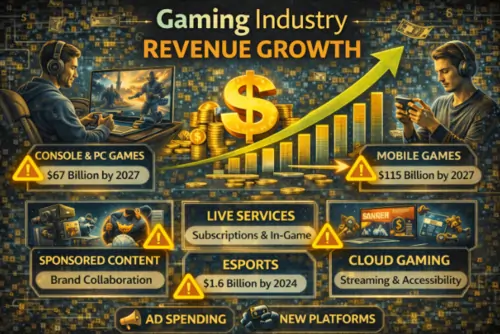
Gaming industry revenue growth means the total money the video game industry earns is increasing over time. That money can come from many places: buying games, paying for in-game items, subscriptions like game libraries, ads inside mobile games, esports sponsorships, and even movies or merchandise based on game characters.
In 2026, this topic matters because gaming is no longer “just for kids.” It’s one of the world’s biggest entertainment businesses, and it keeps changing how it earns money.
Understanding what drives growth helps creators, developers, investors, and even everyday players make smarter decisions—like which platforms will expand, why prices change, and why some games feel like they never stop updating.
What “gaming industry revenue growth” really means
When people say the gaming industry is “growing,” they often mean revenue is rising. Revenue is the money companies bring in before expenses. Profit is what’s left after paying costs like salaries, servers, marketing, and platform fees.
Revenue growth can happen even if the number of players stays almost the same. That’s because companies can increase revenue by:
- Selling more premium games
- Adding subscriptions
- Getting more in-game purchases per player
- Expanding into new regions
- Extending a game’s life with seasonal updates
Newzoo estimated the global games market would generate $187.7 billion in 2024. That gives a useful baseline for understanding how large the industry already is.
Why gaming revenue growth matters in 2026
Gaming is becoming more “everyday” entertainment. A big reason is accessibility: almost everyone has a smartphone, and many games are free to start. Mobile-first audiences are also younger on average, which matters because long-term growth often comes from people who start early and keep playing for years.
The other big reason is competition. The industry is crowded. Newzoo notes that playtime hasn’t grown the way it did during the pandemic era, and revenue is increasingly concentrated among a smaller number of major studios and games. That means “growth” now often depends on smart monetization, strong communities, and live-service updates rather than simply launching more games.
Major revenue sources in the gaming industry
Game sales: premium, indie, and expansion content
Traditional game sales are still important, especially on PC and console. Premium titles can drive large spikes in revenue when the release calendar is strong. Even smaller AA and indie games can become major earners if they hit the right audience.
Microtransactions and in-game purchases
Microtransactions include skins, battle passes, cosmetics, and virtual currency. In many top games, this is the core business model. It works best when players feel they’re paying for fun and personalization—not being forced to pay to compete.
On mobile, in-game purchases are especially important. Newzoo projected mobile revenues of $103.0 billion in 2025 (not including advertising revenue). That shows how much spending power exists in “small purchases” multiplied by millions of players.
Subscriptions and services
Subscriptions reduce risk for players (“try many games for one fee”) and stabilize revenue for platforms. They also change how people discover games, since a title can grow through being included in a library rather than relying only on direct sales.
Advertising and sponsorships
On mobile, ads can be a major revenue stream, especially for free games. Even outside gaming, brands sponsor esports teams, tournaments, and streamers because gaming audiences are large and engaged.
Esports, events, and media rights
Esports revenue comes from sponsorships, ticket sales, media rights, team partnerships, and merchandise. The industry has also faced challenges (often described as an “esports winter”), where costs rose faster than sustainable revenue. This matters because esports is still influential for player growth and brand awareness, even when the business side is tightening.
Merchandise and IP extensions
Games now expand into films, TV shows, toys, collectibles, and licensing deals. This doesn’t replace game revenue, but it adds new streams and keeps brands relevant between releases.
Market trends driving revenue growth
Mobile gaming remains the biggest engine
Mobile gaming stays huge because it removes hardware barriers. Sensor Tower reported that gaming accounted for $107.3 billion in consumer spending in app stores in 2023, making it the largest category of app spending. This helps explain why mobile-first strategies remain central for publishers.
Live-service and “games that keep updating”
Live-service models earn money over time through seasonal content, limited-time events, and constant updates. This can make revenue steadier than relying only on one big launch day.
Crossplay and shared player bases
Crossplay helps games grow by letting friends play together even on different devices. That increases retention, and retention is strongly tied to revenue because long-term players are more likely to spend.
Cloud gaming and lower hardware barriers
Cloud gaming is still developing, but the business idea is simple: stream games like video. If it becomes smoother and cheaper, it could expand PC/console-style gaming to people without high-end devices.
AI in game development
AI tools can speed up certain tasks (like testing, animation support, localization, or generating drafts of assets). The business impact is that it can reduce costs and shorten production time, but it also raises concerns about quality control, jobs, and ethical use. The studios that use AI responsibly—and still deliver great games—may scale faster.
Regional revenue growth insights
Gaming growth looks different depending on region. High-income markets often have higher spending per player, while emerging markets can have faster growth in player counts.
A helpful example is Southeast Asia. Niko Partners estimated Southeast Asia generated $5.37 billion in games revenue in 2024, up 5.2% year over year, with forecasts continuing through the decade. This matters because SEA is mobile-heavy and community-driven, with strong esports and social gaming culture.
A Filipino lens: where the Philippines fits
For Filipino readers, two realities are easy to relate to:
- Mobile-first gaming is dominant because smartphones are more common than consoles or gaming PCs.
- Value matters. Players often prefer free-to-play titles, promos, and wallet-friendly spending.
A payments-focused industry report from Antom described the Philippines as Southeast Asia’s second-largest gaming market, emphasizing a young, mobile-first player base and the role of digital wallets in gaming payments. While this is not a government statistic, it matches the broader regional pattern: the Philippines is an active gaming country where convenience (load, e-wallets, fast transactions) affects spending behavior.
How monetization models shape growth (and trust)
Revenue growth isn’t only about making it easier to spend. It’s about making spending feel fair.
Free-to-play can drive huge growth because it removes the entry price, but it can also damage trust if:
- Progress feels blocked unless you pay
- Loot boxes feel predatory
- Prices are unclear
On the other hand, premium games can build trust faster because you pay once and get the full experience—yet they’re riskier for studios because they rely heavily on launch performance.
The strongest long-term strategy for many companies is a mixed model:
- Premium releases for big spikes
- Live-service updates for steady income
- Optional cosmetic spending that doesn’t feel forced
Challenges and risks that can slow growth
Even in a huge industry, growth is not guaranteed.
Market saturation
Too many games compete for the same time. If playtime is flat, games fight to “steal hours” from each other rather than expanding total demand.
Regulation and consumer protection
Some regions tighten rules on loot boxes, gambling-like mechanics, and youth spending. Changes can reduce revenue from certain monetization styles.
Economic pressure
Gaming is entertainment spending. When budgets get tight, players may cut subscriptions, skip premium releases, or spend less on in-game items.
Platform fees and ecosystem control
App stores, consoles, and PC storefronts take a cut. Companies try to reduce dependence through direct-to-consumer strategies, but that can create friction for players if it becomes inconvenient.
What the next few years could look like (through 2028)
For the global market, Newzoo’s 2025 report shows how platform revenue is projected to distribute:
- PC revenues: $39.9B in 2025
- Console revenues: $45.9B in 2025
- Mobile revenues: $103.0B in 2025
These figures add up to roughly $188.8B for 2025 (from the same report’s platform breakdown).
The takeaway is simple: mobile remains the largest slice, but PC and console still represent a huge share—especially for premium releases and big franchise ecosystems.
Key takeaways for Filipino gamers and creators
If you’re in the Philippines and watching gaming growth, here are the most practical insights:
Mobile-first will keep winning
Not because it’s “better,” but because it’s the easiest way for most people to play. Mobile also fits Filipino habits: quick sessions, social play, and budget-friendly entry.
Community drives revenue
Games that build strong communities (guilds, squads, friend groups) hold attention longer. Longer attention usually means higher spending.
Wallet convenience matters
Digital wallets and local payment options reduce friction, which can increase spending—especially for microtransactions.
The best growth is trust-based
The games that feel fair, fun, and transparent earn longer loyalty. That’s healthier than “quick cash” monetization that burns players out.
FAQs
Is mobile gaming overtaking console revenue?
Mobile already represents the largest share of global game revenue in Newzoo’s projections.
Do microtransactions really drive most revenue?
For many top live-service and mobile games, yes—microtransactions and recurring spending are major drivers of long-term revenue.
Does esports still help revenue growth?
Yes for visibility and community, but the esports business has faced cost and sustainability pressure, pushing leagues to search for new revenue sources.
Can indie games compete with AAA in revenue?
They can, especially on PC platforms where discovery and community support can turn smaller titles into major earners, but it’s harder in a crowded market.
What should I watch if I want to understand growth in 2026?
Watch mobile spending trends, subscription changes, live-service performance, and how studios balance monetization with player trust.