

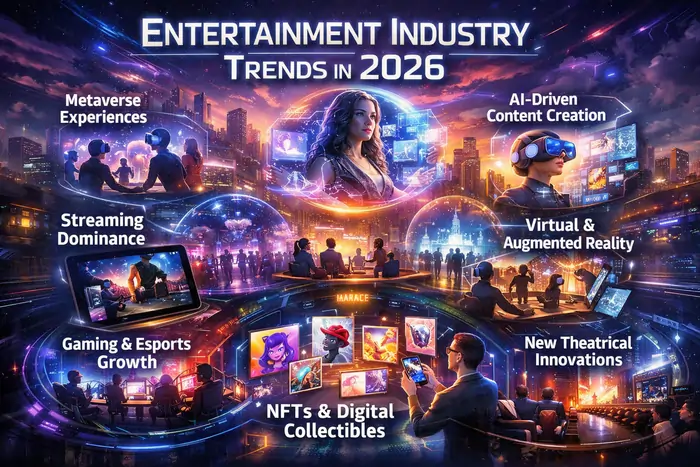
Entertainment Trends in 2026 is defined by convergence: streaming, social video, gaming, and live events are blending into a single attention ecosystem shaped by AI, creators, and new business models.
Why 2026 Is a Pivotal Year
Over the last decade, entertainment has shifted from scheduled broadcast TV to an on‑demand, multi‑platform universe where every screen competes for attention. By 2026, this transformation reaches a tipping point: streaming is mature but fragmented, social video has gone fully mainstream on the TV screen, and AI is embedded in everything from content creation to personalization. Industry analysts describe 2026 as the year when media moves from “streaming wars” to a deeper reshaping of business models and audience relationships.
This article explores key entertainment trends for 2026 across streaming, content formats, monetization, AI, the creator economy, and consumer behavior, with a special focus on how the future of media and streaming is being rewritten in real time. For a high‑level industry view, reports like EY’s analysis of 2026 media and entertainment trends and All Things Insights’ take on what 2026 holds for entertainment trends are useful companions.
The State of Streaming in 2026
By 2026, the streaming TV landscape is a mix of subscription video‑on‑demand (SVOD), ad‑supported services (AVOD), free ad‑supported streaming TV (FAST), and a steadily shrinking slice of traditional linear television. Viewers juggle multiple apps, but subscription fatigue and rising prices have pushed many households to reconsider how much they’re willing to pay for content each month. As a result, aggregation and bundling are back on the agenda, with super‑bundles combining video, music, cloud gaming, and even retail benefits under one bill.
Fragmentation has made discovery a critical battleground. Industry roundups argue that in 2026 the streaming wars pivot from a fight over library size to a fight over the “discovery funnel,” where platforms compete to help viewers find something to watch quickly. Roku’s predictions for streaming in 2026 emphasize that viewers are spending up to 20 minutes searching for content, and that AI‑driven personalization is now central to reversing that trend. Meanwhile, analysis from Streaming Media and others suggests that linear TV has reached a point of no return, with streaming capturing a growing share of viewing and ad spend.
New Business Models: From Subscriptions to Hybrid Monetization
The “all‑subscription” era is over. In 2026, leading services rely on hybrid monetization strategies that blend subscriptions, ads, FAST channels, live events, and commerce. Many premium platforms now offer cheaper ad‑supported tiers or have launched companion FAST channels to reach price‑sensitive audiences and capture incremental ad revenue. Advertising‑backed viewing on connected TV (CTV) is estimated to exceed 40 percent of total TV viewing in some markets, with forecasters expecting further growth.
Dynamic ad insertion and programmatic buying enable more granular targeting and measurement than traditional TV, while attention‑based KPIs and cross‑screen metrics help brands understand impact across devices. Retail media and shoppable formats are also moving into streaming, allowing viewers to click or scan to buy products featured in shows and ads, shortening the path from inspiration to conversion. For a deeper look into the shift, Wordbank’s overview of 10 streaming and entertainment trends for 2026 explains how localization and new ad models are reshaping global strategies.
Content Formats of the Future
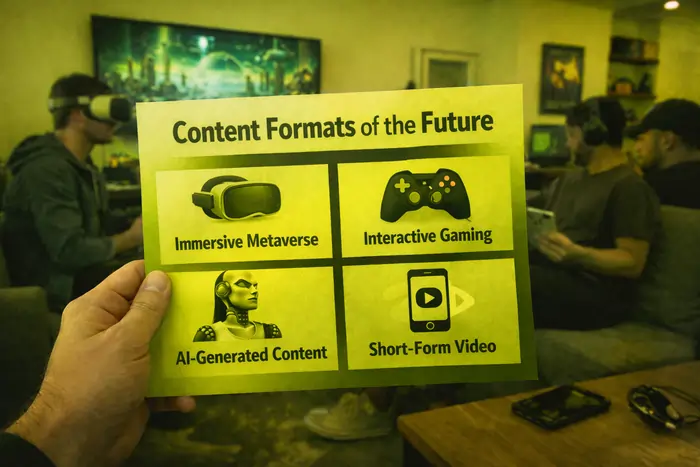
Content formats are evolving just as quickly as platforms. One major trend is the continued rise of short‑form and vertical video beyond mobile‑only environments. Analysts note that social‑style formats once confined to phones are increasingly consumed on TVs and integrated into streaming apps, blurring the lines between “social” and “premium” content. Forbes’ list of media trends redefining entertainment in 2026 points out that storytelling for small screens—snackable episodes, vertical cuts, and micro‑dramas—is now a core creative strategy, not just a marketing tactic.
At the other end of the spectrum, eventized content remains crucial. Live sports, tentpole series, and global concert streams act as “churn‑busters” that keep subscribers engaged and justify higher ARPU. Research from TheWrap notes the migration of live sports to streaming platforms and its impact on fan culture, with new digital‑first experiences emerging around live events. Interactive and choose‑your‑own‑story experiences are also gaining traction, as platforms experiment with branching narratives, social watch‑alongs, and real‑time polls to deepen engagement. MainStreaming’s predictions for the future of video streaming in 2026 highlight low‑latency tech and interactivity as key enablers.
AI and Personalization in Media & Streaming
AI is now a core partner in media rather than a side experiment. On the front end, AI‑driven personalization powers smarter recommendations, dynamic home screens, and tailored previews that adapt to each viewer’s tastes. Roku predicts that a new wave of AI‑driven personalization will significantly reduce the time it takes viewers to find their next watch, with recommendations surfacing both at the OS level and inside individual apps.
Behind the scenes, generative AI is entering production workflows: creating localized trailers, synthetic voices for dubbing, automated highlight reels, and even virtual influencers. Forbes’ piece on media trends in 2026 discusses “generative video” hitting prime time and the emergence of synthetic celebrities, while industry consultants warn that differentiation will depend more on taste and storytelling than on the technology itself.
AI‑powered analytics also help platforms decide which projects to greenlight, how to package catalogs, and which cohorts are at risk of churn. EY’s 2026 trend report emphasizes AI as a driver of production efficiency, personalization, and immersive experiences, but stresses that authenticity and trust remain essential. The Reuters Institute’s journalism, media, and technology predictions add that AI search and summarization are changing how audiences discover news and entertainment content alike.
The Creator Economy Moves to the Big Screen
The creator economy in 2026 is no longer limited to social feeds; it’s moving aggressively onto connected TV and into the center of entertainment strategy. Roku predicts that creators will expand their presence on CTV through licensing deals, ad‑supported channels, and curated “creator” tabs, and that at least one major streamer beyond YouTube will launch a dedicated creator hub. Streaming Media Global’s industry predictions for 2026 also foresee creators bypassing social networks and going straight to living‑room screens via AVOD and FAST platforms.
All Things Insights notes that “creator convergence”—the blurring of lines between Hollywood and creators—is a defining entertainment trend for 2026. Studios are increasingly treating social platforms as development pipelines, using creator‑led content to test formats, talent, and IP before scaling to bigger projects. Brand‑funded entertainment, where creators co‑develop longer‑form series or specials with sponsors, continues to grow as advertisers seek more authentic integrations. Elixirr’s look at media and technology trends for 2026 underscores how social video and long‑form shows are converging on the TV screen.
Many creators are effectively treating their channels as a side hustle that can grow into a full‑time venture; for professionals considering a similar path outside media, this guide on starting a side business while working full‑time walks through the practical steps and mindset shifts involved.
Globalization and Local Stories
Global streaming platforms are doubling down on local‑language originals, even as regional services gain strength in their home markets. Viewers increasingly expect content that feels “local everywhere”—expertly localized and culturally attuned, not just subtitled. Wordbank’s analysis of streaming and entertainment trends for 2026 argues that localization quality is now a competitive differentiator and a key driver of subscriber growth.
At the same time, cross‑border hits continue to flourish, with global fandoms forming around Korean dramas, Latin American series, anime, and European crime thrillers. Regulatory frameworks in some regions push platforms to meet local production quotas or adapt to data and content rules, influencing commissioning decisions and catalog composition. EY’s trends report notes that live sports and gaming are also central to global growth, as rights holders experiment with digital‑first distribution strategies.
User Experience: Friction, Discovery, and Fatigue
As options multiply, user experience becomes a make‑or‑break factor. Fragmentation across dozens of apps and services has led to “subscription clutter” and decision fatigue for many viewers. Reports highlight that consumers are actively seeking simplicity, authenticity, and experiences that feel less like navigating a maze of menus and more like being guided to something they’ll genuinely enjoy.
To address this, platforms and device makers are investing in unified search, cross‑app watchlists, and universal discovery layers that sit above individual services. Roku’s 2026 predictions stress that personalization will increasingly be expressed at the OS level, where home screens adapt dynamically to each user’s tastes. ExchangeWire’s “Predictions 2026: A New Era for TV?” points out that interactive, shoppable, and personalized ad formats are also becoming part of the core UX, not just add‑ons.
However, media consultants warn about “content fatigue” and the need to respect attention spans. Forbes’ discussion of media trends in 2026 notes that dynamically adjusting episode length, generating smart recaps, and designing modular storytelling are tools to keep audiences engaged without overwhelming them.
Advertising and Measurement in a Streaming‑First World
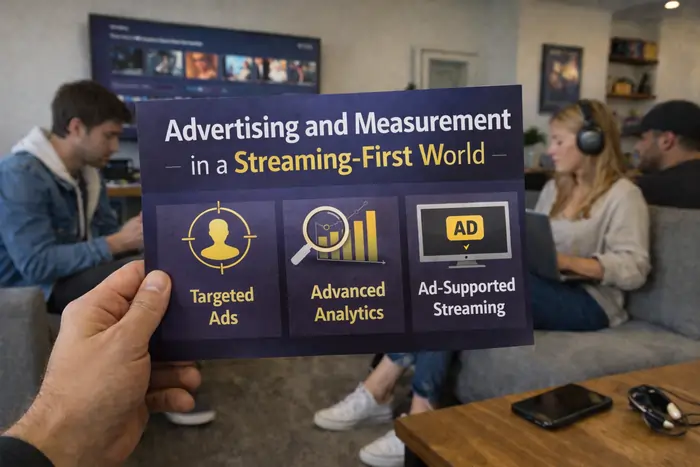
With streaming solidifying its dominance, advertising and measurement are undergoing rapid change. Traditional panel‑based TV measurement is giving way to cross‑screen attribution, attention metrics, and outcome‑based KPIs that span linear, CTV, mobile, and desktop. Advertisers increasingly demand consistent metrics across walled gardens and open web inventory, pushing for more transparency and unified planning tools.
Connected TV offers richer data than linear, enabling campaigns based on household characteristics, viewing behavior, and even retail purchase data. Roku’s forecast suggests that by 2026 “the ad‑free viewer goes extinct” as 100 percent of audiences are exposed to some form of video advertising, whether through AVOD tiers, FAST channels, or in‑experience formats. Streaming Media’s prediction roundup notes that as live sports move further into streaming, advertisers will need unified strategies across linear, addressable, and CTV to maintain reach.
Retail media networks are testing shoppable video and commerce‑enabled placements inside streaming environments, especially around cooking, fashion, and home improvement content. Strategic reports like AlixPartners’ 2026 media and entertainment predictions argue that AI‑driven optimization will make campaigns more efficient, but that brand safety, privacy, and creative differentiation will remain central concerns.
Challenges and Risks for the Entertainment Industry
Despite growth, the entertainment industry faces serious headwinds in 2026. Profitability pressures are intense: content spending remains high while subscriber growth slows in mature markets, pushing companies to cut costs, rethink slates, and seek new revenue streams. Streaming consolidation, layoffs, and shifting priorities around original programming are likely to continue as firms hunt for sustainable business models.
Piracy and account sharing remain stubborn issues, particularly in price‑sensitive regions. Password‑sharing crackdowns have had mixed results, with some platforms seeing revenue gains but also risking churn if consumers feel squeezed. Algorithmic bubbles and cultural homogenization are another concern: as recommendation systems prioritize engagement, there is a risk of narrowing exposure to diverse content and voices.
Finally, the rapid adoption of AI raises ethical questions around deepfakes, synthetic performers, and the future of creative labor. Forbes and All Things Insights both highlight the tension between AI‑powered formats and human‑centric storytelling, warning that audiences will increasingly reward authenticity and purpose. Policymakers and industry bodies are beginning to grapple with IP protection in the AI age, but guidelines are still evolving.
Looking Ahead: What the Future of Media & Streaming Could Look Like
Looking beyond 2026, analysts sketch competing scenarios for the future of media and streaming. One possibility is a world dominated by a handful of “everything hubs” that bundle content, commerce, and services into a few super‑apps; another is a more fragmented universe of niche, passion‑driven platforms serving specific fandoms. ExchangeWire’s predictions suggest TV will become more interactive, measurable, and commerce‑enabled, effectively merging with digital advertising and e‑commerce.
Emerging technologies like AR, VR, and spatial computing may play a bigger role in immersive entertainment, particularly for live sports, concerts, and gaming‑adjacent experiences. Elixirr’s trends outline how social video, vertical formats, and long‑form shows will continue to coexist on TVs and headsets alike, making format boundaries less relevant. At the same time, journalism and news media are experimenting with AI assistants, personalized briefings, and new funding models, as described in the Reuters Institute’s 2026 predictions.
Across scenarios, a few themes remain constant: audiences value simplicity, authenticity, and control over how they spend their time and data; creators and communities wield more influence; and AI sits in the background shaping experiences, for better or worse. For a concise synthesis, 5ly’s overview of the biggest media and entertainment trends for 2026 frames the year as a tipping point where app development, streaming consolidation, and tech disruption collide.
Conclusion: How to Stay Ahead of Entertainment Trends in 2026
For viewers, 2026 is both a golden age of choice and a minefield of complexity; the best strategy is to be intentional about which platforms you keep, lean on recommendation tools you trust, and pay attention to how your attention is being shaped. For creators, the opportunity lies in building strong IP, authentic communities, and flexible distribution strategies that span social, streaming, and live experiences.
For media brands and marketers, staying ahead means embracing hybrid monetization, investing in AI‑driven personalization and measurement, but grounding decisions in clear values and audience insight rather than chasing every shiny object. As multiple analyses point out, 2026 is less about winning a “streaming war” and more about earning long‑term trust in a world where entertainment is everywhere and attention is scarce.