

Childcare hours in Australia are changing fast. With a new three‑day (72‑hour) minimum of subsidised care and updated Child Care Subsidy rules, families have more support to balance work, study and children’s needs. However, choosing the right number of childcare hours still means weighing cost, quality, and your child’s wellbeing. This guide explains the key updates, how they affect you, and what to consider before increasing hours.
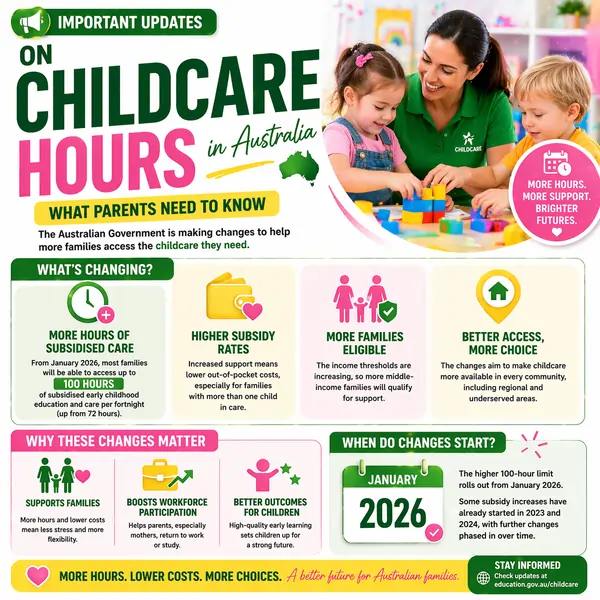
Australia has introduced and proposed several major changes to childcare hours and subsidies, including a new three‑day (72‑hour) minimum of subsidised care per fortnight for all Child Care Subsidy (CCS)–eligible families from 5 January 2026, alongside broader debates about how many hours in care are developmentally appropriate for children and families. These reforms sit within a wider Childcare Hours Study Australia discussion that looks at affordability, access, and the impact of long childcare hours on children and families.
If you are researching Childcare Hours Study Australia for work, study or your own family, it is now critical to understand how these childcare hours updates change your entitlements, daily routines, and long‑term planning.
1. Overview of Childcare Hours in Australia
Australian families use a mix of long day care, family day care, preschool, and outside school hours care, often for 30–40 hours per week or more, depending on work patterns and the age of their children. The federal government supports this through the Child Care Subsidy (CCS), which reduces out‑of‑pocket fees for approved services and is administered by Services Australia.
To understand how many hours you can claim, the best starting point is the official Services Australia guide on hours of subsidised child care for Child Care Subsidy. This page explains how subsidised hours are calculated, including the new three‑day guarantee and special provisions for different family circumstances.
From January 2026, the system is designed so that all CCS‑eligible families can access at least three days of subsidised early learning each week, even if they have low or irregular recognised activity levels. This baseline is one of the central findings you will see referred to in Childcare Hours Study Australia commentary and sector analysis.
For an explanation of how CCS works overall, including eligibility, income thresholds and provider responsibilities, the Department of Education maintains a clear overview at Child Care Subsidy – Department of Education.
2. The New 72‑Hour Minimum (Three‑Day Guarantee)
From 5 January 2026, all CCS‑eligible families can get at least 72 hours of subsidised childcare per fortnight for each child, which is usually equal to three full days a week in a long day care setting. These changes are officially referred to as the 3 Day Guarantee and are clearly outlined on Starting Blocks’ information page 3 Day Guarantee: changes to Child Care Subsidy (CCS).
The three‑day guarantee effectively softens the impact of the activity test because you do not need to meet a minimum level of recognised activity to access those first 72 subsidised hours. This means parents with casual or low weekly hours of work or study, or those caring for other family members, can still secure regular early learning for their child if they meet general CCS eligibility.
Several early learning providers have created parent‑friendly explainers that translate these policy changes into practical scenarios. For example, Woodville Alliance’s guide Child Care Subsidy Changes 2026 Explained: Guide for Families shows how a family’s subsidised hours may effectively double under the new rules. Likewise, My Little Scholars’ article Child Care Subsidy changes in 2026: What Families Need to Know walks through key benefits of the three‑day guarantee for different income and activity profiles.
In Childcare Hours Study Australia–focused reports and media analysis, this 72‑hour minimum is viewed as a structural shift toward recognising early childhood education as a fundamental service for all children, not just a workforce support for parents.
3. Changes to the Activity Test and Access
Before these reforms, the number of CCS hours you could receive was tightly linked to your fortnightly recognised activity (work, training, study or volunteering) through the CCS activity test, which sometimes limited access for families with insecure or variable work. To understand the technical detail of how recognised participation works, you can refer to the Family Assistance Guide – CCS recognised participation.
Under the new settings from 2026, all CCS‑eligible families receive a baseline 72 hours of subsidised care per fortnight, and families with more than 48 hours of recognised activity can receive up to 100 hours per fortnight. These changes are summarised on Services Australia’s main CCS page Child Care Subsidy – Services Australia, which also links to application steps through myGov.
The legislative foundation for the three‑day guarantee is the Early Childhood Education and Care (Three Day Guarantee) Bill 2025, which can be read in full on the Australian Parliament website. The bill consolidates a range of updates around minimum hours, First Nations entitlements and simplification of CCS access, all frequently cited in Childcare Hours Study Australia policy reviews.
For practical guidance on how your activity test result translates into hours, the myGov page Managing child care also outlines how CCS is paid, how absences work and what happens if your circumstances change.
4. Affordability, ACCC and Productivity Commission Findings
The Australian Competition and Consumer Commission (ACCC) conducted a major inquiry into childcare that found affordability and access issues across many parts of the country. The ACCC’s media release Changes proposed to make childcare affordable and accessible for all families highlights key recommendations to improve pricing transparency, regulate fees more effectively and ensure supply in under‑served areas.
Complementing this, the Productivity Commission’s report on early childhood argued that all Australian children should have access to at least three days a week of high‑quality early learning. Victoria University’s article The Productivity Commission wants all Australian kids to get 3 days a week of childcare provides an accessible summary of these recommendations and how they may influence future funding and entitlement models.
These two external resources are among the best for understanding how Childcare Hours Study Australia is shaping high‑level policy thinking on cost, access and equity. They are often used by media, advocacy groups and researchers when analysing whether current reforms go far enough to address barriers for low‑income and regional families.
5. Developmental Concerns About Long Childcare Hours
Alongside policy and cost, growing attention is being paid to the impact of extended childcare hours on children’s emotional and cognitive outcomes. A recent segment from 9 News titled Why long childcare hours is damaging kids reports on experts warning about potential risks associated with very long days in formal care, including emotional regulation issues and stress.
Educators and advocates are also voicing concerns on social platforms. For example, The Curiosity Approach shared reflections on Australian childcare hours and children’s experiences in centres, sparking discussion about whether the current model is too “institutional” for very young children. These practitioner perspectives are an important qualitative layer in Childcare Hours Study Australia, complementing more formal academic research.
For those wanting academic evidence, the Productivity Commission childcare modelling supplement and research such as Winefield & Piteo’s work on parents’ needs and expectations regarding out‑of‑school care shed light on how hours, quality and family preferences intersect. Together, these sources underline that the quality of care and stability of relationships matter just as much as the number of hours a child spends in a centre.
6. Special Provisions for Aboriginal and Torres Strait Islander Children
One of the most significant equity‑focused updates is the guarantee of 100 hours of subsidised care per fortnight for Aboriginal and Torres Strait Islander children. This is clearly set out in both the Services Australia guide to hours of subsidised child care and the Starting Blocks explainer on the 3 Day Guarantee.
These enhanced hours are designed to support regular participation in early education, strengthen culturally safe service delivery and contribute to Closing the Gap targets. The Parliament’s bill digest for the Three Day Guarantee Bill and the Productivity Commission’s broader recommendations frame these provisions as essential for addressing historical disadvantage and promoting children’s wellbeing.
For families and services seeking more detail, the Department of Social Services’ Family Assistance Guide also outlines how special provisions and safety‑net measures interact with the activity test for First Nations children. This targeted expansion of hours is a key case study in Childcare Hours Study Australia debates about universal versus targeted entitlements.
7. Evolving Legislation and Safety Standards
Childcare legislation in Australia is also shifting in areas beyond hours and subsidy, with a strong focus on safety, compliance and workforce quality. Kirana Colleges provides a useful sector‑wide snapshot in its article Current Changes to Childcare Legislation Across Australia, which explains how staffing ratios, qualification requirements and regulatory enforcement are tightening across states and territories.
For people interested in working in early childhood education, training providers like Ausstudies offer detailed course guides such as Early Childhood Education Courses in Australia for 2026 that outline legal and practical requirements. These external links help situate Childcare Hours Study Australia within the broader context of workforce capability, quality frameworks and professional development.
Meanwhile, the University of Sydney’s guide Bringing your family to Australia gives international families a practical overview of how childcare and schooling work locally, including typical hours and expectations. This kind of resource is particularly helpful for parents trying to compare Australian childcare hours with arrangements in other countries.
How Many Hours Can You Actually Use?
In practice, there is a difference between your entitled subsidised hours and the hours you can actually book with your chosen service. Many long day care centres still operate on fixed daily sessions (often 10–12 hours), meaning that using three days may consume most or all of your 72 subsidised hours regardless of the exact drop‑off and pick‑up times.
Provider explainers such as Great Beginnings’ Child Care Subsidy Explained and Roseberry House’s Child Care Subsidy Changes 2026 – 3 Day Guarantee Explained show how different session structures can stretch or compress your subsidy across the fortnight. They also highlight examples of families shifting from two to three days of care once the new guarantee begins, changing their weekly routines and costs.
From a formal policy perspective, Services Australia’s Recognised participation and activity test for CCS page explains how up to 100 hours of subsidy may be available for families with high activity levels or specific circumstances. This is a crucial technical reference for anyone analysing Childcare Hours Study Australia and modelling how real families use their entitlements across different service types.
Implications for Parents and Work Choices
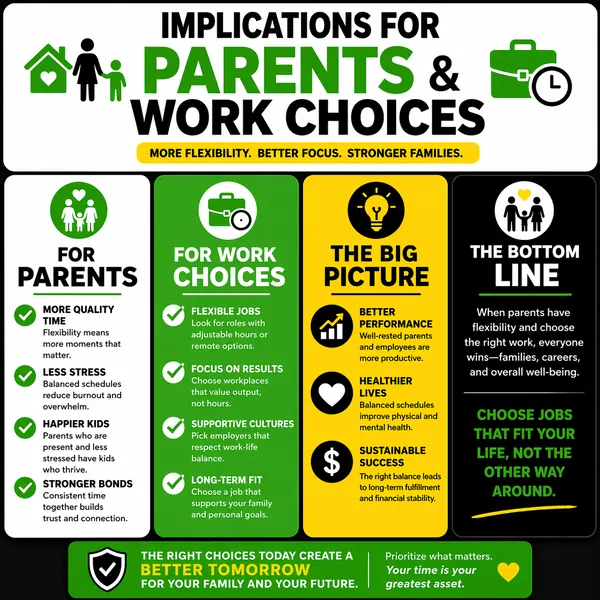
For many families, the three‑day guarantee can change how viable part‑time work, casual shifts, study or job‑seeking feels. Early learning providers like My Little Scholars and Woodville Alliance offer worked examples showing how a parent previously restricted to 36 hours per fortnight under the activity test can now access 72 hours, effectively doubling their subsidised hours and allowing an extra day or two of care.
This shift is central to much Childcare Hours Study Australia commentary, which links improved access to early learning with increased women’s workforce participation and reduced financial stress for low‑ and middle‑income households. However, expert and community discussions (such as those on social platforms and in news coverage) also warn that longer hours in care are not always the best option for every child, especially if service quality is mixed.
International students and migrant families often face additional complexity in managing childcare while meeting visa work limits. Discussion threads like the Facebook group post on childcare while studying or working show real‑life experiences of families juggling limited work rights, high fees and limited CCS eligibility. Combining these lived experiences with official resources like the Child Care Subsidy – Services Australia page gives a more complete picture of how childcare hours intersect with broader migration and employment policies.
Future Directions in Childcare Hours Policy
The three‑day guarantee and related CCS reforms are widely seen as a major step, but not the end of childcare hours reform in Australia. The ACCC’s recommendations on affordability and the Productivity Commission’s call for three days of universal access provide a roadmap for potential future changes, ranging from higher subsidy rates for low‑income families to more direct public provision of care.
Parents, educators and researchers interested in where Childcare Hours Study Australia may head next should monitor a few core sources:
- Child Care Subsidy – Services Australia for live updates on eligibility, rates and application processes.
- Hours of subsidised child care and Recognised participation and activity test for technical detail on hours and activity rules.
- 3 Day Guarantee: changes to CCS for family‑friendly explanations of the 2026 changes.
- Child Care Subsidy – Department of Education for policy context and provider information.
- ACCC and Productivity Commission publications linked above for system‑wide analysis and future reform options.
Conclusion
Childcare hours in Australia are undergoing major reform, with the three‑day (72‑hour) guarantee and updated Child Care Subsidy settings reshaping how families balance early learning, work, and wellbeing. As Childcare Hours Study Australia research continues to evolve, parents will increasingly need to weigh not just affordability and entitlement, but also service quality, flexibility, and long‑term educational pathways for their children.
For families thinking ahead to school and tertiary education, it can be helpful to look at innovative learning models and high‑performing institutions further along the education journey. Articles like University of Technology Sydney (UTS) Explained: Courses, Rankings and Benefits provide a practical overview of how a technology‑focused, industry‑connected university supports graduate outcomes and career readiness. Likewise, understanding unique school environments such as Lindfield’s progressive K–12 model is valuable; the piece 9 Things That Set Lindfield Learning Village Apart from Other Schools highlights how a “stage not age” approach, flexible learning spaces and strong student voice can shape a child’s schooling experience.
Seen together, high‑quality early childhood services, innovative schools, and well‑ranked universities form a continuous learning ecosystem that supports children from their first day in care through to their future careers. By staying informed about childcare hours, subsidy changes and educational options at every stage, families can make more confident, future‑focused decisions that align with their values and their children’s needs.
Frequently Asked Questions About Childcare Hours Study Australia
What is “Childcare Hours Study Australia”?
It refers to research and policy analysis on how many hours children spend in care, how subsidies work, and how this affects affordability, access, and child development.
Why are childcare hours such a big issue in Australia?
Childcare hours are linked to cost-of-living pressures, workforce participation, and children’s outcomes, making them a key policy focus.
What is the three-day (72-hour) childcare guarantee?
It provides at least 72 subsidised hours per fortnight for eligible families, even with low or irregular work schedules.
Does more childcare mean better outcomes?
Not always. Quality of care matters more than total hours, and very long hours in low-quality settings may cause stress.
How can I choose the right childcare hours for my child?
Look at:
- Educator-to-child ratios
- Daily routines and environment
- Your child’s age, temperament, and needs
Are there recommended maximum hours per week?
There’s no strict limit, but experts caution against very long weeks (50+ hours), especially for young children.
How does research influence childcare policy?
Studies guide decisions on subsidies, minimum hours, and access rules, shaping programs like the Child Care Subsidy (CCS).
What signs show my child may be overwhelmed?
Watch for:
- Sleep issues
- Meltdowns or withdrawal
- Reluctance to attend childcare
Can part-time childcare still benefit children?
Yes. Even two days per week can support social skills, language, and school readiness if the quality is high.
How do childcare hours affect long-term education?
Early experiences can shape confidence, curiosity, and learning habits, influencing later school and career outcomes.
Why are innovative schools relevant to this topic?
Schools like Lindfield Learning Village reflect modern, flexible learning approaches that build on early childhood experiences.
How does university planning connect to childcare?
Early education choices can influence long-term pathways, including institutions like University of Technology Sydney.
What should new or international families know?
They should understand local subsidy rules, typical childcare hours, and cultural expectations in Australia.
How can busy parents apply this research?
Start by:
- Checking subsidy eligibility and costs
- Choosing a safe, nurturing service
- Adjusting hours based on your child’s response
Where can I learn more?
Reliable sources include:
- Government childcare resources
- Early learning providers
- Research-based guides and case studies
These insights help parents balance child development, affordability, and work needs when choosing childcare hours.