

Business intelligence tools in 2026 center on AI‑driven insights, self‑service analytics, and cloud‑native architectures, with platforms like Microsoft Power BI, Tableau, Qlik Sense, Looker, and Zoho Analytics leading most shortlists. Choosing the best platform for data insights now means balancing ease of use, governance, integration, and total cost of ownership rather than just picking the tool with the most charts.
What Are Business Intelligence Tools in 2026?
Business intelligence (BI) tools are software platforms that connect to multiple data sources, model and clean that data, then surface insights through dashboards, visualizations, and reports. In 2026, the category has expanded to include AI copilots, natural language querying, and automated insights that proactively highlight anomalies and opportunities without waiting for users to ask.
Modern Business intelligence tools typically combine data integration, semantic modeling, visualization, self‑service dashboards, governed metrics, and collaboration features in a single cloud or hybrid environment. Many leading vendors now also embed low‑code or no‑code automation and workflow capabilities so business users can act on insights directly from dashboards.
A practical way to think about Business intelligence tools in 2026 is as a decision intelligence layer that sits between raw data infrastructure (warehouses, lakes, SaaS apps) and the business, translating data into actions at scale. For example, a sales VP can get a daily AI‑generated summary of pipeline risks, while a product manager gets automated alerts when feature adoption dips below a defined threshold.
For a concise primer, you can check this overview of business intelligence tools.
Key Features to Look For in 2026
When you evaluate Business intelligence tools platforms for data insights in 2026, several feature categories consistently show up as must‑haves.
- Data integration and connectivity: Native connectors to cloud warehouses like Snowflake, BigQuery, and Amazon Redshift, plus databases, spreadsheets, and SaaS apps, are now table stakes.
- Data modeling and semantic layer: Tools increasingly offer reusable, governed metrics layers and central data models so teams work from a single version of truth, as seen in platforms like Looker and Power BI.
- Data visualization and interactive dashboards: Rich chart libraries, cross‑filtering, drill‑throughs, and responsive layouts remain core user expectations, particularly in tools such as Tableau and Qlik Sense.
- Natural language query (NLQ) and AI copilots: Users can type or speak questions like “What drove churn last quarter?” and get narrative explanations, charts, and suggested follow‑up questions through features such as Power BI Copilot and ThoughtSpot search.
- Automated insights and anomaly detection: Platforms scan data for outliers, trends, and correlations, then surface them as notifications or “insight cards,” as described in this article on the future of business intelligence.
- Collaboration and storytelling: Commenting, data stories, and portal experiences let teams share context, not just charts, as highlighted in the Gartner Magic Quadrant for Analytics and BI.
- Governance, security, and compliance: Role‑based access, row‑level security, lineage, and auditability are critical for regulated industries and large enterprises, particularly in platforms like IBM Cognos Analytics and SAP Analytics Cloud.
- Deployment flexibility: Vendors increasingly support cloud, on‑premises, and hybrid options to align with your infrastructure and data residency requirements.
An example of these trends in action is Microsoft Power BI Copilot, which combines NLQ, automated narrative summaries, and direct analysis on data lakes to reduce time‑to‑insight.
Top Business Intelligence Platforms for Data Insights in 2026
Numerous rankings converge on a similar core set of BI leaders, though each tool has distinct strengths and ideal use cases.
1. Microsoft Power BI – Best Overall for Microsoft Shops
Microsoft Power BI remains one of the most widely adopted Business intelligence tools platforms, with notable market share and a long streak in the Leaders quadrant of Gartner’s analytics and BI Magic Quadrant. It integrates deeply with Excel, Azure, SQL Server, Microsoft Fabric and the broader Microsoft 365 ecosystem, making it a natural choice where those tools already dominate.
Key strengths include an intuitive interface, rich visualization options, and strong data modeling capabilities that support both self‑service and enterprise‑scale reporting. Recent releases add Copilot‑style AI that can generate reports, explain drivers behind metrics, and help users build DAX measures with conversational prompts.
For more details and pricing, you can explore the Power BI product page.
2. Tableau – Premier Data Visualization and Enterprise Analytics
Tableau continues to lead in visual analytics and interactive data exploration. It enables users to rapidly build rich, interactive dashboards and perform drag‑and‑drop analysis that’s especially popular with data analysts and business users who value visual flexibility.
Salesforce has expanded Tableau with Einstein AI and Tableau Pulse to deliver automated insights, natural language summaries, and proactive data stories. Organizations already invested in Salesforce CRM often benefit from native integrations, enabling end‑to‑end analytics on customer data, pipelines, and service performance.
You can learn more from the official Tableau product overview.
3. Qlik Sense – Associative Analytics and AI‑Driven Insights
Qlik Sense stands out through its associative analytics engine, which lets users explore data relationships without being tied to predefined SQL queries. This makes it easier to uncover hidden patterns and correlations across large, complex datasets, especially in scenarios with many dimensions and data sources.
In 2026, Qlik pairs this associative model with AI features like Qlik Insight Advisor, which recommends charts and insights, and robust governance for enterprise deployments. Qlik Sense also offers strong hybrid cloud options and mobile‑first experiences, supporting organizations with distributed workforces.
For a deeper look at Qlik’s approach, visit the Qlik Sense product page.
4. Looker (Google Cloud) – Semantic Modeling and Embedded BI
Looker emphasizes a centralized semantic model defined in LookML. This allows teams to codify business metrics once and reuse them across dashboards, embedded analytics, and ad‑hoc queries, reducing metric drift.
Recent updates leverage Google Gemini for Looker to enhance natural language querying, generate explanations, and support cross‑cloud analytics. Looker is particularly attractive for data‑mature organizations that want governed models on top of warehouses such as BigQuery or Snowflake, and extensive embedded BI capabilities.
To explore features and architecture, see the Looker business intelligence overview.
5. Zoho Analytics – Best for Small and Mid‑Size Companies
Zoho Analytics appears frequently as a top BI option for small businesses thanks to its affordability and integration with Zoho’s broader SaaS suite. It offers data connectors, drag‑and‑drop dashboards, AI‑assisted insights (Zia), and reporting with relatively low overhead and fast setup.
This makes it a strong choice for teams that need practical dashboards and reports across marketing, sales, finance, and operations without the complexity of enterprise‑grade platforms. In addition, Zoho’s cloud‑native architecture simplifies administration, making it attractive where IT resources are limited.
You can review capabilities and templates on the Zoho Analytics features page.
6. Sisense – Embedded Analytics and Developer‑Friendly APIs
Sisense focuses on embedding analytics into products and internal tools through robust APIs and modular architecture. It allows software teams and enterprises to build branded analytics experiences, from interactive dashboards inside SaaS apps to custom data‑driven portals.
The platform provides flexible data pipelines, support for complex transformations, and AI‑assisted analytics, making it suitable for high‑volume, multi‑tenant environments. This emphasis on embedded BI positions Sisense well for ISVs and organizations monetizing data through analytics features.
You can learn more by visiting the Sisense embedded analytics resource pages.
7. Domo – Cloud‑Native BI and External Sharing
Domo is a cloud‑native BI platform known for its ease of sharing analytics outside the organization, such as with partners, vendors, and customers. It combines data integration, visualization, workflows, and app‑building in one environment, enabling users to create interactive dashboards and lightweight data apps.
The tool is often recommended where organizations need to blend disparate data quickly and publish insights via secure external portals or mobile apps. By packaging analytics and workflows, Domo aims to shorten the path from insight to action for non‑technical users.
See examples and templates at the Domo business intelligence solutions page.
8. Lumenn AI and Next‑Gen AI‑Native Platforms
Newer entrants like Lumenn AI are positioning themselves as AI‑first enterprise analytics platforms, focusing on natural language analytics and automated dashboard generation. Lumenn AI, for instance, lets users query data with plain language, auto‑build dashboards, and refine SQL generated by the AI through its “SQL Refinery” experience.
These platforms often emphasize in‑place analytics (querying directly on live databases), AI‑driven data quality monitoring, and self‑service capabilities for non‑technical stakeholders. While still maturing compared with long‑established vendors, AI‑native BI tools demonstrate where the category is heading: conversational, automated, and tightly integrated with operational workflows.
You can explore this next‑gen category via the Lumenn AI platform overview.
9. Other Notable Business intelligence tools Platforms
Several other tools frequently appear in 2024–2026 rankings and the Gartner Magic Quadrant.
- SAP BusinessObjects and SAP Analytics Cloud – Strong in large enterprises and SAP‑centric environments.
- IBM Cognos Analytics – Long‑standing enterprise BI with robust governance and AI‑powered NLQ.
- SAS Visual Analytics and SAS Viya – Advanced analytics and statistical modeling for data‑heavy industries.
- MicroStrategy – Emphasizes governance, open platform, and now MicroStrategy AI for GenAI‑assisted analytics.
- ThoughtSpot – Search‑driven analytics with strong natural language and AI explanations.
For a broad overview across many vendors, the Gartner Analytics and Business Intelligence Magic Quadrant summaries remain a valuable resource to cross‑check strengths and cautions.
How BI Tools Deliver Data Insights in 2026
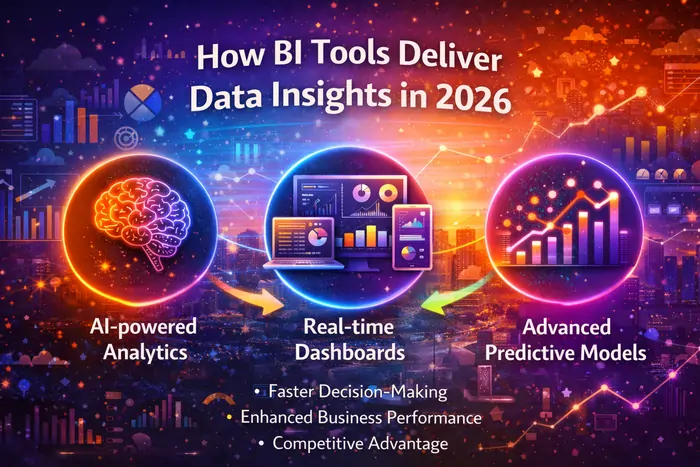
The value of Business intelligence tools now lies less in static dashboards and more in how effectively they turn continuous data streams into timely, actionable insights. Several mechanisms are common across leading platforms.
- Proactive alerts and anomaly detection: Tools monitor KPIs in real time and alert owners when metrics deviate from expected ranges, often with AI‑generated explanations, as described in this article on the future of BI.
- Guided analytics and decision workflows: Embedded recommendations and playbooks help users decide what to do when a metric crosses a threshold.
- Conversational analysis: Natural language interfaces let users ask follow‑up questions iteratively, similar to search‑driven platforms like ThoughtSpot and AI‑assisted Lumenn AI.
- Scenario modeling: Some platforms allow quick what‑if analysis on revenue, churn, or capacity, helping decision‑makers compare potential outcomes, as covered in this guide to data analytics tools.
As an example, modern Power Business intelligence tools or Tableau deployments can send a weekly narrative briefing summarizing key wins, risks, and trend shifts to executive teams, reducing the need for manual reporting decks. Similarly, Qlik Sense and ThoughtSpot use AI to suggest next‑best questions and highlight unusual combinations of factors, pushing users toward deeper insight discovery.
How to Choose the Right BI Tool for Your Organization
Selecting the best Business intelligence tools in 2026 requires aligning vendor capabilities with your data maturity, tech stack, and user base. You can shortlist tools more effectively by assessing several dimensions.
1. Technical Stack and Integrations
- If you are heavily invested in Microsoft (Office 365, Azure, Dynamics), Power BI will usually offer the smoothest integration and cost structure.
- If you rely on Google Cloud and BigQuery, Looker and Looker Studio often provide native advantages.
- For diverse or legacy stacks, tools like Qlik Sense, Tableau, and IBM Cognos Analytics offer broad connector support and hybrid deployment models.
2. User Types and Self‑Service Needs
- For non‑technical business users who need search‑driven analytics, ThoughtSpot, Lumenn AI, and Power BI Copilot are strong candidates.
- For analyst‑driven organizations that want deep visual exploration, Tableau and Qlik Sense are often preferred.
- For small businesses that need quick wins and low admin overhead, Zoho Analytics, datapine, and similar cloud BI tools work well.
For small businesses that need quick wins and low admin overhead, Zoho Analytics, datapine, and similar cloud BI tools work well. If you are an entrepreneur or running one or more side hustles in Australia, pairing lightweight BI dashboards with your side business can help you track revenue, margins, and growth more professionally.
3. Governance, Security, and Compliance
- Highly regulated industries should prioritize platforms with mature governance, data lineage, and compliance certifications like IBM Cognos Analytics, SAP Analytics Cloud, MicroStrategy, and enterprise deployments of Power BI or Tableau.
- If you need multi‑tenant or embedded analytics with robust row‑level security, Sisense, Qlik, and Looker are worth deeper evaluation.
4. Cost and Licensing
Vendors offer a mix of per‑user, per‑capacity, and embedded usage‑based pricing. Power Business intelligence tools often wins on price for Microsoft customers, whereas Tableau and Qlik may carry higher per‑user costs but deliver value in visual flexibility and advanced analytics.
For cost comparisons and TCO planning, reference third‑party guides like this Top BI tools 2026 buyer’s guide. These independent breakdowns often highlight hidden costs such as data egress, premium AI features, and admin overhead.
5. Roadmap and AI Strategy
Given the rapid pace of AI innovation, you should evaluate not only current features but also vendor roadmaps around copilots, generative insights, and integrations with LLM ecosystems. Gartner and industry blogs (for example, this look at the future of business intelligence) can help assess which vendors are likely to keep leading versus lagging.
Practical Three‑Column Comparison of Leading BI Tools (2026)
| Tool | Best For | Key Strengths |
|---|---|---|
| Microsoft Power BI | Microsoft‑centric orgs, broad self‑service | Copilot AI and NLQ, tight Microsoft and Fabric integration, strong price‑performance |
| Tableau | Visual analytics, data‑savvy teams | Best‑in‑class visualizations, Einstein AI and Tableau Pulse, strong Salesforce ecosystem |
| Qlik Sense | Complex, multi‑source analytics | Associative engine, Insight Advisor AI, robust governance and mobile‑first experience |
| Looker | Governed metrics and embedded BI | Central semantic layer, Gemini‑powered NLQ, strong embedded and cross‑cloud analytics |
| Zoho Analytics | SMBs, quick deployments | Affordable cloud BI, Zia AI assistant, easy integration with Zoho apps |
| Sisense | Embedded analytics, ISVs | Developer‑friendly APIs, flexible data pipelines, strong embedded BI focus |
| Domo | External sharing, business apps | Cloud‑native, rapid integration, strong external portals and data apps |
| IBM Cognos | Large enterprises, regulated sectors | Mature governance and security, AI‑assisted NLQ, hybrid deployment options |
| SAP Analytics Cloud | SAP‑centric enterprises | Tight SAP integration, combined planning and analytics, augmented analytics |
| ThoughtSpot | Search‑driven analytics | Google‑like search UX, natural language search and AI explanations, strong for ad‑hoc questions |
Exploring vendor documentation, case studies, and trials through each vendor’s site (for example, Microsoft, Tableau, Qlik, Google Cloud, Zoho, SAP, and IBM) will help validate how these characteristics hold up in your environment.
Future Trends Shaping Business Intelligence Beyond 2026
Trend analyses suggest that BI over the next few years will keep moving from static reporting toward continuous, context‑aware decision intelligence.
- Agentic AI and copilots: Business intelligence tools will act more like agents that can monitor KPIs, trigger workflows, and even initiate remediation actions, not just answer questions.
- Data observability and reliability: As data stacks grow, reliability checks, lineage, and automated data quality monitoring will become embedded expectations within BI workflows, as described in this future of BI trends piece.
- Unified analytics and planning: Boundaries between BI, planning, and operational tools will blur, especially in platforms like SAP Analytics Cloud and Microsoft Fabric.
- Deeper embedding in apps: The line between “application” and “analytics” will increasingly disappear as embedded BI becomes standard in SaaS products and internal tools, a trend highlighted across many of the top BI tools 2026 rankings.
Resources like this overview on the future of business intelligence offer a concise look at these emerging trends and how they interact with data engineering and observability practices. Similarly, Magic Quadrant analysis and independent guides such as the Top BI tools 2026 guide provide updated snapshots of market direction each year.