

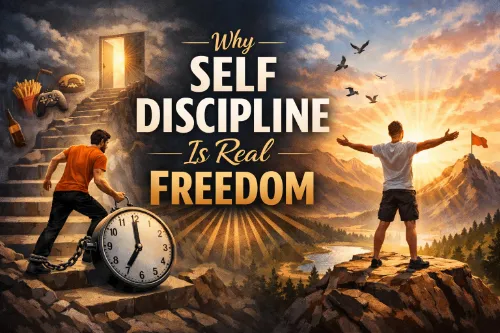
Self discipline feels restrictive in the moment, but over time it’s what gives you the freedom to choose your life instead of being dragged around by impulses, debt, or other people’s agendas. This article unpacks why “self discipline is real freedom” and shows how to build that freedom in practical ways.
What Do We Mean By “Real Freedom”?
Most people think freedom means “doing whatever I feel like,” yet that definition often leads to addiction, chaos, and regret. Philosophers and modern performance coaches argue that real freedom is the ability to direct yourself toward what truly matters, consistently and voluntarily.
- Pythagoras is often paraphrased as saying, “No man is free who cannot control himself,” implying that without self‑control, you are a slave to impulses.
- Modern Stoic‑style thinkers echo this: if you can’t say no to distractions, unhealthy habits, or fear, you’re not free—you’re just unrestrained.
- Jocko Willink puts it bluntly: “Freedom is what everyone wants… But the only way to get to a place of freedom is through discipline.”
You can use Willink’s Forbes interview, “The Relationship Between Discipline And Freedom,” as a foundational external resource for this framing.
Why Discipline And Freedom Are Not Opposites
On the surface, discipline (rules, structure) and freedom (choice, flexibility) look like opposites—but they’re deeply intertwined.
- Willink explains that if you want financial freedom, you first need financial discipline; if you want more free time, you must discipline your schedule and say no to time‑wasting activities.
- Coach Michelle Weimer notes that being disciplined with your time, thoughts, focus, and habits actually gives you more freedom later to do what you love, with the people you love.
- Aristotle defined freedom as “obedience to self‑formulated rules”: the more consistently you act according to your chosen principles, the freer you become from chaos and external control.
Weimer’s article “Discipline Equals Freedom” is a helpful modern, coaching‑oriented take that you can link when you talk about time, focus, and routines.
The Psychology: How Self Discipline Expands Your Options
Psychologically, self discipline is a form of self‑control—the capacity to choose long‑term benefits over short‑term gratification. Over time, that ability expands your options instead of shrinking them.
- PositivePsychology.com summarises dozens of studies showing that self‑control and discipline help you manage impulses, reduce stress, and make better decisions by prioritising long‑term gains.
- Longitudinal research finds that higher self‑control in childhood predicts better grades, less TV watching, lower BMI, higher income, and greater occupational success decades later.
- People with strong self‑control are less likely to engage in behaviours that lead to legal problems, health issues, or financial crises, all of which dramatically limit freedom.
You can link directly to “40+ Benefits of Self‑Control and Self‑Discipline” to give readers a research‑heavy list of long‑term benefits.
Areas Where Discipline Creates Freedom
To make the “discipline equals freedom” idea concrete, it helps to show specific domains where structure today produces freedom tomorrow.
1. Time: Scheduled Days → Free Evenings
- When you plan your day and stick to it, you get more of the important things done sooner, which creates true free time rather than constant catch‑up.
- Michelle Weimer points out that lack of discipline in planning and executing your day means you’ll struggle to achieve anything; discipline in daily routines is what gets you to your goals and creates free time on the other side.
2. Money: Financial Discipline → Financial Freedom
- Willink uses money as a core example: if you want financial freedom, you must practise budgeting, saving, and saying no to impulsive spending.
- Without disciplined choices, you end up stuck with high‑interest debt and living paycheck‑to‑paycheck—technically “free” to spend, but not free to choose your future.
3. Health: Consistent Habits → Energy And Mobility
- Aeologic’s overview of self‑discipline benefits notes that disciplined exercise and healthy eating improve both physical and mental health.
- This converts into freedom years later: freedom from preventable disease, from chronic fatigue, and from needing constant medical intervention just to live your life.
4. Emotions: Self‑Control → Freedom From Inner Chaos
- Cornell’s learning blog explains that self discipline helps reduce stress and anxiety because you spend less time worrying about things you can’t control and more time acting on what you can.
- When you’re less reactive and more intentional, you’re freer to stay calm, choose your response, and avoid drama you don’t want to be part of.
Aeologic’s “Self‑Discipline Benefits and its Importance in Your Life” and Cornell’s “How Self Discipline Can Improve Your Whole Life” are solid sources to back up these claims.
The Philosophical Roots: Ancient Ideas, Modern Lives
The idea that discipline is freedom isn’t new; it runs through Greek philosophy, Stoicism, and modern psychology.
- Aristotle argued that humans are defined by our capacity to choose actions; our free will is enhanced when we adopt habits aligned with our goals and moral values.
- In an Aristotelian framework, “freedom is obedience to self‑formulated rules”—you are most free when you live by principles you’ve chosen, not when you chase every desire.
- Adlerian psychology similarly suggests that inner discipline enables genuine freedom; without self‑control, liberty is ultimately meaningless.
A YouTube explainer, “How To Improve Your Self Discipline – Aristotle,” breaks down five Aristotelian steps—believing in free will, strengthening moral principles, overcoming desires, being temperate, and practising discipline daily—that you can reference when connecting ancient thought to modern practice.
Common Myths: “Discipline Kills Creativity And Joy”
A big reason people resist discipline is the belief that it kills spontaneity or creativity. In reality, disciplined frameworks can protect your creative and joyful time.
Myth corrections you can highlight:
- Myth: Discipline is punishment.
Reality: As Weimer notes, when you think of discipline as self‑control rather than punishment, you see it as a gift you give yourself to create the life you want. - Myth: Discipline means no fun.
Reality: Structured work times often lead to more guilt‑free leisure, because you’re not procrastinating or working in every spare minute. - Myth: Creative people can’t be disciplined.
Reality: Many successful creatives use disciplined routines—set writing hours, practice times, or digital boundaries—to protect their creative energy.
Court Schurman’s blog “Discipline Equals Freedom: How to Dive Deep Into Change” is a good external link when you discuss personal development and creativity.
Practical Ways To Use Discipline To Gain Freedom
It’s not enough to agree with the concept; readers need tangible ways to apply it. You can frame this as building “freedom‑creating disciplines” in a few key areas.
1. Time Discipline
- Plan your day the night before and protect blocks for deep work, rest, and relationships.
- Say no to low‑value commitments so your schedule reflects your priorities instead of other people’s.
2. Money Discipline
- Create a simple budget and stick to it; automate savings to build future freedom.
- Cut or cap high‑interest debt so you’re not locked into years of payments that limit your choices.
3. Health Discipline
- Commit to a baseline routine (e.g., daily walking, fixed sleep window, or a simple workout) to preserve long‑term energy and mobility.
- Choose consistent, moderate habits over extreme, short‑lived programs.
4. Mental And Emotional Discipline
- Practise small acts of self‑control: pausing before reacting, limiting mindless scrolling, and intentionally focusing your attention.
- Use routines (morning, evening) to anchor your day and reduce decision fatigue.
Coach Scotty Russell’s piece “The Value of Self-Discipline: Are You Taking Advantage?” is a practical link to share when you talk about focus, inner strength, and having “something to show” for your discipline.
How To Start: Small Disciplines, Big Freedom
Getting started doesn’t require an extreme boot‑camp; real freedom comes from small, consistent disciplines that compound.
You can suggest a simple starter plan for readers:
- Pick one area of desired freedom. Time, money, health, or emotional calm.
- Define what freedom looks like there. For example, “Debt‑free,” “Two free evenings a week,” or “Enough energy to play with my kids after work.”
- Design one tiny daily discipline. A 15‑minute budgeting session weekly, a 20‑minute walk daily, or 30 minutes of focused work before checking messages.
- Track it and review weekly. Ask, “Did this discipline give me even a little more freedom yet?” and adjust as needed.
PositivePsychology.com’s benefits article and Cornell’s blog both stress that self‑discipline is trainable and that even small gains in self‑control can meaningfully improve wellbeing, grades, health, and career outcomes—exactly the freedoms most people want.