

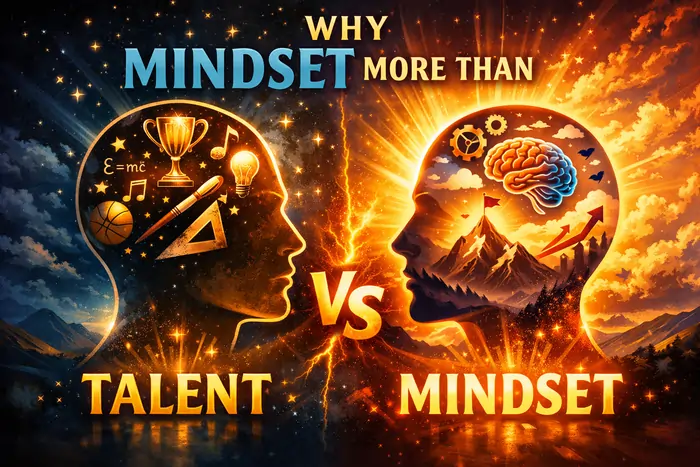
Mindset shapes how far your talent can actually take you, which is why mindset vs. talent is the real debate behind most success stories.
Mindset vs. Talent: What’s the Real Difference?
When people talk about success, they often focus on talent—natural ability, inborn gifts, or being “born for” something. But behind the scenes, it’s usually mindset—your beliefs about growth, effort, and learning—that determines whether that talent is developed or wasted.
At a basic level, mindset is the set of beliefs and attitudes you hold about yourself and the world. It acts like a lens that shapes how you think, feel, and behave in any situation, including how you respond to challenges and setbacks. In the context of success, the most influential distinction is between a growth mindset and a fixed mindset, concepts popularized by psychologist Carol Dweck. You can find a clear primer on what mindset is and why it matters in this overview from Verywell Mind.
Talent, on the other hand, usually refers to natural aptitude—how easily something comes to you at the beginning. Being “good at math,” “musical,” or “athletic” from a young age is often framed as proof of talent, but that says little about whether someone will continue to improve or succeed over the long term.
The problem is that many people overvalue talent and underestimate mindset. Damien Frearson captures this well in his article on why mindset matters more than talent, where he notes that talent may open doors, but it’s mindset that keeps them open by driving action, persistence, and adaptability. When you zoom out across careers, sports, and creative fields, the pattern is clear: mindset determines whether talent grows, stagnates, or fades.
The Power of a Growth Mindset
A growth mindset is the belief that abilities can be developed through effort, learning, and smart strategy, while a fixed mindset sees intelligence and talent as mostly static. The Growth Mindset Institute explains that people with a growth mindset focus on learning and improving, while those with a fixed mindset focus on looking talented and avoiding mistakes that might expose their limits.
In daily life, this difference shows up everywhere. Someone with a fixed mindset might say, “I’m just not a math person” or “I can’t draw,” treating ability as a label, whereas a growth-minded person thinks, “I don’t get this yet, but I can learn it with practice and the right approach.” Articles like this breakdown of growth vs fixed mindset show how that single word “yet” keeps the door open to improvement instead of shutting it.
When you look at learning scenarios—like picking up a new language, starting a side project, or improving at public speaking—the pattern repeats. The “talented” beginner often coasts on early ease and avoids hard tasks, while the growth-minded beginner stumbles, persists, and eventually surpasses the naturally gifted person who stopped stretching.
Ahead gives a practical angle on this in their piece on why a growth mindset matters more than talent when learning new skills. They show how growth-minded learners engage with challenges differently, treat mistakes as data, and push through discomfort—all of which dramatically accelerates learning.
A growth mindset changes how you interpret effort and struggle. Instead of seeing effort as proof you’re “not good enough,” you see it as the path to getting better. Instead of viewing setbacks as a verdict, you treat them as feedback. Over time, this orientation compounds into better skills, stronger resilience, and more opportunities.
Why Mindset Matters More Than Talent for Success
Talent certainly helps, but without the right mindset it often plateaus. Mindset influences whether you keep going when things get hard, how you respond to feedback, and whether you turn obstacles into fuel or excuses.
The article “The Secret to Success: Why Mindset Matters More Than Talent” from Travelpreneur Tribe points out that people with a growth mindset are more inclined to take action, learn from mistakes, and persevere in the face of adversity. These behaviors—not just raw ability—are critical components of long-term success.
Research backs this up. A study on growth and fixed mindsets about talent and career outcomes found that students who believe talent can be developed show higher self-efficacy in career exploration and talent development. That means they’re more confident exploring opportunities, building skills, and taking proactive steps in their careers.
In practice, this looks like:
- Choosing to practice deliberately instead of relying on what comes easily.
- Staying with a difficult project instead of quitting when early comfort disappears.
- Seeking feedback instead of avoiding it to protect your ego.
Reven Concepts explains this dynamic well in “Talent vs. Skill: How Mindset Shapes Your Potential”: talent might give you a head start, but skill—built through effort, feedback, and repetition—is what sustains excellence. A growth mindset fuels that skill-building process, often allowing someone with average starting talent to surpass the naturally gifted person who never developed discipline.
Common Myths About Talent and Natural Ability
Several persistent myths keep people trapped in a talent-focused mindset. They sound reasonable on the surface but quietly limit how much you’re willing to learn or try.
Myth 1: “You either have it or you don’t.”
This myth suggests that ability is binary and fixed. In reality, most skills exist on a continuum, and almost everyone starts as a beginner. The article “What is talent – A growth mindset approach” emphasizes that talent is better viewed as potential that can be developed, not a permanent label.
Myth 2: “If it’s hard, it means I’m not talented.”
Difficulty is often interpreted as a sign you’re in the wrong lane, but it usually just means you’re stretching beyond your comfort zone. Ahead’s growth mindset article mentioned earlier reinforces that growth-minded learners see struggle as a natural part of mastering new skills, while fixed-mindset learners treat it as proof they should stop. In reality, difficulty is where the brain adapts and strengthens.
Myth 3: “Talented people don’t fail like this.”
Many people think truly talented individuals don’t experience major setbacks, but success stories are full of rejection, plateaus, and reinvention. Northern Primrose’s piece on why mindset matters more than talent emphasizes that resilience, not flawlessness, is what separates those who grow from those who stay stuck.
By challenging these myths and reframing them through a growth lens, you create room to improve instead of shutting down at the first sign of friction.
How to Shift from Talent-Obsessed to Mindset-Focused
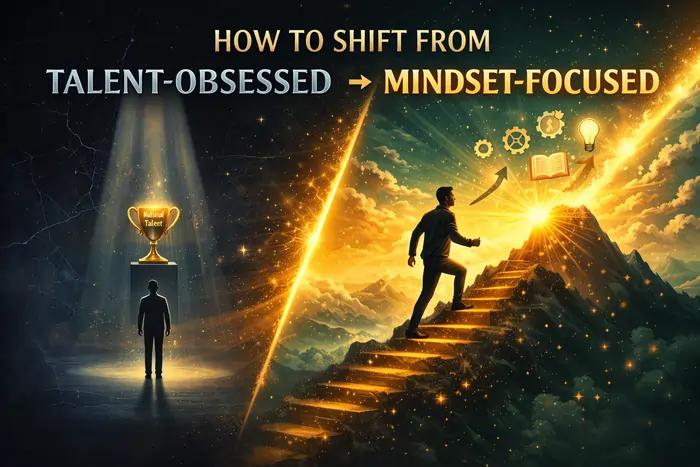
Shifting from a talent-obsessed view to a mindset-focused one is a practical process, not a single “aha moment.” It involves examining your beliefs, redefining what success and failure mean to you, and building daily habits that reinforce a growth mindset.
Step 1 – Notice Your Current Beliefs
Start by observing your self-talk around learning, performance, and mistakes. Do you say things like “I’m just not the creative type,” “I’m terrible with money,” or “I’ll never be a natural leader”? These are fixed-mindset statements disguised as facts.
You can use reflection questions such as:
- “What skills have I decided I ‘just don’t have’?”
- “How do I react when I’m not instantly good at something?”
- “Do I see others’ success as proof I’m behind, or as evidence of what’s possible?”
Adrian Baillargeon’s article on why mindset matters more than you think notes that simply becoming aware of limiting beliefs can be a turning point—because mindsets are, at their core, just beliefs, and beliefs can be updated.
Notice how often you tie your identity to performance: “I failed, so I am a failure,” versus “I failed at this attempt, so I have something to learn.” That small shift is the beginning of a new mindset.
Step 2 – Redefine Failure and Success
Next, redefine what “failure” and “success” mean in your context. In a talent-obsessed frame, failure is evidence that you lack ability, and success is proof that you’re gifted. In a growth frame, failure becomes feedback, and success is tied to effort, learning, and progress.
You can start by setting process goals as well as outcome goals. For example:
- Not just “get promoted,” but “volunteer for one challenging project each quarter.”
- Not just “hit X revenue,” but “speak to five potential customers weekly.”
- Not just “be a better speaker,” but “deliver one talk per month and review the recording.”
The Learning Scientists’ discussion of growth mindset and grit interventions notes that a growth mindset doesn’t make talent irrelevant, but without persistence and resilience, talent rarely translates into long-term achievement. Viewing setbacks as training rather than verdicts helps you stay in the game long enough for your skills—and results—to catch up.
Step 3 – Build Habits That Support a Growth Mindset
Finally, reinforce your new mindset with concrete habits. Mindset shifts stick when your daily actions start to align with them.
Northern Primrose suggests in their mindset article that practicing a growth mindset daily—especially by viewing challenges as opportunities—is what gradually rewires how you respond to difficulty.
Helpful habits include:
- Setting learning goals (e.g., “learn one new sales technique each month”) instead of only performance goals.
- Seeking feedback regularly, asking “What’s one thing I could improve?” and acting on it.
- Taking small, deliberate risks: pitching ideas, publishing content, trying new strategies even when you don’t feel fully ready.
Reven Concepts emphasizes that when people commit to growth and treat challenges as opportunities, they mold raw talent into true expertise. Over time, these small habits compound, creating a genuine success mindset that supports you across different roles and seasons of life.
Mindset vs Talent in Career and Business
In career and business, mindset vs talent shows up very clearly. Technical skills and credentials matter, but employers and clients increasingly look for learning agility—your capacity to adapt, upskill, and handle change.
The study on growth and fixed mindsets about talent and career outcomes found that a growth mindset about talent is linked to higher self-efficacy in career exploration and talent development. In other words, people who believe they can grow their abilities are more proactive in managing their careers.
In practice, this means:
- Being willing to learn new tools and methods as industries evolve.
- Seeing restructuring or role changes as chances to expand your skill set.
- Treating feedback, market shifts, or failed projects as information to adjust your approach.
Keystone Partners’ explanation of a strategic talent mindset highlights how organizations benefit when leaders adopt a mindset that talent can be developed, not just hired. Pair that with a personal growth mindset, and you get a powerful combination: companies that invest in people, and people who actively grow into new opportunities.
For individuals, focusing on mindset means intentionally building resilience, curiosity, and adaptability as part of your professional identity—not just your resume. Sometimes that mindset leads to big, uncomfortable decisions, like leaving a stable role that no longer fits your values or growth. Real-world stories like The Courage to Quit show how people use a growth mindset to walk away from “good on paper” careers and step into the uncertainty of something more aligned, trusting their ability to learn, adapt, and rebuild.
Developing a Success Mindset in Daily Life
Mindset isn’t just a career lever; it shapes how you show up in your everyday life. A success-oriented mindset helps you handle stress, relationships, health goals, and personal projects with more flexibility and self-trust.
You can cultivate this success mindset with simple practices like:
- Journaling about what you learned each day, not just what you checked off.
- Reframing obstacles (“This is annoying, but it’s teaching me patience / negotiation / problem-solving.”).
- Taking micro-actions toward long-term goals, even on days when motivation is low.
Adrian Baillargeon’s article on why mindset matters more than you think emphasizes the idea of “becoming is better than being”—focusing on who you’re becoming through effort instead of clinging to static labels like “talented” or “not talented.”
In relationships, a growth mindset helps you believe that communication and connection can improve with effort, rather than assuming “this is just how things are.” In health, it shifts you from all-or-nothing thinking (“I messed up my diet today, so it’s ruined”) to incremental progress (“Today didn’t go as planned, but I can make a better choice at the next meal”).
The more you practice, the more your identity shifts from “I’m either good or not” to “I’m someone who can learn almost anything if I stick with it.” That identity is incredibly powerful because it frees you to experiment, iterate, and evolve.
Final Thoughts: Choosing Mindset Over Talent
Talent is a great starting point, but it’s not a reliable strategy. Without a growth-oriented mindset, even the most gifted person can stall the moment things stop being easy. With the right mindset, however, you can turn average beginnings into extraordinary outcomes through deliberate practice, resilience, and smart adaptation.
The recurring theme across research and real-world stories is simple: mindset matters more than talent because it controls what you do with whatever talent you have. You don’t need to deny talent or pretend it doesn’t exist; you just need to stop treating it as destiny and start treating mindset as your main competitive edge.
To put this into action, choose one area of your life—career, fitness, creativity, relationships—and commit to a small, growth-focused experiment this week: try something slightly beyond your current comfort level, expect it to feel awkward, and do it anyway.
In many ways, this is exactly what it means to choose growth over comfort, a theme captured in stories like Choosing Growth Over Comfort, where leaders deliberately step into challenge because they value who they become on the other side more than the ease of staying where they are. In doing so, you’ll be living the core truth behind mindset vs. talent that who you become is less about what you start with and more about how you think, learn, and persist over time.