

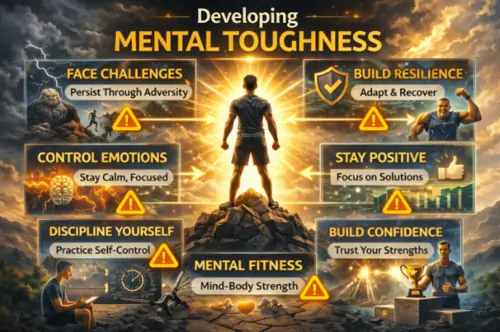
Developing mental toughness means training yourself to stay steady under pressure, keep going when you don’t feel like it, and bounce back after setbacks.
It’s not about pretending you’re okay or forcing yourself to “be strong” all the time. It’s about building reliable habits that help you perform and live better—especially when life is stressful.
For many Filipinos, developing mental toughness matters because daily life can be demanding: school deadlines, job pressures, family responsibilities, financial worries, and online comparisons. When stress is constant, you need skills that keep your mind stable and your actions consistent.
This guide explains developing mental toughness in a simple, practical way—no complicated theories, just tools you can use.
What mental toughness really is (and what it isn’t)
Mental toughness is often misunderstood.
Developing mental toughness is not:
- being emotionless
- suppressing feelings
- acting like nothing hurts
- pushing yourself until burnout
- using “tiis lang” as an excuse to ignore your needs
Developing mental toughness is:
- discipline (doing the work even when motivation is low)
- emotional control (responding instead of reacting)
- resilience (recovering faster after failure)
- focus (staying on what matters, not distractions)
- adaptability (adjusting when plans change)
Think of it like strength training. You don’t become strong by wishing. You become strong by repeating small, consistent actions.
Signs you’re becoming mentally tough
You’re developing mental toughness if you notice these changes:
- You do important tasks even when you don’t feel ready
- You recover faster after embarrassment or failure
- You can handle criticism without collapsing
- You stay calmer during conflict
- You focus on what you can control
- You stop quitting just because it feels uncomfortable
Mental toughness usually shows up quietly. It’s not about showing off. It’s about staying consistent.
The biggest things that break mental toughness
Before you build, know what destroys it.
Lack of sleep
When you’re sleep-deprived, your emotions become louder and your focus becomes weaker. Developing mental toughness is much harder when your body is exhausted.
Overthinking and perfectionism
Perfectionism makes you delay action because you fear mistakes. Mental toughness grows through action, not perfect planning.
Fear of failure and “hiya”
In Filipino culture, shame can feel heavy. But developing mental toughness means accepting that embarrassment is temporary—while quitting can become permanent.
Negative self-talk
If your inner voice is harsh, you’ll avoid challenges. Toughness needs a supportive mindset, not constant self-attack.
Toxic environments
If you’re surrounded by constant negativity, your emotional energy drains fast. Developing mental toughness sometimes includes changing your environment or limiting exposure.
Foundations of developing mental toughness
Before advanced techniques, fix the basics.
Sleep, food, hydration, movement
Mental toughness is not only mental. Your brain needs fuel.
Start simple:
- sleep at a consistent time for 5–7 days
- drink water regularly
- eat enough protein and real meals
- move daily (even a 15-minute walk)
You don’t need a perfect lifestyle. You need stability.
Identity beyond results
If your identity is “I am my grades” or “I am my performance,” setbacks will crush you.
A tougher identity sounds like:
“I am a person who learns and improves.”
That mindset makes failure less personal.
Support system
Developing mental toughness does not mean doing everything alone. Strong people ask for guidance. Mentors, friends, coaches, and family support make pressure easier to manage.
Core skills for developing mental toughness
Skill 1: Control the controllables
This is a mental toughness rule that reduces stress instantly.
Control:
- effort
- preparation
- attitude
- response
- consistency
Release:
- other people’s opinions
- unfair events
- luck
- the past
- outcomes you cannot fully control
Developing mental toughness means putting your energy only where it can actually change something.
Skill 2: Discipline over motivation
Motivation is unstable. Some days you feel inspired, some days you don’t.
Discipline means:
“I do it anyway.”
Start with micro-habits:
- 10 minutes of review
- 10 minutes of training
- 5 minutes of planning
- 1 difficult task before scrolling
Small actions build proof. Proof builds confidence. Confidence supports toughness.
Developing mental toughness is easier when your habits are small enough to repeat daily.
Skill 3: Reframe pressure
Pressure can feel like a threat:
“If I fail, I’m finished.”
Or pressure can feel like readiness:
“This matters, so I will prepare.”
A simple reframe:
“I’m not nervous. I’m prepared and alert.”
This shifts your body from panic to performance.
Skill 4: Emotional regulation under stress
Mental toughness does not mean you never feel anxiety. It means you can calm yourself.
Use these tools:
Box breathing (30 seconds)
- inhale 4 seconds
- hold 4 seconds
- exhale 4 seconds
- hold 4 seconds
Repeat 2–3 rounds.
Pause before response
When triggered, don’t speak immediately. Drink water. Walk. Respond later.
Grounding (5–4–3–2–1)
Name 5 things you see, 4 you feel, 3 you hear, 2 you smell, 1 you taste.
Developing mental toughness often starts with learning to slow down.
Skill 5: Recover from failure like a professional
Failing is not the problem. Staying down is the problem.
Use a 3-step “fail review”:
- What happened? (facts only)
- What was in my control?
- What is my next step within 24 hours?
This turns failure into feedback.
If you do this after every setback, developing mental toughness becomes automatic.
Developing mental toughness in real life
For students
Common challenges:
- exam pressure
- deadlines
- public speaking
- comparison with classmates
Simple toughness habits:
- study in short focus blocks (25 minutes)
- practice 1 hard subject daily
- review mistakes instead of hiding them
- stop scrolling before sleep
For athletes
Common challenges:
- competition nerves
- losing streaks
- criticism from coaches
- injury recovery
Toughness habits:
- focus on process goals (effort, technique, recovery)
- use breathing before games
- track training consistency instead of only wins
- rebuild confidence through small skill reps after injury
For workers and entrepreneurs
Common challenges:
- rejection
- uncertainty
- long projects
- hard conversations
Toughness habits:
- do the hardest task first
- separate feedback from identity
- build routines that reduce decision fatigue
- practice difficult conversations weekly
A simple 30-day plan for developing mental toughness
Week 1: Build a stable routine
- consistent sleep schedule
- one micro-habit daily (10 minutes)
- stop “zero days” (do something even if small)
Week 2: Practice discomfort daily
- cold shower for 30 seconds OR
- 10-minute walk when you don’t feel like it OR
- one hard task before entertainment
Week 3: Pressure training
- timed tasks (finish a work block in 25 minutes)
- practice under mild stress (mock test, rehearsal)
- limit distractions (phone away)
Week 4: Resilience building
- do a fail review after every mistake
- set one boundary that protects your energy
- reflect weekly: “What improved?”
By day 30, you won’t be “perfectly tough,” but developing mental toughness will feel real because you have proof.
Myths about mental toughness
Myth: Strong people don’t feel anxiety.
Truth: They feel it, but they manage it.
Myth: Mental toughness means never resting.
Truth: Rest is part of performance.
Myth: You’re born tough or not.
Truth: Developing mental toughness is learnable.
Myth: Being harsh on yourself makes you tougher.
Truth: It usually causes burnout and avoidance.
When mental toughness is not enough
If you’re dealing with:
- panic attacks
- constant hopelessness
- trauma symptoms
- thoughts of self-harm
- inability to function daily
That’s not a “toughness” issue. That’s a health issue. Professional support is a strong move, not a weak one.
If you’re in immediate danger, contact local emergency services or a trusted person right away.
FAQs
How do I develop mental toughness fast?
Start with daily micro-discipline: one small task you do no matter what.
Is mental toughness the same as confidence?
No. Confidence is belief. Mental toughness is consistency under pressure.
Can I become mentally tough if I’m sensitive?
Yes. Sensitivity becomes strength when you learn regulation and boundaries.
What’s the best daily habit for mental toughness?
Doing one uncomfortable but useful action every day.
How do I stay tough without becoming cold?
Practice firmness with self-compassion: disciplined action, kind inner voice.