

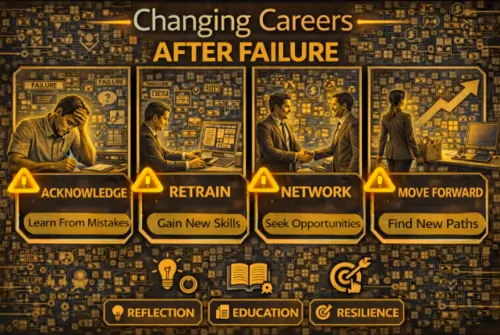
Introduction
Failure can feel final when it affects your career. A lost job, failed business, rejected opportunity, public mistake, or long period of underperformance can shake confidence and make the future seem uncertain. Yet for many professionals, failure does not end a career. It becomes the moment that forces a new direction, stronger self-awareness, and a better long-term path.
The truth is that changing careers after failure is more common than many people realize. People leave industries after burnout, rebuild after layoffs, recover from business losses, and start again after goals collapse. Some do it because they have no choice. Others do it because failure showed them they were pursuing the wrong path in the first place.
A career setback can be painful, but it can also reveal hidden strengths, transferable skills, and new opportunities that were difficult to see before. The process is not easy. It requires emotional recovery, practical planning, and a willingness to rebuild. But many people find that after failure, they become more intentional, more resilient, and more aligned with work that truly suits them.
This article explores what changing careers after failure really looks like, why it happens, what people can learn from it, and how to approach it in a strategic and healthy way.
Why Career Failure Feels So Personal
Career problems often hit harder than other setbacks because work is closely tied to identity. People may connect their sense of value to their profession, job title, income level, or reputation. When something goes wrong, the impact is not only financial. It can feel deeply personal.
Common emotional responses include:
- embarrassment
- fear of judgment
- loss of confidence
- uncertainty about the future
- regret over past decisions
- anxiety about starting over
This is why changing careers after failure often begins with emotional recovery before practical action. A person who still feels trapped by shame may struggle to make clear decisions about what comes next.
Failure does not always mean a person lacks ability. Sometimes it reflects timing, market conditions, poor fit, weak leadership, burnout, lack of support, or a path that was never sustainable to begin with.
What Career Failure Can Look Like
Failure is not always dramatic or public. Sometimes it is obvious, and sometimes it is quieter.
Career failure may include:
- being laid off unexpectedly
- a startup or business collapsing
- losing professional credibility
- repeated rejection in a field
- being fired from a role
- reaching burnout after years in the wrong job
- realizing a chosen profession no longer fits
One of the most important truths about changing careers after failure is that not every failed path was a wasted path. Even painful experiences often build useful skills, clarity, and resilience that carry into the next chapter.
Why People Change Careers After Failure
Career failure often creates a turning point. It can push people to ask harder and more honest questions.
Some of those questions include:
- Do I still want this type of work?
- Am I trying to return to something that no longer fits me?
- What have I learned from this experience?
- What skills do I already have that could work elsewhere?
- What kind of work would feel more sustainable now?
Many people find that failure forces them to stop chasing external expectations and start building a career that better fits their values, strengths, and long-term priorities.
This is why changing careers after failure can become more than recovery. It can become reinvention.
Lesson 1: Failure Can Reveal Misalignment
Sometimes the greatest lesson in failure is realizing that the old path was not right. A person may have been pursuing a career because of family pressure, prestige, money, habit, or fear of change.
Then failure interrupts that path and creates space for honesty.
One of the strongest insights in changing careers after failure is that misalignment often becomes visible only when things break down. What once looked like success may have already been draining confidence, energy, or motivation.
A setback can become the first real chance to ask what kind of work actually fits.
Lesson 2: Transferable Skills Still Matter
People changing careers after failure often assume they are starting from zero. In most cases, they are not. Even after a difficult ending, they still carry valuable experience.
Transferable skills may include:
- communication
- leadership
- client management
- writing
- analysis
- operations
- organization
- project management
- decision-making
- adaptability
The key is learning how to reposition those skills in a different context. Someone leaving a failed business may still have strong experience in sales, marketing, budgeting, customer service, and strategy. Someone who struggled in one industry may thrive in another because their abilities translate better there.
A central part of changing careers after failure is learning to tell a better story about existing strengths.
Lesson 3: Confidence Returns Through Action
After failure, confidence is often damaged. Many people wait to feel confident before they take the next step. In reality, confidence usually returns because of action, not before it.
Confidence grows when people:
- update their resume
- complete training
- have good networking conversations
- finish a project
- get positive feedback
- apply for roles
- test a new direction
One of the most practical truths about changing careers after failure is that movement rebuilds belief. Small progress matters. A single action often creates enough momentum for the next one.
Lesson 4: Career Change Requires a New Strategy
Doing more of the same does not always work after failure. A career reset often needs a different strategy.
This might include:
- targeting a different industry
- shifting to adjacent roles
- learning new tools
- building a portfolio
- freelancing before moving full-time
- using networking more intentionally
- focusing on a niche
People who recover well usually do not just “try harder.” They adjust. That adaptability is one of the most valuable parts of changing careers after failure.
Lesson 5: Reframing the Story Is Essential
How a person explains failure matters. That includes how they explain it to employers, peers, and themselves.
A weak story sounds defensive, ashamed, or unclear. A strong story is honest, reflective, and forward-looking.
For example, a better framing includes:
- what happened
- what was learned
- what has changed
- why the new direction makes sense
- how past experience adds value now
This does not mean pretending failure was easy. It means showing maturity. One of the most important parts of changing careers after failure is becoming able to speak about the setback without letting it define the future.
Practical Steps for Changing Careers After Failure
Step 1: Process the Failure Honestly
Before making big career decisions, it helps to understand what actually happened. Was the failure caused by skill gaps, poor timing, burnout, market conditions, toxic leadership, or lack of fit?
Honest reflection leads to better decisions than panic.
Step 2: Assess Skills and Strengths
List the skills, experiences, and results that still have value. Failure may change confidence, but it does not erase experience.
Step 3: Explore New Paths Carefully
Research adjacent careers, industries, and roles. Look for areas where your existing skills are useful and where your interests feel stronger.
Step 4: Learn What Is Missing
If a new path requires specific tools, certifications, or knowledge, start building them gradually.
Step 5: Rebuild Through Small Wins
Take manageable steps. That may include networking, part-time work, freelance projects, courses, or trial opportunities.
These practical moves make changing careers after failure more structured and less overwhelming.
Common Mistakes to Avoid
Career transitions after failure can go better when a few common mistakes are avoided.
These include:
- making rushed decisions from panic
- assuming the old failure means total incompetence
- hiding from networking because of shame
- ignoring transferable skills
- changing direction with no financial plan
- expecting instant results
- comparing your recovery to someone else’s
The journey of changing careers after failure is often slower and less linear than people want. That does not mean it is not working.
How Failure Can Become a Career Advantage
Failure often teaches lessons that easy success does not.
It can build:
- humility
- emotional resilience
- stronger judgment
- better self-awareness
- clearer priorities
- deeper empathy
- more careful decision-making
These qualities matter in leadership, teamwork, problem-solving, and long-term growth. In many cases, people who rebuild after failure become stronger professionals because they understand pressure, setbacks, and adaptation more deeply.
This is one of the most meaningful aspects of changing careers after failure. The setback may later become the source of a more stable and successful future.
Conclusion
Changing careers after failure can feel frightening, but it can also become one of the most important turning points in a professional life. Failure may close one path, but it can open another that is better aligned, more sustainable, and more honest.
The key is not pretending the setback did not matter. The key is learning from it, rebuilding confidence through action, identifying transferable strengths, and creating a smarter plan for what comes next.
A failed chapter does not mean a failed future. Many professionals find that once they stop trying to return to the old version of success, they become free to build a better one. With reflection, resilience, and strategy, failure can become the starting point of a stronger career.
FAQ
What does changing careers after failure mean?
It means moving into a new professional path after experiencing a setback such as job loss, business failure, burnout, or rejection in a previous career.
Is it possible to start over after career failure?
Yes. Many people rebuild successful careers after failure by reassessing their goals, using transferable skills, and pursuing a better-fitting path.
How do you explain career failure in an interview?
Explain it honestly and briefly, focus on what you learned, and show how that experience prepared you for the role you want next.
What is the first step in changing careers after failure?
The first step is understanding what happened, identifying what you learned, and assessing which skills and strengths still have value.
Can failure actually improve a career?
Yes. Failure can improve a career by building resilience, self-awareness, stronger judgment, and a clearer understanding of what work fits best.