

Australian businesses are entering 2026 with marketing sitting at the centre of growth, customer experience, and competitive advantage. For leaders focused on Marketing Strategy Australia 2026: Trends Driving Business Growth, the real challenge is not whether to invest in marketing, but how to align channels, data, content and technology into a coherent strategy that actually moves revenue and profit.
In this guide, we’ll unpack the key marketing trends shaping Australia in 2026, outline a practical strategy framework you can apply to your business, and show how to directly link marketing activity to measurable growth. Along the way, we’ll naturally embed external resources as hyperlinks so you can dive deeper into specific trends, tactics and Australian‑specific insights.
1. Why marketing strategy matters more than ever in Australia 2026
The Australian market in 2026 is noisy, fragmented and increasingly AI‑mediated. Consumers jump between social platforms, search, marketplaces and offline touchpoints before making a decision, and they expect brands to recognise them and stay consistent across all of those interactions. Without a clear, integrated marketing strategy, it’s almost impossible to keep up.
Multiple research reports show that digital ad spend and marketing technology investment continue to rise in Australia, with social media, search and content marketing taking a growing share of budgets. Studies such as the Essential Australian Marketing Statistics for 2025 highlight that the majority of Australian businesses now have documented content strategies and are committing significant budgets to social media and digital channels. Those that treat marketing as a strategic growth engine, rather than a cost centre, are capturing outsized gains in brand awareness, leads and customer lifetime value.
In this context, Marketing Strategy Australia 2026: Trends Driving Business Growth is about orchestrating your entire go‑to‑market approach: understanding customer behaviour, selecting the right channels, using data intelligently, and building creative and content that cut through. The goal is to create a repeatable system for attracting, converting and retaining profitable customers, rather than relying on isolated campaigns or one‑off tactics.
2. Key marketing trends driving business growth in Australia 2026
To build a relevant marketing strategy for 2026, you need to first understand the macro trends reshaping how Australians discover, evaluate and buy. These trends should directly inform your positioning, channel mix and investment priorities.
2.1 AI‑powered marketing and generative content
Artificial intelligence has moved into the centre of marketing operations. From predictive analytics and audience modelling to creative generation and media optimisation, AI is now embedded in many of the tools Australian marketers use every day. Global and local analyses—such as Kantar Marketing Trends 2026 and HubSpot’s 2026 Marketing Statistics and Trends—show rapid adoption of AI for content creation, personalisation and campaign management.
Localised perspectives like Future of Digital Marketing: Key Trends for Australia 2026 emphasise that Australian businesses are using AI to:
- Generate and test multiple creative variations at scale.
- Optimise bids and budgets programmatically in real time.
- Build richer audience segments based on behavioural and first‑party data.
- Support conversational experiences across chat, search and social.
For Marketing Strategy Australia 2026: Trends Driving Business Growth, this means you should plan for AI not as a side project, but as a core capability. That includes both using AI‑enabled tools and building the data foundations required to feed them with accurate, consented information.
2.2 Short‑form video, social commerce and creator‑led content
Australians continue to spend large amounts of time on platforms like Instagram, TikTok, YouTube and emerging social formats. Reports such as Digital 2026 – We Are Social Australia and the 2026 Australia Digital Report show strong growth in time spent on mobile, social and video, with short‑form formats dominating attention.
Local trend round‑ups like Digital Marketing Trends Australia 2026 – Lemon Tree and IVE Group’s 12 marketing trends that will shape 2026 highlight several shifts:
- Short‑form video and Reels‑style content are now core, not optional, for reach.
- Social commerce features (shops, in‑app checkout, live shopping) are normalising.
- Influencer and creator collaborations are moving from awareness to conversion roles.
- “Human‑led AI”—where creators use AI tools but retain an authentic brand voice—is increasingly valued.
For your Marketing Strategy Australia 2026: Trends Driving Business Growth, the implication is clear: video and social commerce need a deliberate place in your content and channel mix, particularly if you’re targeting younger demographics or product categories with high visual appeal.
2.3 First‑party data, privacy and the cookieless future
Regulatory and platform changes are pushing marketers toward first‑party data strategies. Third‑party cookies are declining, and privacy expectations are rising. Australian marketers, especially those managing performance at scale, are adapting by building stronger owned channels and more robust data capture practices.
Resources like Essential Australian Marketing Statistics for 2025 and Australian Marketing Trends Report 2025 underline that a growing share of marketers are investing in CRM, marketing automation and loyalty programs to capture consented data. Articles such as Marketing Trends for Small Businesses in Australia show that even small businesses are prioritising email lists, first‑party audiences and local SEO to reduce dependency on rented platforms.
In Marketing Strategy Australia 2026: Trends Driving Business Growth, first‑party data should be treated as a strategic asset. That includes capturing it ethically, using it to personalise experiences, and ensuring your privacy practices are transparent and aligned with Australian regulation.
2.4 Omnichannel journeys and integrated experiences
Customers don’t think in channels; they think in journeys. They might see a TikTok video, search on Google, click a retargeting ad, and then walk into a store—all for a single purchase. Omnichannel consistency is therefore essential for growth.
Guides like Ultimate Guide to Planning Your Digital Marketing in 2026 and Digital Marketing Strategy for Australian Businesses emphasise planning journeys across search, social, email, content and offline touchpoints. They recommend:
- Defining key journeys (e.g., first‑time buyer, repeat purchase, upgrade).
- Mapping channels to each stage of your funnel.
- Ensuring message and creative consistency across touchpoints.
- Using analytics to see how channels interplay rather than measuring each in isolation.
For Marketing Strategy Australia 2026: Trends Driving Business Growth, omnichannel thinking must be built into your strategy from the start, not patched on after channels have already been chosen.
To build a truly resilient roadmap, your marketing plan should sit alongside a robust data roadmap, and resources like Data Strategy Australia 2026: Trends, Framework and Business Growth show how Australian leaders can turn data into a structured asset that powers smarter campaigns, better segmentation and more accurate forecasting.
3. A practical marketing strategy framework for Australia 2026
With the trends in view, you can now structure a practical framework for Marketing Strategy Australia 2026: Trends Driving Business Growth. A useful way to organise your thinking is around six pillars: market and customer insight, positioning and value proposition, channel and media strategy, content and creative, data and measurement, and capability and operations.
3.1 Market and customer insight
Everything in your marketing strategy should begin with a deep understanding of your market, competitors and customers. Reports such as 2026 Australia Digital Report and Marketing Trends: Insights from Australia’s Top Marketers are useful for macro and peer‑level insight, while niche‑specific trend pieces can help refine your view.
At a practical level, this pillar includes:
- Defining segments and personas based on needs, behaviours and value.
- Understanding how different segments prefer to discover and buy.
- Analysing competitor positioning and messaging.
- Identifying unmet needs or pain points you can address better than others.
These insights will feed directly into your choices in every other part of Marketing Strategy Australia 2026: Trends Driving Business Growth.
3.2 Positioning and value proposition
Once you understand your market and customers, you need to sharpen your positioning: what you want your brand to stand for in the minds of your target audience. In a crowded digital environment, vague claims around “quality” or “service” are not enough. You need a clear, differentiated, benefit‑led value proposition.
Example elements for this pillar:
- A concise positioning statement that captures who you serve, what you offer and why you are different.
- Proof points (e.g. case studies, statistics, testimonials) that back up your claims.
- Brand narrative and tone of voice guidelines that ensure consistency across channels.
Trend resources like IVE Group’s 12 marketing trends that will shape 2026 point out that brands are shifting towards more specific, tangible claims—particularly around sustainability, performance and value—rather than generic promises. Your positioning should reflect this shift.
3.3 Channel and media strategy
Channel decisions are where strategy meets budget. Based on your goals and audience insights, you need to decide how you’ll allocate spend and effort across search, social, content, email, offline and other touchpoints.
Australian‑focused guides like Australian Digital Marketing Strategy Guide 2026 – The Ardor and Top Digital Marketing Strategies for Australian Businesses in 2026 recommend:
- Maintaining a strong base in search (SEO and SEM) to capture intent.
- Treating social media as both a brand and performance channel.
- Using email and marketing automation for nurturing and retention.
- Testing emerging formats like CTV, podcasts or retail media where relevant.
Your Marketing Strategy Australia 2026: Trends Driving Business Growth should specify:
- Primary and secondary channels by segment and journey stage.
- Budget allocation across channels and campaigns.
- Roles of each channel (awareness, acquisition, consideration, retention).
- How channels will work together (e.g., social to email, search to remarketing).
3.4 Content and creative strategy
Content is the fuel that powers your chosen channels. In 2026, content must be designed not only for humans but also for algorithms, recommendation engines and AI‑mediated search experiences.
Resources like Future of Digital Marketing: Key Trends for Australia 2026 emphasise:
- Short‑form video as a core format for reach and engagement.
- Long‑form, authoritative content for search visibility and “generative engine optimisation”.
- Creator‑led collaborations for authenticity and reach.
- Localisation and cultural relevance for Australian audiences.
In your Marketing Strategy Australia 2026: Trends Driving Business Growth, your content strategy should define:
- Core content pillars aligned with customer needs and your value proposition.
- Priority formats per channel (video, articles, carousels, emails, webinars, etc.).
- A publishing cadence and workflow.
- How AI tools will be used for ideation, drafting and optimisation—without sacrificing quality or authenticity.
3.5 Data, measurement and optimisation
Measurement is where marketing becomes a true growth engine. With rising complexity and privacy constraints, you need a thoughtful measurement framework that balances accuracy with practicality.
Guides like Ultimate Guide to Planning Your Digital Marketing in 2026 and Digital Marketing Strategy for Australian Businesses in 2025 propose:
- Defining clear KPIs for awareness, acquisition, activation, revenue and retention.
- Using first‑party analytics and CRM data wherever possible.
- Setting up dashboards for regular performance reviews.
- Running structured experiments (A/B tests, incrementality tests) to refine tactics.
Your Marketing Strategy Australia 2026: Trends Driving Business Growth should include:
- A measurement plan with KPIs and target ranges.
- A tracking and tagging plan across web, app and offline where relevant.
- Reporting rhythms (weekly, monthly, quarterly) and responsible owners.
- Plans for attribution and media mix analysis that reflect your channel complexity.
3.6 Capability, talent and operating model
Finally, effective marketing in 2026 requires the right skills, processes and structures. Even the best strategy will stall without a capable team and an operating model that allows them to move quickly.
Local perspectives like Small Business Marketing Trends 2025: Australia Insights and Digital Marketing Strategy for Australian Businesses highlight the growing importance of:
- Cross‑functional collaboration between marketing, sales, product and customer success.
- In‑house ownership of brand and strategy, with selective outsourcing of specialist functions (e.g., SEO, performance, creative production).
- Upskilling teams in data literacy, AI tools and omnichannel planning.
Your Marketing Strategy Australia 2026: Trends Driving Business Growth should explicitly address:
- What roles you need in‑house vs. external partners.
- How teams will be structured around customer journeys or product lines.
- Processes for planning, briefing, execution and retrospectives.
- Budget and time allocated to experimentation and learning.
4. Connecting marketing strategy to measurable business growth
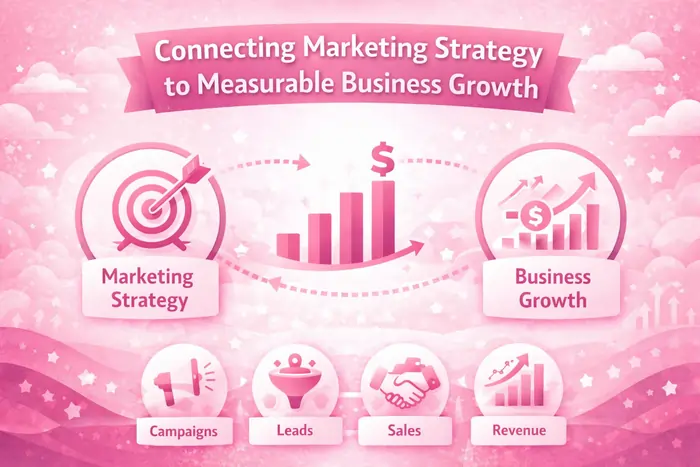
A strategy only matters if it shows up in your numbers. To ensure Marketing Strategy Australia 2026: Trends Driving Business Growth translates into real outcomes, you need clear links between marketing activity and top‑line and bottom‑line results.
4.1 Revenue and customer growth
Effective marketing should drive:
- Increased new customer acquisition.
- Higher average order value or deal size.
- Improved conversion rates across key funnel stages.
You can support this link by:
- Setting revenue targets by channel or campaign.
- Tracking cohort performance over time.
- Aligning marketing and sales on definitions and data.
Trend reports like Top Digital Marketing Strategies for Australian Businesses in 2026 point out that channels like PPC, SEO, social and email remain core revenue drivers, but their impact is maximised when integrated and data‑informed.
4.2 Profitability and efficiency
Marketing strategy also affects profitability. An optimised channel mix and better targeting can reduce cost per acquisition and increase lifetime value. AI‑assisted optimisation and automation can free team capacity and reduce waste.
Resources such as Australian Digital Marketing Strategy Guide 2026 discuss how better planning and optimisation enable businesses to do more with the same or smaller budgets. Embedding test‑and‑learn cycles into Marketing Strategy Australia 2026: Trends Driving Business Growth will help you progressively improve ROI.
4.3 Brand equity and long‑term growth
Not all value shows up immediately as revenue. Strong brands enjoy lower acquisition costs, higher retention and resilience in downturns. Long‑term brand‑building through consistent messaging, creative and customer experience is therefore a critical part of growth.
Insight platforms such as Marketing Trends: Insights from Australia’s Top Marketers highlight that top performers invest in both brand and performance marketing, using data to understand how each contributes over time. Your strategy should similarly protect budget and focus for long‑term brand initiatives, even as you chase short‑term wins.
5. Putting “Marketing Strategy Australia 2026: Trends Driving Business Growth” into action
Knowing the trends and framework is only useful if you apply them. Here is a simple sequence to move from concept to execution.
5.1 Audit your current marketing
Start with a structured audit of your current marketing across channels, content, data and outcomes:
- Review performance data for the last 12–24 months.
- Map current customer journeys and touchpoints.
- Inventory your content and creative assets.
- Assess your tech stack and data flows.
Use external guides like the Ultimate Guide to Planning Your Digital Marketing in 2026 as a checklist to ensure you cover key elements.
5.2 Define goals and focus segments
Next, define clear growth goals (e.g. revenue, market share, retention) and prioritise the segments that matter most. Align stakeholders on what success looks like for Marketing Strategy Australia 2026: Trends Driving Business Growth.
5.3 Design your strategy using the six pillars
Using the framework above, design your strategy across insight, positioning, channels, content, measurement and capability. Where appropriate, reference local best‑practice resources like Australian Digital Marketing Strategy Guide 2026 to benchmark your approach.
5.4 Build a realistic roadmap
Translate your strategy into a 12–18‑month roadmap with:
- Priority initiatives and campaigns.
- Milestones and dependencies.
- Budget and resourcing requirements.
- Measurement and optimisation plans.
5.5 Execute, measure and iterate
Finally, execute in manageable waves, measure rigorously, and iterate based on what you learn. Use the external resources linked throughout this article as references for tactics, benchmarks and case studies as you refine Marketing Strategy Australia 2026: Trends Driving Business Growth over time.