

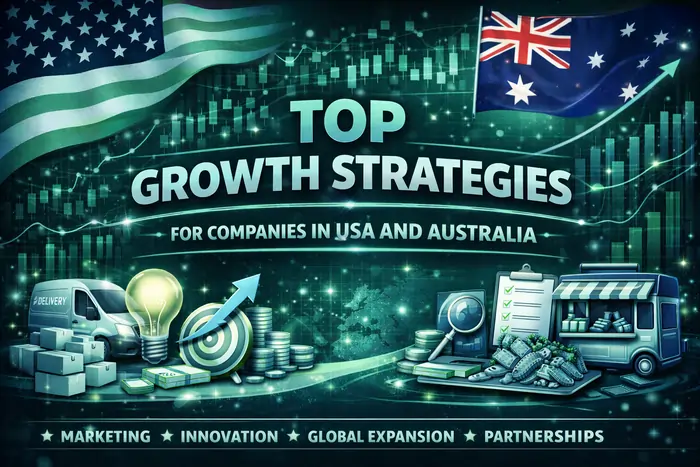
Smart business growth strategies in 2026 focus on being data‑driven, capital‑aware, and customer‑obsessed, rather than just “grow at any cost.” In both the USA and Australia, the businesses that win are using AI, smarter sales and marketing, stronger partnerships, and disciplined financial planning to scale in a choppy economic environment.
Introduction: Why Smart Growth Matters in 2026
Smart business growth strategies are about scaling revenue, profitability, and resilience in a way that your team, cashflow, and systems can actually support. Reports on 2026 small‑business growth emphasise that the old playbook—chasing topline at any cost—is being replaced by smarter approaches that mix cost control, digital tools, and precise targeting.
For small and mid‑sized businesses in the USA and Australia, 2026 brings both tailwinds and headwinds: demand is improving in many sectors but interest rates, labour shortages, and changing customer behaviour make every decision count. Guides like Salesforce’s 6 Small Business Growth Strategies for 2026 and Marlie’s 10 Essential Small Business Growth Strategies for 2026 stress that smart growth is about working on the right things—customer experience, tech, and cash—more than simply working harder. For deeper, practical detail on how to build a truly customer‑centric business in both markets, you can pair these with the Customer‑Centric Strategy Guide for USA and Australia, which links customer experience directly to sustainable growth.
The 2026 Business Landscape: USA vs Australia
In the USA, small businesses are focused on strengthening their online presence, deepening customer engagement, and managing cashflow carefully to fuel sustainable growth. Commentators and advisors emphasise five core plays for 2026: local SEO, customer engagement, cash management, networking, and targeted marketing—each designed to drive results without overextending. Posts like Townsquare’s Top 7 Business Tips for Small Businesses in 2026 capture this shift toward focused, measurable action.
In Australia, the picture is one of cautious optimism: state and federal outlooks expect gradual growth supported by population increases and easing inflation, but with ongoing pressure from higher rates and tight labour markets. Business Victoria’s 2026 Outlook: the year ahead for small businesses and ANZ’s Australian economic outlook for 2026 both highlight that demand is improving but households remain price‑sensitive, which means SMEs must be disciplined and strategic in how they grow.
Industry groups such as the Australian Industry Group suggest that Australian businesses are becoming more agile, digitally aware, and commercially savvy, even as conditions stay challenging. Their Australian Industry Outlook for 2026 notes that smart growth will come from targeting high‑potential sectors, embracing digitisation, and investing in capabilities rather than just expanding headcount.
Smart Customer and Revenue Growth Strategies
A core theme across 2026 growth advice is to get smarter about who you serve and how you grow each customer, not just chase more leads. Salesforce’s growth guides, for example, emphasise identifying your ideal customer profile, using data to segment audiences, and focusing on the channels that convert best.
Smart customer and revenue moves include:
- Market penetration: improving conversion rates and retention among your existing target segments with better offers, follow‑up, and customer experience.
- Upsell and cross‑sell: designing logical add‑ons and premium tiers that increase average order value without heavy marketing spend.
- Reactivation: deliberately re‑engaging lapsed customers with targeted campaigns and tailored offers.
A LinkedIn post on Small Business Growth Strategies for 2026 summarises this approach as: strengthen online presence, focus on customer engagement, manage cashflow, network actively, and leverage targeted marketing—starting small, measuring everything, and scaling what works.
For a US business, this might look like using local SEO, Google Business Profiles, and email automation to deepen relationships in a specific metro area. For an Australian business, smart revenue growth might mean doubling down on regional hubs where population growth is strongest and competition is lower, as Business Victoria notes for regional centres like Geelong and Ballarat. A structured way to embed this customer‑first thinking into your growth plans is outlined in Customer‑Centric Strategy Guide for USA and Australia, which shows how to align products, messaging, and metrics around customer value rather than vanity growth.
Digital, AI, and Automation as Growth Levers
Digital tools and AI are no longer “nice to have”—they’re central to smart growth strategies in 2026. Articles like SixPaths Consulting’s 7 Innovative Ways to Develop Business Strategies in 2026 argue that AI, partnership, customer focus, and sustainability will define future‑ready businesses.
Practical ways SMEs are using digital and AI to grow smarter include:
- CRM and customer data platforms to centralise customer history and track which campaigns, offers, and segments deliver profitable growth.
- Marketing automation and precision targeting, where AI tools help refine audiences and messages instead of blanket campaigns, as highlighted in Arizona State University’s Five Growth Strategies Every Early‑Stage Startup Should Explore in 2026.
- Workflow automation in operations, finance, and service delivery to increase output per employee and reduce errors.
Salesforce’s SMB growth articles show how small businesses can “make enterprise‑level impact” by combining CRM, AI‑driven insights, and automation. Similarly, Marlie’s 10 Essential Small Business Growth Strategies for 2026 encourages owners to use analytics and AI to understand customer behaviour and optimise their sales funnels.
In Australia, DHL’s Small business growth strategies for success in Australia stresses that digitising sales channels and operations is crucial for navigating cost pressures and competition, and that online capability is now a baseline requirement for growth.
Smart Product and Service Strategy in 2026
Smart growth also means knowing what to sell and how to evolve your offering. Classic strategy tools like the Ansoff matrix—market penetration, market development, product development, and diversification—still apply, but 2026 advice pushes SMEs toward low‑risk product moves.
Common product and service plays include:
- Deepening current offerings with bundles, add‑ons, and premium tiers that increase customer lifetime value without heavy R&D.
- Digitising existing services, such as turning workshops into online courses or adding subscription support packages, to create recurring revenue.
- Localising or adapting offers for each market: for example, adjusting pricing, compliance, or messaging for US vs Australian customers.
US‑focused resources like SAP Concur’s Best Business Growth Strategies to Drive Success and Scale emphasise bundling, subscription models, and customer‑centric innovation to scale sustainably. On the Australian side, Sageflow’s Top 10 Effective Business Growth Strategies highlight refining your value proposition, improving service design, and targeting new verticals with carefully adapted offerings.
For Australian businesses expanding into the US, resources such as Foothold America’s Expanding your business to the USA from Australia and Marketing Eye’s guide to expanding Australian businesses in the U.S. stress tailoring product, messaging, and service levels to different US regions, not treating the US as a single homogeneous market. When you refine your offer, it helps to be clear on how it creates and protects your edge—concepts broken down step‑by‑step in Competitive Advantage Explained.
Partnerships, Ecosystems, and Platforms
Smart growth in 2026 often means “growing with others” rather than trying to do everything alone. Many growth strategy resources emphasise ecosystem thinking: building strategic partnerships, joining platforms, and collaborating with complementary businesses.
Key partnership levers include:
- Channel and referral partners who introduce you to new customers in return for commissions or reciprocal referrals.
- Platform and marketplace participation (e.g., app stores, ecommerce marketplaces, service directories) to expand reach with limited marketing spend.
- Industry networks and chambers, which provide events, introductions, and co‑marketing opportunities.
DHL’s small business growth strategy in Australia explicitly advises building relationships with other businesses and industry organisations to unlock new opportunities and foster growth. Australian advisory guides, like SBAAS’s Business Growth Strategies for 2025–26: Your Complete Guide, also stress tapping into government programs, export initiatives, and high‑growth sectors through networks.
For US businesses, growth tips from SMB‑focused blogs and advisors stress networking actively—online and offline—to unlock partnerships and referrals that drive real results.
Building a Growth-Ready Organisation
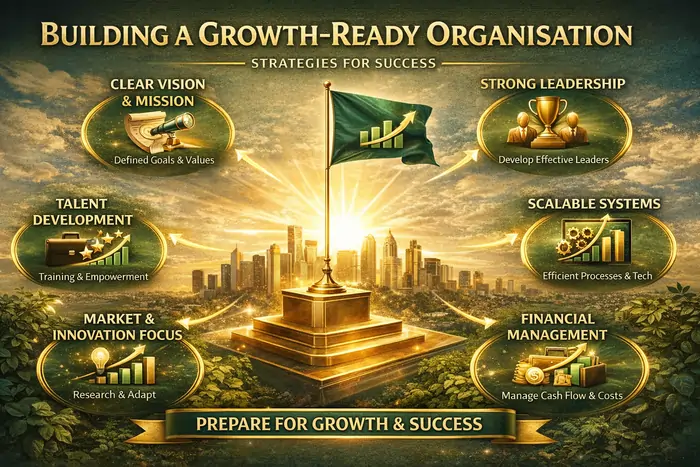
Smart strategies will stall if the organisation isn’t ready to execute. Growth‑oriented commentary for 2026 repeatedly calls out culture, leadership, and talent as critical enablers.
Elements of a growth‑ready organisation include:
- A culture of ideas and experimentation: InspireIP’s Small Business Growth Strategies article argues that encouraging employee ideas and running small experiments allows firms to adapt faster and uncover opportunities from inside the business.
- Clear strategic priorities and KPIs: advisory firms like Kreischer Miller recommend turning growth goals into metrics and dashboards so teams see what matters and can course‑correct quickly, as outlined in 6 Small‑to‑Mid‑Sized Business Growth Strategies to Prepare for 2026.
- Talent and capability building: SBAAS’s Australian growth guide emphasises investing in skills and leadership capability as a prerequisite for successful digital and market expansion.
Trend pieces like Think & Grow’s Our Predicted Trends for Business Growth in 2026 highlight that future‑ready leadership will need to be comfortable with AI, hybrid work, and rapid change, not just traditional management. Business Victoria’s 2026 outlook echoes this, observing that small businesses are more agile and commercially aware than before and must maintain that proactive mindset to succeed.
Financially Smart Growth: Risk, Funding, and Cashflow
Smart business growth strategies always balance ambition with financial discipline. Several 2026 growth guides put cost management and cashflow at the top of their lists. Kreischer Miller’s 6 Small‑to‑Mid‑Sized Business Growth Strategies to Prepare for 2026 includes better cost management and cashflow optimisation as foundational moves before aggressive expansion.
Financially smart growth typically involves:
- Maintaining cash buffers and modelling different revenue scenarios so you’re not forced into panic decisions when conditions change.
- Funding growth with a mix of profits and appropriate finance, such as lines of credit, working capital loans, or grants—rather than relying solely on debt or personal savings, as suggested in SBA and bank guides and summarised in resources like 3 Strategies for Small Business Growth.
- Watching margins closely, especially in sectors exposed to price‑sensitive consumers, as Business Victoria notes for retail, hospitality, and personal services in 2026.
In Australia, government strategies like Tasmania’s Small Business Growth Strategy 2026 and federal programs referenced in SBAAS’s guide highlight grants, tax incentives, and advisory support (e.g., the Industry Growth Program) as tools to de‑risk growth investments. ANZ’s economic outlook also frames 2026 as a “year of balance,” where businesses need to weigh growth opportunities against interest rate impacts and cost structures.
In the USA, SME resources often advise tightening financial controls—budgeting, forecasting, and cash‑flow tracking—so that owners can invest in marketing and technology without jeopardising day‑to‑day operations.
Action Plan: 90-Day Smart Growth Sprint
Most sources agree that strategies only matter if they turn into action. A practical way to implement smart business growth strategies is to run a focused 90‑day sprint.
A simple 90‑day framework might be:
- Assess (Weeks 1–2)
- Review your current revenue mix, top customers, costs, and key KPIs.
- Use checklists from guides like Salesforce’s SMB growth articles and SBAAS’s Australian playbooks to benchmark where you stand on digital, customer, and financial readiness.
- Focus (Weeks 3–4)
- Design and Launch (Weeks 5–10)
- Build simple experiments: a targeted email sequence, a new bundle offer, a pilot partnership, a CRM upgrade.
- Use learnings from AI‑driven strategy articles like SixPaths’ and ASU’s startup guide to refine your hypotheses and segmentation.
- Measure and Decide (Weeks 11–13)
- Track performance against clear metrics (revenue lift, margin, retention, lead quality).
- Decide what to double down on, what to tweak, and what to sunset based on data, as recommended in precision‑marketing and growth‑strategy pieces.
Australian advisors like SBAAS emphasise turning this into a rolling strategic growth roadmap where you continually update your initiatives based on financial audits, digital upgrades, funding opportunities, and sector trends.