

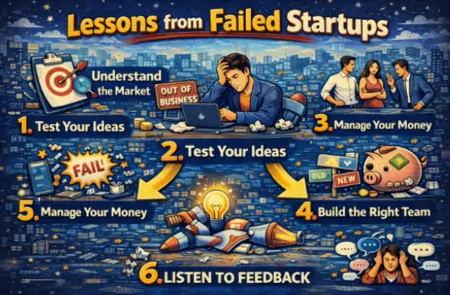
Lessons from Failed Startups
Success stories are exciting. Failure stories are educational.
When people talk about startups, they usually highlight billion-dollar valuations, viral growth, and big exits. But if you truly want to build something sustainable, you need to study Lessons from Failed Startups.
Why?
Because failure leaves patterns. And patterns leave warnings.
Most startups don’t fail because founders are lazy or stupid. They fail because of repeated, predictable mistakes. If you understand the biggest Lessons from Failed Startups, you can avoid stepping into the same traps.
Let’s break down the real reasons companies collapse—and what they teach us.
1. Building Before Validating Demand
One of the biggest Lessons from Failed Startups is this: founders build first and validate later.
They spend months perfecting features, branding, and design—without confirming if customers truly need the product.
An idea might sound brilliant in your head. But markets don’t reward ideas. They reward solutions to painful problems.
Many founders mistake compliments for commitment. People may say, “That’s cool!” But when it’s time to pay, they disappear.
The smarter approach:
- Talk to potential users early
- Ask about their real frustrations
- Test with a simple version
- Pre-sell before building fully
One of the most practical Lessons from Failed Startups is simple: validate demand before scaling effort.
2. Ignoring Cash Flow Reality
Another painful pattern in lessons from failed startups is poor financial management.
Startups don’t just die from bad ideas—they die from running out of money.
Research from Entrepreneur.com highlights cash flow problems as one of the top contributors to startup collapse.
Founders often focus on:
- Branding
- Features
- Growth hacks
But ignore:
- Burn rate
- Revenue predictability
- Unit economics
Revenue is oxygen. Without it, even good ideas suffocate.
3. Scaling Too Fast
Fast growth looks impressive—but scaling before stability is risky.
One of the repeated Lessons from Failed Startups is premature scaling. Founders increase marketing budgets, hire teams, and expand operations before proving repeatable sales.
Growth multiplies weaknesses.
If your customer support system struggles with 50 users, it will collapse with 5,000. If your product has unresolved issues, scaling exposes them faster.
A better approach:
- Stabilize operations
- Improve retention
- Ensure predictable sales
- Then expand carefully
Patience is underrated. But patience appears again and again in Lessons from Failed Startups.
4. Founder Conflict
People often think products kill startups. But sometimes, people do.
Another powerful theme in Lessons from Failed Startups is founder misalignment.
Problems include:
- Different long-term visions
- Unequal workloads
- Poor communication
- Ego battles
At the beginning, excitement hides tension. Over time, stress reveals cracks.
Clear roles, written agreements, and regular honest conversations prevent small misunderstandings from turning into company-ending conflicts.
One emotional but critical truth from Lessons from Failed Startups: alignment matters more than talent.
5. Building Features Instead of Solving Problems
Many startups focus on adding features.
But customers don’t buy features—they buy outcomes.
If your product has 20 features but solves no urgent pain, it will struggle.
Among the most repeated Lessons from Failed Startups is misunderstanding value.
Ask:
- What urgent problem does this solve?
- Why does it matter today?
- Is the pain strong enough for someone to pay?
If the answer isn’t clear, the product isn’t ready.
6. Ignoring Customer Feedback
Ego can quietly destroy progress.
Another essential insight from Lessons from Failed Startups is the failure to listen.
Some founders:
- Ignore negative reviews
- Avoid user interviews
- Assume they know better
But customers often give early warning signs. If users complain repeatedly, that’s not noise—that’s data.
Strong startups build feedback loops:
- Surveys
- Direct conversations
- Behavior tracking
- Retention monitoring
Listening early prevents expensive mistakes later. This principle appears often in Lessons from Failed Startups.
7. Poor Timing
Sometimes the idea is good—but the timing is wrong.
Market readiness matters.
Among the more subtle Lessons from Failed Startups is misunderstanding timing. A product launched too early may require too much education. Launched too late, competition may dominate.
Timing affects:
- Consumer behavior
- Technology adoption
- Economic climate
- Investment appetite
Not every failure is about execution. Some failures are about readiness.
Understanding timing helps founders stay realistic when evaluating risk.
8. Lack of Focus
Startups often try to do too many things at once.
One recurring message in Lessons from Failed Startups is lack of clarity.
When founders chase every opportunity, they lose direction.
Clear companies focus on:
- One target customer
- One core problem
- One primary metric
When priorities shift weekly, teams lose momentum.
Discipline may feel boring, but discipline consistently appears in Lessons from Failed Startups as the missing ingredient.
9. Weak Marketing Strategy
Even strong products fail without visibility.
Some startups believe “If we build it, they will come.” That rarely happens.
Another hard truth from Lessons from Failed Startups is underestimating distribution.
Founders spend all their energy on product development but ignore:
- Customer acquisition channels
- Brand positioning
- Messaging clarity
- Conversion optimization
A product without distribution is invisible.
10. Founder Burnout
Startups are emotionally demanding.
Long hours, uncertainty, financial pressure, and isolation wear people down.
One often overlooked theme in Lessons from Failed Startups is burnout.
Burnout leads to:
- Poor decision-making
- Impatience
- Conflict
- Risky shortcuts
Founders must treat energy as a resource. Sustainable growth requires sustainable leadership.
11. Overestimating Hype
Media coverage, awards, and social media attention can create illusions.
But attention is not traction.
A painful reality from Lessons from Failed Startups is that vanity metrics mislead founders.
Likes are not revenue.
Downloads are not retention.
Press coverage is not profitability.
Real traction means:
- Paying customers
- Repeat usage
- Positive retention curves
Anything else can be temporary.
Patterns Behind Startup Collapse
When you step back, Lessons from Failed Startups usually connect to five root causes:
- No real market need
- Poor financial control
- Premature scaling
- Founder misalignment
- Weak customer understanding
These aren’t dramatic Hollywood-style failures.
They’re quiet mistakes that compound over time.
What Smart Founders Learn Early
The reason studying Lessons from Failed Startups is powerful is because it reveals warning signs.
Smart founders:
- Validate ideas before heavy investment
- Protect runway aggressively
- Grow only after proof
- Align deeply with co-founders
- Focus on retention, not hype
- Track meaningful metrics
Failure is rarely random.
It’s usually patterned.
And patterns are predictable.
The Most Important Insight
If you remember only one takeaway from Lessons from Failed Startups, let it be this:
Startups don’t collapse overnight.
They decline slowly—through ignored signals.
A small retention drop.
A growing cash burn.
A misaligned partnership.
Unanswered customer complaints.
Each one seems manageable alone. Together, they become fatal.
Final Thoughts
Studying unicorn success stories can inspire you.
But studying Lessons from Failed Startups can protect you.
Failure is a teacher that charges expensive tuition. Learning from others is cheaper.
Before launching your next idea, ask:
- Is the demand real?
- Is the runway protected?
- Are we aligned?
- Are we solving a painful problem?
- Are we growing responsibly?
If you take these Lessons from Failed Startups seriously, you increase your odds dramatically.
Because in entrepreneurship, survival is the first victory.
And survival starts with awareness.
FAQ
Why do most startups fail?
Most startups fail because there is no real demand for their product. If people don’t truly need it or aren’t willing to pay for it, the business struggles.
Is running out of money a common reason?
Yes. Many companies collapse because they spend too fast and don’t earn enough. Cash flow problems are one of the biggest lessons from failed startups.
Does competition cause startup failure?
Not usually. Competition matters, but most failed startups struggle more with poor planning, weak product-market fit, or financial mistakes.
What is the biggest mistake new founders make?
A common mistake is building too much before testing. Founders create a full product without checking if customers actually want it.