

Understanding the 10 Mistakes First-Time Startup Founders make can save you years of frustration, wasted money, and burnout. In 2026, startups are launching faster than ever thanks to AI tools, no-code platforms, and easier digital distribution.
But speed also means more competition. If you don’t avoid the 10 Mistakes First-Time Startup Founders commonly fall into, your startup may struggle before it even finds product-market fit.
This guide breaks down the 10 Mistakes First-Time Startup Founders encounter most often, why they happen, and exactly how to fix them. Whether you’re building in the Philippines or targeting a global audience, these lessons apply directly to today’s startup environment.
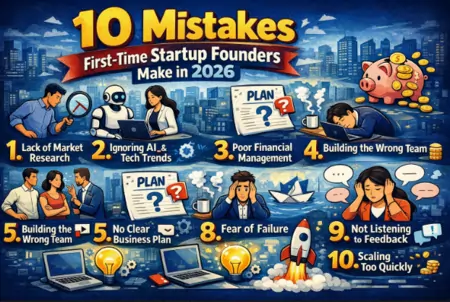
The 10 Mistakes First-Time Startup Founders make include building without validation, targeting everyone, weak positioning, poor pricing, ignoring marketing, hiring at the wrong time, poor financial control, skipping legal basics, and burning out. Fixing these mistakes early dramatically increases survival and growth chances.
Why the 10 Mistakes First-Time Startup Founders Happen
The reason the 10 Mistakes First-Time Startup Founders keep repeating across industries is simple: new founders focus heavily on product and underestimate business fundamentals.
Common reasons include:
- Overconfidence in the idea
- Fear of selling too early
- Limited runway
- Trying to copy big startup strategies
The truth is, most of the 10 Mistakes First-Time Startup Founders make are preventable with discipline, clarity, and early validation.
Mistake #1: Building Before Validating
One of the biggest items in the 10 Mistakes First-Time Startup Founders list is building a full product before confirming demand.
What it looks like:
- Months of development
- No paying customers
- Delayed launch because “it’s not perfect yet”
Why it’s dangerous:
You waste time and money solving the wrong problem.
The fix:
- Conduct 15–30 customer interviews
- Pre-sell before building
- Launch a simple MVP
- Deliver manually first
Among the 10 Mistakes First-Time Startup Founders, this is often the most expensive one.
Mistake #2: Solving a “Nice-to-Have” Problem
Another common entry in the 10 Mistakes First-Time Startup Founders make is building something people like—but don’t need.
Warning signs:
- “That’s cool!” but no one pays
- Low urgency
- No repeat usage
The fix:
Focus on problems that are:
- Frequent
- Expensive
- Painful
- Risky
If customers won’t feel discomfort without your solution, rethink the idea.
Mistake #3: Targeting Everyone
Many founders underestimate how damaging this mistake is. In fact, unclear targeting is one of the quietest among the 10 Mistakes First-Time Startup Founders make.
When you say:
“Our product is for everyone.”
You’re basically saying it’s for no one.
Fix:
Define your Ideal Customer Profile:
- Industry
- Size
- Location
- Pain
Clear targeting simplifies marketing, product decisions, and sales messaging.
Mistake #4: Weak Positioning
Poor messaging is another key entry in the 10 Mistakes First-Time Startup Founders list.
If people can’t explain what you do in one sentence, you have a positioning problem.
Fix:
Use this template:
We help [specific customer] achieve [specific result] without [specific pain].
Clarity converts. Confusion kills.
Mistake #5: Pricing Too Low
Underpricing feels safe—but it’s one of the most damaging of the 10 Mistakes First-Time Startup Founders make.
Symptoms:
- Always stressed about money
- Attracting price-sensitive customers
- No room to grow
Fix:
- Price based on value delivered
- Create packages
- Ensure strong margins
You’re not building a charity—you’re building a sustainable company.
Mistake #6: Ignoring Distribution
One of the most repeated themes in the 10 Mistakes First-Time Startup Founders make is focusing on product instead of customers.
Building is easier than selling.
Fix:
Pick one acquisition channel:
- Short-form content
- SEO
- Cold outreach
- Partnerships
Track simple metrics weekly. Without distribution, even great products fail.
Mistake #7: Hiring at the Wrong Time
Poor hiring decisions are firmly on the list of 10 Mistakes First-Time Startup Founders make.
Hiring too early:
Burns runway.
Hiring too late:
Creates founder burnout.
Fix:
Hire when:
- Revenue is consistent
- Work is repeatable
- A clear bottleneck exists
Start with contractors.
Mistake #8: Ignoring Financial Discipline
Runway blindness is one of the silent killers in the 10 Mistakes First-Time Startup Founders.
If you don’t know:
- Monthly burn
- Cash on hand
- Revenue trends
You’re guessing.
Fix:
Track runway monthly:
Runway = Cash ÷ Monthly expenses
Smart founders survive longer.
Mistake #9: Skipping Legal and Security Basics
Many founders treat compliance as “later.” But this is a serious item among the 10 Mistakes First-Time Startup Founders make.
Basic essentials:
- Terms & Conditions
- Privacy Policy
- Clear client contracts
- Basic security hygiene
Trust is critical in 2026. One security issue can destroy reputation fast.
Mistake #10: Founder Burnout
The final but equally dangerous entry in the 10 Mistakes First-Time Startup Founders list is burnout.
You cannot scale chaos.
Symptoms:
- Constant overwhelm
- Reactive work
- No systems
Fix:
- Weekly planning
- SOPs
- Clear work blocks
- Rest as strategy
Burned-out founders make poor decisions.
Final Thoughts
Let’s recap the 10 Mistakes First-Time Startup Founders commonly experience:
- Building without validation
- Solving weak problems
- No clear ICP
- Weak positioning
- Poor pricing
- Ignoring marketing
- Wrong hiring timing
- Poor financial control
- Skipping compliance/security
- Founder burnout
If you actively avoid these 10 Mistakes First-Time Startup Founders make, your probability of success increases dramatically.
30-Day Founder Action Plan
To avoid the 10 Mistakes First-Time Startup Founders make:
Week 1:
Validate demand.
Week 2:
Build MVP + pricing.
Week 3:
Focus on one distribution channel.
Week 4:
Set financial tracking + document processes.
FAQs
What is the biggest mistake first-time startup founders make?
Building before validating demand is often the most costly.
How can I avoid common startup mistakes?
Talk to customers early, sell before scaling, and track your runway.
Should I hire early?
Only if revenue supports it and work is repeatable.
How much runway should I have?
Ideally 3–6 months minimum to experiment and adjust.
Why do most startups fail?
Because they run out of money before finding product-market fit, often due to several of the 10 Mistakes First-Time Startup Founders make.