

Digital market trends in 2026 are no longer about chasing one “magic” channel; they are about how you combine AI, content, community, and data into one human‑centered, profitable system for your online business.
Global usage insights from the Digital 2026 Global Overview Report by DataReportal show that social, search, and mobile now dominate how people discover brands, compare options, and decide where to spend their money.
Trusted analyses like the Digital Marketing Institute’s 2026 Digital Marketing Trends and Brandwatch’s Digital Marketing Trends 2026 point to the same pattern: AI and automation are becoming the “engine room” of modern marketing, while human creativity, story, and trust decide who actually stands out.
Deep‑dive guides such as Digital Marketing Trends 2026: What Marketers Must Know and IE University’s overview of top digital marketing trends for 2026 underline how fast small businesses are adopting AI tools, automation, and creator collaborations to keep up.
In simple terms, these digital market trends are about three big shifts:
- From manual to AI‑assisted execution
- From isolated tactics to joined‑up customer journeys
- From generic messages to human, story‑driven brands
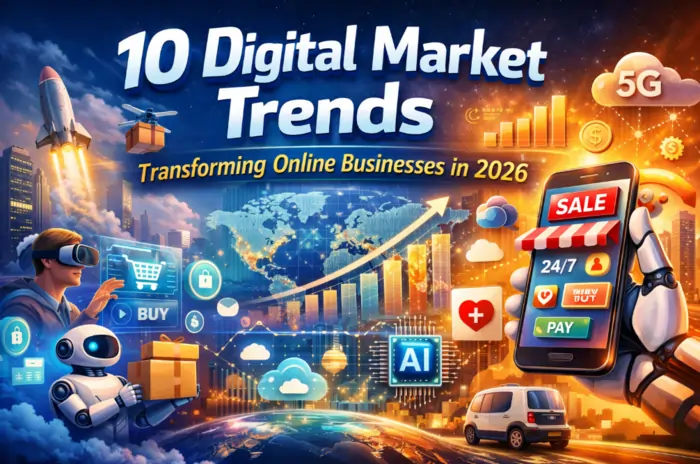
Digital Market Trends Reshaping Online Businesses In 2026
1. AI‑First Marketing And Automation Becomes The New Baseline
AI is no longer a side experiment—it sits at the center of how many online businesses run their marketing in 2026. The State of Marketing Report and similar 2026 research show more teams using AI‑powered tools to handle routine work like email sequencing, segmentation, campaign testing, and basic copy drafts so humans can focus on strategy and creative decisions.
Common AI‑first marketing moves you see now:
- Using AI email platforms to:
- Auto‑segment subscribers by behavior
- Time sends for when people are most active
- Adding AI chatbots to:
- Answer FAQs on your site and social pages
- Route complex questions to humans
- Running AI‑driven ad experiments to:
- Generate multiple creatives
- Shift budget toward top‑performing ads automatically
Technical sources like the Global State of IT Automation reports show how these tools plug into a bigger “automation fabric” that connects data, content, and channels behind the scenes.
2. Generative Engine Optimization (GEO) And AI Search Change Discoverability
Search is going through a major transformation. With conversational and generative search rolling out on big platforms, more people now see AI‑generated answers before they decide whether to click any traditional result.
Think‑pieces and data‑driven explainers from Google’s Think with Google and Brandwatch make it clear: your content is not just competing for classic blue links anymore; it is competing to be cited in AI answers.
Generative engine optimization (GEO) is the response to that shift. GEO means structuring your content so AI systems can easily:
- Understand what you are saying
- Summarize it accurately
- Reference it as a trusted source
Content features that help with GEO:
- Clear H2/H3 sections tied to specific questions
- Strong FAQ sections using real search‑style questions
- Evidence‑backed claims with external references and data
Strategy frameworks like Smart Insights’ RACE Digital Marketing Trends 2026 show how GEO slots in alongside SEO as another discoverability layer you can’t ignore.
3. Short‑Form Video Dominates Attention And Discovery
Short‑form video remains one of the strongest discovery engines in 2026. Platforms like TikTok, Instagram Reels, and YouTube Shorts reward quick, story‑driven clips that give viewers a result, a feeling, or a clear insight in seconds.
The article on digital marketing trends for small businesses in 2026 from Social Hospitality highlights short‑form video as a key growth lever for smaller brands.
How online businesses use short‑form video:
- Behind the scenes: Showing how products are made or how services actually work
- Customer stories: Quick before‑and‑after clips or mini‑case studies
- Educational snippets: How‑tos, myths busted, and FAQs in visual form
Ad‑focused reports from platforms like Smartly.io and others also show short‑form video at the center of performance marketing strategies—not just organic reach—because it can drive attention, clicks, and conversions in a single format.
4. Social Commerce And Shoppable Experiences Move Closer To The Purchase
The line between “content” and “storefront” keeps getting thinner. Social commerce features—from shoppable posts to live shopping and in‑app checkout—allow people to discover, research, and buy without ever leaving the apps they already use.
Forecasts like Small Business Marketing Predictions for 2026 and analysis pieces from outlets such as Global Trade Magazine show that social is becoming a full funnel, not just top‑of‑funnel.
You see social commerce in moves like:
- Live shopping livestreams where hosts:
- Demo products in real time
- Answer questions on the spot
- Creator‑led tutorials where influencers:
- Show how they use a product
- Add product links directly in the video
- Native shops on platforms such as Instagram and Facebook that:
- Sync with inventory and shipping
- Keep the entire purchase in‑app
This trend turns social content into a direct revenue channel. Instead of pushing people away from their feed, you meet them where they already are and make it easy to act in the moment.
5. Community‑Driven Marketing And The Creator Economy Mature
Community‑driven growth has moved from theory to core strategy. More brands are building smaller, tighter communities on private platforms, membership sites, and invite‑only groups where they have direct, two‑way relationships with customers.
At the same time, the creator economy has matured into a serious distribution channel. Creators, influencers, and niche experts act as independent media brands with their own audiences and trust. Articles like “7 Small Business Marketing Trends You Can’t Ignore in 2026” and founder essays about 2026 business trends show businesses shifting from one‑off sponsored posts to:
- Long‑term creator ambassadorships
- Co‑created products or services
- Joint launches and ongoing content series
Community + creators together create a growth loop: creators introduce the brand, and community keeps people close.
6. Human‑Centric Brand Storytelling Cuts Through AI Noise
As AI makes it easier to mass‑produce content, audiences are paying more attention to voice, story, and lived experience. Leadership and marketing reports across 2026 all point to the same reality: people still care most about real stories from real people.
Human‑centric storytelling shows up in content like:
- Comeback stories where founders rebuild after failure
- “Starting over” narratives explaining hard pivots and what changed
- Leadership reflections that share honest lessons instead of just wins
Collections of CEO success stories and comeback case studies show how strongly these narratives resonate. They mix emotional impact with actionable insights and help readers see themselves in the story. In a feed full of generic AI writing, specific, human‑scale stories are what people remember.
7. First‑Party Data, Privacy, And Trust Shape Marketing Strategy
First‑party data and privacy have moved to the center of marketing strategy. With third‑party cookies fading and regulations tightening, brands are relying more on data they collect directly from subscribers, customers, and communities—with explicit consent.
Global digital data reports and privacy‑focused marketing papers agree: trust is now a business asset.
How brands are shifting into a first‑party mindset:
- Building stronger email lists and community spaces
- Offering real value in exchange for data (content, tools, access)
- Communicating clearly about what is collected and why
Board‑level studies and CEO outlook reports show topics like AI governance, data ethics, and cybersecurity appearing more often in strategic discussions. That means marketing, product, and leadership are aligning around one idea: if trust breaks, everything else becomes harder.
8. No‑Code Tools And Automation Democratize Marketing Execution
Advanced digital operations used to require large IT teams; now no‑code and low‑code tools make them accessible to small businesses and solo founders. Many 2026 trend reports list no‑code as a key enabler for experimentation and speed because it lets non‑developers build systems visually.
Common no‑code use cases in 2026:
- Automated onboarding flows that connect:
- Forms → CRM → email → product access
- Internal dashboards to track:
- Leads, sales, content performance, retention
- Conditional workflows that adjust messaging based on:
- Pages visited
- Products purchased
- Engagement levels
Automation and operations reports describe this as “democratizing automation”—turning advanced workflows into something more teams can actually use and iterate on themselves.
9. Customer Experience And Omnichannel Journeys Decide Loyalty
Customers do not think in channels; they think in experiences. Customer experience research and small‑business marketing predictions for 2026 show that loyalty and lifetime value are heavily influenced by how smooth and consistent that experience feels from first touch to follow‑up.
Pieces of the omnichannel experience that matter:
- Website performance (speed, mobile usability, clarity)
- Booking, checkout, and payment flows
- Consistent offers and tone across social, email, and site
- Support speed and quality in chat, email, and phone
When everything fits together, people feel like they are dealing with one organized, trustworthy brand. When it does not, they feel friction—even if the product itself is good. This is why so many CX playbooks now talk about experience as a system, not as a collection of isolated tactics.
10. Purpose, Ethics, And Resilience Become Strategic Advantages
Purpose, ethics, and resilience sit above all the other trends. CEO outlooks and leadership reports for 2026 show that leaders are being measured not only on financial performance but also on how they adopt AI, protect people, and respond to shocks.
What this looks like inside real businesses:
- Clear statements about who they serve and what they stand for
- Thoughtful AI adoption that weighs efficiency against jobs and trust
- Transparent communication during crises or major pivots
Many of the most‑shared stories about CEOs today are not about perfect success—they are about rebuilding after failure, making hard calls, and sticking to values under pressure. These narratives line up perfectly with comeback stories and “starting over” themes and have become a major part of how brands earn long‑term respect.
Snapshot Of 10 Digital Market Trends In 2026
| # | Trend | What It Changes Most | Key 2026 Focus |
|---|---|---|---|
| 1 | AI‑First Marketing & Automation | Everyday execution | Automating repetitive tasks and freeing humans for strategy |
| 2 | Generative Engine Optimization (GEO) | Search & discoverability | Being referenced in AI answers, not just ranked in classic SERPs |
| 3 | Short‑Form Video Dominance | Awareness & engagement | Using TikTok/Reels/Shorts as core discovery engines |
| 4 | Social Commerce & Shoppable Content | Conversion paths | Turning social content into direct, in‑platform checkout journeys |
| 5 | Community & Creator‑Led Growth | Audience relationship | Building owned communities and long‑term creator partnerships |
| 6 | Human‑Centric Storytelling | Brand differentiation | Using real stories, vulnerability, and leadership lessons |
| 7 | First‑Party Data & Privacy | Data strategy | Building trust with consent‑based data and clear privacy practices |
| 8 | No‑Code & Automation Tools | Operations & agility | Letting small teams build complex workflows without heavy dev work |
| 9 | Omnichannel Experience | Customer loyalty | Creating seamless journeys across digital and offline touchpoints |
| 10 | Purpose, Ethics & Resilience | Long‑term positioning | Showing how you lead, adapt, and contribute beyond profit |
Channels vs Purpose: How The Trends Work Together
| Channel / Lever | Main Purpose In 2026 | Typical Use Case |
|---|---|---|
| AI Tools | Efficiency & insight | Automate emails, segment audiences, test creatives |
| SEO + GEO | Discoverability | Rank in search and appear in AI answers |
| Short‑Form Video | Attention & proof | Show results, stories, and offers in seconds |
| Social Commerce | Direct revenue | Turn posts and lives into fast purchases |
| Communities | Retention & advocacy | Keep best customers close and active |
| Creators | Trust & reach | Borrow audiences and credibility from niche experts |
| Email / First‑Party Data | Long‑term relationships | Stay in touch without relying on algorithms |
Final Verdict: How To Think About Digital Market Trends In 2026
Digital market trends in 2026 are moving fast, but they are all pointing toward the same reality: AI and automation will run more of the background work, while your story, your values, and your relationships will decide whether people care about your brand. Each trend—GEO, short‑form video, social commerce, first‑party data, community, creators—is a different angle on the same challenge: staying visible and trusted in a noisy environment.
The online businesses that win are not the ones copying every new tactic first; they are the ones that use AI as a powerful assistant, stay close to their customers, tell real stories about real people, and keep their purpose clear even when the tools change.
If you treat these trends as a lens for your decisions instead of a checklist to chase, you will have a much clearer way to shape your digital strategy for 2026 and beyond.
Frequently Asked Questions
1. What Are The Top Digital Marketing Trends In 2026 For Online Businesses?
The most important trends include AI‑first marketing, generative engine optimization, short‑form video, social commerce, community‑driven growth, first‑party data strategies, no‑code automation, omnichannel experiences, and purpose‑led branding.
2. How Is AI Changing Digital Marketing In 2026?
AI is powering automation, personalization, predictive analytics, creative testing, and conversational support, making campaigns more data‑driven and efficient while leaving humans to focus on strategy and creative direction.
3. What Is Generative Engine Optimization (GEO)?
Generative engine optimization is the practice of structuring content so AI answer engines can easily understand, summarize, and reference it when responding to conversational queries.
4. Why Does Short‑Form Video Matter So Much In 2026?
Short‑form video holds some of the highest engagement and discovery rates on major platforms, helping brands show results, proof, and personality in seconds.
5. What Is Social Commerce And How Is It Evolving?
Social commerce is the ability to buy directly within social platforms through features like shoppable posts, in‑stream product tags, and live shopping checkout, so discovery and purchase happen in the same place.
6. Are Communities More Important Than Follower Counts Now?
Many founders are prioritizing smaller, more engaged communities over large, passive follower counts because community members tend to convert better and stay loyal longer.
7. How Does The Creator Economy Affect Online Businesses In 2026?
Creators act as independent media channels with their own audiences, and businesses partner with them for co‑created content, launches, and long‑term brand storytelling.
8. What Role Does Storytelling Play In Digital Marketing Now?
Storytelling differentiates brands in an AI‑heavy environment by focusing on specific human experiences, real stakes, and honest lessons rather than generic claims.
9. Why Is First‑Party Data So Important In 2026?
First‑party data is more reliable and compliant as third‑party cookies decline, and it gives brands a direct, durable way to understand and serve their customers.
10. How Are Privacy And Data Regulations Impacting Digital Marketing?
Privacy rules are pushing marketers toward more transparent consent flows, clearer data policies, and tighter security, which affects how data is collected, stored, and used.
11. What Are No‑Code Tools And Why Are They Popular?
No‑code tools let non‑developers build automations, pages, and dashboards using visual interfaces, speeding up experimentation and reducing reliance on engineering resources.
12. How Do Small Businesses Use Automation Without Losing The Human Touch?
They automate repetitive processes such as reminders and routing while keeping nuanced conversations, relationship‑building, and strategic decisions in human hands.
13. What Does “Omnichannel Experience” Mean In Practice?
An omnichannel experience means customers get consistent messaging, branding, and service quality whether they interact via website, social media, email, chat, or offline channels.
14. Which Channels Still Matter Most For Online Businesses In 2026?
Search, social platforms, email, communities, and short‑form video remain central, but the real strength comes from how they are integrated into one cohesive journey.
15. Are Blogs And Long‑Form Content Still Relevant?
Long‑form content still matters for building authority, ranking in traditional search, feeding AI summaries with context, and serving high‑intent readers who want depth.
16. How Do Digital Market Trends In 2026 Affect B2B Companies?
B2B companies are using AI for account‑based marketing, rely on niche communities and professional networks, and depend heavily on thought leadership to earn trust with decision‑makers.
17. What Are CEOs Most Concerned About In This Digital Landscape?
Surveys of CEOs and leadership teams point to AI adoption, cybersecurity, regulation, talent, and resilience as major concerns, alongside the pressure to keep growing.
18. How Do Comeback And “Starting Over” Stories Connect To Digital Market Trends?
Comeback stories show how leaders adapt to shifts like AI, new customer behavior, and economic shocks, turning digital strategy into a visible part of their resilience narrative.
19. Where Can Founders Learn More About 2026 Digital Market Trends?
Founders can explore reputable global digital data reports, specialist digital marketing institutes, independent trend reports, and CEO outlook studies from major consultancies and research firms.
20. How Do These 10 Trends Fit Together For An Online Business?
Together, they describe a landscape where AI and automation handle the heavy lifting, but strategy, story, community, and trust decide which brands grow steadily and which ones disappear from view.