

The Australian dollar exchange rate plays a crucial role in trade, travel, investing, and everyday money transfers between Australia and the rest of the world. In 2026, AUD has been trading at comparatively strong levels, reshaping import costs, export competitiveness, and the value of overseas remittances.
By tracking live exchange rates on reputable converters, reviewing official benchmarks from the Reserve Bank of Australia, and comparing provider markups, individuals and businesses can secure better conversion deals and manage currency risk more effectively.
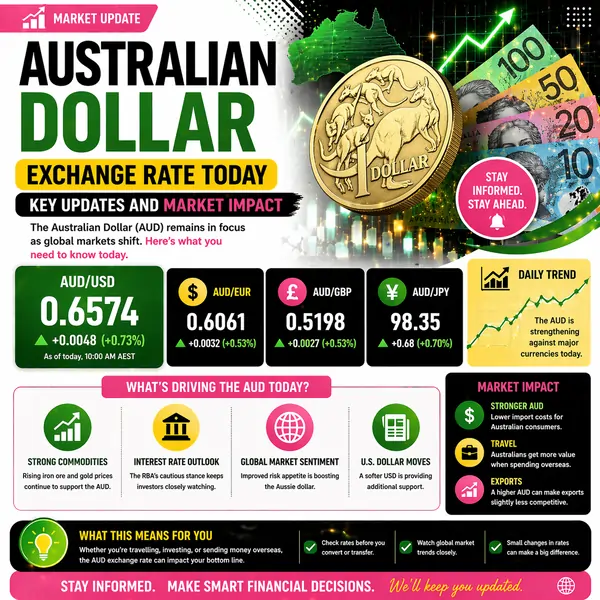
The Australian dollar (AUD) has been trading at relatively strong levels in 2026, and today’s exchange rate is shaping everything from trade flows and inflation to travel costs and remittances. To make informed decisions, Australians and global investors are closely monitoring live data, forecasts, and policy signals linked to the Australian currency.
What Is the Australian Dollar Exchange Rate Today?
When people talk about the Australian dollar exchange rate, they usually refer to how many units of another currency one AUD can buy, with AUD/USD being the most watched pair globally. You can see the live market price and historical chart for the Australian dollar on the Trading Economics Australian Dollar page, which tracks real‑time quotes, historical data and projections.
The exchange rate moves constantly during trading hours as banks, hedge funds, corporates and individuals buy and sell currencies. For a quick snapshot of how 1 AUD converts into multiple currencies at once, reference tools such as the X‑Rates AUD currency exchange table, which lists indicative rates against USD, EUR, GBP and more. These platforms give you a fast overview of how the Aussie is performing across the board, not just against the US dollar.
AUD vs Major Currencies: A Quick Snapshot
The Australian dollar’s performance can look very different depending on which currency you compare it with. Traders and economists therefore track a set of major pairs rather than focusing on a single exchange rate.
- Against the US dollar (AUD/USD), the pair is a global benchmark and heavily influenced by commodity prices, interest‑rate expectations, and risk sentiment. Sites like Trading Economics and AlanChand’s AUD to USD page show the current rate, daily moves, and recent percentage changes.
- Versus the euro and British pound, the rate can shift more in response to regional developments in Europe and the UK, as well as global risk‑on/risk‑off moves. You can view these in a grid format via the X‑Rates AUD table for a convenient multi‑currency comparison.
- Investors who want a deeper sense of historical context often use tools such as PoundSterlingLive’s AUD–USD history page, which shows daily open, high, low, and close levels across 2026.
For businesses, this broad view of the Australian dollar exchange rate helps with pricing, budgeting and hedging, because it highlights where the AUD is relatively strong or weak at any given time.
AUD to PHP Exchange Rate: A Practical Case
One of the most relevant crosses for many Australians and Filipinos is the AUD to PHP exchange rate, given strong migration, tourism, and remittance links between the two countries. If you work in Australia and send money home to the Philippines, or if you’re a Philippine‑based business invoicing Australian clients, the AUD/PHP rate directly affects how much value you receive.
To see the live AUD to PHP exchange rate, you can use:
- Wise’s AUD to PHP converter for a mid‑market rate and transparent transfer pricing.
- Xe’s 1 AUD to PHP converter to quickly check how many pesos one Australian dollar buys.
- OFX’s AUD to PHP exchange rate and converter for charts and transfer tools aimed at individuals and businesses.
These services typically quote a mid‑market or near‑mid‑market exchange rate, then apply their own margin or fee structure when you actually send money. In parallel, Philippine banks publish their own indicative rates. For example, you can review the Bank of the Philippine Islands (BPI) foreign exchange rates to see the bank’s buying and selling levels for AUD in PHP.
If you’re converting pesos back to Australian dollars, you can reverse the flow with tools like the PHP to AUD exchange rate converter on Wise, which shows you exactly how many AUD you’ll receive per PHP at today’s rate.
Why the Australian Dollar Exchange Rate Moves
The Australian dollar exchange rate is driven by a combination of domestic fundamentals, global conditions, and market sentiment. Economists and central banks highlight several major forces that tend to matter most over time:
- Terms of trade: When prices for Australia’s key exports (iron ore, coal, LNG, agricultural products) rise relative to import prices, the country’s terms of trade improve, usually supporting a stronger AUD. The Reserve Bank of Australia (RBA) has discussed this in detail in its bulletin article “Determinants of the Australian Dollar Over Recent Years”.
- Interest‑rate differentials: The gap between the RBA’s cash rate and policy rates in economies like the US, euro area and UK shapes capital flows. When Australian rates are high or expected to rise, global investors are more willing to hold AUD assets, which can lift the exchange rate over time.
- Risk sentiment: The AUD is known as a “risk‑sensitive” currency. It typically performs better when global stock markets are strong and investors are comfortable taking risk, and tends to weaken when markets are fearful and capital rushes toward safe‑haven currencies like the US dollar.
- Local economic data: Employment figures, inflation readings, retail sales and GDP releases can all move the Australian dollar if they change expectations about future RBA decisions.
For an official benchmark, the RBA itself publishes daily averages of major exchange rates on its Exchange Rates statistics page, providing a stable reference set for analysts and businesses.
Recent Market Themes Affecting the AUD
In recent years, several themes have been particularly important for the Australian dollar exchange rate:
- Recovering global growth and strong commodity demand have supported export volumes and prices, improving Australia’s terms of trade.
- Shifts in expectations for US Federal Reserve policy have led to swings in AUD/USD, as changing interest‑rate differentials influence the relative appeal of Australian assets.
- Periodic bouts of risk aversion tied to geopolitical tensions or financial‑market stress have led to sharp, temporary pullbacks in the Australian dollar as funds flow into the US dollar and other havens.
Australian research houses frequently analyse whether the stronger AUD is likely to last and what it means for inflation and growth. For example, the AMP econosights article on the Australian dollar explains how a higher exchange rate can tighten financial conditions by making imports cheaper and exports less competitive.
Economic Impact of a Stronger or Weaker Australian Dollar
Changes in the Australian dollar exchange rate affect the broader economy through inflation, trade and investment.
- When the AUD appreciates, imported goods such as fuel, electronics, and vehicles become cheaper in local‑currency terms. This can help ease inflation pressures and support household purchasing power.
- At the same time, exporters who earn revenue in foreign currency receive fewer AUD when they convert those earnings back home, unless they have hedged their exposure. This can squeeze profit margins in sectors such as mining, agriculture, manufacturing and tourism.
- A weaker exchange rate typically has the opposite effect: more expensive imports, higher tradables inflation, but stronger competitiveness for exporters and tourism.
Australian policymakers must balance these effects. A high AUD can act as a “brake” on the economy—similar in effect to a modest interest‑rate hike—while a low AUD can provide stimulus. Analysis like AMP’s “Is the stronger Australian dollar here to stay?” explores how this interacts with the RBA’s inflation‑targeting framework.
Impact on Businesses and Trade‑Exposed Sectors
For businesses, the Australian dollar exchange rate is more than a headline; it’s a key input into pricing, sourcing and investment decisions.
Exporters face revenue and margin risk when the AUD rises sharply. A mining company paid in US dollars, for example, sees its AUD revenue decline if the AUD strengthens and the USD price of its output stays unchanged. Similarly, agricultural exporters selling into Asia might find that a higher exchange rate erodes their competitiveness unless they adjust pricing or hedge their currency exposure.
Importers and retailers often experience the opposite effect. Companies that import finished goods or components may benefit from a strong AUD because their foreign‑currency costs fall in local terms. This can allow them either to widen margins or reduce prices for consumers. The impact on each firm depends on its cost structure, hedging policies, and competitive landscape.
Service exporters such as universities and tourism operators also watch the exchange rate closely. A strong Australian dollar makes tuition fees, holidays and professional services more expensive for foreign customers, potentially reducing inbound demand. A weaker AUD can make Australia more attractive as a destination and education hub.
Implications for Investors and Financial Markets
The Australian dollar exchange rate is central to investment strategy for both locals and foreigners. Currency moves can amplify or reduce returns, sometimes overshadowing the performance of the underlying assets.
- For international investors buying Australian equities or bonds, a strengthening AUD boosts returns when profits are translated back into their home currency; a weakening AUD does the opposite.
- Australian investors purchasing foreign shares, ETFs or bonds must decide whether to hedge currency exposure. A rising AUD can erode returns on unhedged overseas investments, while a falling AUD can enhance them.
Forecast‑oriented pages like the Trading Economics AUD forecast and chart aggregate consensus expectations, macro models and technicals to indicate where the exchange rate might be headed over the next few quarters. While no forecast is perfect, these tools help investors frame risk scenarios and build hedging or diversification strategies accordingly.
What the Exchange Rate Means for Consumers
For everyday consumers, the Australian dollar exchange rate shows up in several familiar ways:
- The cost of overseas travel: When the AUD is strong, Australians get more foreign currency for each dollar, making accommodation, dining, and activities cheaper overseas.
- Prices of imported goods: Retail prices for imported electronics, cars, clothing and household items are influenced by the exchange rate, especially when swings are large and sustained.
- Fuel and energy costs: Because global oil benchmarks are priced in US dollars, a stronger AUD can partially offset higher global oil prices, whereas a weaker AUD compounds the effect.
Services aimed at travellers and remitters provide user‑friendly exchange rate information. For example, Travelex’s AUD to PHP exchange rate page shows not only today’s rates for cash but also how they have moved over time, which can help you decide when to purchase foreign currency.
If you regularly send money to family overseas, comparing providers such as Western Union’s AUD to PHP converter, Ria’s live AUD to PHP page, and Revolut’s AUD to PHP exchange rate page can reveal meaningful differences in the net amount your recipient receives. Even small differences in the exchange rate and fees can add up over time.
How to Check and Compare Exchange Rates
Because the Australian dollar exchange rate moves throughout the day, it’s best to check multiple sources before making large conversions or international transfers. A simple workflow is:
- Look up the mid‑market rate on a neutral reference site such as Xe’s converter or Wise’s AUD to PHP page.
- Compare this with the rate quoted by your bank or remittance provider (for example, BPI’s indicative FX rates or Metrobank’s foreign exchange rate page).
- Consider specialist providers like OFX or Travelex to see if they offer a better effective exchange rate for the amount and corridor you need.
This approach helps you spot the markup each provider adds on top of the mid‑market exchange rate, allowing you to choose the most cost‑effective option.
Managing Exchange Rate Risk
For anyone significantly exposed to currency movements—exporters, importers, investors, and even frequent remitters—managing exchange rate risk is essential. Common strategies include:
- Natural hedging: Matching foreign‑currency revenues with expenses in the same currency to reduce net exposure.
- Financial hedging: Using forwards, futures, options or swaps to lock in or limit future exchange rate moves for a portion of your flows.
- Diversification: Spreading investments, suppliers and markets across multiple currencies so that no single exchange rate dominates your outcomes.
To better understand the macro forces behind the Australian dollar and design a sensible risk approach, the RBA’s bulletin piece “Determinants of the Australian Dollar Over Recent Years” is an excellent technical reference. Complementing that, practical commentary like AMP’s Australian dollar insight helps translate those drivers into concrete implications for inflation, interest rates and asset markets.
By combining live market data from sources like Trading Economics, independent exchange rate references from Xe and Wise, official benchmarks from the RBA, and bank or remittance quotes from providers such as OFX, Western Union, Ria, and Travelex, you can build a clear, real‑time view of the Australian dollar exchange rate today. This allows you to time your conversions better, choose the right partners, and understand how currency movements affect your costs, income and investment returns.
For a broader view of how one of Australia’s biggest banks is navigating this environment, you can also read 7 Things to Know About Commonwealth Bank Right Now, which highlights key strategic and financial developments at CBA.
FAQs About the Australian Dollar Exchange Rate Today
What is the Australian dollar exchange rate today?
The Australian dollar exchange rate today refers to how many units of another currency one AUD can buy at the current market price. It changes constantly throughout the trading day as currencies are traded globally.
Why does the Australian dollar exchange rate change so often?
The exchange rate fluctuates due to shifting supply and demand, influenced by interest rates, economic data, commodity prices, global risk sentiment, and geopolitical events.
How can I check the live AUD to PHP exchange rate?
You can use online currency converters and financial platforms that display real-time data. Comparing multiple providers helps you find the most competitive rates.
What is the mid-market exchange rate?
It is the midpoint between buying and selling prices in global markets, often considered the “real” exchange rate before providers add margins.
Why is the Australian dollar considered a risk-sensitive currency?
The AUD performs strongly when global economic conditions are positive and weakens when investors move toward safer currencies during uncertainty.
How do interest rates affect the AUD exchange rate?
Higher interest rates in Australia can attract foreign investment, strengthening the AUD, while lower relative rates can weaken it.
What is the impact of a stronger AUD on exporters?
A stronger AUD reduces the value of foreign earnings when converted back to AUD, potentially lowering exporter profits and competitiveness.
How does the exchange rate affect Australian consumers?
A strong AUD makes imports and travel cheaper, while a weak AUD increases costs but can support local industries.
What should I compare when choosing an exchange provider?
Look at the exchange rate vs. mid-market rate, transaction fees, and the total amount received after charges.
How do I know if I’m getting a good exchange rate?
Compare your provider’s rate to the mid-market rate and calculate the markup. Lower margins and transparent fees indicate better deals.
Can I lock in an exchange rate in advance?
Yes, tools like forward contracts and limit orders allow you to secure a rate for future transactions, helping reduce risk.
How does the exchange rate affect overseas investments?
A rising AUD can reduce returns from foreign investments, while a weaker AUD can increase their value when converted back.
Why are bank exchange rates often less competitive?
Banks typically include higher margins and fees, while online providers often offer more competitive and transparent pricing.
How often should businesses review exchange rate exposure?
Businesses should monitor regularly, especially during major economic events, with at least quarterly reviews to adjust strategies.
What’s the best way to stay updated on AUD exchange rates?
Use live tracking tools, follow financial news, monitor central bank updates, and set alerts for target rates.