

Australian bonds are back in the spotlight because they now offer some of the safest yields in the developed world at a time when equity markets, especially AI‑linked tech, look increasingly volatile. For Australian and global investors, that combination of relative safety and higher income is making bonds a serious contender again for portfolio core holdings and defensive positioning.
What Are Australian Bonds?
At their core, bonds are IOUs: you lend money to a borrower (like the Australian Government or a company) for a fixed period in exchange for regular interest payments and the eventual return of your principal. In Australia, bonds are a key part of the fixed‑income market and are widely used by governments, banks, and corporates to raise capital, and by investors to generate income and reduce portfolio risk.
When you invest in bonds:
- You receive regular “coupon” interest payments, usually semi‑annually or quarterly.
- You get your original capital (the “face value”) back at maturity, assuming the issuer does not default.
- The bond’s price in the market will move up and down with interest rates and investor sentiment, so you can gain or lose if you sell before maturity.
The Reserve Bank of Australia’s explainer “Bonds and the Yield Curve” is an excellent primer if you want to see detailed diagrams of how bond pricing and yields work.
For a plain‑language overview of bonds as an investment, the government site Moneysmart’s guide to bonds is also worth reading.
Types of Australian Bonds
Australia’s bond market includes a range of issuers and structures, each with different risk and return profiles.
1. Australian Government Bonds
Australian Government Bonds (AGBs), often called Treasury Bonds, are issued by the Commonwealth government and are generally considered to be among the lowest‑risk investments available in Australian dollars. The government guarantees the interest and principal if you hold the bond to maturity, which makes these securities a core “safe haven” holding for many investors.
Key sub‑types include:
- Treasury Bonds (TBs): Pay a fixed coupon every six months and return face value at maturity.
- Treasury Indexed Bonds (TIBs): Adjust the capital value with inflation (based on the CPI) and pay interest on the inflation‑adjusted amount, helping protect purchasing power.
If you want a clear, official overview of how government bonds and Treasury Bonds work, the site Australian Government Bonds provides detailed FAQs and diagrams, especially around exchange‑traded Treasury Bonds (eTBs).
2. State and Territory Government Bonds (Semis)
State and territory governments also issue bonds, sometimes called “semis.” According to the Australian Treasury, state and territory fixed‑coupon bonds account for around a third of outstanding domestic bond issuance, with New South Wales, Victoria, and Queensland as the dominant issuers.
These bonds:
- Fund schools, hospitals, transport, and other public infrastructure.
- Are often issued via central borrowing authorities (CBAs) that borrow on behalf of multiple public sector entities.
- Usually offer slightly higher yields than Commonwealth bonds to compensate for marginally higher credit risk.
A good background on this part of the market can be found in the Treasury’s overview of the Australian financial markets and debt market.
3. Corporate Bonds
Corporate bonds are issued by companies (such as banks, infrastructure firms, and industrial businesses) to finance operations, acquisitions, or projects. They tend to offer higher yields than government bonds to compensate for higher default risk, and their pricing can be more sensitive to the company’s financial health and broader credit conditions.
Corporate bonds:
- Range from relatively low‑risk investment‑grade issues to high‑yield (sub‑investment‑grade) bonds.
- Can be fixed‑rate, floating‑rate, or inflation‑linked.
- Are often accessed via managed funds or ETFs rather than buying individual issues directly.
The ASX’s guide to the types of bonds listed on the Australian Securities Exchange offers a useful breakdown of government, corporate, and other listed interest‑bearing securities.
4. Exchange‑Traded Bonds and Bond ETFs
Retail investors increasingly access bonds via the sharemarket using:
- Exchange‑traded Treasury Bonds (eTBs): These represent beneficial interests in AGBs, but trade like shares on the ASX.
- Bond ETFs: Funds that hold diversified portfolios of bonds and trade under a single ASX code.
Examples include:
- Vanguard Australian Government Bond ETF (ASX: VGB), which holds a portfolio of AAA‑rated Commonwealth and state government bonds.
- SPDR S&P/ASX Australian Bond ETF (ASX: BOND), which tracks a broad Australian fixed‑interest index across government and corporate securities.
For an investor‑level explainer on how exchange‑traded Australian Government Bonds work, Westpac’s PDF “Guide to Exchange‑Traded Australian Government Bonds” is a detailed resource.
How Australian Bonds Work: Yield, Price, and the Yield Curve
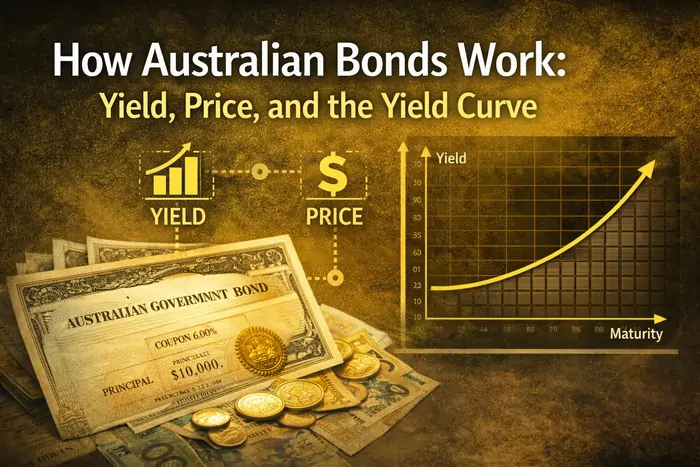
Understanding why investors are watching bonds so closely starts with a few key mechanics.
Bond Yield and Price
Bond yield is the effective return you earn, taking into account the coupon payments and the price you pay for the bond. The crucial relationship is:
- When market interest rates rise, existing bond prices usually fall, so their yields rise.
- When rates fall, existing bond prices typically rise, and yields fall.
If you buy a bond at par and hold it to maturity, you lock in a known series of interest payments and the return of your principal, ignoring default risk. But if you trade bonds before maturity, you are exposed to price moves driven mainly by interest rate expectations, inflation, and risk sentiment.
The RBA’s explainer on bonds and the yield curve walks through these relationships with charts and examples.
The Yield Curve
The yield curve plots bond yields across different maturities, from short‑term to long‑term. Its shape reflects investor expectations about economic growth and inflation:
- Upward‑sloping (normal) curve: long‑term bonds yield more than short‑term bonds, suggesting expectations of growth and inflation over time.
- Flattened or inverted curve: long‑term yields are close to or below short‑term yields, often interpreted as a sign of slower growth or potential recession.
Australia’s bond curve has attracted attention because longer‑dated yields are comparatively high versus many other developed markets, offering attractive carry for global funds seeking positive real yields.
Why Investors Are Watching Australian Bonds Closely
Over the past year, Australian bonds have drawn renewed interest from both domestic and international investors.
1. Attractive Yields Among Developed Markets
As of early 2026, Australia’s 10‑year government bond yield sits around the mid‑4% range, among the highest yields in developed sovereign markets. Bloomberg reports that at roughly 4.7%, the Australian 10‑year benchmark offers more income than comparable US or European government bonds, making it appealing to global bond funds seeking yield without moving into riskier emerging‑market debt.
YieldReport data in February 2026 noted that Australian government bond yields edged slightly lower but remained near multi‑year highs, keeping real (inflation‑adjusted) yields positive or close to positive for many maturities. For income‑focused investors, that combination of safety and solid yield is a key reason to watch this market.
For a regular snapshot of yields and bond‑market moves, specialist site YieldReport provides weekly commentary on Australian government and credit markets.
2. Safe Haven Appeal Amid AI‑Driven Volatility
The surge in AI‑related tech stocks globally has created both substantial gains and considerable volatility. When sentiment around the “AI boom” wobbles, some investors retreat from high‑beta equities into safer assets, and Australian bonds have been a beneficiary of that rotation.
Recent commentary highlighted that:
- Australian bonds are seen as one of the “safest and highest‑yielding” sovereign debt markets today.
- Inflows into Australian bond funds topped A$4 billion in the past year, the highest in four years, as global funds sought refuge from AI‑related volatility.
- Some analysts describe this shift as an “AI scare trade” pushing capital into bond markets like Australia’s.
A short summary of this dynamic appears in Binance’s note on Australian Bonds Attract Investors Amid AI Concerns, and a deeper institutional take is outlined in Bloomberg’s piece “Global Funds Seek Refuge in Australian Bonds as AI Boom Wobbles”.
3. Diversification and Defensive Positioning
Bonds traditionally provide diversification benefits because they tend to hold value or even rise when equities fall, especially if central banks respond to downturns by cutting interest rates. With Australia’s yields now materially higher than a few years ago, bonds offer:
- More meaningful income to offset inflation.
- Potential capital gains if economic weakness leads to RBA rate cuts and falling yields.
- A cushion in multi‑asset portfolios if risk assets sell off.
Firstlinks’ article on building a lazy ETF portfolio in 2026 illustrates how an investor might use a government bond ETF like VGB as the defensive anchor in a diversified ETF portfolio.
4. Relative Value vs Other Bond Markets
Some institutional strategists argue that Australian long‑term bonds now offer better value than US Treasuries, after underperforming for a period and ending up 60–70 basis points higher in yield than comparable US bonds. In a recent comment, Pendal Group noted that this spread and Australia’s stable institutional framework have sparked “a huge pickup in investor interest from around the globe” in Australian bonds.
For investors comparing markets, these relative yield differentials matter: higher yields for similar or lower credit risk can be an opportunity for both income and potential capital gains if spreads converge.
How to Invest in Australian Bonds
You can access Australian bonds in several ways, depending on your capital, experience, and desired level of hands‑on involvement.
1. Buying Bonds Directly
Sophisticated or wholesale investors often buy bonds directly via:
- Over‑the‑counter (OTC) bond dealers and brokers.
- Government programs that allow direct purchase of Treasury Bonds.
Direct holdings give you precise control over maturity and issuer, but:
- Minimum parcels can be large.
- Pricing and liquidity vary by bond.
- You must manage reinvestment risk and diversification yourself.
Moneysmart’s bonds guide outlines the pros and cons of direct bond investing for individuals.
2. Exchange‑Traded Treasury Bonds (eTBs)
Exchange‑traded Treasury Bonds let you buy small parcels of AGBs through a normal share‑trading account, with ASX codes representing specific maturities and coupons. You receive the same coupon and principal as if you held the underlying bond directly, but you can also sell the eTB at market prices during ASX trading hours.
The Australian Government Bonds site and Westpac’s guide to exchange‑traded AGBs walk through how these instruments work and the key risks to consider.
3. Bond ETFs and Managed Funds
For most individual investors, bond ETFs and managed funds provide the simplest route into Australian fixed income.
Examples:
- Vanguard Australian Government Bond ETF (VGB) – holds a diversified portfolio of Australian government and semi‑government bonds, currently offering yields above 4%.
- SPDR S&P/ASX Australian Bond ETF (BOND) – tracks a broad Australian fixed‑interest index including government and high‑quality corporate bonds.
The ASX’s investor education page on bond types and listed fixed‑interest products is a great place to explore what’s available under different ASX codes.
Risks and Considerations
Even though Australian bonds are drawing attention for their yields and perceived safety, they still carry risks that investors must understand.
Key risks include:
- Interest rate risk: If RBA or global rates rise further, bond prices can fall, especially for long‑duration bonds.
- Inflation risk: Higher‑than‑expected inflation can erode the real value of fixed coupon payments unless you hold inflation‑linked bonds.
- Credit risk: Corporate and high‑yield bonds carry default and downgrade risk, which can lead to capital loss.
- Liquidity risk: Some individual bonds and smaller funds may be harder to trade quickly at fair prices in stressed markets.
Balanced, practical guidance on these trade‑offs is available in Moneysmart’s bonds explainer and HSBC Australia’s introductory article “What are bonds?”.
How Australian Bonds Fit in a Portfolio
For many investors, Australian bonds play several roles:
- Income generation: Regular coupon payments can provide a more predictable income stream than dividends alone.
- Capital preservation: High‑quality government and investment‑grade bonds can cushion portfolios during equity downturns.
- Diversification: Bonds often behave differently to shares, reducing overall volatility when combined in a balanced portfolio.
Firstlinks’ piece on building a lazy ETF portfolio in 2026 shows how a moderate allocation to a government bond ETF can stabilise returns while still allowing growth from equities and other assets. Fund providers like Vanguard and State Street also publish asset‑allocation tools and model portfolios that illustrate the impact of various bond weightings.
If you’re thinking about bonds as part of a broader wealth‑building plan, it also pays to understand how your biggest liability – your home loan – fits into the picture. A good mortgage strategy can free up cash flow that you can redirect into fixed‑income investments. For a detailed breakdown of how mortgage specialists can help you structure debt more efficiently, see Top Mortgage Brokers in Australia: How They Can Save You Thousands.