

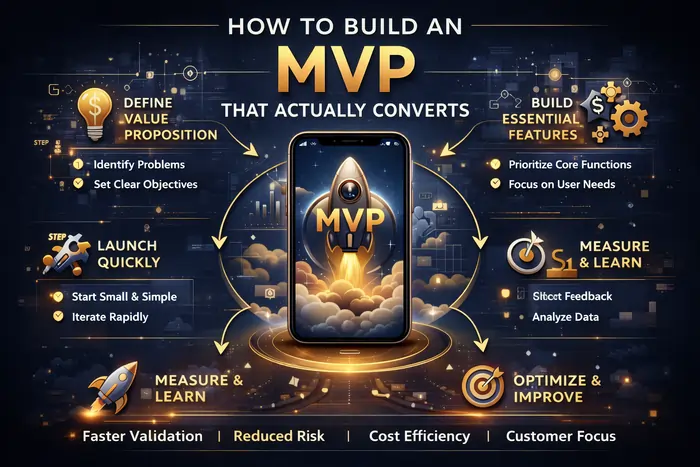
How to Build an MVP That Actually Converts
Most founders understand they should launch a minimum viable product, but far fewer know how to ship an MVP that actually converts real users into paying customers or qualified leads. The difference is not in how fast you ship, but in how deliberately you design every feature, page, and interaction around a clearly defined conversion goal.
Instead of treating an MVP as a barebones prototype, you’ll get better results by thinking of it as a focused conversion machine: just enough functionality to deliver value, combined with a streamlined funnel that makes it easy for the right users to say “yes.” In this guide, you’ll learn how to define that “yes,” prioritize only the features that move the needle, validate with real users, and iterate based on data so your MVP becomes a reliable growth asset instead of an expensive experiment.
For a foundational definition of MVP and its role in lean product development, you can reference guides like Atlassian’s Minimum Viable Product guide or Miro’s Minimum Viable Products — the Ultimate Guide.
Get Crystal Clear on the Problem and Target User
Conversion starts long before you build a single feature. It starts with picking a sharp, specific problem and a narrow, well‑defined early adopter. If you don’t know exactly who you’re building for and what painful problem you’re solving, no amount of UX polish or funnel optimization will save your MVP.
First, articulate the core problem in one or two sentences. Avoid vague statements like “help teams be more productive.” Instead, aim for something like “help remote engineering teams reduce time spent in status meetings by 50%.” The more specific you get, the easier it becomes to design features and messaging that resonate.
Next, define your ideal early adopter profile. Early adopters feel the problem more intensely and are more willing to tolerate rough edges as long as you clearly address their pain. For many founders, this stage often overlaps with running a side hustle that later becomes a full‑time business, so pay attention to the specific niches and customer segments that respond best to your early offers.
Capture basic firmographics and demographics if relevant, but go deeper into their goals, frustrations, buying triggers, and the alternatives they currently use. A practical way to do this is to build lightweight user personas and journey maps. Personas keep the whole team aligned on who you’re building for, while journey maps help you identify high‑friction steps where your MVP can deliver quick wins and where conversion opportunities naturally occur.
Finally, frame your solution as a job to be done: what is the job your user is hiring your product to do? When you know the job, you can prioritize features and messaging around the moments that prove you’re doing that job effectively, which is exactly where conversions happen.
Define “Conversion” for Your MVP
You can’t build an MVP that converts if you haven’t defined what “conversion” means. For an early‑stage product, conversion might not be a direct sale yet, but it must represent real progress toward revenue or validated learning.
Start by choosing one primary conversion goal for your MVP. Depending on your business model and stage, this could be:
- New trial signups for a SaaS product
- Email subscribers for a waitlist
- Booked demo or strategy calls
- Self‑serve plan upgrades from free to paid
Pick the one action that best predicts long‑term value and keep it front and center across your product and landing page.
Then define one or two micro‑conversions that indicate users are moving in the right direction. These might include:
- Completing onboarding
- Activating a key feature at least once
- Connecting an integration
- Inviting teammates
These micro‑conversions help you diagnose where users are dropping off before the main conversion and give you concrete levers to pull when iterating.
Most importantly, resist the temptation to chase multiple competing goals at once. When you try to optimize for signups, demos, and ebook downloads simultaneously, you dilute your message and confuse users, which almost always hurts your overall conversion rate.
Prioritize Only the Features That Drive That Conversion
Once you know your target user and your primary conversion goal, feature prioritization becomes much clearer. The question is no longer “what would be nice to have?” but “what directly helps users reach that conversion quickly and confidently?”
A simple, effective approach is to use a MoSCoW prioritization (Must, Should, Could, Won’t) informed by user research and the job to be done. Must‑have features are those without which your product can’t deliver the core value proposition or can’t reasonably lead users to the desired conversion. Everything else can wait for later iterations.
For example:
- In a SaaS analytics tool, must‑have features might include connecting at least one data source, viewing a core dashboard, and exporting or sharing a basic report.
- In a marketplace MVP, you might focus on listing creation, search/browse, and a safe way to contact or transact with a small number of vetted providers.
Each must‑have feature should map to a clear step in the conversion journey: discovering value, experiencing value, and committing. If a feature doesn’t help users move along that path, it’s likely a distraction at the MVP stage.
This is where frameworks like the Minimum Viable Product Framework Guide are useful. They give you a shared language to say no to low‑impact requests and keep the team anchored on what will actually move your main metric.
Design a Landing Page That Sells the MVP
Even the most thoughtfully designed MVP will struggle if the landing page doesn’t clearly communicate value and guide visitors toward your primary conversion. Your landing page is often the first—and sometimes only—experience prospects have with your product, so it needs to work hard.
Start with a sharp, benefit‑driven value proposition above the fold. It should quickly answer three questions for the visitor: What does this do? Who is it for? Why should I care right now? Pair that with a single, prominent call to action aligned with your conversion goal, such as “Start free trial,” “Join the waitlist,” or “Book a demo.”
Structure the rest of the page around the core questions and objections your target users have. Common high‑converting sections include:
- Problem: A short description of the pain your target audience feels.
- Solution: How your MVP addresses that pain in a simple, concrete way.
- Benefits and outcomes: What changes for the user once they adopt your solution.
- Social proof: Testimonials, logos, or early usage numbers, even if from beta or pilot users.
- Objection handling: Short answers to common concerns about risk, time investment, or switching costs.
- Final CTA: A repeat of your primary call to action with minimal distraction.
Avoid common landing page mistakes such as cluttered navigation, multiple conflicting CTAs, jargon‑heavy copy, and long walls of text. At the MVP stage, your goal is to reduce friction, build trust quickly, and make it obvious what the next step should be.
If you’re building a remote or distributed team around your MVP, keep in mind how your landing page messaging also reflects the realities of remote‑first startups, such as asynchronous collaboration and access to global talent.
Validate with Real Users Before You Over‑Build
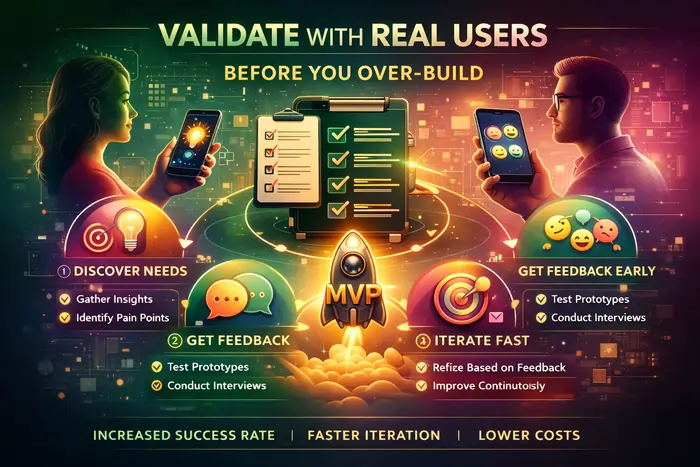
Before you invest heavily in building out your roadmap, validate that your MVP actually resonates with the people you designed it for—and that it leads to your defined conversion. Validation doesn’t have to be complicated or expensive; it just has to be intentional and tied to the right metrics.
Low‑cost validation approaches include:
- User interviews with people who match your early‑adopter profile, focusing on their current workflows and pains rather than pitching your solution.
- Concept testing with clickable prototypes or simple demos to gauge interest and understand expectations.
- Landing‑page tests that measure signups or waitlist opt‑ins before the full product is ready.
- Concierge or manual‑service experiments where you deliver the outcome by hand behind the scenes while learning how users behave.
The key is to frame your experiments around your primary conversion instead of vanity metrics like social media followers or pageviews. Ask questions like: Do people who see the value proposition sign up? Do new signups reach activation? Are users willing to pay, commit time, or change behavior?
Aim for “good enough” validation rather than perfection. You’re looking for strong signals that you’re solving a real problem for a defined group of people and that your funnel is capable of turning interest into meaningful action.
Measure, Learn, and Iterate for Higher Conversions
Once your MVP is in the hands of real users, your job shifts from building to learning. The goal is to understand where users get stuck, why they drop off, and which changes have the biggest impact on your conversion rate.
Start with a small, focused set of MVP metrics:
- Top‑of‑funnel: number of qualified visitors or signups.
- Core conversion: trial starts, demo bookings, or purchases, depending on your goal.
- Activation: percentage of new users who reach a key “aha” moment, such as completing an important action.
- Retention or engagement: short‑term signals that users are getting ongoing value.
Pair quantitative data with qualitative feedback from surveys, support tickets, and conversations. The numbers tell you what is happening; the words tell you why. Use this feedback to identify specific friction points and hypothesis‑driven improvements.
Keep your experimentation lightweight. Simple tests like trying a new headline, adjusting onboarding steps, simplifying a form, or clarifying a pricing section can yield meaningful gains without months of development work. After each change, measure its impact on your core metrics and decide whether to keep, iterate, or roll back.
Over time, this build‑measure‑learn loop turns your MVP into a more robust and reliable product that’s better tuned to how your users think and behave, not just how you imagined they would.
Common MVP Conversion Traps to Avoid
Even experienced teams fall into patterns that quietly kill MVP conversions. Being aware of these traps helps you steer around them before they cost you time and traction.
One common trap is over‑building your MVP before you have evidence that users care about your core value proposition. It’s tempting to add more features to make the product feel “complete,” but every extra feature adds complexity and risk without guaranteeing better conversions. Focus on making your must‑have features excellent and easy to discover instead.
Another trap is ignoring your financial runway while you iterate. If you don’t pay attention to startup burn rate and cash out date, you can find yourself with a promising MVP that never reaches product‑market fit simply because you ran out of time. Basic burn‑rate calculations and disciplined spending help you buy enough runway to run multiple learning cycles.
A third trap is treating every user request as a priority. Feedback is invaluable, but if you don’t filter it through your main conversion goal and ideal user profile, you’ll end up with a bloated MVP that serves no one particularly well. Use your prioritization framework to ask: Will this change significantly improve the path to our primary conversion for our target users?
Finally, many teams underestimate onboarding, support, and user education. Even a well‑designed product can feel overwhelming or confusing without clear guidance, especially for first‑time users. A simple onboarding checklist, in‑app hints, or short help articles can dramatically improve activation and downstream conversions.
Real‑World Examples of MVPs That Converted
Examples are powerful because they show how these principles look in practice. While every product is different, successful MVPs tend to share a few patterns: narrow scope, clear value proposition, and a tightly focused funnel.
For instance, many well‑known SaaS companies started by solving one specific, painful workflow problem for a narrow audience, then expanded as they learned more about adjacent needs. Their early MVPs typically had just enough functionality to help users complete that workflow and a single landing page built around a concrete outcome. Early social proof often came from a small group of beta users, but it was prominently surfaced in their messaging.
Marketplace and platform MVPs often begin even smaller, sometimes with a manual or concierge model behind the scenes. The publicly visible experience focuses on browsing a curated set of options and taking a single key action—such as requesting a quote or booking a call—rather than trying to automate every step from day one.
As you grow from prototype to a real business, many founders will recognize the transition described in stories of moving from a side hustle to full‑time entrepreneur: the MVP is the bridge that lets you validate demand before you commit fully.
Conclusion and Next Steps
An MVP that actually converts is not just a smaller version of your full vision; it’s a deliberately constrained product designed to prove that a specific group of people will take a specific high‑value action when presented with your solution. When you get clear on your problem and user, define a single conversion goal, prioritize only the features that enable that conversion, craft a landing page that sells the outcome, validate with real users, and iterate based on data, you dramatically increase your odds of building something that deserves to grow.
At the same time, you can’t ignore the “unsexy” side of building a real business around your MVP: managing startup burn rate, keeping an eye on cash flow, and even investing in local SEO for small businesses if your product has a geographic component. Strong fundamentals here give you the financial and marketing runway to keep iterating until your MVP becomes a sustainable product.
Your next step is to choose one concrete action: tighten your definition of the problem and early adopter, strip your backlog down to conversion‑driving features, or redesign your landing page so that your value proposition and CTA are impossible to miss. Once you’ve done that, you’ll be ready to run your next set of validation experiments and move one step closer to a minimum but truly viable product.