

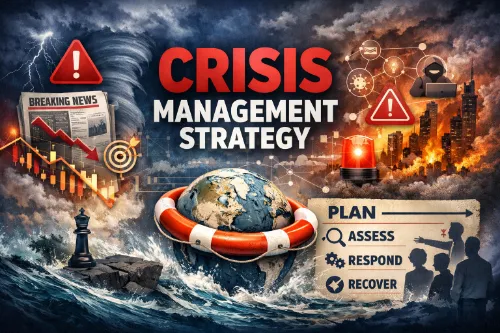
A crisis management strategy is your organization’s playbook for preparing for, responding to, and recovering from serious disruptions that could harm people, operations, finances, or reputation. Instead of reacting chaotically when something goes wrong, you use a structured, tested strategy that integrates planning, response, recovery, and learning under clear governance.
What Is Crisis Management Strategy?
Crisis management is the process and strategy‑based approach an organization uses to identify potential threats, respond to critical events, and restore normal operations while protecting stakeholders. A crisis management strategy turns that process into a coherent set of policies, structures, and actions that guide what you do before, during, and after a crisis.
Investopedia defines crisis management as a proactive effort to identify, manage, and mitigate threats that could harm an organization or its stakeholders. Umbrex describes a crisis management strategy as encompassing risk assessment, crisis planning, a crisis team, structured communication, and recovery planning. Everbridge similarly frames crisis management as a “process and strategy‑based approach” organized around five stages: prevent, prepare, identify, respond, and recover.
Stages and Frameworks of Crisis Management
Most crisis management frameworks break the lifecycle into stages that span prevention through recovery. Understanding these stages makes it easier to build a comprehensive crisis management strategy instead of isolated plans.
Common Stage Models
Several reputable sources outline similar crisis stages:
- Everbridge’s five stages: prevent, prepare, identify, respond, recover.
- International SOS’s three stages: pre‑crisis, crisis response, and post‑crisis.
- EuroMaTech’s 4Rs model: reduction, readiness, response, recovery.
Everbridge explains that a mature strategy moves through prevention (risk identification and safeguards), preparation (plans and training), identification (recognizing events early), response (executing the plan and communicating), and recovery (restoring operations and improving). EuroMaTech’s crisis management frameworks overview adds that frameworks like the 4Rs and the MIT crisis framework help leaders respond adaptively and consistently under pressure.
International SOS emphasizes the importance of pre‑crisis planning as “arguably the most important stage,” because it determines how effective your response and recovery will be.
Core Components of a Crisis Management Strategy
A robust crisis management strategy normally includes several core components that work together.
1. Risk Assessment and Scenario Planning
Risk assessment identifies potential crises (natural disasters, cyberattacks, product failures, PR scandals, supply chain disruptions) and evaluates their likelihood and impact. This becomes the foundation for prioritizing your crisis planning.
Umbrex lists risk assessment as the first key component of a crisis management strategy: identifying potential crises, assessing impact, and prioritizing them. Crises Control’s step‑by‑step crisis plan guide recommends a structured risk assessment and threat analysis to focus your plan on the most critical threats.
Protecht’s comprehensive crisis management guide adds scenario planning and simulations so you can test how the organization would respond to different crisis types and refine your strategy proactively.
2. Crisis Management Team and Governance
A crisis management strategy requires a defined crisis management team (CMT) with clear roles, responsibilities, and authority.
Common roles include:
- Crisis manager or incident commander (overall coordination and final decisions).
- Communications lead (media, social, internal updates).
- Operations and IT leads (continuity and resource allocation).
- Legal and compliance (regulatory, liability, contracts).
- HR/People (employee safety, internal concerns).
Crises Control emphasizes assembling a cross‑functional team with representatives from communications, legal, IT, and HR who can make informed decisions under pressure. Monday.com’s guide to a crisis management plan includes a similar set of roles, noting that clear roles prevent confusion when “every minute counts.”
Protecht stresses that strong governance underpins effective crisis management: defined roles, escalation pathways, and executive sponsorship so the team has authority to act.
3. Crisis Management Plan (CMP)
A crisis management strategy is implemented through a documented crisis management plan that covers multiple scenarios and outlines procedures.
Smartsheet’s step‑by‑step guide to a crisis management plan lists essential elements such as:
- Risk analysis and business impact analysis.
- Activation protocol and chain of command.
- Command center set‑up and response action plans.
- Internal and external communication programs.
- Training and review processes.
Asana describes a crisis management plan as a document outlining how your business will react if a crisis occurs, including who will act and what their roles are. Crises Control adds that effective plans include detailed action plans by scenario, resource allocation, and decision‑making protocols.
4. Communication Strategy
Crisis communication is a central pillar of any crisis management strategy. The communication plan should define how you will communicate with employees, customers, regulators, media, and the public during a crisis.
AlertMedia’s 7‑step crisis management guide stresses that clear communication helps contain incidents, safeguard operations, and prevent escalation. Crises Control similarly highlights internal communication protocols and media‑handling procedures as core to a good plan.
Umbrex lists communication planning as one of the five key components of a crisis management strategy, ensuring internal and external stakeholders stay informed.
5. Recovery and Learning
An effective crisis management strategy includes detailed steps for restoring operations (business continuity and recovery) and learning from each event.
Protecht’s guide describes a recovery phase where organizations focus on restoring operations and reputation, followed by a learning phase where they analyze root causes, evaluate performance, and improve frameworks. EuroMaTech’s 4Rs framework defines recovery as restoring normal operations and incorporating lessons to strengthen resilience.
Umbrex and CE Interim both emphasize post‑crisis reviews and framework updates as part of a mature strategy.
Designing Your Crisis Management Strategy: Step-by-Step
Bringing a crisis management strategy to life requires a structured, iterative approach.
Step 1: Identify and Prioritize Potential Crises
Start with an enterprise‑wide risk assessment that identifies and categorizes potential crises by likelihood and impact.
- Use risk workshops and historical incident data.
- Consider operational, financial, cyber, reputational, and physical risks.
- Prioritize high‑impact, higher‑likelihood threats for detailed planning.
CE Interim’s crisis management frameworks guide recommends developing crisis scenarios around your top threats, outlining potential impacts and required responses.
Step 2: Form Your Crisis Management Team
Define your crisis governance structure and appoint a cross‑functional CMT.
Monday.com’s 7‑step plan guide suggests including a crisis manager, communications lead, operations rep, legal counsel, and HR representative. Crises Control’s CMP guide similarly calls for a dedicated team with representatives from communications, legal, IT, and HR.
Clarify:
- Roles and decision‑making authority.
- Backup roles and deputies.
- Escalation rules and activation triggers.
Step 3: Build Your Crisis Management Plan and Framework
Using your prioritized risks and team structure, create a crisis management plan and framework.
Key elements include:
- Scenario‑specific action plans: precise steps for each crisis type (e.g., cyberattack, data breach, natural disaster, PR crisis).
- Activation triggers and decision hierarchy: when the plan is activated and who approves major actions.
- Resource allocation plans: how you will deploy people, equipment, and budget under pressure.
- Command center concept: where and how the crisis team will coordinate (physical or virtual).
Smartsheet’s crisis management plan guide offers a practical five‑step structure: ground rules and risk assessment; business impact analysis; response and contingency planning; training and coordination; and review.
Step 4: Develop Your Communication Strategy
Define how you will communicate before, during, and after crises.
AlertMedia’s crisis communication guide recommends:
- Pre‑approved messaging templates for common scenarios.
- Identification of spokespersons and media protocols.
- Clear internal communication channels (email, intranet, SMS, apps).
- Guidelines for social media monitoring and response.
Crises Control adds that internal updates must be frequent and consistent to reduce fear and rumors, while external messages must balance speed and accuracy.
Step 5: Train, Simulate, and Test
Documentation alone is not enough; training and exercises are what turn plans into real capability.
Protecht notes that regular testing—through drills, simulations, and tabletop exercises—is what embeds crisis readiness into culture. EuroMaTech and International SOS both highlight simulations as essential for improving coordination and spotting gaps.
Smartsheet and Asana both recommend scheduling periodic reviews and simulations, then updating plans based on outcomes.
Step 6: Monitor, Respond, and Adapt in Real Time
When a crisis occurs, your strategy shifts to identification and response.
Everbridge’s five‑stage model stresses:
- Early identification of critical events via monitoring tools and front‑line reporting.
- Rapid activation of the CMT and crisis plan.
- Dynamic adjustment of tactics as new information emerges.
Protecht’s response strategy guidance includes real‑time threat identification and triage, activation of the crisis team, coordinated communication, and continuity planning.
Step 7: Recover and Learn
After the immediate crisis, your focus moves to restoring operations and learning from what happened.
Umbrex and CE Interim both recommend post‑incident reviews that assess:
- What worked and what didn’t.
- How well roles, communication, and decisions aligned with the plan.
- Improvements needed for frameworks, training, and tools.
Protecht describes this as integrating learning into governance so each crisis strengthens future resilience rather than being a one‑off event.
Examples and Frameworks in Practice
Real‑world case studies show how organizations use frameworks and strategies to manage crises effectively.
CE Interim’s crisis management frameworks guide highlights:
- A financial institution using the KPMG crisis framework to handle a cyberattack with minimal disruption.
- A healthcare provider using the BCM Institute model during COVID‑19 to maintain continuity of care.
EuroMaTech’s overview showcases the 4Rs and MIT frameworks as examples of models that structure reduction, readiness, response, and recovery. Smartsheet and Monday.com provide template‑driven approaches that many smaller organizations can adopt quickly.
For concrete brand‑level examples, Sash & Company’s article on 20 successful crisis management examples illustrates how companies like Facebook/Meta, Peloton, and Boeing handled crises through communication, recalls, and structural changes.
Crises Control also outlines “10 essential crisis management strategies” for facilities managers, including comprehensive risk assessments, response plans, training, and continuous improvement.
Crisis Management Strategy Best Practices
Pulling together guidance from Investopedia, Umbrex, Protecht, CE Interim, and others, several best practices stand out:
- Be proactive, not reactive: Conduct regular risk assessments and scenario planning, and embed crisis readiness into governance.
- Define clear roles and authority: A well‑structured crisis team with a clear chain of command prevents confusion.
- Focus on communication: Transparent, consistent messages to employees, customers, regulators, and media are crucial for maintaining trust.
- Integrate continuity and recovery: Link crisis management with business continuity and disaster recovery plans.
- Train and rehearse: Simulations reveal gaps and build confidence so teams are ready when real crises hit.
- Learn continuously: Use after‑action reviews to refine your crisis management strategy after every incident or exercise.
Investopedia’s crisis management overview and Umbrex’s crisis management strategy explainer are good starting points for understanding the strategic concepts. Protecht’s comprehensive crisis management guide and CE Interim’s frameworks and templates then help translate those ideas into a practical, organization‑wide crisis management strategy you can implement and continuously improve