

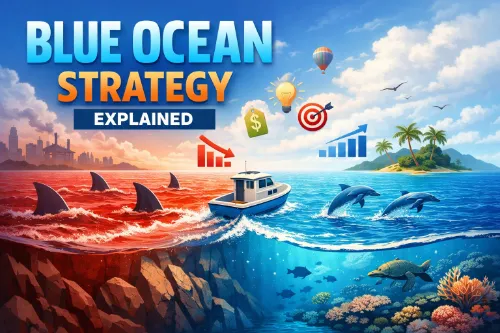
Blue Ocean Strategy is a framework for creating uncontested market space by pursuing differentiation and low cost at the same time, instead of fighting rivals in crowded “red ocean” markets. Put simply, it is about making the competition irrelevant by creating new demand rather than battling over existing demand.
What Is Blue Ocean Strategy?
Blue Ocean Strategy was developed by W. Chan Kim and Renée Mauborgne to describe how companies can escape cut‑throat competition by creating “blue oceans” of new, uncontested market space. In these blue oceans, the rules of the game are not yet set, and competition is largely irrelevant because you are offering something fundamentally different.
According to the official Blue Ocean Strategy site, a blue ocean strategy is “the simultaneous pursuit of differentiation and low cost to open up a new market space and create new demand.” Britannica’s overview of Blue Ocean Strategy explained adds that this is done through “value innovation,” creating a leap in value for both customers and the company.
Blue Ocean vs Red Ocean Strategy
To understand Blue Ocean Strategy, it helps to contrast it with traditional “red ocean” strategy.
- Red ocean: You compete in existing market space, fight rivals for market share, and often end up in price wars or incremental feature battles.
- Blue ocean: You create new market space, reshape demand, and design offerings that make competition largely irrelevant.
Harvard Business Review’s classic article on Blue Ocean Strategy notes that red ocean competition is like fighting for limited territory, while blue ocean strategy is about “creating new land” instead of slicing up the existing land. Santander Open Academy’s guide on blue ocean vs red ocean strategy describes red oceans as crowded, price‑driven markets, and blue oceans as innovative spaces where demand is created rather than captured.
If you want a quick, visual comparison, Wayra’s article on red ocean vs blue ocean strategy and Investopedia’s Blue Ocean Strategy definition and examples both outline the key differences.
Core Principles: Value Innovation at the Center
The heart of Blue Ocean Strategy is value innovation—creating a step‑change in value for customers while simultaneously reducing costs. Instead of accepting a trade‑off between value and cost, you redesign your offering and business model so you can deliver more value at lower cost.
Britannica explains that you create a blue ocean by reshaping market boundaries and focusing on value innovation, often by recombining existing technologies and services in novel ways. The official Blue Ocean Strategy site emphasizes that the goal is to “open up a new market space and create new demand” through this simultaneous pursuit of differentiation and low cost.
Quantive’s primer on what Blue Ocean Strategy is and how to apply it elaborates that value innovation often involves:
- Removing features customers do not truly value.
- Elevating or adding factors that create a compelling new experience.
- Realigning internal activities to support the new value proposition at a low cost.
Key Tools of Blue Ocean Strategy
The Blue Ocean framework provides several practical tools to help you move from red oceans to blue oceans. Three of the most important are the strategy canvas, the value curve, and the Four Actions Framework (ERRC grid).
1. Strategy Canvas and Value Curve
The strategy canvas is a visual tool that maps the key factors on which an industry competes and shows how different players perform on each factor. When you plot your and your competitors’ offerings, the resulting line is your value curve—a profile of where you over‑ or under‑invest relative to industry norms.
Wayra’s article on Blue Ocean Strategy and the value curve explains that analyzing the value curve helps you:
- See where everyone is converging and competing.
- Spot areas where you can eliminate or reduce features that don’t matter much to customers.
- Identify features you can raise or create to deliver a different kind of value.
Spider Strategies’ guide on Blue Ocean Strategy and value curves offers concrete tips for building a strategy canvas and using the resulting value curve to design a differentiated offering.
2. Four Actions Framework and ERRC Grid
The Four Actions Framework (also called the ERRC grid—Eliminate, Reduce, Raise, Create) prompts four questions about your industry’s value factors:
- What should we eliminate that the industry takes for granted?
- What should we reduce below the industry standard?
- What should we raise above the industry standard?
- What should we create that the industry has never offered?
The official Blue Ocean Strategy site’s article on the Four Actions Framework and ERRC grid describes it as an analytical tool to break the value‑cost trade‑off and craft a new value curve. Spider Strategies also highlights this framework as a way to challenge assumptions and systematically design a new strategic profile.
3. Guiding Principles of Blue Ocean Strategy
Lucidity’s summary of Blue Ocean Strategy organizes the book’s ideas into eight guiding principles, split between formulation and execution:
- Reconstruct market boundaries.
- Focus on the big picture, not the numbers.
- Reach beyond existing demand.
- Get the strategic sequence right.
- Overcome key organizational hurdles.
- Build execution into strategy.
- Align value, profit, and people propositions.
- Renew blue oceans over time.
These principles emphasize that Blue Ocean Strategy is as much about execution and organizational alignment as it is about creative ideation.
How to Create a Blue Ocean: Step-by-Step
Turning the Blue Ocean concept into action requires a structured process. Based on guidance from the official Blue Ocean site, Lucidity, Quantive, and Santander Open Academy, a typical path looks like this:
Step 1: Understand the Current “Red Ocean”
Start by mapping your current industry landscape. Use the strategy canvas to:
- Identify the key competitive factors (price, features, convenience, brand, etc.).
- Plot your own value curve against key competitors.
- See where competition is intense and where customers are underserved.
Lucidity and Wayra both recommend this analysis as a foundation before you attempt to redraw your value curve.
Step 2: Look Beyond Existing Customers
Blue oceans are often found by targeting non‑customers—people who either rarely use your category, refuse to use it, or have alternative ways of meeting the same need.
Santander Open Academy’s blue and red ocean strategy guide suggests using tools like the Three Tiers of Noncustomers, looking at:
- Soon‑to‑be noncustomers (on the edge of leaving).
- Refusing noncustomers (who have considered your category and rejected it).
- Unexplored noncustomers (who have never been targeted).
Quantive’s Blue Ocean Strategy examples and application shows how companies like Cirque du Soleil and Southwest Airlines expanded beyond traditional customer segments.
Step 3: Apply the Four Actions Framework
Use the ERRC grid to redesign your offering. For each industry factor on your strategy canvas, ask:
- What can we eliminate or reduce to cut costs and simplify?
- What can we raise or create to deliver a step‑change in value?
The ERRC grid template and examples provide practical case studies of companies that eliminated industry‑taken‑for‑granted factors, reduced over‑delivered elements, and created new features to unlock demand.
Step 4: Craft a New Value Curve and Test It
Plot your proposed value curve and compare it to the current industry curves. Check whether it:
- Diverges clearly from rivals (rather than mimicking them).
- Focuses sharply on a few key factors.
- Is compelling and easy to understand for your target buyers.
Spider Strategies’ Blue Ocean Strategy guide suggests using this value curve as a blueprint for product design, pricing, and go‑to‑market decisions.
Step 5: Align Your Business Model and Execution
A great concept fails without aligned operations, pricing, and people. Lucidity’s summary stresses aligning the value proposition, profit proposition, and people proposition to sustain a blue ocean move.
That means:
- Adjusting processes, technology, and partnerships to deliver the new value at low cost.
- Designing a pricing model that reflects the new value curve and encourages adoption.
- Engaging employees, overcoming resistance, and building execution into strategy.
ClearPoint Strategy’s article on Blue Ocean Strategy examples and how to apply it covers how organizations can translate a blue ocean idea into KPIs, initiatives, and performance management.
Examples of Blue Ocean Strategy in Action
Classic Blue Ocean Strategy examples show how companies reshaped industries by changing the rules rather than playing by them.
Britannica’s overview mentions Cirque du Soleil, Southwest Airlines, and Yellow Tail as emblematic cases. For instance:
- Cirque du Soleil combined elements of circus and theater, eliminating costly star performers and animals while raising the storytelling and artistic quality, creating a new form of live entertainment.
- Yellow Tail simplified wine choices and branding, targeting beer and cocktail drinkers with easy‑drinking, fun‑positioned wine, rather than fighting over sophisticated connoisseurs.
ClearPoint and Quantive both highlight similar cases in their Blue Ocean Strategy example collections and Quantive’s Blue Ocean overview.
Blue Ocean Strategy vs Traditional Competitive Strategy
Traditional strategy frameworks often assume a trade‑off: you either compete on low cost or differentiation. Blue Ocean Strategy challenges this by seeking both differentiation and low cost simultaneously.
The Strategy Institute’s article on understanding red ocean vs blue ocean strategies explains that:
- Red ocean strategies focus on beating rivals in known markets, often through incremental improvements.
- Blue ocean strategies encourage firms to venture into uncharted territory, using creativity to create new markets and demand.
HBR’s original Blue Ocean Strategy article underscores that companies get stuck when they treat differentiation and low cost as mutually exclusive; blue ocean moves break this trade‑off through value innovation.
Risks and Challenges of Blue Ocean Strategy
While the potential rewards of a blue ocean move are significant, the strategy is not risk‑free.
Key challenges include:
- Misreading customer needs and creating an offering nobody wants.
- Underestimating the operational changes needed to deliver the new value at low cost.
- Attracting imitators once your blue ocean becomes visible, gradually turning it red.
YouTube explainers like “What Is the Blue Ocean Strategy?” and “Red Ocean vs Blue Ocean Strategy” often stress that blue oceans carry higher uncertainty but potentially much greater long‑term rewards.
When to Use Blue Ocean Strategy
Blue Ocean Strategy is particularly useful when:
- Your industry is saturated and incremental improvements no longer move the needle.
- Competing on price or features feels like a race to the bottom.
- There are clear signs of underserved customers or noncustomers with unmet needs.
ClearPoint’s and Lucidity’s guides suggest that even if you cannot create a full new market, applying Blue Ocean tools can still reveal differentiation opportunities within your current space.
Putting “Blue Ocean Strategy Explained” Into Practice
To start applying Blue Ocean Strategy in your own business, you can:
- Read a concise overview from the official Blue Ocean Strategy site to internalize the basics.
- Map your red ocean using a strategy canvas and value curve, as outlined by Wayra and Spider Strategies.
- Use the Four Actions Framework with the ERRC grid from the Blue Ocean site to redesign your value proposition.
- Explore noncustomers using Santander’s guidance on blue vs red ocean and Lucidity’s principles for reaching beyond existing demand.
- Align your execution by following Lucidity’s eight guiding principles and ClearPoint’s advice on embedding Blue Ocean moves into strategy and metrics.
By combining these external resources with a deep understanding of your customers and capabilities, you can move from competing in bloody red oceans to carving out your own blue ocean strategy, where you set the rules and unlock new demand instead of fighting over what already exists.