

Startup founders obsess over product, growth, and fundraising—but many overlook the one metric that can quietly kill their company: burn rate. Your startup burn rate tells you how fast you’re spending cash, how long you can survive at your current pace, and when you must either raise more money or hit profitability. Understanding how to calculate and control it is non‑negotiable if you want to avoid becoming a “great idea that ran out of runway.”
Startup Burn Rate: How to Calculate and Control It
Startup burn rate is the rate at which your company uses up its cash reserves before generating positive cash flow. In practice, it answers a simple but critical question: “How fast are we burning money each month?” For early‑stage companies, common pain points include underestimating how quickly expenses add up, over‑hiring ahead of product‑market fit, and assuming fundraising will be faster and easier than it actually is.
Resources like Stripe’s guide to burn rate, Brex’s breakdown of startup burn mistakes, and SVB’s “Understanding What Your Startup’s Burn Rate Really Means” all stress the same message: if you don’t measure and manage burn, you’re flying blind. Taking an experimental approach to spending—testing, measuring, and learning—mirrors the principles in the lean startup model, where every dollar is treated as fuel for validated learning rather than a blank cheque for growth.
What Is Startup Burn Rate?
Burn Rate Explained in Plain Language
Burn rate is simply the speed at which your startup is spending down its cash. If your bank balance drops from 500,000 USD to 380,000 USD over four months, you’ve “burned” 120,000 USD of cash over that period, which implies an average monthly burn.
Corporate Finance Institute’s burn rate overview explains that burn rate is particularly important for early‑stage startups that are intentionally operating at a loss while they develop product and grow revenue. A reasonable burn, backed by a clear plan and enough cash, can be a strategic bet on growth; an uncontrolled burn—with no line of sight to milestones or next funding—quickly becomes existential risk.
Gross Burn vs Net Burn
Most guides distinguish between gross burn and net burn:
- Gross burn rate – Your total monthly cash outflows (operating expenses, payroll, rent, tools, etc.) before considering revenue.
- Net burn rate – Your monthly cash loss, calculated as cash outflows minus cash inflows (revenue and other income).
Stripe and Brex note that gross burn is particularly useful pre‑revenue or when revenue is minimal, while net burn becomes more meaningful once you have material recurring revenue. Investors often ask for both, because together they show if you’re managing expenses and how quickly revenue is offsetting those expenses.
How to Calculate Burn Rate (Step by Step)
Basic Burn Rate Formula
At its simplest, burn rate looks at how fast your cash balance is shrinking over time. Competera’s “How to Calculate Burn Rate: Definition, Formula, and Examples” and Afino’s startup burn overview both use a basic formula:
Burn rate = (Starting cash – Ending cash) ÷ Number of months
Example:
- Starting cash in January: 500,000 USD
- Ending cash in June: 380,000 USD
- Time period: 6 months
Burn rate=(500,000−380,000)÷6=120,000÷6=20,000 USD per month
This tells you that, on average, you’re burning 20,000 USD per month over that period.
Calculating Monthly Gross and Net Burn
To manage actively, you’ll also want to compute monthly gross and net burn from your accounting data. Stripe and Rho’s burn rate guide outline this approach:
- Gross burn (per month) = Total monthly operating cash outflows
- Example: payroll 60,000 + rent 10,000 + tools 5,000 + marketing 15,000 + other 10,000 = 100,000 USD gross burn.
- Net burn (per month) = Gross burn – cash inflows (typically revenue)
- If you bring in 40,000 USD in monthly cash receipts, net burn = 100,000 – 40,000 = 60,000 USD.
Visible.vc’s “How to Reduce Burn Rate” and Lighter Capital’s burn management guide recommend using at least a 3–6 month average for these numbers to smooth out one‑time spikes or dips.
Burn Rate and Runway – How Long Until You Run Out of Cash?
Startup Runway Formula
Runway tells you how long your startup can operate at its current net burn before running out of cash. Afino and Founders Network both use the classic formula:
Runway (months) = Current cash balance ÷ Monthly net burn
Example:
- Current cash: 360,000 USD
- Monthly net burn: 60,000 USD
Runway=360,000÷60,000=6 months
That means, if nothing changes, you have 6 months before you hit zero—an alarmingly short window if you still need to reach key milestones or raise funding.
Silicon Valley Bank’s article makes a crucial point: runway is not static. Changes in expenses, hiring, pricing, or growth will alter your burn and thus your runway, which is why they recommend updating these calculations at least monthly.
What Is a “Healthy” Burn Rate and Runway?
There is no one‑size‑fits‑all “good burn rate,” but multiple sources offer broad guidance:
- Pre‑seed / Seed – Often targeting 12–24 months of runway, given long product‑market fit cycles and uncertain fundraising conditions.
- Series A/B – Some startups operate with 12–18 months runway, balancing growth with risk; others push more aggressively if they have strong traction.
- Later stage – Expectations shift toward more efficient growth and clearer paths to profitability; high burn with poor unit economics becomes less acceptable.
Brex’s startup guide and Preferred CFO’s “From Burn Rate to Boom” emphasize that what matters is whether your burn is clearly tied to hitting milestones (product, revenue, retention) that will unlock the next round or sustainable profitability.
Why Burn Rate Matters to Founders and Investors

Burn Rate as a Signal of Financial Health
Burn rate is more than an accounting metric; it’s a signal of your financial discipline and risk profile. Corporate Finance Institute notes that investors often track burn rate over time to see whether founders are reacting to market changes or letting expenses drift upward unchecked.
Key reasons burn rate matters:
- It reveals whether your cost base is aligned with your stage and strategy.
- It helps boards and investors assess execution discipline, not just vision.
- It acts as an early warning system for cash‑flow problems long before the bank balance hits zero.
SVB highlights that founders who proactively adjust burn in response to changing conditions (for example, tighter funding markets) tend to survive downturns more often than those who keep “growth at all costs” spending.
Burn Rate and Fundraising Strategy
Burn rate directly shapes your fundraising timeline and leverage.
Stripe and Founders Network point out that investors generally want to see you can reach specific milestones within your existing runway, not that you need immediate cash just to survive. If your burn is so high that you have only a few months of runway while still pre‑traction, you’ll likely face tough terms—or no terms at all.
Preferred CFO’s article recommends working backwards:
- Identify the milestones you must hit before the next round (ARR target, key logos, retention metrics).
- Estimate how long those realistically take.
- Design your burn and runway to comfortably cover that timeframe plus a buffer for delays and fundraising.
Treat cash as the fuel for hitting milestones, not something to burn for vanity growth; this mindset aligns closely with the experimental, hypothesis‑driven thinking in the lean startup model.
How to Control and Reduce Your Startup Burn Rate
Get Visibility with Forecasts and Dashboards
You can’t control what you don’t understand. Rho’s “How to Calculate and Reduce Burn Rate for Your Startup” and Wise’s cash burn guide both recommend starting with clear visibility:
- A monthly budget vs actuals report that breaks down spending by category.
- A 12–18 month cash‑flow forecast showing expected inflows, outflows, and runway under different scenarios.
- A simple dashboard summarizing current cash, gross burn, net burn, and runway.
Tools like Brex, Rho, or even a well‑designed spreadsheet can track these metrics, but what matters most is a regular review cadence (for example, a monthly burn meeting with your leadership team). To really understand what’s driving your burn, combine these dashboards with a clear profit and loss guide and the discipline of managing cash flow so you can see how every spending decision affects both your runway and your day‑to‑day liquidity.
Cut or Re‑Prioritize Non‑Essential Spend
Once you see where money is going, the next step is to cut or re‑prioritize non‑essential expenses. Inkle’s “Limiting Startup Burn Rate: 6 Effective Strategies”, Visible’s cost‑saving tips, and Preferred CFO’s “stretch every dollar” article all recommend:
- Identifying “nice‑to‑have” vs mission‑critical line items (e.g., expensive offices, underused tools, travel).
- Consolidating software subscriptions and renegotiating vendor contracts.
- Pausing low‑ROI marketing experiments, focusing budget on proven channels.
From a strategy perspective, this is where competitive advantage thinking matters: you want to cut aggressively where it doesn’t hurt your differentiation while protecting (or even increasing) investment in what truly sets you apart—an idea explored in competitive advantage. For experiments and growth initiatives, favor scrappy, low‑cost business ideas like those in low-cost business ideas instead of expensive bets that don’t yet have validation.
Manage Headcount and Hiring Carefully
Payroll is often the largest contributor to burn. Lighter Capital’s guide and Brex’s article both warn that over‑hiring before product‑market fit is one of the most common burn‑rate mistakes.
Practical approaches:
- Tie new hires to clear, measurable milestones (for example, hitting specific ARR or usage thresholds).
- Use contractors, agencies, or fractional roles for non‑core functions or temporary needs.
- Avoid building large teams around unproven products or markets.
Making disciplined hiring calls—saying “not yet” to roles you can’t afford or don’t need—is as much about mindset as math, and it draws heavily on the resilience, focus, and long‑term thinking described in entrepreneur traits.
Improve Revenue and Cash Inflows
You can’t cost‑cut your way to success forever; you also need to improve revenue and cash inflows to reduce net burn. Afino and Visible suggest:
- Tightening collections: shorter payment terms, deposits, or upfront payments where possible.
- Targeting faster‑paying customer segments or pricing plans.
- Adjusting pricing and packaging so that profitable, higher‑LTV customers are prioritized.
Many of these revenue levers are best approached as structured experiments—small, testable changes to pricing, packaging, and payment terms—using the build‑measure‑learn cycle from the lean startup model and grounding decisions in solid managing cash flow principles so that stronger topline also translates into healthier cash.
Best Practices and Common Burn Rate Mistakes
Burn Rate Mistakes Founders Frequently Make
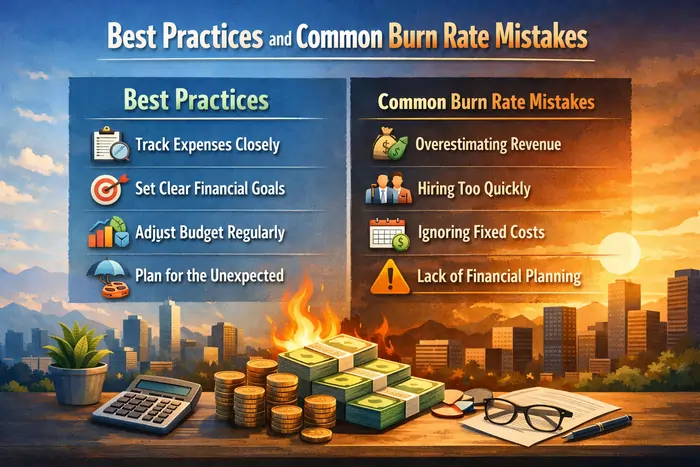
Brex, Visible, and Wise all list common burn‑rate pitfalls founders should avoid:
- Ignoring burn until it’s urgent – Only checking cash and runway when the bank balance looks scary, instead of tracking monthly.
- Chasing growth at any cost – Scaling sales and marketing aggressively without proven unit economics or retention.
- Underestimating fundraising timelines – Assuming a round will close in a few weeks, then scrambling when it takes six months or more.
- Over‑optimistic forecasts – Planning around best‑case scenarios instead of base/worst‑case realities.
These mistakes often stem from optimism bias and pressure to match headline growth stories, rather than from deliberate, data‑driven decision‑making.
Best Practices to Keep Burn Under Control
On the flip side, Afino, Rho, and Preferred CFO highlight best practices that healthy startups use:
- Monthly “burn reviews” – Review cash, burn, and runway at least once a month with your leadership team, adjusting as needed.
- Scenario planning – Maintain base, optimistic, and worst‑case models, and know what cost or hiring changes you’ll make under each scenario.
- Milestone‑linked spending – Increase burn only when you’ve hit clear milestones that justify it (for example, product‑market fit, strong retention).
- Data‑driven experiments – Tie major spending (especially in marketing and growth) to specific hypotheses and metrics rather than vague goals.
This experimental, metrics‑driven mindset is exactly what the lean startup model advocates: use limited resources to test, learn, and double‑down only when evidence supports it.
Tools, Frameworks, and Habits to Stay on Top of Burn
Financial Tools and Simple Models
You don’t need a complex FP&A stack to track burn; many startups start with a simple spreadsheet model and evolve over time.
Useful components include a monthly cash‑flow model, a straightforward P&L (guided by the profit and loss guide), and a short KPI dashboard that tracks cash, gross burn, net burn, runway, and a few core growth metrics. When you layer this on top of the operational practices in managing cash flow, you get a much clearer, real‑time picture of how burn interacts with the rest of your financial engine.
Fintech tools like Brex and Rho provide automated dashboards, but the core habit is what matters: reviewing these numbers regularly and acting on them.
Founder Mindset Around Burn
Wise’s startup guide emphasizes treating cash as fuel for learning and growth, not something to burn for its own sake. That means approaching spend like a portfolio of experiments, just as in the lean startup model, favoring scrappy tests and low-cost business ideas over high‑burn bets, and constantly asking whether each dollar strengthens your competitive advantage.
The founders who thrive combine the right entrepreneur traits—resilience, clear thinking under pressure, and willingness to pivot—from entrepreneur traits with hard financial skills learned from profit and loss guide and managing cash flow. As AI reshapes markets and cost structures, staying on top of macro trends like those in AI in global markets will also help you spot new ways to automate, optimize, and reduce burn without sacrificing growth.
Controlling startup burn rate isn’t about becoming frugal for its own sake; it’s about buying yourself enough time and flexibility to discover product‑market fit, build a real business, and negotiate from a position of strength. Start by calculating your current gross and net burn, work out your runway, and then identify 2–3 levers—expense cuts, hiring changes, or revenue improvements—you can pull this quarter to extend that runway. Combine those actions with a regular burn review, straightforward models, and the disciplined, experimental mindset from the lean startup model, and your burn rate becomes a strategic tool—not a ticking time bomb.