

Startup ecosystems are the living infrastructure of innovation: the cities, countries, and networks where new ventures are born, funded, and scaled. The Startup Ecosystem Report 2026 pulls those moving parts together into a global picture, showing which hubs are leading, which are catching up, and what founders, investors, and policymakers need to know to stay ahead.
Introduction
A startup ecosystem is the interconnected web of founders, investors, universities, corporates, accelerators, talent, and policy that supports the creation and scaling of startups in a specific location. Tracking these ecosystems annually matters because capital, talent, and regulatory advantages are constantly shifting, and where you choose to build can significantly change your odds of success.
Recent editions of the Global Startup Ecosystem Report 2024 and the Global Startup Ecosystem Index Report 2024 show that while leaders like Silicon Valley, New York, and London remain dominant, emerging hubs from Asia, the Middle East, and Latin America are rapidly improving. In 2024, for example, Startup Genome highlighted Silicon Valley, New York, and London as the top three ecosystems, while Tokyo, Seoul, Paris, and Madrid showed strong upward momentum.
The Startup Ecosystem Report 2026 builds on these trends to explore global rankings, regional strengths, sector shifts, and funding patterns, and what they mean for founders, investors, and policymakers in the next wave of innovation. To go deeper into the foundations of startup execution, it also helps to understand frameworks like the lean startup model, which shape how high-performing ecosystems operate in practice.
Methodology of the Startup Ecosystem Report 2026
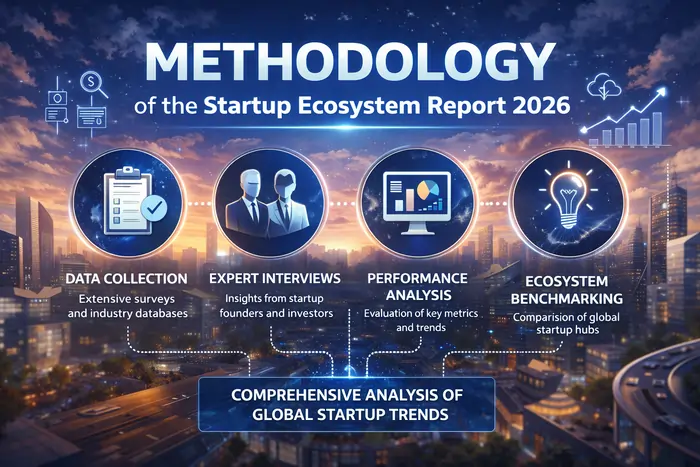
Behind any ecosystem ranking is a methodology that blends quantitative data and qualitative insight. Reports such as the Global Startup Ecosystem Report 2024 draw from millions of data points across thousands of ecosystems, tracking indicators like funding, exits, talent, and market reach. The Global Startup Ecosystem Index by StartupBlink similarly scores 100 countries and 1,000+ cities using more than 40 parameters.
Most robust methodologies share a few core pillars:
- Performance – exits, valuations, growth-stage startups, and economic impact.
- Funding – access to venture capital, deal volume, and investment diversity.
- Market Reach – ability of local startups to serve regional and global markets.
- Talent & Experience – density of experienced founders, technical talent, and serial entrepreneurs.
- Connectedness & Infrastructure – accelerators, coworking spaces, research institutions, and supportive policy.
These factors are normalized and combined into an Ecosystem Index Value, allowing comparison between cities and countries of very different sizes. Understanding this methodology helps founders interpret rankings beyond vanity, and align their own strategy with where their ecosystem is strong or weak.
Global Startup Ecosystem Rankings 2026
Top Global Startup Hubs in 2026
Recent reports show that global leaders have enjoyed remarkable stability. In 2024, Silicon Valley, New York, and London topped Startup Genome’s rankings, while StartupBlink’s index ranked the United States, United Kingdom, Israel, Canada, and Singapore as the top five countries. By 2026, it is reasonable to expect continuity at the top, with a few key shifts:
- Silicon Valley / San Francisco remains the world’s leading ecosystem, widening its lead thanks to AI and deep tech strength.
- New York City continues as a powerhouse in fintech, media, and enterprise SaaS, with a score significantly ahead of most other cities.
- London maintains its position as Europe’s flagship hub, driven by fintech, climate tech, and a strong financial sector.
These hubs combine deep capital pools, dense talent, and a culture that embraces risk—traits also reflected in classic entrepreneurial profiles such as those discussed in entrepreneur traits, which are disproportionately concentrated in such environments.
Fastest-Rising Startup Ecosystems
While the leaders hold their ground, newer hubs are moving quickly up the rankings. Recent data highlighted Singapore’s meteoric rise into the global top five, along with strong gains from Sweden, Tokyo, Seoul, Paris, and emerging ecosystems like Madrid and Manila.
By 2026, fast-rising ecosystems are likely to share several features:
- Clear national or regional innovation strategies.
- Targeted support for high-growth sectors (AI, fintech, climate tech).
- Improved access to capital through local VCs, corporate investors, and international funds.
These “climbers” are often where low-cost business ideas can be tested and scaled effectively, especially in markets still hungry for basic digital solutions; guides like low-cost business ideas resonate strongly in these emerging ecosystems.
Regional Deep Dives
North America
North America remains the world’s most mature and capital-rich startup region. The United States leads globally by a wide margin in StartupBlink’s country index, with a score nearly four times that of the second-ranked United Kingdom. Beyond Silicon Valley and New York, ecosystems like Austin, Miami, and Toronto continue to grow, especially in AI, fintech, and creative industries.
Canada, meanwhile, benefits from strong immigration policies, high-quality universities, and sector strengths in AI, cleantech, and life sciences. North America’s ecosystems also host many of the world’s leading accelerators, corporate innovation labs, and venture funds, reinforcing their global pull.
Europe
Europe’s startup scene is increasingly diversified, with London, Berlin, Paris, Stockholm, and Amsterdam anchoring the region. EU policy has helped accelerate cleantech and sustainability-focused startups, with climate and energy innovation receiving increasing funding even during funding “winters.”
At the same time, Nordic and Baltic countries punch above their weight due to strong digital infrastructure, high-quality education, and export-oriented cultures. Ecosystems like Madrid and Barcelona are rising as well, helped by quality of life, relatively low costs, and growing pools of technical talent.
Asia-Pacific
Asia-Pacific features both massive, mature ecosystems and fast-moving emerging hubs. Singapore, Bangalore, Shanghai, Tokyo, and Seoul represent different models of success—from state-led strategies to private-sector-driven growth.
These ecosystems benefit from large domestic markets (India, China), manufacturing integration (East Asia), or strategic positioning as global financial and logistics hubs (Singapore). Sectors like AI, fintech, gaming, and e-commerce thrive here, supported by high digital adoption and mobile-first economies.
Latin America, MENA, and Africa
Latin America, the Middle East, and Africa are seeing a new wave of startup growth as funding and talent become more globally distributed. Cities like São Paulo, Mexico City, Bogotá, Dubai, Riyadh, Cairo, Lagos, and Nairobi are appearing more frequently in ecosystem rankings.
These regions often focus on solving “real economy” problems in finance, logistics, healthcare, and agriculture—areas where local knowledge is critical and global incumbents are weaker. However, ecosystems still face challenges around capital access, regulatory stability, and infrastructure, making policy design and competitive advantage thinking, as detailed in resources like competitive advantage, particularly important.
Sector & Technology Trends in 2026
AI and Automation
AI has moved from a niche to a defining pillar of startup ecosystems. The GSER 2024 noted that generative AI startups captured around 18% of global venture capital funding in 2023, driven in part by mainstream tools like ChatGPT. StartupBlink’s data further highlighted how Silicon Valley’s lead over other cities widened largely due to AI strength.
By 2026, AI is central across sectors—powering fintech, healthtech, logistics, and creative industries. Ecosystems that invest in AI talent, research centers, and data infrastructure are climbing the rankings fastest. For a wider macro view, pieces such as AI in global markets help explain how AI adoption is changing competitive dynamics across industries and geographies.
Climate, Cleantech, and Sustainability
Cleantech and climate-focused startups are another major driver of ecosystem evolution. GSER 2024 notes that EU policies and sustainability initiatives channeled significant funding into cleantech, supporting innovation in energy, water, transport, and agriculture.
By 2026, climate and sustainability solutions are no longer niche; they are central to national strategies in Europe and increasingly in Asia and North America as well. Startups working on decarbonization, circular economy models, and climate resilience benefit from both policy support and growing investor interest in impact-driven returns.
Fintech, Healthtech, and Other Key Verticals
Fintech and healthtech remain pillars of many ecosystems due to their high addressable markets and strong regulatory tailwinds. After a period of overfunding and correction, fintech funding is regaining momentum, especially where AI improves underwriting, personalization, and cost efficiency.
Other verticals gaining attention in 2026 include deep tech, spacetech, cybersecurity, and Web3 infrastructure, though investor appetite is more cautious and focused on clear use cases. For founders, aligning sector choice with ecosystem strengths and personal entrepreneur traits—such as resilience, risk tolerance, and learning agility, as discussed in entrepreneur traits—is increasingly critical.
Funding Landscape and Investment Trends
The funding environment has gone through a clear cycle. Reports describe 2024 as a challenging year, with the global startup ecosystem entering a deeper “winter” due to high interest rates, inflation, and reduced capital availability. GSER 2024 notes a slowdown in large exits and a more careful approach to late-stage funding.
By 2025–2026, multiple analyses show a selective thaw: overall funding volumes are recovering, but investors are prioritizing quality over quantity, backing fewer deals with stronger fundamentals. Key trends include:
- Greater emphasis on profitability, unit economics, and sustainable growth.
- Increased role of corporate venture capital and strategic investors, who bring customers and distribution as well as capital.
- Growing diversification of funding across geographies, with India, MENA, and other emerging markets attracting more large rounds.
For founders, this means more rigorous expectations around profit and loss literacy, cash runway, and capital efficiency—topics covered clearly in guides like profit and loss guide, which are now essential reading for anyone raising money in 2026.
Policy, Talent, and Infrastructure Shaping Ecosystems
Government Policies and Incentives
Policies can accelerate or stall ecosystems. The GSER routinely highlights how targeted grants, tax incentives, visa programs, and regulatory sandboxes have helped cities like Singapore, Tel Aviv, and Stockholm advance rapidly. Conversely, inconsistent or restrictive regulations can drive startups and talent elsewhere.
In 2026, governments that craft coherent innovation strategies—investing in R&D, enabling startup-friendly regulations, and promoting open data—tend to host the ecosystems that rise the fastest.
Talent, Universities, and Corporate Innovation
Universities and research institutions are core to high-performing ecosystems, providing both technical talent and intellectual property. Silicon Valley’s relationship with Stanford and Berkeley, or Boston’s with MIT and Harvard, are classic examples.
Corporate innovation labs and partnerships are increasingly important as well. Corporate VCs nearly doubled their global funding activity in 2025, stepping into some of the gap left by traditional VCs. This blurs the line between startup and corporate worlds and embeds founders into larger innovation networks.
Community, Accelerators, and Support Networks
Founder communities, accelerators, incubators, and coworking spaces play a big role in knowledge transfer and social proof. Platforms like StartupBlink map accelerators, venture capital firms, and other ecosystem assets across hundreds of cities, illustrating how density and connectivity correlate with success.
Healthy ecosystems typically have multiple overlapping communities—meetups, online forums, sector-specific clusters—where founders can quickly access advice, early talent, and warm investor introductions. These networks are often where lean experimentation, as described in the lean startup model, is reinforced through shared norms and stories.
What the 2026 Ecosystem Report Means for Key Stakeholders
For Founders
For founders, ecosystem reports are strategic tools. Rankings and sector breakdowns help you decide where to launch, which markets to expand into, and what kind of capital is realistic to target. If you’re operating in a nascent ecosystem, you might lean more heavily on remote work, global customers, and bootstrapping or low-capex models inspired by low-cost business ideas frameworks like those in low-cost business ideas.
Founders should also benchmark their own approach against the traits and behaviors common in top ecosystems, including iterative testing, customer-centric design, and a clear path to competitive differentiation—where insights like those from competitive advantage become practically useful.
For Investors
Investors use ecosystem data to shape theses, source dealflow, and identify undervalued regions or sectors. Knowing which ecosystems are rising, where AI or climate tech clusters are forming, and how funding dynamics are shifting helps VCs and corporate investors allocate capital more intelligently.
By 2026, investors are increasingly focused on:
- Ecosystems with strong talent but relatively lower valuations.
- Sectors with clear regulatory support and long-term demand (AI infrastructure, fintech, climate solutions, healthcare).
- Founding teams that demonstrate both strong entrepreneur traits and disciplined financial management, as reflected in resources like entrepreneur traits and profit and loss guide.
For Policymakers and Ecosystem Builders
For policymakers and ecosystem builders, the 2026 report is a diagnostic. It shows where their city or country lags—be it in funding, exits, talent retention, or policy clarity—and what leading ecosystems are doing differently.
Actionable levers include:
- Improving visa and immigration pathways for founders and technical talent.
- Creating targeted incentives for priority sectors aligned with national strengths (e.g., climate for Nordics, fintech for the UK, AI for North America and parts of Asia).
- Investing in universities, R&D, and public-private partnerships to seed deep tech and knowledge-intensive startups.
Predictions and Outlook Beyond 2026
Looking beyond 2026, several macro forces are likely to shape the next wave of startup ecosystems:
- AI everywhere: AI will continue to permeate every sector and geography, making AI fluency table stakes for both founders and policymakers.
- Geopolitical fragmentation: Regional blocs and supply-chain realignments will create new opportunities for local champions, but also more regulatory complexity.
- Climate urgency: Climate-related innovation will remain a top priority, with ecosystems that support cleantech and resilience seeing outsized growth.
- Capital discipline: Even as funding recovers, investors are unlikely to return to the excesses of 2021; capital-efficient, lean models will dominate.
For founders and ecosystem builders alike, the winning strategy is to combine an honest reading of the data with a commitment to growth over comfort—staying willing to experiment, adapt, and build in environments that may not yet be fully optimized. Resources that explore AI’s macro impact, such as AI in global markets, can help contextualize where your ecosystem sits in that broader shift.
In practice, the Startup Ecosystem Report 2026 is not just a ranking; it’s a decision-support tool. It tells founders where to launch, investors where to look next, and policymakers where to intervene. Used alongside practical frameworks like the lean startup model, tactical ideas from low-cost business ideas, mindset insights from entrepreneur traits, strategic thinking from competitive advantage, financial clarity from profit and loss guide, and macro trend analysis like AI in global markets, it becomes a powerful lens for planning not just a company, but a career and an ecosystem that can thrive in the decade ahead.