

Nick Daicos Free Kick Key Takeaways
The Nick Daicos Free Kick that led to a crucial shot on goal has blown up well beyond one whistle, reopening a long-running AFL argument about staging, contact and how the modern game is umpired.
- The Nick Daicos Free Kick has become the latest flashpoint in the ongoing AFL staging debate , splitting fans across Australia.
- Slow-motion replays, commentary reactions and social media angles have all framed the moment differently, showing how grey the AFL free kick staging rules can feel in real time.
- The incident raises bigger questions about how umpires protect ball carriers, how the Match Review Officer responds and what it means for Nick Daicos’ reputation in the modern game.
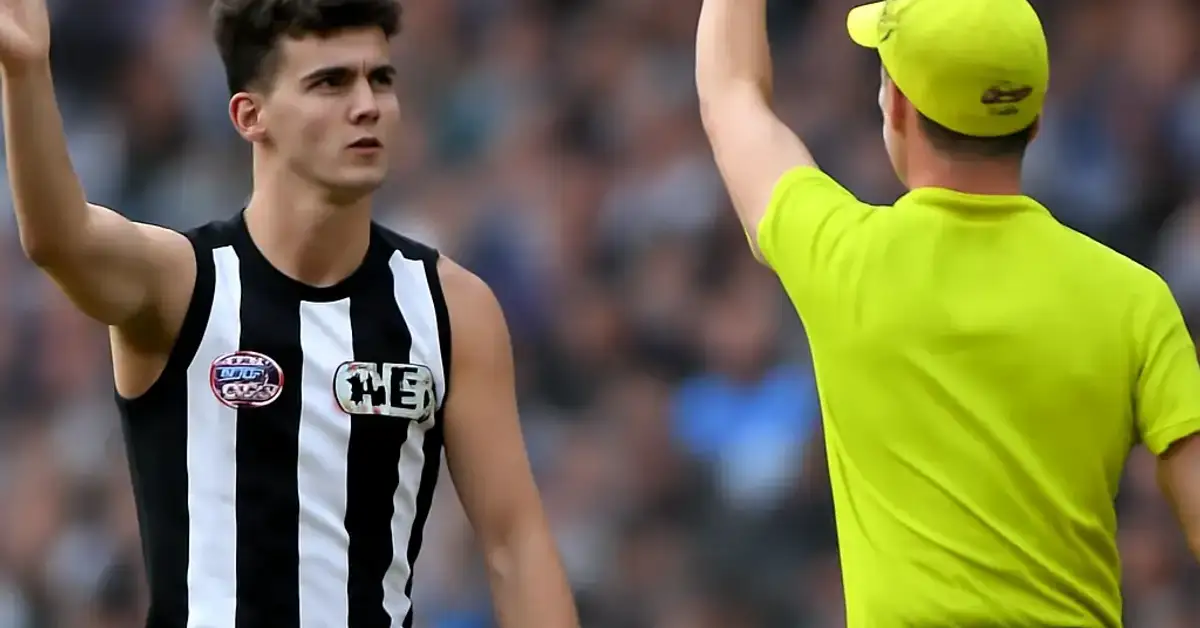
What Really Happened With the Nick Daicos Free Kick Incident?
Even if you missed the game live, you probably caught the clip of the Nick Daicos Free Kick doing the rounds on your socials. Late in a tight contest, Daicos gathered the ball on the wing under pressure, felt contact from behind, went to ground, and the whistle blew almost instantly. Collingwood got the free, momentum swung, and the commentary box lit up.
On first watch at full speed, many viewers thought it looked like a standard push in the back: ball carrier nudged off balance, arms out, legs taken away. But in slow motion, it looked a lot murkier. The defender’s hands barely seemed to extend, Daicos twisted as he fell, and the contact looked more like a brush than a shove.
Why the moment blew up so quickly
The Nick Daicos free kick controversy exploded for a few reasons:
- It happened in a high-pressure part of the game, amplifying the impact of the decision.
- Daicos is already one of the most talked-about players in the league, so every whistle involving him gets magnified.
- Replays from multiple angles seemed to tell different stories, feeding endless debate on talkback and Twitter.
Within minutes, clips were being paused frame-by-frame, fans were accusing him of “milking it”, and pundits were dissecting whether it was a classic case of clever body positioning or a clear example of staging.
How AFL Free Kick and Staging Rules Shape the Nick Daicos Free Kick Debate
To unpack why the Nick Daicos Free Kick set everyone off, you have to look at how the rules are actually written and applied. On paper, they seem straightforward; in the chaos of a game, they are anything but.
The basics of AFL free kick protection
Under the Laws of the Game, a free kick is paid when a player is pushed in the back, held when not in possession, tripped, or contacted high. Umpires are instructed to protect the ball carrier and reward players who go in first for the footy. That’s why, in real time, the Daicos free probably felt automatic to the official standing a few metres away.
There’s also an emphasis on prior opportunity and genuine attempts to dispose of the ball. Players who take contact while going for the footy are supposed to get the benefit of the doubt. Daicos fit that template: he had the ball, absorbed contact, and went to ground.
What the AFL free kick staging rules say
The league has also tried to clamp down on staging. The official AFL free kick staging rules say players can be sanctioned for “exaggerating contact” or “attempting to deceive the umpire”. This is usually handled after the game by the Match Review Officer, with fines rather than suspensions.
So when the Nick Daicos free kick row reignites AFL staging debate, what people are really arguing is:
- Did he cop legitimate contact that would reasonably cause a player to fall?
- Or did he amplify that contact to make sure the whistle blew?
- If it was exaggerated, is it enough to trigger MRO action, or just a grey-area footy moment?
Importantly, the rule doesn’t say you can’t protect yourself or brace for contact. It’s about whether a player is deliberately trying to trick the umpire. That intent is incredibly hard to judge from the couch.
Fan, Player and Media Reactions to the Nick Daicos Free Kick Controversy
As soon as the siren went, the takes started flying. In many ways, the reaction to the Nick Daicos free kick controversy says as much about the state of the footy conversation as it does about the incident itself.
What Aussie fans are saying
Jump into any Facebook comments section and you’ll find three main camps:
- “Softest free of the year” crowd – They reckon Daicos barely got touched, that he played for it, and that this is exactly what’s wrong with modern footy.
- “That’s paid every week” crowd – They point out that contact from behind on a ball carrier is whistled constantly, and that Daicos would’ve been hammered if he didn’t protect himself.
- “Blame the rules, not the player” crowd – They argue that if the rules reward minimal contact, players would be silly not to play to them.
The split isn’t just club-based either. Plenty of neutrals were uncomfortable with the look of the free kick, even if they admitted it was technically there.
Former players and media pundits weigh in
Ex-players on TV and radio have been just as divided. Some have defended Daicos as “footy smart”, saying you’re taught from junior levels to accentuate contact so the ump can see it. Others have been harsher, arguing that actions like this encourage a culture where kids learn to flop rather than fight through tackles.
High-profile commentators on shows like Footy Classified and On the Couch have used the AFL staging debate to call for clearer guidelines and stronger in-game deterrents. A few have even suggested that, like in soccer, umpires should feel empowered to reverse a free if they believe staging has occurred on the spot.
Officially, the AFL tends to back its umpires, but in past seasons it has published explainer videos and memos after controversial calls. It would not be surprising to see the league include a breakdown of this Daicos incident in a future “AFL Explain” clip like those they’ve shared on AFL.com.au’s rules and interpretations pages.
What the Nick Daicos Free Kick Means for His Reputation and the Modern Game
Beyond the scoreboard, the Nick Daicos Free Kick has put his on-field reputation under the microscope. Fair or not, these flashpoint moments tend to stick in people’s minds.
Is Nick Daicos a smart operator or a stager?
Daicos has already built a reputation as a classy ball user with elite footy IQ. Supporters argue that smart players invite contact: they know how to position their bodies so any illegal pressure stands out to the umpire. From that angle, what he did was simply good craft.
Critics, though, worry that this crosses into theatrics. They point to the way he fell, the angle of his body, or the slight delay between contact and collapse as evidence that he sold it. They argue that if a superstar is seen to get “protected species” calls, it breeds resentment across the comp.
How this fits into modern AFL trends
The sport has changed massively in the last decade. With higher speeds, stricter head contact rules and constant scrutiny via HD replays, players are adapting. They learn where the line is drawn and, naturally, push right up against it.
We’ve already seen similar debates around high-contact frees where ball carriers lift their arm to draw contact, or forwards who collapse under even minimal holding. The Nick Daicos free kick row reignites AFL staging debate in that same space: is this just the modern game evolving, or is it eroding the toughness many Aussie fans cherish?
| Aspect | Supporters of the Free Kick | Critics of the Free Kick |
|---|---|---|
| Type of Contact | Illegal nudge in the back on ball carrier | Minimal contact, not enough to cause the fall |
| Player Intent | Protecting himself and highlighting the foul | Deliberately exaggerating for a whistle |
| Impact on Game | Correctly rewards hard running and getting the ball | Gives an unfair advantage and invites more staging |
| Message to Juniors | Shows the importance of drawing contact smartly | Teaches kids to flop instead of playing the ball |
Umpires, the MRO and Rule Tweaks: What Happens After the Nick Daicos Free Kick?
Every time a big incident like the Nick Daicos Free Kick hits the headlines, there’s pressure on the AFL to “do something”. That usually falls into a few buckets: umpire coaching, Match Review Officer decisions and potential rule or interpretation changes.
Pressure on umpires in real time
Umpires already operate under brutal pressure. They have one look, at game speed, with limited angles. From their vantage point, a player with the footy hit from behind and sent sprawling is almost always a free. Asking them to instantly judge whether a fall was “natural” or exaggerated is a massive ask.
We may see the AFL quietly adjust its coaching, telling umpires to hesitate a touch more when the contact is slight and the fall is dramatic. But if that goes too far, players who are genuinely knocked off balance will stop being protected.
How the MRO might view the incident
The Match Review Officer can fine players after the fact if it’s clear they’ve staged. The key threshold is obvious deception. Past cases highlighted by the AFL in its laws and interpretations updates have usually involved glaring dives or players clutching their face after chest contact.
With the Nick Daicos free kick controversy, the footage is more borderline. There is genuine contact, and Daicos does brace. Whether that reaches the level of “exaggeration” the AFL is willing to punish is unclear. If they do pin him, it sends a strong message to every star in the comp. If they don’t, some fans will see it as another example of inconsistency. For a related guide, see F1 2026: Latest Grand Prix Results, Driver Standings and Championship Updates.
Could this force future rule tweaks?
Instead of rewriting laws, the AFL often tinkers with interpretations and umpire focus points. Out of this saga, we might see:
- More clarity on how much contact is required before a push-in-the-back is paid.
- Guidelines around players “launching” forward versus being nudged forward.
- Greater willingness to fine obvious staging even when a free wasn’t paid, to send a deterrent message.
The league wants to protect players’ bodies without encouraging acting. That balance is at the heart of the AFL staging debate, and the Daicos moment has thrown that balancing act back into the spotlight.
Where Should Aussie Fans Land on the Nick Daicos Free Kick Staging Debate?
If you’re feeling torn about the Nick Daicos Free Kick, you’re not alone. On one hand, you want umpires to protect stars who take the game on. On the other, you don’t want footy turning into a game where the best actors win the free kick count.
Maybe the most balanced view is this: Daicos, like every modern player, is operating inside the incentives the rules create. If the AFL and its umpires consistently reward certain types of contact, clever footballers will adapt to that. The real challenge is for the league to make sure the incentives still line up with how Australians want the game to be played.
So where do you sit? Was the Nick Daicos free kick row reignites AFL staging debate all heat and no light, or do you think it’s a genuine turning point for how we talk about staging? However you see it, this won’t be the last time a borderline free blows up the football week—and the next one might involve your club on the wrong end of the whistle.
Useful Resources
For readers who want to dig into the official wording and recent interpretations around incidents like the Nick Daicos Free Kick, these resources are a good starting point:
- Official AFL Laws of the Game – Full rulebook including sections on free kicks and misconduct.
- AFL Match Review Officer Updates – Weekly MRO decisions, including staging fines and explanations.
Frequently Asked Questions About Nick Daicos Free Kick
Why did the Nick Daicos Free Kick cause such a big reaction?
The free kick involving Nick Daicos came at a crucial moment in a tight game and looked different in real time compared to slow-motion replays, which made fans question whether it was a legitimate push or exaggerated contact. Because Daicos is already a high-profile player, the incident quickly became a lightning rod for broader concerns about staging and umpiring consistency.
Was the Nick Daicos Free Kick technically correct under AFL rules?
From a strict rules perspective, many umpires and ex-players argue the free was there because Daicos, as the ball carrier, was contacted from behind and lost his balance. Critics counter that the level of contact was minimal and that his fall helped sell the free, which shows how much interpretation is involved even when the rulebook suggests a free should be paid.
Did Nick Daicos stage for the free kick?
Whether Nick Daicos staged depends largely on how you interpret his fall and intent, which is very hard to prove. Supporters say he simply protected himself and highlighted the illegal contact, while critics believe he exaggerated the impact, but at this stage there has been no definitive official finding labelling the incident as staging.
What do the AFL rules say about staging for free kicks?
The AFL’s laws state that staging is deliberately exaggerating or feigning contact to deceive the umpire, and players can be sanctioned by the Match Review Officer for such behaviour. Penalties are usually financial rather than suspensions, reflecting the league’s desire to discourage acting without dramatically altering player availability.
Can the Match Review Officer punish staging even if a free kick was paid?
Yes, the Match Review Officer can review vision of incidents where a free kick was paid and determine whether a player staged, issuing a fine even if the umpire’s original decision stands. This separation between on-field whistle and post-game sanction is designed to deter players from exaggerating contact while acknowledging umpiring decisions are made in real time.
How often do AFL players get fined for staging?
Staging fines are relatively rare compared with other MRO outcomes, and they tend to be reserved for clear-cut cases where the video shows obvious dives or players clutching areas that were not contacted. The rarity is part of why any high-profile case, like the debate around Nick Daicos, draws so much attention from fans and the media.
Does the AFL treat star players differently when it comes to staging?
Officially, the AFL insists all players are treated the same, but many supporters believe star players receive more free kicks and more scrutiny. In practice, incidents involving big names like Nick Daicos are replayed and debated far more heavily, which can create a perception of special treatment even when the formal rules are applied consistently.
How do umpires decide if contact is strong enough for a free?
Umpires are trained to assess whether contact is illegal and whether it affects the player’s ability to contest or dispose of the ball, all at full speed and usually from a single angle. In borderline cases like the Daicos incident, they often err on the side of protecting the ball carrier, which can later look soft when slowed down on TV.
Why do some fans say modern AFL is becoming too soft?
Many long-time supporters compare today’s interpretations to past eras where more physical contesting was allowed and minor contact went unwhistled, leading them to feel the game has softened. Incidents like the Nick Daicos Free Kick, where relatively light contact can result in a free, fuel the perception that acting and umpire reliance are replacing toughness and play-on footy.
Is accentuating contact the same as staging?
Accentuating contact sits in a grey area where a player does receive genuine contact but adjusts their body or fall to ensure the umpire sees it clearly, which coaches often call “drawing a free.” Staging goes a step further, involving fabricated or wildly exaggerated contact, and the difficulty of separating the two is at the core of the current staging debate.
How does the Nick Daicos Free Kick compare to other controversial frees?
Like high-contact frees where players lift their arms or forwards who fall easily in marking contests, the Daicos incident sits in the broader trend of players learning how to work within, and sometimes press against, interpretations. It’s not the most blatant example of staging, but it has become a symbol for how finely balanced the modern free-kick landscape has become.
What can the AFL do to reduce staging without making the game more dangerous?
The AFL can focus on clearer guidelines for umpires, stronger post-game penalties for obvious staging, and communication with clubs about acceptable behaviours, all while maintaining strict protection for the head and ball carriers. Adjusting interpretations rather than completely rewriting rules may help reduce acting without encouraging late hits or dangerous physicality.
Does video review play a role in free kick decisions like this?
At the moment, video review in AFL is mainly limited to scoring decisions, not general free kicks such as the one to Nick Daicos, which remain the domain of field umpires. However, the ability for fans and commentators to replay incidents endlessly in high definition means public pressure on umpires and the AFL has never been higher.
How do coaches talk to players about drawing free kicks?
Coaches generally encourage players to be strong in the contest but also smart in highlighting illegal contact so umpires can see it, especially around the ball and inside 50. Most will publicly discourage outright staging, but behind closed doors there is acknowledgment that understanding how the game is umpired can win crucial free kicks and, ultimately, games.
Will the Nick Daicos Free Kick change how umpires call similar incidents?
High-profile controversies often influence umpire coaching points, so it is likely that examples similar to the Daicos free will be used in internal reviews to fine-tune decision-making. While we may not see a dramatic overnight shift, subtle changes in emphasis on how much contact is required or how falls are interpreted could emerge over the remainder of the season.
What impact does this debate have on junior and community footy?
Young players watch the AFL closely and often imitate what they see from their heroes, so repeated exposure to players winning frees from minimal contact can influence behaviour at grassroots level. That’s why many community coaches and parents are invested in how the league handles staging, wanting kids to prioritise courage and contest work over flopping for frees.
Are other sports facing similar staging issues?
Yes, sports like soccer, basketball and rugby league all grapple with players exaggerating contact to win penalties or free throws, and each has developed its own systems of fines, cards or video review to combat it. The AFL’s challenge is to learn from these competitions while keeping the unique flow and physical character of Australian rules football.
Does social media make AFL staging controversies worse?
Social media amplifies every borderline call by allowing fans to share clipped highlights, slow-motion replays and hot takes within seconds, turning routine frees into national talking points. In the case of the Nick Daicos Free Kick, this amplification helped turn one whistle into a full-blown debate about player behaviour, umpiring and the state of the game.
Could the AFL ever introduce in-game penalties for staging like yellow cards?
While there has been occasional discussion about harsher in-game penalties for staging, such as reversing frees or issuing immediate reports, the AFL has so far preferred fines and education over card-style systems. Introducing something like yellow cards would be a major structural change and could risk more controversy, so any move in that direction would require strong support from clubs and fans.
How should fans judge incidents like the Nick Daicos Free Kick fairly?
To judge incidents fairly, it helps to consider both the real-time speed and angle the umpire had, the actual wording of the rules, and the player’s right to protect themselves from contact. Accepting that some calls will always live in a grey area can make it easier to separate frustration about a single free from broader questions about whether you want the game to favour toughness, safety, spectacle or some mix of all three. For a related guide, see England World Cup Squad 2026 Confirmed as Tuchel Makes Big Calls.