

A mobile rank tracking stack in 2026 requires three layers: API rank tracking for scale, first-party data (Google Search Console, GA4) for accuracy, and manual mobile testing for GPS-localized and AI Overview detection.
Organizations that rely on a single rank tracking tool while ignoring first-party data often miss SERP volatility signals and make decisions based on incomplete information
. Knowing when to fire your rank tracker means understanding the specific gaps in your current mobile rank tracking stack and supplementing them with zero-click SERP measurement and AI Overview citation audits.
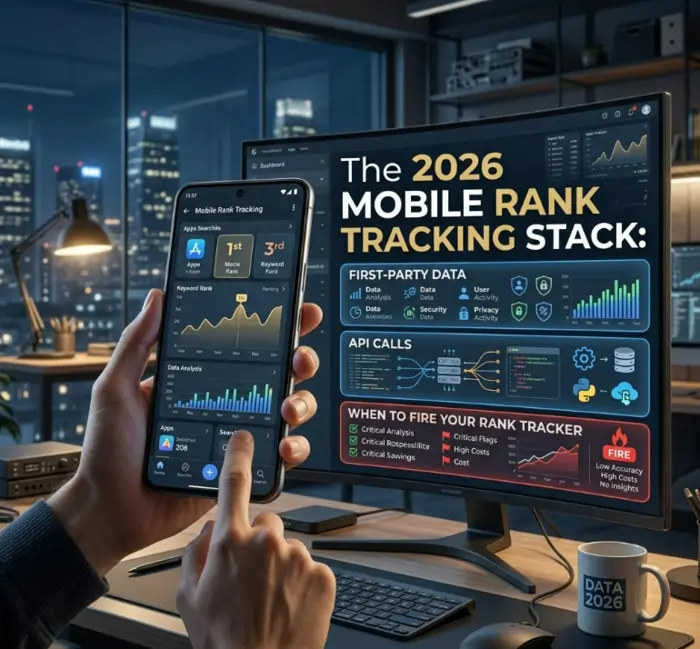
The $50,000 Rank Tracking Mistake
A mid-sized eCommerce brand paid $50,000 annually for an enterprise rank tracking tool. The dashboard showed thousands of keywords. The reports were beautiful. The SEO team trusted the data completely.
Then traffic dropped. Not a small drop — a 40% drop over three months.
The rank tracking tool showed stable rankings. Everything looked fine. But Google Search Console told a different story. Impressions had collapsed for dozens of high-value keywords. The rank tracking tool had missed an AI Overview change that pushed the brand’s blue links below the fold across an entire product category.
The brand had a rank tracking tool. They did not have a mobile rank tracking stack.
Jin Grey, a Senior SEO Consultant with 18+ years of experience, has documented this pattern across hundreds of client engagements. In her practice, organizations that rely on a single rank tracking tool while ignoring first-party data and manual testing consistently miss critical signals.
This guide explains how to build a mobile rank tracking stack with three essential layers, when to trust (and when to fire) your rank tracking tool, and how to use first-party data to validate everything.
Why a Single Rank Tracking Tool Is No Longer Enough
In 2015, a single rank tracking tool was sufficient. SERPs were relatively stable. AI Overviews did not exist. Mobile-first indexing was years away. Zero-click search was a footnote.
In 2026, a single tool is a single point of failure.
Here is why:
| Limitation of Single Tools | Why It Matters |
|---|---|
| AI Overview detection is incomplete | Most tools miss 20-40% of AI Overview citations |
| GPS-localized tracking is limited | City-level tracking misses block-level fluctuations |
| No first-party data integration | Tools cannot see actual impressions and clicks |
| Emulator-based testing | Emulators miss device-specific and carrier-specific variations |
| No zero-click measurement | Tools report rankings, not actual visibility |
For a broader understanding of how mobile tracking has evolved, see the pillar guide on Mobile Rank Tracking in 2026: 7 Data-Backed Strategies for AI-First SERPs .
“Most rank tracking tools were architected for desktop SEO in 2015. They struggle with GPS-localized results, AI Overview dominance, and zero-click mobile SERPs in 2026.” — Jin Grey, Senior SEO Consultant
The Three Layers of a 2026 Mobile Rank Tracking Stack
An effective mobile rank tracking stack has three essential layers. Each layer compensates for the blind spots of the others.
Layer 1: API Rank Tracking (Scale)
Purpose: Automated tracking of thousands of keywords at daily or weekly frequency.
What it does well:
- Scales to thousands or tens of thousands of keywords
- Provides consistent, comparable data over time
- Detects large-scale ranking changes quickly
What it misses:
- AI Overview citations (20-40% miss rate)
- GPS-localized block-level fluctuations
- Device-specific and carrier-specific variations
- Zero-click measurement
Recommended tools: Semrush, Ahrefs, STAT, AccuRanker
Action Step: Use API rank tracking for broad keyword coverage (thousands of keywords) and trend detection. Do not use it for operational decisions on individual keywords without validation from other layers.
Layer 2: First-Party Data (Accuracy)
Purpose: Real user data from Google Search Console and Google Analytics 4 (GA4).
What it does well:
- Shows actual impressions and clicks (not estimated)
- Provides device-specific breakdowns (mobile vs. desktop)
- Captures what users actually see and click
- Free (no additional cost)
What it misses:
- Rank position for keywords with low impression volume (anonymized)
- Competitor data (your site only)
- Real-time data (2-3 day delay)
Key first-party data sources:
| Source | What It Provides | Update Frequency |
|---|---|---|
| Google Search Console | Impressions, clicks, average position by device | Daily to 3-day delay |
| Google Analytics 4 (GA4) | Organic traffic, engagement, conversions by device | Real-time to daily |
| Google Business Profile Insights | Local search impressions, direction requests, calls | Daily |
Action Step: Add Google Search Console’s “Performance Report” filtered by device = Mobile to your weekly dashboard. Compare Search Console data to your API rank tracking tool. Where they diverge, trust Search Console.
For a deeper exploration of how to integrate first-party data, see The 2026 Mobile Rank Tracking Stack: First-Party Data, API Calls, and Strategic Tool Selection .
Layer 3: Manual Mobile Testing (Ground Truth)
Purpose: Human-conducted searches on real mobile devices at real locations.
What it does well:
- Captures AI Overview citations that automated tools miss
- Reveals GPS-localized block-level fluctuations
- Shows device-specific and carrier-specific variations
- Provides ground truth to validate other layers
What it misses:
- Scale (time-consuming, limited to hundreds of keywords)
- Historical trending (unless meticulously documented)
Manual testing process:
- Use a real mobile device (not emulator)
- Disable WiFi (use cellular network)
- Search from multiple physical locations (parking lot, one block north, one block south)
- Document: AI Overview presence? Citation? Blue link position? Above or below fold?
- Repeat at different times of day
Action Step: Schedule 60 minutes weekly for manual mobile testing. Focus on 20-50 high-value keywords. Rotate through different keywords each week.
For a deeper exploration of GPS-localized testing, see Local SEO & Mobile Rank Tracking: Why Your “Near Me” Rankings Fluctuate by the Block .
What Is a “Mobile Rank Tracking Stack” and Why Do You Need One?
A mobile rank tracking stack is the combination of tools, data sources, and processes used to measure mobile search visibility. It is not a single tool. It is a system.
The core insight behind the stack approach is simple: No single tool is accurate enough to trust alone.
Here is what different layers capture that single tools miss:
| Metric | API Rank Tracking | First-Party Data | Manual Testing |
|---|---|---|---|
| Blue link position | Yes (estimated) | Yes (average) | Yes (exact) |
| AI Overview citation | Partial (60-80%) | Indirect | Yes |
| GPS-localized rank | Partial (city-level) | No | Yes (block-level) |
| Zero-click rate | No | Yes | Partial |
| Impressions/clicks | Estimated | Actual | No |
| Competitor data | Yes | No | Yes |
For specific methodologies on AI Overview tracking, see How to Track Mobile Rankings for Google AI Overviews & Zero-Click Results .
When to Fire Your Rank Tracker (And When to Keep It)
Knowing when to fire your rank tracker is as important as knowing how to use it. Below are scenarios for firing, keeping, and supplementing.
Fire Your Rank Tracker If:
| Scenario | Why |
|---|---|
| It cannot detect AI Overviews | AI Overviews are now central to mobile visibility |
| It uses IP-based geolocation only | GPS-localized tracking is essential for local SEO |
| It blends desktop and mobile data | Separate tracking is non-negotiable |
| It cannot export raw data | You need to validate their algorithms against your first-party data |
| Support cannot explain how they detect AI Overviews | If they cannot explain it, they probably do not do it well |
Keep Your Rank Tracker But Supplement It If:
| Scenario | Supplement With |
|---|---|
| AI Overview detection is partial | Manual audits + Google Search Console |
| GPS-localized tracking is city-level | Manual testing from multiple physical locations |
| Zero-click measurement is missing | Google Search Console zero-click rate calculation |
| Device-specific tracking is limited | Manual testing on multiple device types |
Never Fire Your Rank Tracker Completely If:
- You need to track thousands of keywords (manual testing cannot scale)
- You need historical trending data (first-party data has limited history)
- You need competitor tracking (first-party data has no competitor data)
For guidance on filtering noise from rank tracking data, see Mobile Rank Tracking Alert Fatigue: How to Filter Noise and Find Real SEO Threats . (Note: This page is currently being updated; check back soon.)
How to Audit Your Current Mobile Rank Tracking Stack
Before building a new mobile rank tracking stack, audit your current setup.
Step 1: List All Current Tools and Data Sources
Include:
- Rank tracking tools (e.g., Semrush, Ahrefs, BrightLocal)
- First-party data sources (Google Search Console, GA4, GBP Insights)
- Manual testing processes (if any)
Step 2: Identify Missing Layers
| Layer | Do You Have It? | If Missing, Risk Is… |
|---|---|---|
| API Rank Tracking | ___ Yes / ___ No | Cannot scale to thousands of keywords |
| First-Party Data | ___ Yes / ___ No | No ground truth for impressions/clicks |
| Manual Testing | ___ Yes / ___ No | Missing AI Overview and GPS-localized variations |
Step 3: Test Your API Tool’s AI Overview Detection
Run a manual audit of 20 keywords. Compare your tool’s AI Overview citation detection to your manual results.
- If tool catches >80%: Acceptable
- If tool catches 60-80%: Supplement with manual audits
- If tool catches <60%: Consider firing or adding a secondary tool
Step 4: Calculate Your Zero-Click Rate by Query
Use Google Search Console:
- Export queries with >100 impressions
- Calculate: (Impressions – Clicks) / Impressions
- Identify queries with >70% zero-click rate
These queries require AI Overview optimization, not traditional rank tracking.
Step 5: Document GPS-Localized Variance
Run manual tests from 3-5 physical locations for local keywords. Calculate the rank variance.
- If variance <5 positions: City-level tracking may be sufficient
- If variance >10 positions: You need GPS-localized tracking
Understanding how Google evaluates content quality is also helpful — the Search Quality Evaluator Guidelines explain how E-E-A-T signals influence which content gets cited in AI-generated answers.
Recommended Mobile Rank Tracking Stack by Business Type
Different businesses need different stacks. Below are recommendations by business type.
For Local Businesses (Single Location)
| Layer | Recommended Tool/Method |
|---|---|
| API Rank Tracking | BrightLocal or Semrush (with GPS-spoofing) |
| First-Party Data | Google Search Console + Google Business Profile Insights |
| Manual Testing | Weekly tests from 5 physical locations (parking lot + 4 cardinal directions) |
| Budget | $50-200/month + 2 hours/week manual |
For Local Businesses (Multiple Locations)
| Layer | Recommended Tool/Method |
|---|---|
| API Rank Tracking | BrightLocal (multi-location) or STAT |
| First-Party Data | Google Search Console (property per location) + GBP Insights |
| Manual Testing | Monthly tests from 3 locations per city (prioritize high-volume locations) |
| Budget | $200-500/month + 5 hours/week manual |
For eCommerce / National Brands
| Layer | Recommended Tool/Method |
|---|---|
| API Rank Tracking | Semrush, Ahrefs, or STAT (thousands of keywords) |
| First-Party Data | Google Search Console + GA4 (product-level tracking) |
| Manual Testing | Monthly audits for top 50 product keywords |
| Budget | $500-2,000/month + 2 hours/week manual |
For Agencies (Multiple Clients)
| Layer | Recommended Tool/Method |
|---|---|
| API Rank Tracking | STAT or Semrush (multi-client) |
| First-Party Data | Google Search Console (client properties) + Looker Studio dashboards |
| Manual Testing | Quarterly audits per client (sample of keywords) |
| Budget | $1,000-5,000/month + variable manual time |
For a deeper exploration of rank tracking tool selection, see Desktop vs. Mobile Rank Tracking: Why a 200-Point Discrepancy Kills Your Strategy .
Expert Spotlight: Jin Grey on Building a Mobile Rank Tracking Stack
Jin Grey has spent 18 years helping organizations build tracking systems that actually work. Her conclusion on mobile rank tracking stacks is direct:
“If you have only one source of truth for rankings, you do not have truth — you have a single point of failure. I require every client to have at least three layers before I make any strategic recommendation.”
In her consulting practice, Grey runs a 30-day stack audit for every new client. The audit typically reveals that the client’s existing rank tracking tool misses 20-40% of AI Overview citations and understates local rank volatility by 50% or more.
Key frameworks from Grey’s practice for building a mobile rank tracking stack:
- The Three-Layer Rule: API tracking + first-party data + manual testing. No exceptions.
- The Monthly Validation Audit: Compare API tool data to Google Search Console. Investigate discrepancies >20%.
- The Weekly Manual Spot Check: 20 keywords, 3 locations, 2 devices. Document everything.
- The Zero-Click Threshold: Queries with >70% zero-click rate are removed from traditional rank tracking and moved to AI Overview optimization tracking.
Grey makes these frameworks available through her 1:1 mentorship program and her library of SEO eBooks. She operates as a direct consultant — no agency layers, no junior staff.
For historical context on how rank tracking has evolved with Google’s algorithm changes, Moz’s Google Algorithm Update History provides valuable background on SERP feature launches that have made single-tool tracking insufficient.
Frequently Asked Questions
1. What is a mobile rank tracking stack?
A mobile rank tracking stack is the combination of tools, data sources, and processes used to measure mobile search visibility. It typically includes API rank tracking, first-party data, and manual testing.
2. Why is a single rank tracking tool no longer enough?
Single tools miss 20-40% of AI Overview citations, cannot measure zero-click rates, and lack GPS-localized block-level tracking.
3. What are the three layers of a mobile rank tracking stack?
Layer 1: API rank tracking (scale). Layer 2: First-party data (accuracy). Layer 3: Manual mobile testing (ground truth).
4. How do I validate my rank tracking tool’s accuracy?
Compare your tool’s data to Google Search Console for the same keywords. Investigate discrepancies >20%.
5. What is first-party data and why does it matter?
First-party data comes from Google Search Console, GA4, and Google Business Profile Insights. It shows actual impressions and clicks, not estimates.
6. How often should I run manual mobile tests?
Weekly for high-value keywords (20-50 keywords). Monthly for secondary keywords. Rotate through different keywords.
7. When should I fire my rank tracking tool?
Fire it if it cannot detect AI Overviews, uses IP-based geolocation only, blends desktop and mobile data, or cannot export raw data.
8. Can I build a mobile rank tracking stack for free?
Partially. Google Search Console and GA4 are free. Manual testing costs only time. API rank tracking requires a paid tool ($50-500+/month).
9. What is zero-click rate and how do I measure it?
Zero-click rate is the percentage of searches that end without a website click. Calculate: (Impressions – Clicks) / Impressions using Google Search Console.
10. How does GPS-localized tracking differ from city-level tracking?
City-level tracking uses IP-based geolocation (approximate). GPS-localized tracking uses precise physical location (meter-level). Only GPS-localized works for “near me” keywords.
11. What is the minimum budget for a mobile rank tracking stack?
For local businesses: $50-200/month + 2 hours/week manual. For eCommerce: $500-2,000/month + 2 hours/week manual.
12. How do AI Overviews affect my rank tracking stack?
AI Overviews require separate tracking (citation detection) that many API tools handle poorly. Add manual audits and Search Console zero-click analysis.
13. Can I use Google Search Console as my only rank tracking tool?
No. Search Console shows average position (not exact), has a 2-3 day delay, anonymizes low-volume queries, and shows no competitor data.
14. How do I track local rankings across multiple locations?
Use a tool with multi-location GPS-spoofing (BrightLocal, STAT). Create separate test pins for each location. Never average across locations.
15. What is the difference between emulator-based and real-device testing?
Emulators simulate devices but miss carrier-specific variations, real GPS signals, and device-specific rendering. Real-device testing is more accurate but slower.
16. How do I present stack data to leadership?
Show two numbers: API rank tracking (trends) and first-party data (actual performance). Explain that both matter, but first-party data drives business decisions.
17. What is the most common mistake in building a rank tracking stack?
Relying on a single tool. Organizations often buy an expensive API tool and assume it is sufficient. It is not.
18. How does mobile-first indexing affect my stack?
Mobile-first indexing means your stack must prioritize mobile data. Separate desktop and mobile tracking. Use mobile-specific filters in Search Console.
19. What metrics should my stack dashboard include?
Blue link position by device, AI Overview citation rate, zero-click rate by query, GPS-localized rank variance, and impressions/clicks from Search Console.
20. When should I hire a consultant to build my stack?
When internal teams cannot reconcile discrepancies between tools, when manual testing reveals problems that API tools miss, or when zero-click rates exceed 70% for money keywords.
Conclusion: Build a Stack, Not a Single Point of Failure
A mobile rank tracking stack is not a luxury. It is a necessity for any organization that depends on organic search traffic. Single rank tracking tools miss AI Overview citations, GPS-localized fluctuations, and zero-click measurement — all of which are central to mobile visibility in 2026.
Organizations that continue to rely on a single tool are making decisions based on incomplete data. The cost of this blind spot includes misallocated resources, false confidence, missed AI opportunities, and delayed responses to SERP changes.
Immediate next steps:
- Audit your current stack against the three-layer framework
- Add first-party data (Google Search Console, GA4) if missing
- Schedule weekly manual mobile tests
- Validate your API tool’s AI Overview detection
- Calculate zero-click rates for high-value queries
For organizations seeking direct implementation support, Jin Grey offers consulting and mentorship — operating without agency layers or junior staff. Her strategic frameworks for building mobile rank tracking stacks are also documented in her library of SEO eBooks, available through her website .