

Track mobile rankings google ai overviews requires shifting from traditional blue link position tracking to measuring AI Overview citation presence separately. Mobile-first indexing and SERP volatility mean a #1 ranking below an AI Overview may receive zero clicks — while a page on page 3 cited inside the AI Overview can drive significant visibility.
Organizations that want to track mobile rankings google ai overviews effectively must use first-party data, API rank tracking, and manual AI Overview citation audits to distinguish between traditional rankings and zero-click SERP visibility.
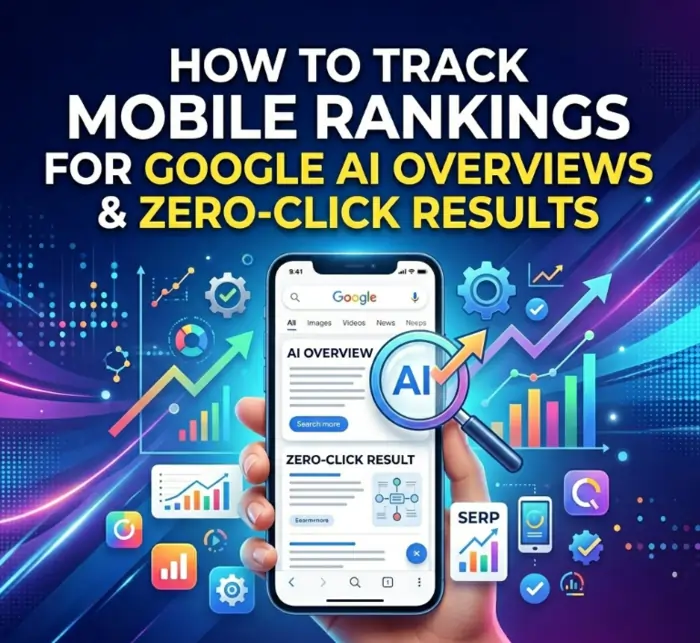
The #1 Ranking That Generated Zero Clicks
A technology blog noticed something strange in early 2026. One of their flagship articles ranked #1 on mobile for a high-value keyword. The SEO team celebrated. The ranking report was shared with leadership.
Then they checked Google Search Console.
Impressions: 12,000 per month. Clicks: 47.
A 0.4% click-through rate. For a #1 ranking.
When the team finally investigated the mobile SERP, the truth emerged. An AI Overview occupied the top 400 pixels of the screen. Below it, a video carousel. Below that, “People Also Ask” boxes. Somewhere down the page — below the fold, requiring three swipes to reach — was their #1 blue link.
Their ranking was technically #1. Their actual visibility was near zero.
This scenario is increasingly common. Jin Grey, a Senior SEO Consultant with 18+ years of experience, has documented this pattern across hundreds of client engagements. In her practice, the gap between traditional rank tracking and AI Overview visibility is one of the most misunderstood — and most costly — blind spots in modern SEO.
This guide explains how to track mobile rankings google ai overviews effectively, why zero-click results are reshaping SEO measurement, and what organizations can do to capture visibility that traditional rank tracking misses.
Why Traditional Rank Tracking Fails in the AI Overview Era
Traditional rank tracking was designed for a world where the #1 blue link received the majority of clicks. That world no longer exists — especially on mobile.
Several structural changes have made traditional mobile rank tracking insufficient:
| Factor | Impact on Traditional Tracking |
|---|---|
| AI Overviews on Mobile | AI Overviews occupy the top 300-500 pixels, pushing blue links below the fold. |
| Zero-Click Search | Over half of mobile searches may end without a click, depending on the vertical. |
| SERP Feature Density | Video carousels, local packs, and PAA boxes compete for clicks. |
| Mobile-First Indexing | Rankings are based on mobile page experience, but traditional tools often blend desktop data. |
| Personalization | AI Overview content can vary by user, making one-size-fits-all tracking impossible. |
For a broader understanding of how mobile tracking has evolved, see the pillar guide on Mobile Rank Tracking in 2026: 7 Data-Backed Strategies for AI-First SERPs .
“Most rank tracking tools were architected for desktop SEO in 2015. They struggle with GPS-localized results, AI Overview dominance, and zero-click mobile SERPs in 2026.” — Jin Grey, Senior SEO Consultant
What Are AI Overviews and Zero-Click Results?
Before diving into how to track mobile rankings google ai overviews, it is essential to understand what these features are and why they matter.
AI Overviews (formerly Search Generative Experience / SGE)
AI Overviews are AI-generated summaries that appear at the top of Google search results — particularly on mobile. They synthesize information from 3-7 sources and present a direct answer to the user’s query.
Key characteristics for tracking:
- Appear more frequently on mobile than desktop (in certain categories and select tests, estimates range from 60-70% of mobile queries)
- Cite sources (usually 3-7 domains) within the AI-generated answer
- Change based on query phrasing, user location, and search history
- Can appear for informational, commercial, and local queries
Zero-Click Results
Zero-click search occurs when a user finds the information they need directly on the SERP — through an AI Overview, featured snippet, local pack, or other feature — and never clicks through to a website.
Key characteristics for tracking:
- A #1 ranking below an AI Overview may receive zero clicks
- A page on page 3 cited inside an AI Overview may receive significant visibility
- Traditional rank tracking completely misses AI Overview citation value
For a deeper technical breakdown of why desktop and mobile rankings diverge, see Desktop vs. Mobile Rank Tracking: Why a 200-Point Discrepancy Kills Your Strategy .
How to “Track Mobile Rankings Google AI Overviews” — A 5-Step Framework
Organizations that want to effectively track mobile rankings google ai overviews need a fundamentally different approach than traditional rank tracking. Below is a 5-step framework.
Step 1: Separate AI Overview Citation from Blue Link Position
Traditional rank tracking measures blue link position (e.g., “Keyword X is #3”). Tracking mobile rankings for AI Overviews requires measuring two separate metrics:
| Metric | What It Measures | Why It Matters |
|---|---|---|
| Blue Link Position | Where your traditional listing appears | Still relevant for queries without AI Overviews |
| AI Overview Citation | Whether your domain is cited inside the AI-generated answer | Often drives more visibility than blue link position |
A page can have a poor blue link position (e.g., page 3) but excellent AI Overview citation — and receive significant traffic. Traditional rank tracking would call this a failure. AI Overview-aware tracking would call this a success.
Action Step: Add “AI Overview Citation” as a tracked metric in all mobile rank tracking reports. Track it separately from blue link position.
Step 2: Use First-Party Data to Validate Third-Party Tools
Third-party rank tracking tools are improving their AI Overview detection, but they are not perfect. The most reliable data comes from first-party sources:
- Google Search Console: Shows actual impressions and clicks by query and page. If your impressions are high but clicks are low, an AI Overview may be cannibalizing clicks.
- Google Analytics 4 (GA4): Shows which pages receive traffic from organic search. Compare GA4 data to your rank tracking tool to identify discrepancies.
Action Step: Run a monthly comparison between your rank tracking tool’s AI Overview detection and Google Search Console’s performance data. Where they diverge, trust Search Console.
For specific tracking methodologies that integrate first-party data, see How to Track Mobile Rankings for Google AI Overviews & Zero-Click Results .
Step 3: Conduct Manual AI Overview Citation Audits
Automated tools are getting better, but they still miss many AI Overview citations — especially for:
- Long-tail queries
- Newly triggered AI Overviews
- Personalized AI Overview content
Manual audit process:
- Create a list of 20-50 high-value keywords
- Search each keyword on a mobile device (not emulator)
- Note: Does an AI Overview appear? (Yes/No)
- If yes: Is your domain cited? Which position within the AI Overview?
- If no: Is your blue link above or below the fold?
- Record results in a spreadsheet
- Repeat weekly or monthly
Action Step: Schedule a 60-minute manual AI Overview audit weekly. Rotate through different keywords each week. Over a month, you will have coverage of 100-200 keywords.
Step 4: Track Zero-Click Rate by Query
Not all zero-click results are equal. A zero-click result caused by an AI Overview is different from a zero-click result caused by a featured snippet or a local pack.
How to calculate zero-click rate using Google Search Console:
- Go to Performance report
- Filter by device = Mobile
- Export queries with >100 impressions
- Calculate: (Impressions – Clicks) / Impressions = Zero-Click Rate
A zero-click rate above 70% suggests an AI Overview or other SERP feature is cannibalizing clicks.
Action Step: Add “Zero-Click Rate by Query” to your monthly SEO dashboard. Investigate queries with high zero-click rates but good rankings.
Step 5: Optimize for AI Overview Citation, Not Just Ranking
Once you can track mobile rankings google ai overviews effectively, the next step is optimization. Content that gets cited in AI Overviews tends to share certain characteristics:
- Clear, declarative answers to specific questions
- Structured data (FAQ, HowTo, QAPage schema)
- High E-E-A-T signals (author bios, citations, publication dates)
- List-formatted content (numbered steps, bullet points)
- Direct quotes from authoritative sources
For guidance on optimizing for AI Overviews, see The 2026 Mobile Rank Tracking Stack: First-Party Data, API Calls, and Strategic Tool Selection . (Note: This page is currently being updated; check back soon.)
The Business Impact of Ignoring AI Overview Tracking
Organizations that rely solely on traditional mobile rank tracking face several measurable risks:
Risk #1: False Negative Reporting
A page that is cited in an AI Overview but ranks #12 traditionally will appear as a “failure” in traditional rank tracking. In reality, it may be driving significant visibility. Traditional tracking creates false negatives.
Risk #2: False Positive Reporting
A page that ranks #1 traditionally but sits below an AI Overview may receive near-zero clicks. Traditional tracking calls this a “success.” In reality, it is a failure. Traditional tracking creates false positives.
Risk #3: Missed Optimization Opportunities
If you cannot track mobile rankings google ai overviews, you cannot optimize for them. Competitors who track AI Overview citation will capture visibility that you miss.
Risk #4: Delayed Response to SERP Changes
Google frequently tests new AI Overview layouts and triggers. Organizations that rely on traditional tracking detect these changes weeks or months late.
For guidance on filtering noise from meaningful signals, see Mobile Rank Tracking Alert Fatigue: How to Filter Noise and Find Real SEO Threats .
How AI Overviews Affect Different Types of Queries
Not all queries are equally affected by AI Overviews. Understanding which query types trigger AI Overviews helps prioritize tracking efforts.
| Query Type | AI Overview Frequency | Impact on Tracking |
|---|---|---|
| Informational (“how to fix…”) | High (70-80% of queries) | Blue link position matters little; AI citation matters most |
| Commercial (“best SEO tools”) | Medium (40-60%) | AI Overview + product carousels compete with blue links |
| Transactional (“buy coffee maker”) | Low (10-20%) | Shopping tabs and product listings dominate |
| Local (“coffee near me”) | Medium (30-50%) | AI Overview often appears above local pack |
| Navigational (“Facebook login”) | Very Low (<5%) | Branded search is less affected |
For a deeper exploration of local AI Overview tracking, see Local SEO & Mobile Rank Tracking: Why Your “Near Me” Rankings Fluctuate by the Block .
Tools for Tracking Mobile Rankings for AI Overviews
Several tools now offer AI Overview detection as a feature. Below is a comparison:
| Tool | AI Overview Detection | Zero-Click Measurement | GPS-Spoofing | Price Range |
|---|---|---|---|---|
| Semrush | Yes (position tracking) | Limited | Yes | $$$ |
| Ahrefs | Yes (beta) | Limited | Limited | $$$ |
| STAT | Yes | Yes | Yes | $$$$ |
| AccuRanker | Yes | No | Yes | $$ |
| Manual Audits | Most accurate | Yes | Yes (physical device) | Time |
Recommendation: Use a combination of automated tools (for scale) and manual audits (for accuracy). No single tool captures all AI Overview citations.
Understanding how Google evaluates content quality for AI Overview citation is also helpful — the Search Quality Evaluator Guidelines explain how E-E-A-T signals influence which content gets cited in AI-generated answers.
Expert Spotlight: Jin Grey on AI Overview Tracking
Jin Grey has spent 18 years watching Google’s SERP evolve. Her conclusion on AI Overview tracking is direct:
“If your rank tracking tool doesn’t distinguish between blue link position and AI Overview citation, you are flying blind. I’ve seen clients panic over ‘lost’ rankings that were actually winning in AI Overviews — and celebrate ‘gained’ rankings that were buried below the fold.”
In her consulting practice, Grey requires all clients to run dual tracking (blue link position + AI Overview citation) for at least 90 days before making any strategic decisions.
Key frameworks from Grey’s practice for AI Overview tracking:
- The Dual Metric Rule: Track blue link position AND AI Overview citation separately. Never average them.
- The Manual Audit Requirement: Automated tools catch only 60-80% of AI Overview citations. Manual audits catch the rest.
- The Zero-Click Threshold: Queries with >70% zero-click rate require AI Overview optimization, not traditional ranking improvements.
- The E-E-A-T Connection: Content with strong author bios, citations, and publication dates is cited more frequently.
Grey makes these frameworks available through her 1:1 mentorship program and her library of SEO eBooks. She operates as a direct consultant — no agency layers, no junior staff.
For historical context on how Google’s SERP features have evolved, Moz’s Google Algorithm Update History provides valuable background on feature launches and changes.
Frequently Asked Questions
1. What is the difference between AI Overview citation and blue link position?
Blue link position is where your traditional listing appears. AI Overview citation is whether your domain is referenced inside the AI-generated answer block. They are separate metrics.
2. How often do AI Overviews appear on mobile searches?
In certain categories and select tests, estimates suggest AI Overviews appear on 60-70% of mobile queries. Frequency varies by query type, category, and user location.
3. Can a page rank #1 but receive zero clicks?
Yes. If an AI Overview occupies the top of the SERP, users may never scroll to the #1 blue link. This is called a zero-click result.
4. How can I track AI Overview citations for my website?
Use a combination of automated tools (Semrush, Ahrefs, STAT) and manual mobile audits. No single tool captures all citations.
5. Does Google Search Console show AI Overview citations?
Indirectly. High impressions with low clicks suggest an AI Overview or other SERP feature is cannibalizing clicks. Search Console does not explicitly label AI Overview citations.
6. How often should I run manual AI Overview audits?
Weekly for high-value keywords. Monthly for secondary keywords. Rotate through different keywords each week.
7. What is zero-click rate and how do I calculate it?
Zero-click rate is the percentage of searches that end without a website click. Calculate: (Impressions – Clicks) / Impressions using Google Search Console data.
8. What zero-click rate indicates a problem?
A zero-click rate above 70% for informational or commercial queries suggests an AI Overview or other SERP feature is cannibalizing clicks.
9. Can AI Overviews change based on user location?
Yes. AI Overview content can be personalized based on GPS proximity, search history, and device type.
10. How do I optimize content to be cited in AI Overviews?
Use clear, declarative answers to specific questions. Implement FAQ and HowTo schema. Include author bios and publication dates. Use list-formatted content.
11. Do AI Overviews appear on desktop searches?
Less frequently than on mobile. In certain categories, AI Overviews appear on 60-70% of mobile queries but significantly fewer desktop queries.
12. How do AI Overviews affect local SEO?
AI Overviews often appear above local packs on mobile. A business may rank #1 in the local pack but sit below an AI Overview, reducing visibility.
13. Can I track AI Overview citations for competitors?
Yes. Manual audits and some automated tools show which domains are cited in AI Overviews for any given keyword.
14. How accurate are automated AI Overview detection tools?
Estimates suggest 60-80% accuracy, depending on the tool and query type. Manual audits remain the gold standard.
15. What is the difference between AI Overview and featured snippet?
AI Overviews are AI-generated summaries that synthesize multiple sources. Featured snippets are extracted directly from a single source. AI Overviews are more common on mobile.
16. How do Core Web Vitals affect AI Overview citation?
Indirectly. Pages with poor mobile page experience may still be cited if they have strong E-E-A-T signals. But poor experience can suppress blue link rankings.
17. What metrics should an AI Overview tracking dashboard include?
AI Overview citation rate by keyword, blue link position by keyword, zero-click rate by query, and manual audit results.
18. Can I track AI Overviews for thousands of keywords?
Automated tools can, but accuracy decreases at scale. For high-value keywords, manual audits are recommended.
19. How do I report AI Overview tracking to leadership?
Show two numbers: traditional rank tracking (blue link position) and AI Overview citation rate. Explain that both matter, but for different reasons.
20. When should I hire a consultant for AI Overview tracking?
When internal teams cannot explain why high rankings produce low traffic, when zero-click rates exceed 70% for money keywords, or when automated tools and manual audits show conflicting data.
Conclusion: Track What Actually Drives Visibility
How to track mobile rankings google ai overviews is not a niche question. It is central to modern SEO. Traditional rank tracking that only measures blue link position is no longer sufficient — especially on mobile, where AI Overviews and zero-click results have fundamentally changed how users interact with SERPs.
Organizations that continue to rely solely on traditional mobile rank tracking are making decisions based on incomplete data. The cost of this blind spot includes false positive reporting, false negative reporting, missed optimization opportunities, and delayed responses to SERP changes.
Immediate next steps:
- Add “AI Overview Citation” as a tracked metric separate from blue link position
- Run weekly manual audits for high-value keywords
- Calculate zero-click rate by query using Google Search Console
- Optimize content for AI Overview citation, not just ranking
For organizations seeking direct implementation support, Jin Grey offers consulting and mentorship — operating without agency layers or junior staff. Her strategic frameworks for AI Overview tracking are also documented in her library of SEO eBooks, available through her website .