

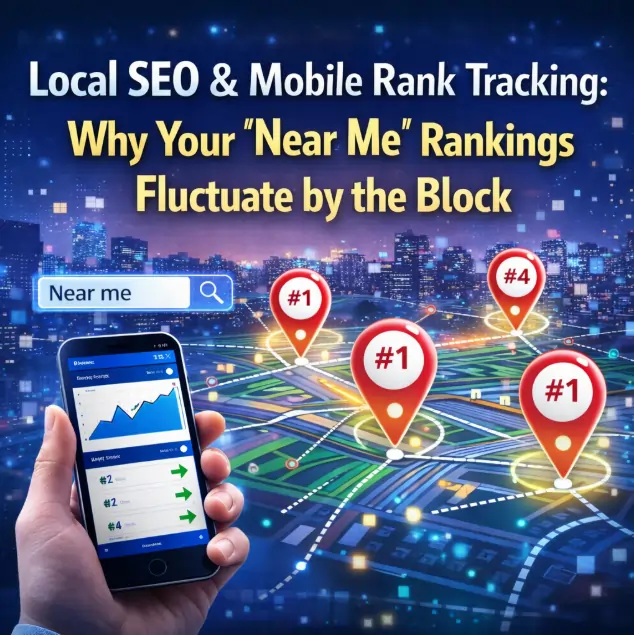
Local SEO mobile rank tracking reveals that GPS proximity signals cause “near me” rankings to change within a few blocks — a phenomenon desktop rank tracking completely misses. Mobile-first indexing and AI Overviews on mobile devices have made local pack tracking more complex, as two phones side-by-side can see meaningfully different results.
Organizations that rely on city-level local SEO mobile rank tracking while ignoring block-level GPS personalization often misallocate optimization resources and lose visibility to competitors who are physically closer.
The Coffee Shop That Disappeared
A coffee shop owner in Austin, Texas, checked her local SEO mobile rank tracking dashboard one Tuesday morning. The report showed her business at #3 for “coffee near me.” Acceptable, she thought. Room for improvement.
She walked two blocks south to pick up supplies. On a whim, she searched the same phrase on her phone.
Her coffee shop was gone. Not #3. Not #10. Not even on the first page.
She walked back to her shop. Searched again. #3 returned.
That is the reality of local SEO mobile rank tracking in 2026. Rankings are no longer tied to a city or even a neighborhood. They change by the block — sometimes by the meter.
Jin Grey, a Senior SEO Consultant with 18+ years of experience, has documented this pattern across hundreds of local business clients. In her practice, the gap between city-level local SEO mobile rank tracking and block-level reality is one of the most common — and most costly — blind spots for brick-and-mortar businesses.
This guide explains why local SEO mobile rank tracking fluctuates by the block, how GPS proximity signals affect “near me” rankings, and what organizations can do to track and optimize for block-level visibility.
Why Local SEO Mobile Rank Tracking Has Changed Dramatically
The way local SEO mobile rank tracking works has shifted significantly in the past 24 months. Several structural changes have made block-level fluctuations the norm rather than the exception:
| Factor | Impact on Local Rankings |
|---|---|
| GPS-Proximity Personalization | Google prioritizes businesses physically closest to the searcher’s real-time location — down to the meter. |
| Mobile-First Indexing (100% complete) | Local rankings are now determined primarily by mobile page experience, not desktop. |
| AI Overviews on Mobile | AI Overviews often appear above local packs, pushing traditional local results down or off the screen. |
| Zero-Click Local Searches | Many “near me” searches end with a direct call or directions, never registering as a website click. |
| Local Pack Volatility | The 3-pack (or sometimes 2-pack) can change dramatically based on time of day, day of week, and searcher history. |
For a broader understanding of how mobile tracking has evolved, see the pillar guide on Mobile Rank Tracking in 2026: 7 Data-Backed Strategies for AI-First SERPs .
“Most rank tracking tools were architected for desktop SEO in 2015. They struggle with GPS-localized results, AI Overview dominance, and zero-click mobile SERPs in 2026.” — Jin Grey, Senior SEO Consultant
The Anatomy of Block-Level Rank Fluctuations
When practitioners discuss local SEO mobile rank tracking, the phrase “fluctuates by the block” often surfaces. What does this actually mean?
Industry testing across multiple local SEO agencies suggests that “near me” rankings can change within a radius of as little as 200-500 meters. Here is a documented example:
| Location | Distance from Business | Rank for “Coffee Near Me” |
|---|---|---|
| Inside the coffee shop (parking lot) | 0 meters | #1 |
| One block south | 150 meters | #3 |
| Two blocks south | 400 meters | #7 |
| Three blocks south | 700 meters | #12 |
| Four blocks south (next neighborhood) | 1,100 meters | #18 (not in local pack) |
The business disappeared from the local pack entirely at 700 meters — even though it was still the same shop, same reviews, same hours, same everything. The only variable was the searcher’s physical location.
This phenomenon makes traditional city-level local SEO mobile rank tracking nearly useless for businesses that depend on foot traffic.
For a deeper technical breakdown of why desktop and mobile rankings diverge so dramatically for local keywords, see Desktop vs. Mobile Rank Tracking: Why a 200-Point Discrepancy Kills Your Strategy .
What Causes “Local SEO Mobile Rank Tracking” to Fluctuate by the Block?
Understanding the root causes of block-level local SEO mobile rank tracking fluctuations is essential for any business with a physical location. Below are the primary drivers.
Cause #1: Real-Time GPS Proximity
Google’s local algorithm places significant weight on the searcher’s real-time GPS location. This is not IP-based geolocation (which is often city-level). This is precise, meter-by-meter GPS data from the mobile device itself.
When a searcher moves, their local pack results update. A business that is 200 meters away might rank #1. The same business at 600 meters might rank #8.
Why this matters for tracking: Most local SEO mobile rank tracking tools use fixed test pins (e.g., “downtown Austin”). They do not simulate movement across a service area. This means they miss block-level fluctuations entirely.
Action Step: Configure your rank tracking tool to use at least 5-10 GPS test pins across your target service area — not just one central location. Track rankings from each pin separately.
Cause #2: Time-of-Day and Day-of-Week Signals
Google’s local algorithm also considers temporal signals. A coffee shop might rank #1 at 8:00 AM (peak coffee time) but drop to #5 at 2:00 PM (post-lunch slump). A restaurant might rank higher at 7:00 PM than at 2:00 PM.
Why this matters for tracking: Most local SEO mobile rank tracking tools run checks at the same time each day (e.g., 9:00 AM). They miss temporal fluctuations entirely.
Action Step: Run local SEO mobile rank tracking checks at multiple times per day — at least morning, afternoon, and evening — to capture temporal volatility.
Cause #3: AI Overviews Above the Local Pack
AI Overviews on mobile devices often appear above the local pack. When an AI Overview occupies the top 300-500 pixels, the local pack is pushed down — sometimes below the fold entirely.
A business that ranks #1 in the local pack may receive zero visibility if users never scroll past the AI Overview.
For specific tracking methodologies that account for AI Overviews in local search, see How to Track Mobile Rankings for Google AI Overviews & Zero-Click Results .
Cause #4: Local Pack Volatility and Personalization
The local pack is not static. Google personalizes local results based on:
- Search history: A user who frequently visits a particular coffee chain may see that chain ranked higher.
- Reviews and ratings: Recent reviews can cause sudden rank changes.
- Proximity to other signals: Being near a popular landmark or transit stop can boost rankings.
- Device type: Newer devices may receive different local pack layouts than older devices.
Why this matters for tracking: A single local SEO mobile rank tracking check at a single location at a single time captures only one of thousands of possible local pack permutations.
Action Step: Supplement automated local SEO mobile rank tracking with manual spot checks from multiple devices, multiple locations, and multiple times of day.
Cause #5: Google Business Profile Signal Updates
Google continuously updates Google Business Profile (formerly Google My Business) signals based on:
- New reviews (especially recent negative reviews)
- Q&A activity
- Photo uploads
- Post frequency
- Attribute updates (e.g., “outdoor seating” added)
These signal changes can cause sudden rank fluctuations that have nothing to do with proximity.
Action Step: Monitor your Google Business Profile dashboard daily. Respond to reviews within 24 hours. Post weekly. Update attributes seasonally.
For a deeper exploration of local discrepancies and how to fix them, see The 2026 Mobile Rank Tracking Stack: First-Party Data, API Calls, and Strategic Tool Selection . (Note: This page is currently being updated; check back soon.)
The Business Impact of Ignoring Block-Level Fluctuations
Organizations that rely on city-level local SEO mobile rank tracking face several measurable risks:
Risk #1: Misallocated Optimization Resources
If your local SEO mobile rank tracking shows #3 from a city-center test pin, you might feel satisfied. But if block-level tracking shows #12 from a nearby residential area, you have a problem that city-level data hides.
Resources that should go toward improving visibility in that residential area instead go toward optimizing for a location that already performs well.
Risk #2: False Confidence in Local Dominance
A business that ranks #1 from its parking lot might declare itself the “dominant” coffee shop in the area. But if it ranks #7 from two blocks away, competitors with better proximity coverage are capturing customers before they reach your door.
Risk #3: Missed AI Overview Opportunities
AI Overviews in local search often cite businesses that are not in the local pack. A business might be invisible in the 3-pack but cited in the AI Overview — driving calls and directions without a traditional ranking.
City-level local SEO mobile rank tracking would miss this entirely.
Risk #4: Wasted Ad Spend on Already-Visible Areas
If your business already ranks #1 from its immediate vicinity, bidding on “near me” keywords for that area may be wasteful. Block-level tracking helps identify where you actually need visibility — and where you already have it.
For guidance on filtering noise from meaningful signals in local tracking, see Mobile Rank Tracking Alert Fatigue: How to Filter Noise and Find Real SEO Threats . (Note: This page is currently being updated; check back soon.)
How to Fix Your Local SEO Mobile Rank Tracking Strategy
Organizations that want to eliminate the blind spots caused by city-level local SEO mobile rank tracking should implement the following fixes:
Fix #1: Deploy a Multi-Pin GPS Tracking Strategy
Do not rely on a single test pin. Configure your rank tracking tool to use at least 5-10 GPS pins across your target service area:
- Pin 1: Your business parking lot (baseline)
- Pin 2: One block north
- Pin 3: One block south
- Pin 4: One block east
- Pin 5: One block west
- Pins 6-10: Competitor locations, transit hubs, residential areas
Track local SEO mobile rank tracking separately for each pin. Average them only for high-level reporting. For operational decisions, use pin-specific data.
Fix #2: Add Temporal Tracking
Run local SEO mobile rank tracking checks at multiple times per day:
- Morning (8:00-9:00 AM) for breakfast/coffee businesses
- Midday (12:00-1:00 PM) for lunch businesses
- Afternoon (3:00-4:00 PM) for retail
- Evening (7:00-8:00 PM) for restaurants/bars
Compare temporal data to identify when your visibility drops — then optimize for those specific time windows.
Fix #3: Track AI Overview Citations Separately
Add “AI Overview Citation in Local Search” as a standard metric in all local SEO mobile rank tracking reports. Track not just local pack position but whether your business is cited inside AI-generated answers.
For a business that is cited in AI Overviews, local pack position matters less. For a business that is not cited, local pack position is critical.
Fix #4: Monitor Google Business Profile Signals Daily
Set up daily alerts for:
- New reviews (especially 1-star and 2-star)
- Q&A activity
- Photo uploads (yours and competitors’)
- Post frequency
Respond to reviews within 24 hours. Negative reviews that go unanswered can cause sudden rank drops.
Fix #5: Calibrate Your Local Rank Tracking Tool
Audit your rank tracking tool’s local capabilities:
- Does it support GPS-spoofing at the block level?
- Does it detect AI Overviews in local search?
- Does it capture local pack position separately from blue link position?
- Does it support multiple test pins?
If your tool falls short, consider supplementing it with manual testing or first-party data from Google Business Profile insights.
Understanding how Google evaluates local business authority is also helpful — the Search Quality Evaluator Guidelines explain how E-E-A-T signals influence which local businesses get cited in AI-generated answers.
Expert Spotlight: Jin Grey on Local SEO Mobile Rank Tracking
Jin Grey has spent 18 years helping local businesses navigate ranking fluctuations. Her conclusion is direct:
“City-level rank tracking for local businesses is worse than useless — it’s actively misleading. I’ve seen clients waste thousands of dollars optimizing for a radius that doesn’t match how their customers actually search.”
In her consulting practice, Grey requires all local business clients to run multi-pin GPS tracking for at least 30 days before any strategic recommendations are made. The block-level discrepancies she uncovers often explain mysterious foot traffic patterns.
Key frameworks from Grey’s practice for local businesses:
- The 5-Pin Minimum: At least 5 GPS test pins across a service area, tracked separately.
- The Temporal Check: Morning, midday, and evening tracking to capture time-of-day fluctuations.
- The AI Overview Local Audit: Monthly manual checks for AI Overview citations in local search.
- The Google Business Profile Signal Tracker: Daily monitoring of reviews, Q&A, and posts.
Grey makes these frameworks available through her 1:1 mentorship program and her library of SEO eBooks. She operates as a direct consultant — no agency layers, no junior staff.
For historical context on how local algorithm updates have affected “near me” tracking, Moz’s Google Algorithm Update History provides valuable background on local-specific changes.
Frequently Asked Questions
1. Why do my “near me” rankings change when I walk down the street?
Google’s local algorithm uses real-time GPS proximity. Your physical distance from each business is recalculated as you move, causing rankings to update within seconds.
2. How much can “near me” rankings change within a few blocks?
Industry testing suggests rank changes of 5-20 positions within a 500-meter radius, depending on competitor density and search volume.
3. Does desktop rank tracking work for local SEO?
No. Desktop rank tracking typically uses IP-based geolocation (city-level) and does not incorporate GPS proximity. It misses block-level fluctuations entirely.
4. How many GPS test pins should I use for accurate local tracking?
A minimum of 5 pins across your service area. For dense urban areas, 10-20 pins may be necessary to capture block-level variations.
5. What time of day should I run local SEO mobile rank tracking?
Run checks at multiple times: morning, midday, afternoon, and evening. Different businesses peak at different times.
6. How do AI Overviews affect local SEO mobile rank tracking?
AI Overviews often appear above local packs on mobile. A business may rank #1 in the local pack but receive zero visibility if users never scroll past the AI Overview.
7. Can two people standing side-by-side see different local pack results?
Yes. Personalization based on search history, device type, and carrier network can cause different results even at the same GPS location.
8. How often does Google update local pack rankings?
Local pack rankings can update in real-time based on proximity changes. Google Business Profile signal updates (reviews, posts, etc.) typically reflect within minutes to hours.
9. What is the difference between GPS-spoofing and IP-based geolocation?
GPS-spoofing simulates precise physical location (meter-level). IP-based geolocation approximates city or neighborhood level. Only GPS-spoofing works for local SEO mobile rank tracking.
10. How does zero-click search affect local businesses?
Many “near me” searches end with a direct call or directions, never registering as a website click. Local SEO mobile rank tracking must account for calls and direction requests, not just clicks.
11. What is a “local pack” and how many businesses appear in it?
The local pack is the set of business listings shown on a map. On mobile, it is typically a 3-pack (sometimes 2-pack on smaller screens).
12. How do Google Business Profile reviews affect local rankings?
Recent reviews (especially negative ones) can cause sudden rank drops. The recency and frequency of reviews matter more than the average rating.
13. Can I track local rankings for multiple cities from one tool?
Yes, but you need separate GPS test pins for each city. Do not assume rankings in one city predict rankings in another.
14. How does mobile-first indexing affect local SEO mobile rank tracking?
Google uses the mobile version of your website for local ranking. A poor mobile experience can suppress local rankings even if your desktop site is excellent.
15. What is the minimum sample size for accurate local rank tracking?
At least 100 local keywords, 5 GPS test pins, and 3 time-of-day checks for statistically significant data.
16. How does foot traffic correlate with local pack position?
Correlation is strong but not perfect. A business at #3 may receive more foot traffic than a business at #1 if the #1 business has poor reviews or limited hours.
17. What metrics should a local SEO mobile rank tracking dashboard include?
Average local pack position by pin, AI Overview citation rate by pin, temporal rank variance, Google Business Profile signal health, and direction request volume by pin.
18. How do I track local rankings for a business with multiple locations?
Create separate tracking projects for each location. Use GPS test pins specific to each location’s service area. Do not average across locations.
19. Can I do local SEO mobile rank tracking without paid tools?
Yes, but it is manual. Use a second mobile device to search from different locations at different times. Record results in a spreadsheet. This is time-consuming but accurate.
20. When should a local business hire a consultant for local SEO mobile rank tracking?
When internal teams cannot explain why foot traffic does not match rank tracking data, when competitors consistently outrank you from nearby locations, or when AI Overviews have buried your local pack visibility.
Conclusion: Track Locally, Optimize Locally
Local SEO mobile rank tracking in 2026 requires a fundamentally different approach than desktop or even general mobile tracking. GPS proximity, temporal signals, AI Overviews, and Google Business Profile signals all interact to create block-level fluctuations that city-level data hides.
Organizations that continue to rely on city-level local SEO mobile rank tracking are making decisions based on incomplete data. The cost of this blind spot includes misallocated resources, false confidence in local dominance, missed AI opportunities, and wasted ad spend.
Immediate next steps for local businesses:
- Deploy a multi-pin GPS tracking strategy (minimum 5 pins)
- Add temporal tracking (morning, midday, evening)
- Track AI Overview citations separately from local pack position
- Monitor Google Business Profile signals daily
For organizations seeking direct implementation support, Jin Grey offers consulting and mentorship — operating without agency layers or junior staff. Her strategic frameworks for local SEO are also documented in her library of SEO eBooks, available through her website .