

The International Space Station (ISS) is a permanently crewed laboratory orbiting about 400 km above Earth, where astronauts live and work in microgravity to conduct research that cannot be done on the ground. It has been continuously occupied since 2000 and is run by a partnership of NASA, Roscosmos, ESA, JAXA and CSA, supporting breakthroughs in medicine, materials, technology and Earth observation.
Current plans call for operating the ISS through around 2030, then safely deorbiting it as NASA and its partners transition research and human presence to new commercial space stations in low Earth orbit. For students, professionals and space fans, following the ISS now offers a front‑row view of how today’s orbital outpost is paving the way for future missions to the Moon, Mars and beyond.
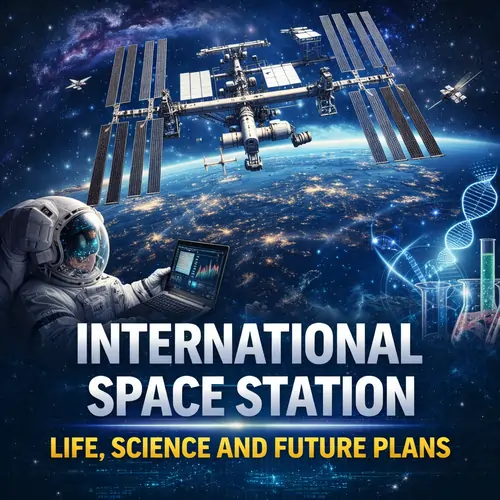
For more than two decades, the International Space Station has been humanity’s permanent outpost in space, orbiting Earth every 90 minutes at 28,000 km/h. It’s both a home and a high‑tech laboratory, where astronauts live in microgravity while running experiments that can’t be done on Earth. Yet, as the station ages, NASA and its partners are now planning for its retirement around 2030 and a transition to a new generation of commercial space stations.
This guide explains how the International Space Station works, what daily life and science look like on board, and what comes next once the ISS is deorbited and replaced by privately operated orbital platforms. Whether you’re a student, space enthusiast, investor, or just curious, you’ll get a clear, up‑to‑date overview backed by NASA’s official plans and recent expert analysis.
What Is the International Space Station?
The International Space Station (ISS) is a large, permanently crewed space laboratory that orbits Earth at roughly 400 km altitude in low Earth orbit. It has been continuously inhabited since November 2000, making it the longest‑running human presence in space.
According to NASA, the ISS is a “microgravity laboratory” used to advance scientific, technological and commercial goals and to prepare for future missions to the Moon and Mars. It is operated by a partnership of five space agencies:
- NASA (United States)
- Roscosmos (Russia)
- ESA (European Space Agency)
- JAXA (Japan Aerospace Exploration Agency)
- CSA (Canadian Space Agency)
The station has a mass of over 400,000 kg and a habitable volume comparable to a large house, with multiple modules connected in a long truss and large solar arrays powering the complex. Crews typically consist of 7 astronauts and cosmonauts rotating on 6‑month missions.
Inside the ISS: Design, Modules and Partners
How the International Space Station is built
The ISS was assembled piece by piece in orbit, starting with the launch of its first module in 1998. Over time, additional pressurised modules, truss segments, solar arrays, and laboratories from the different partner agencies were added via dozens of space shuttle flights and other vehicles.
- US Laboratory (Destiny) – core American research module.
- European Columbus laboratory – ESA’s main science module.
- Japanese Kibo laboratory – includes a pressurised module, logistics module and external platform.
- Russian service modules (Zvezda, Nauka, etc.) – provide propulsion, life support, and additional labs.
- Canadarm2 and robotics systems – critical for assembly and maintenance, provided by Canada.
These modules link to form a continuous interior where astronauts can work and sleep without spacesuits, while external platforms host experiments exposed to the vacuum of space.
International partnership at work
The ISS partnership is governed by intergovernmental agreements that share responsibilities for operations, logistics, crew time and scientific access. NASA notes that the station has become a test bed for international cooperation, integrating:
- Joint mission planning and control across multiple mission control centres.
- Shared use of cargo and crew vehicles (NASA’s Commercial Crew, Dragon, Soyuz, etc.).
- Collaborative research, with experiments from universities, companies and space agencies worldwide.
This framework forms the model for future joint missions to the Moon, Mars and beyond.
Daily Life on the International Space Station
Living in microgravity
Astronauts on the International Space Station live in a microgravity environment where everything floats. This affects everyday tasks, from eating and sleeping to hygiene and exercise:
- Sleeping: Astronauts sleep in small crew quarters, often in sleeping bags tethered to the wall so they don’t drift.
- Eating: Food is packaged to prevent crumbs and spills from floating into equipment; drinks are consumed through sealed pouches with straws.
- Hygiene: Showers are not practical; instead, crew members use rinse‑less wipes and leave‑in shampoo.
Without gravity, bodily fluids shift toward the upper body and head, which can cause facial puffiness, vision changes, and other effects. The ISS is used to study these changes in detail.
Exercise and health
To counteract muscle and bone loss in microgravity, astronauts must exercise about two hours per day using specialised equipment:
- Treadmills with harnesses to keep them “attached” to the surface.
- Stationary bicycles without seats, since they don’t need to sit.
- Resistive exercise devices that simulate weightlifting.
These routines help maintain bone density and cardiovascular fitness and inform medical protocols for long‑duration missions to Mars.
Work schedules and routine
Days on the International Space Station are carefully scheduled:
- Workday: Around 10 hours on weekdays, shorter on weekends.
- Activities: Conducting experiments, maintenance, system checks, exercise, Earth observation, and outreach (like live video calls with schools).
- Free time: Reading, watching movies, taking photos of Earth, or personal projects.
Despite orbiting Earth 16 times per day, the station operates on Coordinated Universal Time (UTC), and crews follow a regular “day–night” cycle using artificial lighting and scheduled sleep.
Science in Microgravity: Why the ISS Matters
NASA describes the International Space Station as “returning enormous scientific, educational, and technological developments to benefit people on Earth” while enabling deep‑space exploration. The key feature is microgravity: a near‑weightless environment that allows researchers to isolate physical and biological processes that are masked by gravity on Earth.
Major research areas include:
- Life sciences: Human physiology, microbiology, plant biology, bio‑regenerative life support, radiation effects.
- Physical sciences: Fluid dynamics, combustion, materials science, fundamental physics.
- Technology demonstrations: Spacecraft systems, autonomous robots, 3D printing, in‑space manufacturing.
- Earth and space observation: Climate, weather, natural disasters, astronomy.
The ISS also hosts the U.S. National Laboratory, which allocates U.S. research time to non‑NASA users like universities and companies, turning the station into a platform for commercial R&D and private astronaut missions.
Key Scientific Breakthroughs From the ISS
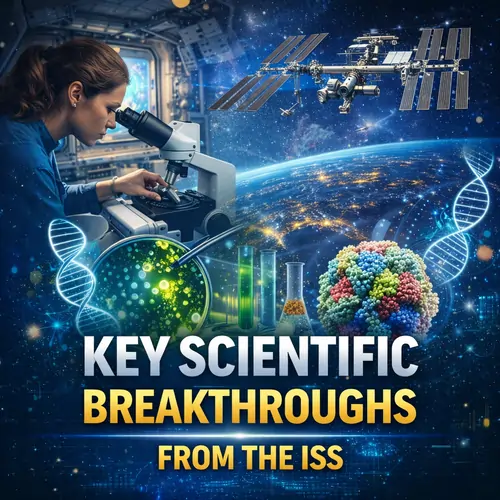
Medical and biological advances
Experiments on the International Space Station have produced insights directly relevant to human health:
- Cancer and drug development: Studies of protein crystal growth in microgravity have improved understanding of how to crystallise key cancer‑fighting drugs more effectively.
- Tissue and organ research: Experiments in cell growth and tissue engineering explore how to grow complex tissues in space, including retina organoids and other structures.
- Genomics in orbit: DNA sequencing on the station has demonstrated that genomic analysis can be done in space, critical for future long‑duration missions.
These findings support better treatments on Earth and inform life support and medical care for deep‑space missions.
Materials and manufacturing
Microgravity allows for the production and testing of materials that behave differently than on Earth:
- Ultrapure optical fibers: Experiments show that certain glass fibers can be manufactured with fewer defects, potentially enabling faster communications.
- Combustion science: Flame behaviour differs in microgravity, helping design safer and more efficient combustion systems.
- Alloys and metals: Understanding how metals solidify and mix without gravity improves industrial processes and component design.
These lines of research feed into advanced manufacturing both in space and on Earth.
Technology and operations for deep space
The ISS is also a proving ground for technologies needed for the Artemis Moon missions and eventual Mars missions:
- Closed‑loop life support systems.
- Autonomous docking and robotics.
- Long‑duration crew operations and behavioural health.
NASA’s ISS transition plan emphasises that long‑duration flights in low Earth orbit are vital to mitigate risks for future trips to Mars.
Current Status and Timeline to Retirement
How long will the International Space Station operate?
NASA’s official International Space Station Transition Plan outlines a target to continue ISS operations through at least 2030, subject to hardware health and partner agreements. The station’s technical lifetime is limited by its primary structure—modules, truss and radiators—which face continuous exposure to radiation, thermal cycles and micrometeoroids.
Multiple sources, including NASA and independent analyses, now converge on a deorbit window around 2030–2031:
- Operations extended beyond the original design life (about 15 years) thanks to safety margins and continuous upgrades.
- Structural limits and cost considerations mean indefinite extension is not viable.
- NASA and partners are planning a controlled deorbit over the Pacific Ocean (“Point Nemo”) to safely dispose of the station.
Operational focus leading up to 2030
In the final years of the International Space Station, NASA’s goals include:
- Maximising scientific return in life sciences, physical sciences and technology.
- Testing systems and operational models for commercial stations.
- Preparing for a seamless handover of research and crewed presence to commercial low Earth orbit destinations.
The emphasis is on making the most of remaining years while avoiding a gap in human presence in low Earth orbit after ISS retirement.
Future Plans After the International Space Station
NASA’s strategy for low Earth orbit
NASA’s transition strategy is clear: when the International Space Station retires, the U.S. does not plan to build another government‑owned station in low Earth orbit. Instead, it will become a customer of commercial space stations operated by private companies.
NASA’s low Earth orbit goals include:
- Maintaining continuous human presence in orbit.
- Advancing microgravity research and technology to benefit Earth and deep‑space missions.
- Fostering a thriving space economy with multiple commercial providers.
- Supporting international partnerships and STEM engagement.
You can find NASA’s official summary of this shift in its ISS Transition Plan FAQs.
Commercial space stations and private destinations
Several companies are developing or proposing free‑flying commercial stations that could host NASA astronauts, international partners, private researchers and tourists. Scientific American notes that NASA is actively pushing industry to use the ISS now as a test ground for these future stations.
Key elements of this transition:
- NASA offers contracts and technical support to companies building commercial low Earth orbit destinations (CLDs).
- Research and crew operations move from the ISS to these private stations before the ISS is deorbited, avoiding a gap.
- NASA buys services (crew time, lab access, cargo) instead of owning and operating the station itself.
This model mirrors how NASA handles Commercial Cargo and Commercial Crew to the ISS today.
Gateway and deep‑space exploration
While the ISS is in low Earth orbit, NASA and partners are also building the Lunar Gateway, a small station in orbit around the Moon that will support Artemis missions. Experience from ISS operations—life support, docking, robotics, international management—feeds directly into Gateway and future Mars transit vehicles.
So, the end of the ISS era is not the end of human spaceflight. Instead, it’s a pivot toward a multi‑platform, multi‑provider architecture spanning low Earth orbit, cislunar space and eventually Mars.
Expert Insights: How the ISS Shapes Space Economy
Analyses of NASA’s transition roadmap highlight several strategic themes:
- Space as an economic domain: Low Earth orbit is shifting from a government‑only arena to a commercial ecosystem, with the ISS acting as an incubator for new markets like in‑space manufacturing, pharma R&D and tourism.
- Risk reduction for Mars: Long‑duration ISS missions provide critical data on health, psychology and technology reliability needed to plan Mars missions safely.
- International leadership: NASA’s deputy administrator has emphasised that maintaining a continuous human presence in space, even after ISS, is central to U.S. leadership and global partnerships.
From an economic and policy perspective, the International Space Station is both a sunk investment and a springboard: it has already paid for itself scientifically, and it now underwrites the business case for commercial stations that follow.
Pro Tips for Learning More or Getting Involved
If you want to go deeper than this overview, here are some practical ways to engage with International Space Station content and opportunities:
- Follow official sources first.
Start with NASA’s dedicated ISS pages and its ISS Transition Plan FAQ for the most accurate, current information on operations and future plans. - Use educational hubs.
NASA, ESA and other agencies publish free lesson plans, videos and interactive tools designed for students and teachers. - Track commercial developments.
Science and tech outlets such as Scientific American and space news sites regularly cover commercial station projects and NASA’s CLD contracts. - Look for citizen science and outreach.
Programs sometimes allow the public to help classify ISS imagery, monitor light pollution, or join live Q&A sessions with astronauts. - For students and professionals:
Study STEM subjects, aerospace engineering, life sciences or robotics, and explore internships or fellowships with space agencies, contractors or emerging space companies.
Frequently Asked Questions (FAQ)
What is the International Space Station?
The International Space Station (ISS) is a permanently crewed space laboratory orbiting about 400 km above Earth, used for scientific research, technology development, and future deep-space mission preparation.
Who operates the International Space Station?
The ISS is operated by an international partnership including NASA (USA), Roscosmos (Russia), ESA (Europe), JAXA (Japan), and CSA (Canada).
How long has the ISS been occupied?
Humans have continuously lived on the ISS since November 2000, making it the longest-running human presence in space.
How big is the International Space Station?
The ISS has a mass of over 400 tons and spans roughly the size of a football field, with a living space comparable to a large house.
What is life like on the International Space Station?
Astronauts live in microgravity where everything floats. They sleep in secured sleeping bags, eat packaged food, and follow strict daily routines including work, exercise, and rest.
Why do astronauts exercise on the ISS?
Without gravity, muscles and bones weaken quickly, so astronauts exercise about two hours daily to stay healthy.
What kind of science is done on the ISS?
Research includes life sciences, physics, materials science, Earth observation, and technology experiments, all benefiting from microgravity conditions.
Has the ISS produced benefits for people on Earth?
Yes, it has contributed to advances in medicine, materials science, and technology, including drug development and DNA sequencing.
When will the International Space Station be retired?
NASA and its partners plan to operate the ISS until at least 2030, after which it will be safely deorbited.
Why can’t the ISS stay in orbit forever?
The station is aging and exposed to harsh space conditions, making long-term maintenance costly and impractical.
What will replace the International Space Station?
Commercial space stations developed by private companies are expected to replace the ISS in low Earth orbit.
Will humans still live in space after the ISS?
Yes, future plans include commercial stations, Moon missions (Artemis), and eventual Mars exploration.
How does the ISS support Moon and Mars missions?
It provides data on long-duration space living, tests new technologies, and helps refine mission operations.
Can tourists visit the ISS?
Yes, a limited number of private astronauts have already visited, and more commercial missions are expected.
How fast does the ISS travel?
The ISS travels at about 28,000 km/h, orbiting Earth roughly every 90 minutes.
How do astronauts travel to the ISS?
Astronauts use spacecraft such as SpaceX Crew Dragon or Russian Soyuz vehicles to reach and return from the station.
Who decides what research is done on the ISS?
Research is selected by space agencies, scientific organizations, and peer-reviewed proposals from global researchers.
Can the ISS change its orbit?
Yes, its orbit is regularly adjusted to counter atmospheric drag and avoid space debris.
How can students use ISS resources?
Students and educators can access free educational materials, live events, and even participate in experiments through space agency programs.
Where can I find official ISS information?
Official updates are available from NASA and other partner agencies, along with trusted science publications.
Conclusion
The International Space Station has transformed low Earth orbit from a distant frontier into a working laboratory and a stepping stone for deeper exploration. It has shown how international cooperation, continuous human presence and microgravity research can deliver breakthroughs in medicine, materials and technology while laying the groundwork for missions to the Moon and Mars.
As the ISS approaches retirement around 2030, NASA and its partners are moving toward a new era of commercial space stations and a broader space economy rather than stepping back from orbit. For learners, professionals and space fans, this is the moment to follow developments, explore educational resources and consider how your skills or interests could connect to the next generation of orbital platforms.
The way we work, learn and communicate about these developments is also changing rapidly on the ground. If you rely on your phone to stay on top of missions, meetings and research, a modern email app can make a real difference. To see how one of the most widely used tools is evolving, check out Microsoft Outlook Android: Powerful Email App Features You Need in 2026 for a deep dive into productivity features, mobile email best practices and how to manage a busy inbox in a world that increasingly looks to space.
If you want to stay ahead of the ISS story and what comes after, bookmark NASA’s transition resources and in‑depth analyses on future low Earth orbit plans, and check back regularly as new commercial stations and missions are announced.