

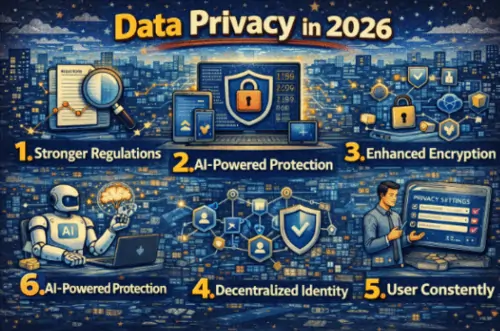
Data privacy in 2026 is no longer just a legal requirement. It directly impacts customer trust, AI adoption, cross-border operations, and long-term business stability. Organizations that treat privacy as a checkbox risk regulatory penalties, operational disruption, and reputational damage.
As AI systems become embedded in daily workflows and consumer rights enforcement becomes more structured, businesses must shift from reactive compliance to operational privacy systems. This guide explains what data privacy in 2026 means, the evolving regulatory landscape, key risks, and practical steps to stay compliant and competitive.
Why Data Privacy in 2026 Is Different
Several forces are reshaping the privacy environment:
AI integration across marketing, analytics, and decision-making
Cross-border data transfers and global vendor ecosystems
Stronger enforcement tools and consumer deletion rights
AI tools now process customer service logs, behavioral data, financial records, and marketing insights. That expands the exposure of personal information beyond traditional databases.
At the same time, global regulations are tightening around automated systems, cross-border transfers, and accountability documentation. Enforcement is becoming more structured, requiring organizations to prove compliance through documentation and operational controls.
Privacy is no longer about having a policy. It is about demonstrating measurable governance.
The Philippine Data Privacy Landscape in 2026
For businesses operating in the Philippines, compliance remains anchored in the Data Privacy Act of 2012 and oversight from the National Privacy Commission (NPC).
Recent regulatory guidance emphasizes privacy-by-design and privacy-by-default principles. This means privacy controls must be embedded throughout the system life cycle — from planning and development to deployment and maintenance.
For Philippine companies serving international clients, especially in BPO, SaaS, e-commerce, and digital services, cross-border data governance and documented vendor agreements are increasingly required in contracts and audits.
Privacy compliance is now a competitive differentiator in global markets.
Core Risks Businesses Face in 2026
Shadow AI usage
Employees may input sensitive data into AI tools without proper controls or documentation.
Excessive data collection
Collecting unnecessary personal information increases exposure during breaches.
Weak retention policies
Logs, archived files, exported reports, and customer records remain stored longer than necessary.
Vendor sprawl
Third-party tools, analytics scripts, and integrations create complex and sometimes invisible data flows.
Slow incident response
Unclear escalation paths delay breach reporting and regulatory notifications.
These risks increase legal exposure and reduce consumer trust.
What Strong Data Privacy Looks Like in 2026
Modern privacy programs are system-driven and evidence-based.
Clear data inventory
Organizations maintain an updated map of what data is collected, where it is stored, and who can access it.
Data minimization
Only necessary data is collected for defined purposes.
Retention enforcement
Automated deletion schedules reduce long-term storage risks.
Vendor governance
Documented processing agreements and periodic vendor reviews are standard practice.
AI governance controls
Approved tool lists, restricted data categories, output review processes, and documented safeguards protect against misuse.
Documentation readiness
Policies, training records, vendor agreements, and audit logs must be organized and easily retrievable.
Privacy maturity is measured by operational readiness, not policy length.
Privacy and AI Governance in 2026
AI introduces additional layers of privacy risk:
Training data exposure
Prompt logging and retention
Automated decision-making impacts
Inferred data profiling
Organizations must define:
What data can enter AI systems
How AI outputs are stored
Who reviews automated decisions
How long AI-related records are retained
Privacy-enhancing techniques such as masking, tokenization, and strict access control reduce exposure while allowing innovation to continue.
AI governance is now part of privacy governance.
Practical Compliance Checklist for 2026
Maintain a current data inventory
Review vendors based on risk level
Enforce automated retention schedules
Restrict sensitive data entry into AI tools
Audit analytics scripts and tracking tools
Test incident response procedures annually
Monitor regulatory updates
Maintain organized compliance documentation
Consistency and documentation reduce both regulatory risk and business disruption.
Why Data Privacy Impacts Search and Brand Trust
Privacy transparency influences user trust. Clear data disclosures, visible compliance practices, and responsible handling of personal information improve brand credibility.
Credibility affects engagement signals such as time on page, repeat visits, and user confidence. In competitive industries, trust becomes a strategic advantage.
Strong privacy practices support long-term brand authority.
Final Thoughts
Data privacy in 2026 represents operational maturity.
Organizations that succeed treat privacy as a structured system built on visibility, minimization, retention discipline, vendor oversight, AI governance, and audit-ready documentation.
For Philippine businesses competing in global markets, privacy compliance is no longer optional. It is foundational to stability, partnerships, and long-term growth.
Frequently Asked Questions About Data Privacy in 2026
What is data privacy in 2026?
Data privacy in 2026 means protecting personal information through clear systems that control how data is collected, used, stored, and shared.
Why is data privacy more important now?
It is more important because businesses use AI, handle more customer data, and face stricter enforcement from regulators.
How does AI affect data privacy?
AI tools process and store data automatically, so companies must control what information is entered and how outputs are handled.
Does data privacy affect customer trust?
Yes, strong privacy practices increase customer confidence and strengthen brand reputation.